Sunday Scaries in a Planner—and How to Support One Real Need

Finding Clarity in the 7:12 p.m. Spiral
If you're good at your job but still treat Sunday night like evidence that your whole life is slipping, this is exactly the kind of high-functioning dread people mean when they talk about the Sunday Scaries. When Taylor (name changed for privacy) sat down with me, she did not describe some dramatic collapse. She described a downtown Toronto Sunday that felt painfully ordinary: Google Calendar open on her laptop, TikTok 'Sunday reset' audio going tinny through her phone speaker, one sock still in her hand from the laundry pile, the dishwasher humming under the counter, her tea gone lukewarm beside an Instacart cart she still had not checked out.
She told me, 'I cannot tell if I need a better system or if I am just freaking myself out again.' The way she said it was calm, but her chest was already braced ahead of her, like she had turned Monday into a smoke alarm and her body could hear it before the week had even started. I know that feeling. In my old Wall Street years, uncertainty had a way of getting loud at night. It never arrived wearing a villain costume. It arrived looking responsible.
I told her, gently, 'Sunday dread can wear a planner.' Then I said what I say when I want to take the shame out of the room: 'We are not here to decide whether you are disciplined enough or broken enough. We are here to find out what is actually true. Let's draw a map through the fog and see whether this is a real support problem, a panic loop, or both.'

Choosing the Compass: The Decision Cross · Context Edition
I asked Taylor to put her phone face down, plant both feet on the floor, and take one slow breath while holding her question in mind. Then I shuffled. Nothing theatrical. Just a clean pause between being inside the spiral and looking at it from the outside.
For her reading, I chose the Decision Cross · Context Edition, a five-card spread I use when someone is caught between two explanations and keeps trying to force a yes-or-no answer out of a more layered reality. This is how tarot works when it is actually useful: not as fate dropped from the ceiling, but as card meanings in context. A good spread lets me test competing stories without flattening a real human situation into a slogan.
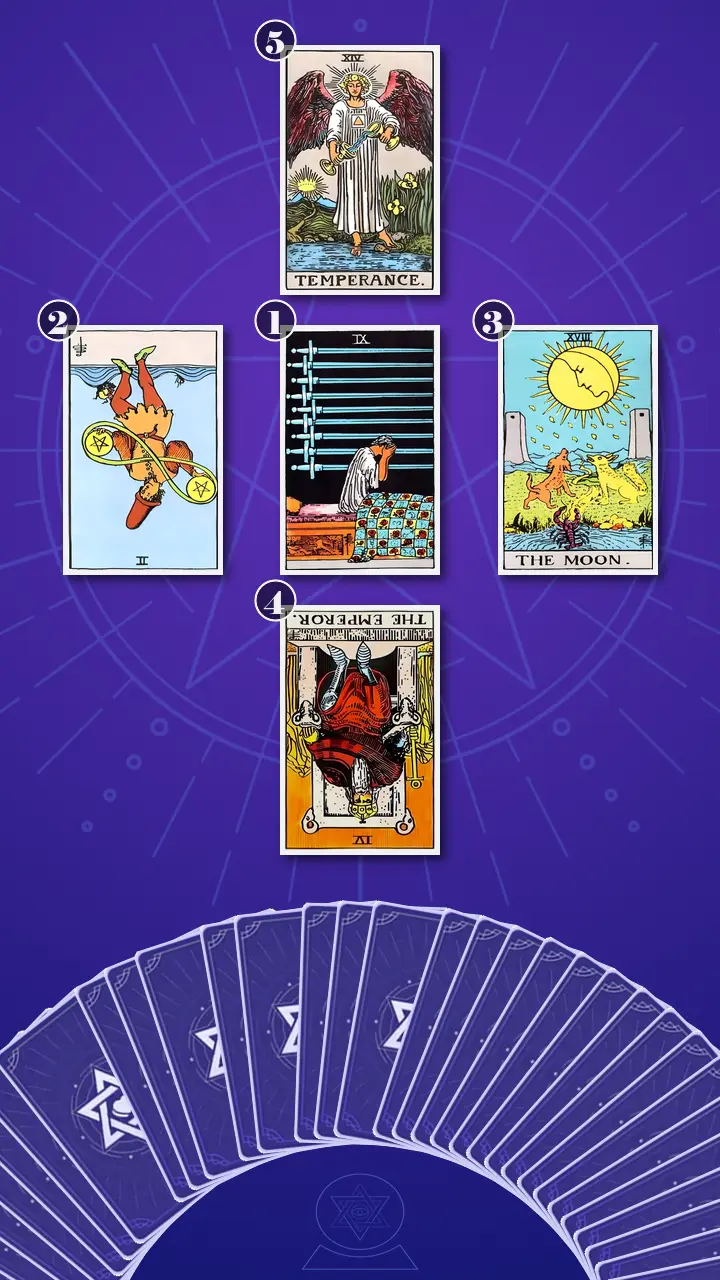
This spread was right for her because the question was not simply, 'Do I need a new routine?' It was, 'Is my Sunday-night overplanning telling me something practical, or is fear borrowing the language of productivity?' So I laid the cards as a small compass cross: the center card for the visible symptom, the left card for the 'I need a new routine' path, the right card for the 'this is Sunday-night panic' path, the lower card for the deeper root underneath both, and the top card for the integrating direction forward. In other words, we would not rush to a verdict. We would weigh the two stories, go down to the control pattern beneath them, and then lift into finding clarity.
Reading the Map of a Sunday Reset Spiral
Position 1: The Bedside Panic Loop
I turned over the first card and said, 'This position shows the visible Sunday-night symptom: the concrete spiral of planning, checking, and late-night dread.' The card was the Nine of Swords, upright.
I did not have to stretch for the translation. This was the exact Sunday-night moment when Taylor is in bed with her phone in one hand, Notes app open, replaying tomorrow's tasks until a normal Monday starts feeling like a private disaster. She is not planning anymore; she is rehearsing fear in the dark and using more checking as if it could make her body feel safe enough to sleep. The energy here is excess Air: too much thought, too little landing. It is like having twelve browser tabs open in your brain and one of them is autoplaying worst-case scenarios.
I told her, 'This card is not saying your concerns are fake. It is saying the loop has crossed a line. You start by trying to prepare, and then the preparing itself keeps your body awake and braced.' I asked her the practical question the card always asks: 'Which part of Sunday night is a concrete task, and which part is a story your mind keeps pinning to the wall like an alert you cannot clear?'
Taylor let out one short laugh, the kind that lands with a little sting in it. 'That is so accurate it feels rude,' she said. Her fingers pinched the bridge of her nose, then dropped to her lap. I shook my head. 'Rude would be calling this laziness. This is a nervous system trying to solve dread with admin.'
Position 2: The Wobble in the Weekly Handoff
I moved to the left card. 'This position tests the idea that you genuinely need a new routine by revealing what part of the weekly structure lacks support.' The card was the Two of Pentacles, reversed.
This card landed exactly where real life tends to wobble. It showed Taylor trying to do the whole Sunday handoff at once: laundry, groceries, room reset, commute math, meal ideas, and a fresh weekly plan, then reading the wobble as proof she lacks discipline. The energy here is unstable Earth, or what I call blocked grounding. There is effort, motion, even sincerity, but the system is carrying too many moving parts to absorb normal life. It is like a Notion dashboard that looks incredible on Sunday and gets abandoned by Tuesday because actual life showed up.
'So yes,' I told her, 'there is a real structure issue here. But it is not evidence that your entire life needs a rebrand. It is a weekly handoff problem. Too many tasks, too many choices, not enough prioritization.' I asked her which one point of friction tends to wobble first: sleep, lunch prep, commute timing, first-meeting clarity, or downtime. She answered almost immediately: 'First-meeting clarity. And then I start trying to fix everything else around it.'
She looked down at the card, then back at me, shoulders still high but less defensive now. Recognition had started to replace self-attack.
Position 3: Fact, Forecast, and the Glow of the Screen
I turned the right-hand card. 'This position tests the idea that this is Sunday-night panic by showing what fear, projection, or uncertainty is inflating.' The card was The Moon, upright.
This was the other half of the truth. The Moon is the feeling that arrives before the facts do: Taylor sees two calendar blocks before noon, a couple of unread messages, and suddenly her body decides the whole week is suspect. Nothing disastrous is actually there, but the emotion starts posing as proof. The energy here is amplified Water under low visibility. Not false feeling, but foggy interpretation. Very, 'I saw one preview notification and wrote a whole plot around it' energy.
I asked her, 'What do you actually know for sure by Sunday night, and what are you filling in because the feeling is loud?' Then I softened my voice and added, 'What if the feeling is real, but it is not the forecast?' That is the Moon's whole lesson. A blurry night photo can still contain real shapes, but every shadow does not get to call itself definitive.
Something in her face changed there. First her jaw unclenched. Then her gaze drifted off the cards and toward the window, where the last grey light was thinning against the glass. Then she breathed in more deeply than she had since sitting down. 'I do that,' she said quietly. 'I read discomfort like data.'
Position 4: The Inner Middle Manager
I turned the lower card. 'This position uncovers the deeper root beneath both interpretations, especially the control-based fear keeping the loop alive.' The card was The Emperor, reversed.
The second I saw it, I had one of those private flashes from my old career. On the trading floor, the dashboards were built to flag deviation fast. That logic can be useful in markets. It is awful as a way to run a human nervous system. Reversed Emperor is distorted structure: systems that are either too rigid to live inside or only appear when stress forces them into existence. In Taylor's life, it looked like Sunday becoming a private performance review.
I told her, 'This is the deeper loop. A missed prep task does not feel like an inconvenience to you. It feels like exposure. You are not just asking, "What would help Monday?" You are asking, "What will prove I still have control?"' I let that land, then gave her the line the card demanded: 'A routine should support you, not grade you.'
She went very still. Then came the long exhale. Then the small, almost disbelieving shake of her head. 'I never realized my routine questions sounded like self-judgment,' she said. I nodded. 'That is the reversed Emperor. An inner middle manager with terrible people skills. It turns Sunday into surveillance instead of support.'
When Temperance Poured Between Two Cups
Position 5: The Card That Refused the False Binary
By the time I reached the top card, the room had gone quieter in that unmistakable way it sometimes does right before the core truth appears. I turned it over and felt the whole spread click into place. The card was Temperance, upright.
This position offers the integrating way forward: how to build support without letting Sunday become an emergency. Temperance was perfect. Not a total overhaul. Not a dismissal. Not 'just relax' and not 'optimize harder.' This was the image of one foot on land and one in water, one practical reality and one emotional reality, held together by a steady exchange rather than a frantic fix. Less full-life reset montage, more set the coffee, take the shower, and let that count.
You know that 9:41 p.m. moment in bed when your phone is hot, your Notes app is open, and you are still rearranging Monday instead of resting? That is often the point where fear has taken over the microphone, even if some logistics do need attention.
Stop treating every uneasy Sunday as evidence that your life is off course, and start blending one practical support with one calming ritual, like Temperance pouring steadily between two cups.
This is where my old Wall Street brain always clicks in. Before any major move, I still run what I call a Resource Readiness Assessment: what are the actual external demands, and do your internal assets match the scale of the action you are about to take? On Sunday at 9:41 p.m., the demand is rarely 'reinvent your life before bed.' It is usually far smaller: know your first meeting, know where you need to be, choose one real priority. Temperance says the issue is not lack of discipline. It is a mismatch between the size of the feeling and the size of the response. Taylor froze for a beat. Her breath stalled. Her thumb hovered over the edge of her phone. Her eyes unfocused as if she were replaying three Sundays at once. Then her shoulders dropped, but not cleanly; there was that lightheaded softness people get when a weight comes off and they suddenly feel how long they were carrying it. 'Honestly?' she said. 'That makes me kind of mad. Because it sounds so small.' I smiled. 'Small is not trivial. Small is testable. Small has better ROI than panic.' I let the silence do its work, then asked, 'Now, with this new lens, can you see a moment last Sunday when one support and one settle would have helped more than one more list edit?' She nodded before she answered. That was the hinge: the first step from anticipatory dread toward a steadier weekly rhythm she could actually inhabit.
The Strategic Holding Pattern for a 10% Easier Monday
Once all five cards were on the table, the story they told was clean. The Nine of Swords named the surface symptom: planning that had tipped into panic. The Two of Pentacles reversed showed there really was a practical wobble in the weekly handoff. The Moon showed how fear inflated that wobble into a forecast. The Emperor reversed explained why it all felt so loaded: Taylor was using routine as proof of competence, not as care. And Temperance gave the transformation direction plainly: shift from using planning to erase discomfort to using planning to support one concrete need.
The blind spot was not that she lacked discipline. It was that she had been asking a planner to do the work of reassurance. Not every uneasy Sunday means your life is off track. Sometimes it means your routine is carrying too many jobs. Sometimes it means discomfort has been mistaken for evidence. Usually, as this Decision Cross · Context Edition made clear, it means both truths are present and need separating.
So I gave her the framework I use for these in-between moments. I call it The Strategic Holding Pattern. In markets, the waiting period is where people often burn the most energy, because they mistake movement for progress. A strong holding pattern is not passive. It is selective. It preserves energy, prepares what matters, and refuses low-value noise. Sunday night works the same way. If the plan only works when nothing goes wrong, it is not support.
- The 6-and-6 Support Ritual This Sunday, set a 12-minute timer. Use 6 minutes for one Monday support task only - check your first meeting time, pack your work bag, or prep lunch - then 6 minutes for one actual calming action such as a hot shower, tea on the balcony, or slow stretching with your phone face down. When the timer ends, stop on purpose. Expect the thought, 'This is not enough.' That does not mean the ritual is failing; it means you interrupted the old control loop. If 12 minutes feels too big, do 3 and 3, and do not open Slack or email afterward unless it is truly essential.
- The Two-Anchor Week Pick only two anchors for the next seven days: one workday start cue and one Sunday reset task. For Taylor, that looked like 'open calendar before opening Slack' and 'check Monday's first calendar block before 8 p.m.' Put them in Google Calendar or Apple Reminders and test the same two anchors for one week. Two means two. Do not add a bonus spreadsheet, a new planner, or a fantasy routine that only works on your best, most fictional week. Make Monday 10% easier, not your whole life perfect.
- The Fact-vs-Forecast Filter On Sunday night, make a two-column note: 'What I Know' and 'What I'm Predicting.' List only three real Monday facts - first meeting time, where you need to be, and one actual priority. If you reach for work messages again, ask once, 'Am I looking for information, or am I looking for relief?' Keep it under five minutes. This is not a new journaling project. It is a discernment tool, which is exactly what this tarot spread was designed to provide.

A Week Later, the Quiet Proof
A week later, Taylor sent me a text from the TTC. 'Did the one support + one settle thing,' she wrote. 'Packed my bag, took a shower, stopped. I still wanted to keep going, but I did not open Slack again, and I actually slept.' Monday morning was not perfect. Her first thought was still, 'What if I missed something?' But this time she smiled at the thought, checked only her first meeting time, and made coffee anyway.
That mattered more to me than any dramatic breakthrough ever could. The Decision Cross · Context Edition had not handed her certainty. It had given her discernment. She was no longer turning Sunday into a fire drill or a performance review. She was learning the quieter move from self-surveillance to self-support, from panic-led planning to a grounded weekly rhythm.
There is a lonely kind of tension in staring at Monday with a tight chest, trying to decide whether you need a better routine or just proof that you have not already fallen behind. If that is where you are tonight, I hope you remember this: the moment you stop asking planning to grade your worth, you begin to hear what would actually help.
So if Sunday did not have to prove you are in control tonight, what would your own two-cup version look like - one practical support, one calming ritual - and what would it feel like to let that be enough?
Every reading at AceTarot is a Journey to connect with inner wisdom and empower next step.
Learn more about our Journey to Clarity.