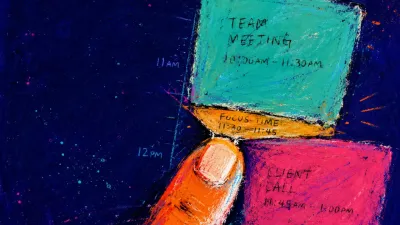
From Sunday Reset Paralysis to a Monday You Can Actually Enter

The 9:37 p.m. Sunday Reset Paralysis
If you're a late-20s hybrid worker in Toronto who opens Google Calendar around 9:30 on Sunday, sees Monday already stacked with obligations, and gets hit with the Sunday Scaries before you've chosen a single real priority, you already understand the flavor of dread that brought Maya (name changed for privacy) to me.
When she described her Sunday night, I could see it instantly: 9:37 p.m., on the bed in a downtown apartment, laptop open to Google Calendar, phone warm in one hand, half-folded laundry nudging her thigh. The radiator hummed. The blue light from the screen flattened her face. She kept dragging one task from Tuesday to Wednesday and then back again, as if the right arrangement might make Monday feel kinder.
"I know it's just a planner," she told me, "but it never feels that simple." What I heard clearly was the contradiction at the center of her question: she wanted a reset, and she froze at the exact threshold of it. It had that Severance split-screen quality to it: weekend-self not done exhaling, work-self already waiting in the corridor with a clipboard.
I told her, gently, what I have learned reading for people in different cities and different seasons of adulthood: sometimes planning paralysis is just self-judgment in a productivity outfit. In her body, the week wasn't arriving like a schedule. It was arriving like a report card slid under a locked door—jaw tightening, breath going shallow, stomach dropping as if the floor had tipped and all the weight in the room had slid straight into her. "Let's not force an answer," I said. "Let's make a map and find some clarity without turning this into another test."

Choosing the Compass: The Four-Card Spread · Context Edition
I asked her to put both feet on the floor and take one slow breath before we began. While she held the question in mind, I shuffled—not as theater, but as a clean transition, the moment where scattered feeling becomes something we can actually look at together.
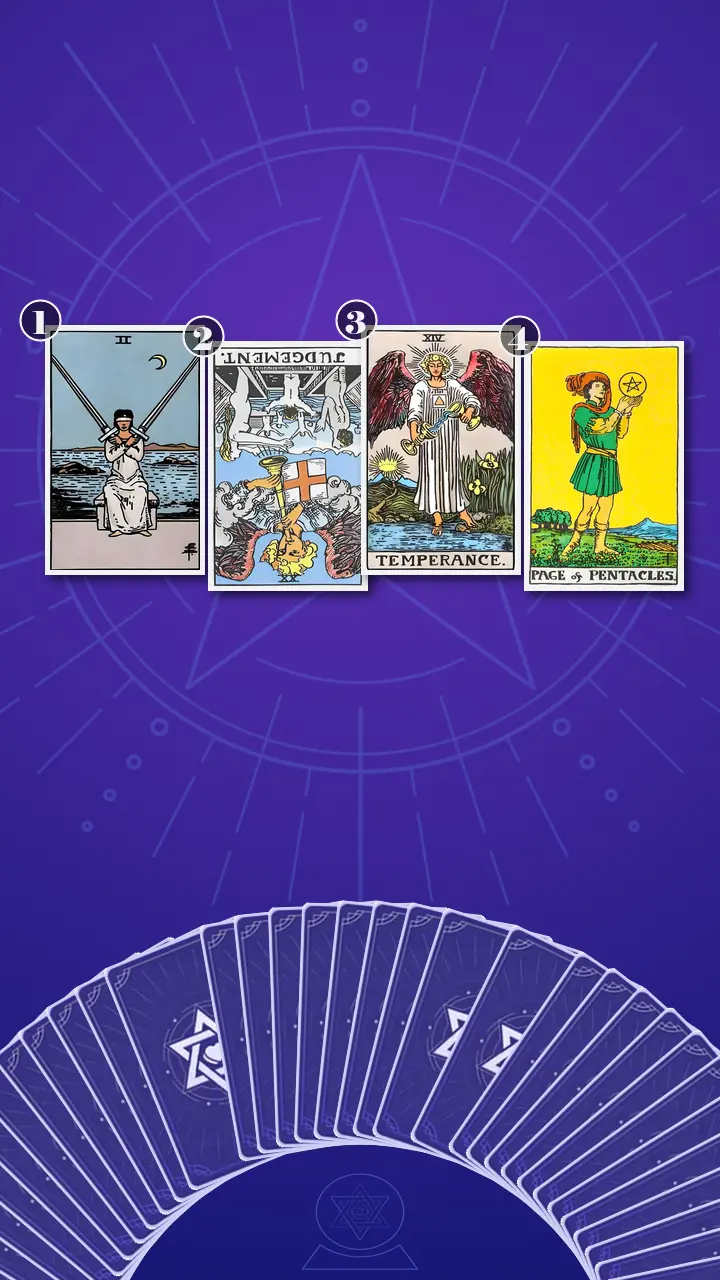
For this session, I used the Four-Card Spread · Context Edition. This is how tarot works in my practice when someone is stuck in weekly planning anxiety: not as prediction, and never as a verdict, but as a compact mirror. Four cards were enough here because Maya did not need more complexity. She needed sequence: what the Sunday night planning freeze looks like, what hidden blocker is feeding it, what medicine shifts it, and what practical integration would help Monday feel enterable again.
I told her I would read it left to right, like a short runway. The first card would show the visible moment where planning turns into stalling. The second would reveal the less visible script underneath it. The third—our hinge card—would name the inner adjustment that could loosen the whole pattern. The fourth would translate that shift into a grounded next step. Clean structure matters when a mind is already overclocked.
Reading the Frozen Screen
Position 1: The Loop That Calls Itself Planning
Now I turned over the card representing the concrete Sunday-night freeze described in her question: the visible moment where planning turns into stalling. It was the Two of Swords, upright.
I pointed first to the image before I interpreted it. Two swords crossed over the chest. A blindfold. Still water under moonlight. In card meanings in context, this was not abstract indecision. This was Sunday night on the bed with Google Calendar on the laptop, Notes on the phone, and maybe one more task app open because some part of you hopes the right interface will make the choice easier. You move tasks around, tidy categories, maybe hunt for a cleaner template, and the whole week stays suspended because choosing Monday's first real task would make the week emotionally real.
"This is blocked air," I said. "Thought without movement. Protection that has gone a little too far." The blindfold wasn't ignorance; it was bracing. The crossed swords were not strategy; they were emotional armor. It was like having twelve tabs open and none of them becoming the first click. I asked her, "When you open the calendar, what changes first—seeing Monday's meetings, seeing carry-over tasks, or realizing you're supposed to map the whole week before bed?"
Maya gave a short laugh that landed halfway between amused and exposed. "That is accurate enough to be rude," she said. On my screen, her fingers stopped tapping the phone case. Then came the small wince, the eyes dropping away from me for a second, and finally the nod. "It's when I see Monday already full before I've picked anything for myself." I nodded back. "Good. Specific is useful. The freeze is happening at the threshold of choice, not because you can't plan, but because planning has started to feel high-stakes."
Position 2: The Private Performance Review
I turned to the card representing the hidden blocker beneath the freeze: the fear of not keeping up, and the self-worth script that keeps the loop alive. It was Judgement, in reversed position.
Whenever Judgement reversed shows up like this, I stop hearing a trumpet and start hearing an internal alarm. Under a Jungian lens, this is the Inner Examiner—the part of the psyche that turns reflection into prosecution. I told Maya, "Your weekly reset stops helping the moment it becomes a character test." In real life, this is the moment you open last week's checklist "just to review" and within seconds you're not reviewing at all; you're mentally tallying evidence. You should've handled this. Why is this still here. Everyone else has a system that works. The planner stops being a tool and becomes a private performance review.
This was where I used something I call Compensatory Routine Decoding. I wasn't interested in scolding the behavior—app-switching, rewriting the to-do list, ending up on TikTok #SundayReset videos while your own sink still has two mugs in it. I wanted to decode what the behavior was protecting. In Maya's case, the overplanning and the scrolling were not discipline failures. They were coping mechanisms. If she kept reorganizing, she did not have to commit. If she did not commit, she could not "fail" the plan yet. Short-term, that lowered the emotional charge. Long-term, it guaranteed Monday would arrive louder.
I have seen that exact look across cultures and time zones—the tiny tightening around the eyes when a practical task starts carrying moral weight. On my screen, Maya's jaw shifted. One shoulder lifted toward her ear. Then she gave me that tight nod people give when they would rather joke than admit a hit landed cleanly. "Yeah," she said. "I tell myself I'm getting organized, but I'm kind of grading myself the whole time."
When Temperance Turned the Courtroom into a Mixing Table
Position 3: The Antidote
Before I turned the third card, the whole reading seemed to go quieter. The radiator hiss from her mic softened. Even the blue cast of her laptop screen had shifted warmer on night mode. This was the position that names the transformational medicine—the perspective that can interrupt all-or-nothing planning and restore a more workable rhythm. The card was Temperance, upright.
Temperance is the card I want to see when someone's nervous system has been asked to do too much at once. One foot on land, one in water. Two cups pouring into each other. Not intensity—calibration. I told her that when this card appears, I do a quick Psychological Bandwidth Audit. Not of tasks, but of invisible load. How much energy is already being drained before Sunday planning even begins? The half-reset apartment. The carry-over tasks. The comparison spiral after one polished TikTok routine. The hybrid-work blur where Monday starts before Sunday has emotionally ended. By the time Maya opened the planner, most of her bandwidth was already spent on pre-failure and self-monitoring. Of course the week felt impossible. She wasn't lacking willpower. She was trying to plan on emotional low battery.
I asked her to picture the usual scene again: laptop open on the bed, laundry still half-folded, Google Calendar glowing blue, phone warm in her hand, stomach dropping the second Monday comes into view. "The plan has barely started," I said, "but your body already acts like you're being graded." I let that sit for a breath.
Sunday is not a courtroom to survive; it is Temperance's mixing table, where one realistic pour at a time builds a week you can actually live.
I let that line settle, then said the quieter version of the same truth: "A reset stops helping when it becomes a verdict. It starts helping again when it becomes a way to pace Monday."
I watched the sentence hit in layers. First came the physical freeze: her inhale stopped halfway, thumb suspended on the phone screen. Then the cognitive shift: her eyes unfocused and went slightly to the side, as if she were replaying half a dozen Sunday nights at once—the tabs, the laundry, the self-scoring, the little rush to productivity content when her own life felt unfinished. Then came the emotional turn, and it wasn't instant relief. Her forehead tightened. "But doesn't that mean I've been doing it wrong this whole time?" she asked. There was a flash of anger in it, which I often trust more than easy agreement; anger can be shame loosening its grip.
"No," I said. "It means you've been asking planning to do a job it cannot do. You've been using it for reassurance about your worth, not because you're broken, but because you're tired and scared of another week becoming evidence against you." She stared at the card. Her shoulders dropped a full inch. One hand came up to cover her mouth. Then she laughed once, softly, the kind of laugh that arrives with a little sting in it. The release was real, but so was the brief blankness after it—the small, dizzy responsibility that comes when an old rule disappears and a new one has not fully settled yet.
I followed the opening while it was there. "Now, with this lens," I asked, "can you think of one moment last week when choosing less would actually have helped more?" She didn't answer right away. Then she said, "Thursday. I spent forty minutes making the whole day look tidy instead of just deciding what had to get done before lunch."
That was the hinge. Not from chaos to control, but from self-grading to self-regulation. From dread-heavy overthinking toward steadier Monday clarity. Temperance was not lowering her standards. It was teaching her to pace her energy so the week stopped behaving like a moral exam.
I told her what Temperance sounds like in practice: "Within ten minutes, close every planning tool except one. Set a short timer. Write only Monday's fixed obligation, one real priority, and one support step. If your chest tightens or the urge to optimize spikes, you can stop there. A partial reset still counts."
The Monday Landing Strip
Position 4: One Visible Thing
The final card represented integration: not prediction, but the next grounded practice if the guidance was applied. It was the Page of Pentacles, upright.
I smiled when I saw it, because the visual dialogue with the first card was so clean. In the Two of Swords, vision was blocked and choice was held at arm's length. Here, the page looks directly at one pentacle held at eye level. In modern life, this is the sticky note on the laptop. The charger packed in the bag. The transit card by the door. Monday gets a landing strip. You are not solving the whole week; you are giving tomorrow a place to begin.
"This is balanced earth," I told her. "Grounded attention. The opposite of trying to hold the entire subway line in your head before you step onto the first platform." Then I said the line that usually helps this card land: "Choose a Monday, not an entire life." Her face softened immediately. She actually reached off-screen, found a sticky note, and held it up with a sheepish smile. "So... literally one task?"
"Literally one task," I said. "And one support step. One screen. One priority. One support step. That's not underachieving. That's how you re-enter choice." The page is teachable, not performative. It treats the week like something to learn from, not something you must instantly master.
One Screen, One Priority, One Support Step
By the time I had all four cards in view, the story was clear. The Two of Swords showed the surface symptom: choice paralysis dressed up as planning. Judgement reversed exposed the deeper mechanism: a weekly review turning into self-verdict, so even simple carry-over tasks felt morally loaded. Temperance broke the spell by reframing Sunday as pacing rather than proof. And the Page of Pentacles translated that shift into something touchable: a Monday landing strip instead of a total life overhaul.
The blind spot was not that Maya lacked discipline, or even that she needed a better app. The blind spot was that she was treating a tool like a witness stand. The transformation direction was simple, but not easy: move from designing a flawless week to choosing one realistic priority and one supportive rhythm for Monday. That is how Sunday reset paralysis starts loosening—when the planner stops acting like a report card.
Maya asked the practical question almost immediately. "But what if by Sunday night I'm already so fried I don't even want to do twelve minutes?" I appreciated that, because real actionable advice has to survive contact with a real nervous system. "Then we make the ritual smaller before we make it better," I told her. "Your only job is to create enough safety for one honest choice." I gave her three low-pressure next steps:
- The Ego Unplugging ProtocolBefore you open Google Calendar, Notes, or any task app on Sunday night, sit where the spiral usually starts—bed, desk, or kitchen counter—place one hand on the closed laptop, and say, "This reset is for pacing my energy, not proving my worth." Then open only one planning tool.If saying it out loud feels awkward, type the sentence at the top of a note. The point is to detach self-worth from productivity before the planner can turn into a judge.
- Pattern, Not Verdict ReviewUse one sticky note or one note on your phone and spend under three minutes writing only three lines: "worked," "unrealistic," and "carry forward." Use facts, not self-labels—for example, "too many meetings Thursday," not "I was lazy."If a harsh label slips in, cross it out and replace it with an adjustment word like "timing," "capacity," or "context switching." Basic is not childish here; basic is regulating.
- The 12-Minute Temperance ResetSet a 12-minute timer and switch to Monday-only view. Write one sentence: "Monday starts with ____." Then add one support step that Monday-you can literally see—pack your charger, leave a sticky note on the laptop, or put your transit card by the door. When the timer ends, close the laptop even if the rest of the week still looks imperfect.If 12 minutes feels too big, start with 5. Small enough to repeat beats perfect enough to abandon.
I reminded her that these were not magic tricks. They were ways to lower the emotional voltage enough for choice to come back online. That is what good tarot guidance should do: not run your life for you, but return your hands to the wheel.

A Week Later: The Quiet Proof
A week later, Maya sent me a photo at 9:48 p.m. on Sunday. Her laptop was closed. On top of it was a yellow sticky note that read, "Monday starts with campaign draft." Her charger was looped beside it, and her TTC card was by the door. Her text said, "Still had the stomach drop. It just didn't run the whole night." I loved that message because it was honest. Clear, but still a little vulnerable.
That is the part people often miss when they ask me whether tarot can help with Sunday Scaries or weekly planning anxiety. The Four-Card Spread · Context Edition did not erase Maya's feelings or hand her a perfect system. It did something better. It made the pattern visible, helped her stop mistaking dread for truth, and gave her a Monday-first rhythm she could actually repeat. That is a real journey to clarity: from self-verdict-driven overplanning to steadier self-trust, one small practiced proof at a time.
When a planner stops feeling like a tool and starts feeling like proof that you should already be better at life, even one tiny Sunday choice can make your jaw lock and your stomach drop. If that is where you are tonight, noticing the pattern is already the first unclenching.
If tomorrow only needed one honest priority and one small support from you, what would you want waiting on your own Monday landing strip, where Monday-you can actually see it?
Every reading at AceTarot is a Journey to connect with inner wisdom and empower next step.
Learn more about our Journey to Clarity.