Office Hours, the Paycheck, and Turning Silence Into One Fair Ask

When Office Hours Land on Your Shift
When Maya (name changed for privacy) slid into the back booth of my café, I said something I have said to more working students than I can count: “If you’re a uni student in a big city working café, retail, or hospitality shifts and your chest drops every time office hours land right on your schedule, this is working-student survival math, not bad planning.”
She gave me the kind of laugh that lands with a bruise inside it. Then she told me about Wednesday, 3:18 p.m., on the quiet floor at Robarts Library: Quercus open on her laptop, an email draft to her instructor half-written, her phone face-up beside an iced coffee just as 7shifts lit the screen. The fluorescent lights buzzed overhead, the AC made her forearms cold, and the phone felt too warm in her palm. She kept telling herself, just one more check, just one more calculation, just one more minute, and somehow the only thing she did not do was contact a real person.
Her question sounded simple on paper: office hours clash with my shift—ask for help or keep the paycheck? But I could hear the deeper split under it. She was torn between asking for help and keeping the paycheck, and both choices felt wired straight into her nervous system. The pressure sat in her body like trying to step onto two moving TTC cars at once and freezing in the gap, apron in one hand, coursework in the other, while the doors kept chiming.
“I can’t afford to be the difficult one at work,” she told me. “And if I ask my instructor, it sounds like I can’t handle basic adult life.”
I wrapped my hands around my espresso cup and met her eyes. “That tight-chest, stomach-drop feeling every time a schedule notification lands? I don’t hear laziness in that. I hear pressure, guilt, fear, and a very practiced habit of carrying too much alone. So let’s not turn this into a character judgment. Let’s make a map and see where clarity actually lives.”

Choosing the Compass: A Decision Cross for a Hard Choice
I asked her to take one slower breath, not because breath solves rent or deadlines, but because it gives the body one clean second to stop reacting and start noticing. Then I shuffled while she held the question in its most honest form: what is the fairest next step when office hours conflict with work and missing either one feels expensive?
For this reading, I chose a Decision Cross tarot spread. When people ask me how tarot works in moments like this, my answer is simple: I use the spread as a thinking structure. I’m not predicting whether a professor or manager will say yes. I’m looking at the pressure system around the choice so the person in front of me can stop treating panic like truth.
The Decision Cross fit because Maya’s situation had two explicit paths on the surface—ask for help or keep the paycheck—but the real story clearly lived underneath. One card would show the live knot. One would explore the path of asking. One would explore the pull of protecting income. One would reveal the hidden fear driving the freeze. And the final card would show the most balanced, fact-based way forward.
I laid the cards in a cross on the marble-topped table: the center for the present dilemma, the upper card for the deeper influence, the left and right for the two paths, and the lower card for integration. I like this spread because it looks like a weighing scale with a human being at the center. In decisions like hers, that matters. The goal is not perfect certainty. The goal is discernment.
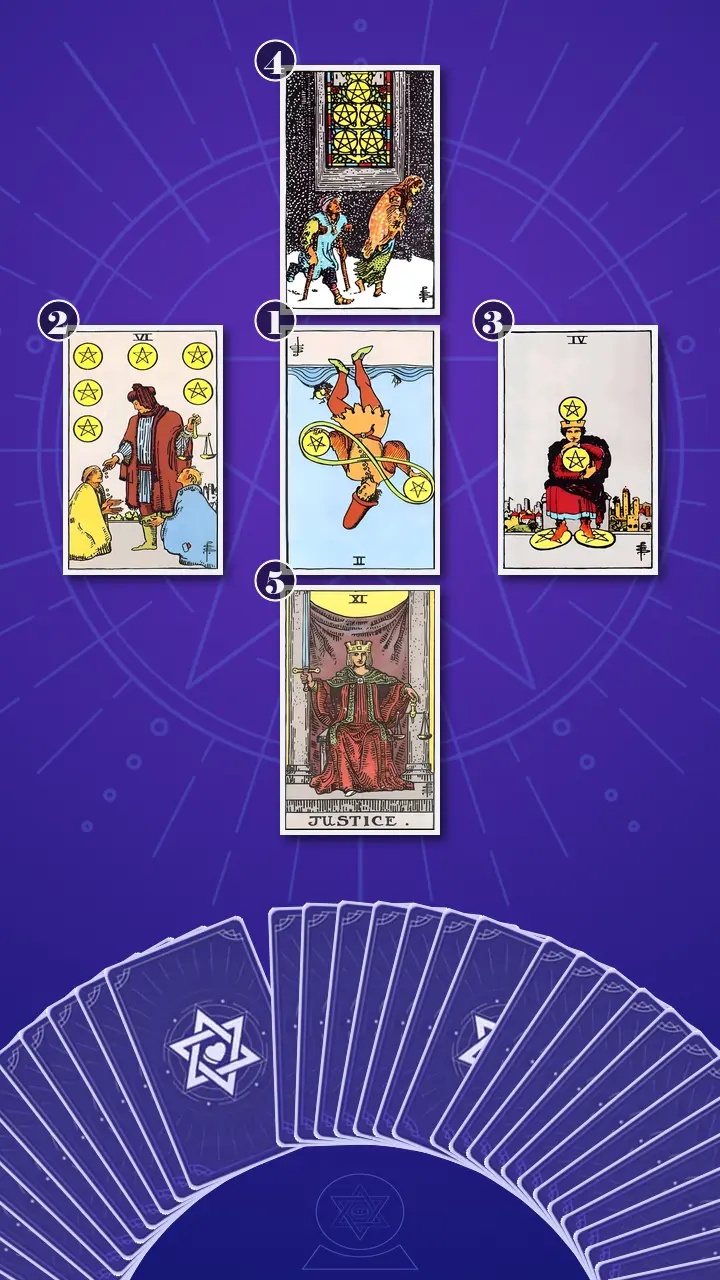
Reading the Pressure System
Position 1: The Juggle That Became a Stall
Now I turned the card that represented the observable scheduling knot from the diagnosis: the clash between office hours and the shift, and the habit of stalling instead of contacting either side.
Two of Pentacles, reversed.
I did not need to embellish it. “This is the library table,” I told her. “Laptop open to the course portal, shift app glowing on your phone, bank balance one swipe away. Just one more check, just one more calculation, just one more minute. The infinity loop on this card becomes the app-switching loop—shift app, syllabus, balance, back again—until your brain mistakes toggling for progress.”
In this position, the reversed Two of Pentacles showed blocked Earth energy: responsibility pushed past capacity until it tipped into overload. Not lack of effort. Not bad intentions. The schedule simply had no slack left, and the over-functioning itself had become the stall. It had a little bit of The Bear in it—ticket-printer stress, except the tickets were all in her head and every one of them said shift, assignment, balance.
Maya let out a quick laugh and shook her head. “That’s… kind of rude,” she said. “But yeah. That’s literally what I do.”
I smiled. “Exactly. The busyness is real. But it is also disguising the fact that nothing moves until words leave your body.” Her thumb ran along the rim of her paper cup, and I watched the uncomfortable recognition land: she wasn’t failing because she cared too little. She was exhausted because caring had turned into looping.
Position 2: Asking Without Turning It Into a Confession
Next I turned the card representing the inner logic of asking for help, especially whether receiving support could coexist with self-respect and practical need.
Six of Pentacles, upright.
“This card is quieter than people expect,” I said. “It doesn’t look like begging. It looks like a fair exchange.” I pointed to the scales and the open hand. “In modern life, this is one calm message: office hours overlap with my work shift this week, I want to clarify this topic before Friday, is there another time or an async option? That’s not a rescue mission. That’s logistics.”
Here the energy was balanced and circulating. The Six of Pentacles said support could be practical, adult, and boundaried. She could bring effort and specificity; the other person could offer time, a workaround, or a simple no. Support is a resource, not a confession.
I saw the first softening in her shoulders. Not full relief. Just a tiny release, like someone loosening an apron knot after a long shift. “I think I always make the email sound like I need to justify my entire life,” she said.
“A lot of reliable people do,” I replied. “Because they’re trying to pre-pay for the inconvenience of having limits. But this card says the dignity is in the clarity, not in how thoroughly you apologize.”
Position 3: What the Paycheck Protects, and What It Tightens
Then I turned the card exploring the pull of keeping the paycheck, including the real short-term safety it offered and the rigidity it might reinforce.
Four of Pentacles, upright.
I tapped the pentacle pressed to the figure’s chest. “This is the body language of I cannot risk losing anything. And honestly? I respect why.” I never treat money stress like a mindset problem when it is paying for transit, groceries, and the gap between student funding and actual city living. “Keeping the shift protects something real. It keeps today’s hours intact. It preserves immediate security. That matters.”
But the energy here was excess control edging into constriction. “This is what happens when protecting the paycheck turns into protecting silence,” I said. “You keep the shift so tightly that school gets pushed into midnight, commute time, and whatever scraps of nervous-system bandwidth are left. Silence can protect the paycheck for a day and cost you breathing room for a month.”
She stared at the card for a long beat. Her jaw set the way people do when a truth matches their body before it matches their words. “I keep saying it’s the responsible choice,” she said quietly.
“Sometimes it is,” I answered. “But Justice will ask us a tougher question in a minute: are you preserving income, or preserving the fear that you do not get to need anything?”
Position 4: The Cold Story Under the Calendar
Then I turned the card that reveals the deeper fear shaping the whole choice: scarcity, shame about needing support, and the belief that speaking up threatens safety.
Five of Pentacles, upright.
The room seemed to cool around us. Outside the front window, the streetcar rattled past, and for a second I could see exactly the scene this card carried: a commute home after shift, wet coats on Line 1, an office-hours announcement glowing on a phone like a lit window. “This,” I told her softly, “is the story underneath the schedule. Not just I am busy. More like: that kind of help is for students with daylight hours, more money, more backup, more margin. Not for me.”
The Five of Pentacles is lack, but also the expectation of exclusion. The visible help is there—the office-hours note, the course page, the professor saying reach out anytime—yet psychologically it feels like walking past a warm café and deciding before you even touch the door that it must be too expensive for someone like you. The energy here was deficiency shaped by shame. Scarcity had trained her to expect rejection before contact.
First she went still. Then her gaze slipped off the card and unfocused somewhere near the sugar jar, as if a memory had started replaying behind her eyes. Finally she pressed her lips together and whispered, “I actually do think office hours are kind of for people whose lives are easier. That’s awful to say out loud.”
“It’s painful to say out loud,” I corrected gently. “Not awful. There’s a difference. When did being responsible start meaning no one is allowed to know you’re stretched?”
Her breath caught high in her chest, then came out in a quiet, tired “Oh.” That was the card doing its work. Not accusing. Naming.
When Justice Set Down the Scales
Position 5: The Fair Move Forward
When I turned the final card, even the grinder in the front of the café went silent. I always notice little things like that—the way a room sometimes helps a truth arrive. This was the integrating guidance, the bridge card, the one pointing toward the key shift: moving from silent self-protection to a clear, bounded, fact-based request or decision.
Justice, upright.
I pointed to the balanced scales in one hand and the upright sword in the other. “The scales weigh actual constraints,” I said. “The sword cuts the extra apology.” Then I looked at Maya, still half-braced like the next notification might interrupt us. At that library table, this had felt like a test of character: be the easy employee or the competent student, but do not let either side see the strain. The trap wasn’t that she needed help. It was that she had started treating one honest request like proof she was failing at adulthood.
This is not about gripping harder out of fear; it is about steadying the scales, telling the truth, and choosing from clarity rather than panic.
I let the sentence sit between us for a moment.
Then I gave her the clearest tool I know from both tarot and coffee. In my café, if the paper filter slips, the grounds flood the whole pot and every sip turns gritty. When someone’s mind is doing the same thing, I use what I call my Knowledge Filtration rule. Justice is that filter. Facts go through. Fear gets caught long enough for us to see it clearly. The time clash is a fact. The assignment deadline is a fact. The shift is a fact. “If I ask, they’ll decide I’m unreliable in every part of my life” is fear. Real feeling, yes. Confirmed fact, no. Facts first. Panic second.
First her fingers froze on the cup sleeve. Then her eyes drifted past me toward the pastry case, unfocused, as if she were back under Robarts’ fluorescent lights with the unsent draft open. Finally she inhaled, stopped halfway, and said, with more edge than relief, “But if that’s true, doesn’t that mean I’ve been making this into a moral drama for nothing?”
“No,” I said. “It means your nervous system built a survival strategy under money stress. It kept you from immediate rejection by delaying contact. That strategy is understandable. It is just expensive now.” Her shoulders dropped on the exhale, though not all the way; there was still that slight, floaty vulnerability that comes after setting down a load you had started to mistake for part of your posture. Then she looked back at the card and said, more steadily, “So what I’m asking for isn’t special treatment. It’s one fair question.”
“Exactly.” I leaned forward. “Now, using this lens, tell me: last week, was there a moment when this would have changed how you felt?”
She didn’t hesitate. “Wednesday. I had the email open. If I’d separated facts from fear, I would’ve sent three lines instead of writing a whole apology and deleting it.” That was the hinge of the reading: not from confusion to perfect certainty, but from money-panic silence to clearer self-trust through direct communication. Justice did not promise an easy answer. It gave her a fair stance from which to ask.
From Survival Math to a Clear Ask
Once all five cards were on the table, the story was clean. The spread began in overloaded Earth: shifts, groceries, Presto taps, deadlines, and a body trying to stay functional by turning every feeling into logistics. Two of Pentacles reversed showed the live overload. Four of Pentacles showed why the paycheck mattered and why the grip had become rigid. Five of Pentacles revealed the cold belief underneath: help exists, but probably not for me. Six of Pentacles offered the first opening back into exchange. And Justice brought the missing Air—the language, boundaries, and discernment that could turn a schedule conflict into a solvable conversation.
The cognitive blind spot was this: Maya had been treating one ordinary request as if it were a character verdict. She was editing herself for reactions that had not happened yet. That is why the issue kept feeling morally heavy instead of practically manageable. The transformation direction was much simpler and much braver: move from protecting yourself through silence to testing one clear request for flexibility.
I slid a small napkin toward her and drew two columns: Facts and Fear. In the café, I use a tiny visual cue I call my Latte Memory Technique when someone needs something simple enough to remember under stress. Two columns. Two letters. No drama. “This is where we stop letting the algorithm in your head rank calendar conflict and personal worth as the same thing,” I said. “Facts first. Panic second.”
Your next steps, small enough to actually do
- The Three-Sentence Ask Before your next shift, open Notes and draft one message to your instructor. Sentence one: name the office-hours clash. Sentence two: name the topic, assignment, or concept you need help with. Sentence three: ask whether another time or an async option exists this week. Set a ten-minute timer. If your body spikes, save the draft, drink water, and come back later. The goal is a clear ask, not emotional perfection.
- The Facts-Before-Panic Filter Make a phone note with two headers: Facts and Fear. Under Facts, write only what is objectively true: the timing conflict, the deadline, the shift, and the question you need answered. Under Fear, list the imagined consequences. Write the final message from the Facts column only, and cut every extra apology that is trying to manage someone else’s reaction. If you worry concise sounds rude, let a trusted friend check whether the draft is clear rather than over-defensive. Clear is not cold.
- The Bounded Schedule Question If work may be part of the solution, ask your manager one narrow process question instead of giving a full emotional backstory: “If I ever needed to swap part of one shift for a class commitment, what’s the best way to request that here?” If the answer is no, make your academic backup plan the same day: email one focused question, ask after class, or request an async answer. Keep it hypothetical and specific if that feels safer. Gathering information is not the same as causing trouble.
None of these steps required her to dismiss financial reality. That mattered to me. Good tarot does not ask people to be less practical. It asks them to become more honest about what practicality actually includes. Sometimes the most practical move is contact.

A Week Later: The Quiet Proof
Five days later, just before my morning crowd arrived for cappuccinos and cornetti, I got a message from Maya: “Sent the email. Asked the manager about swap process too. Nothing exploded.” A few minutes later another message came in. Her instructor had offered ten minutes after class and an async follow-up for the rest. Her manager hadn’t cut her hours; he had simply told her how much notice shift swaps usually needed.
The part I loved most was not the reply itself. It was the tone. There was no victory-lap energy, no fake everything’s-fixed glow. Just steadier ground. She had not solved the entire semester. She had made one bounded request, and the world had become information again instead of verdict.
That night she slept a full stretch. In the morning, her first thought was still, what if next week gets messy again? This time, she laughed, opened one app instead of three, and started with the message.
I have spent twenty years pouring coffee for people on their way to exams, breakups, interviews, and night shifts, and tarot still shows me the same quiet truth: clarity rarely arrives as thunder. More often it is the small unclenching that happens when someone stops proving their worth through silent suffering and starts speaking from self-respect.
Sometimes the hardest part is not the clash on the calendar. It is the stomach-drop moment when one honest message feels like it could cost the tiny bit of safety you have fought to keep.
If that is where you are this week, remember: a clear ask is not the same as being difficult.
When the three-app spiral starts again, what might your smallest clear ask sound like once it passes through your own Justice filter—facts first, panic second?
Every reading at AceTarot is a Journey to connect with inner wisdom and empower next step.
Learn more about our Journey to Clarity.