When Tuition Panic Became a Six-Month Plan Instead of a Life Verdict

Finding Clarity in the 11:38 p.m. Three-Tab Spiral
If you’re a final-year student in Toronto working part-time and every tuition reminder sends you from the school portal straight to LinkedIn or Indeed, I already know the shape of that silence. It’s one of the clearest forms of choice paralysis under financial pressure I see: not dramatic from the outside, just painfully still.
When Maya (name changed for privacy) appeared on my screen, it was 11:38 p.m. in her small Toronto kitchen. A mug of coffee had gone cold beside her laptop. The fridge hummed through her mic. Blue-white light from the screen flattened the room and made every number look harsher. She kept refreshing her student account, then glancing at her bank app, then flicking to job listings as if one more tab might finally make the decision easier.
“I keep telling myself I just need one more spreadsheet,” she said, rubbing at the hinge of her jaw. “But if I pause now, what if I never go back? And if I stay enrolled and can’t cover it, that feels reckless.”
I heard the real conflict immediately: finish the degree and protect long-term momentum, or pause school for full-time work and relieve immediate financial pressure. She was trying to calculate her way out of fear, but her body had already filed the problem as an emergency. The anxiety sat in her like a TTC train braking too hard — chest locked, jaw set, stomach pulled tight before her thoughts could even form a sentence.
I told her, gently, “That isn’t laziness, and it isn’t a lack of discipline. It’s what happens when a practical decision starts masquerading as a verdict on your whole future.” Then I leaned a little closer to the camera and added, “Let’s make a map for the fog. We’re not here to force certainty. We’re here to find clarity.”

Choosing the Compass: Why I Laid a Decision Cross Tarot Spread
I always begin sessions like this with my pre-meeting 3-minute cosmic breathing. It sounds poetic because I’m me, but it’s practical. I asked Maya to put both feet on the floor, inhale for four, hold for four, exhale for six, and let her shoulders drop on the out-breath. After ten years of guiding people through star fields at a planetarium, I’ve learned that no one navigates well while internally sprinting.
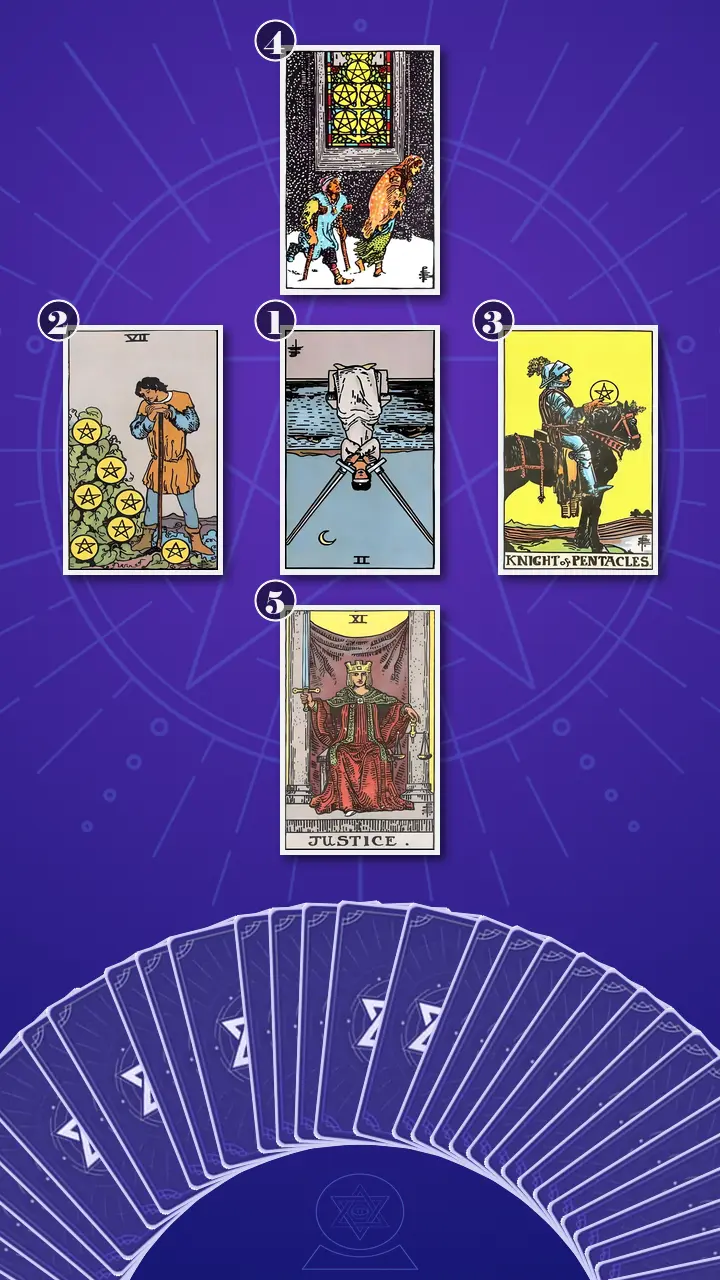
Once her breathing stopped skimming the surface, I shuffled and chose the Decision Cross · Context Edition. For a school-or-work freeze, this is the tarot spread I trust most because it uses the fewest cards that still cover the whole problem. One card shows the present blockage. Two cards compare the actual options. One reveals the hidden factor driving the panic. The last gives grounded guidance. That’s how tarot works best in a real career crossroads: not as fortune-telling, but as structure. It turns emotional noise into card meanings in context.
I told her what I was looking for before I turned anything over. The center would show the observable freeze she kept describing. The left and right cards would examine the two live paths — staying enrolled versus pausing for full-time work. The upper card would expose the fear shaping both options. And the bottom card, the most important one in this reading, would show how to make a fair decision instead of a perfect one.
Reading the Crossroads in Context
The Loop That Calls Itself Research
I turned the card representing the heart of the matter — the exact moment the tuition deadline, job listings, and budget math collide and create paralysis. It was Two of Swords, reversed.
I pointed to the slipping blindfold and the crossed swords over the chest. Then I translated it into her actual life. “This is past 11 p.m., three tabs open — tuition portal, bank app, and job listings. You recalculate rent, transit, and shift income. You don’t pay, apply, or email anyone. The paralysis isn’t a lack of intelligence. It’s a mind treating delay as the last safe option.”
In energetic terms, this was blocked Air turning into excess: too much thinking, but none of it usable. The mind was moving fast while the choice itself stayed frozen. Sometimes more research is just fear in spreadsheet clothing. One more tab, one more calculation, one more night. Relief now versus the belief that she should somehow produce the flawless answer before morning.
Maya let out a short laugh that caught at the edges. “Okay,” she said, wincing a little. “That’s so accurate it’s almost rude.” Her fingers drummed once on the mug, then stopped. Recognition had landed, and with it, the first crack in the performance of being merely ‘practical.’
The Path You’ve Already Been Growing
I turned the card examining the finish-the-degree side of the dilemma — what continued investment, pacing, and support would require. It was Seven of Pentacles, upright.
“This one is not asking whether your degree is noble,” I told her. “It’s asking whether the investment is real — and under what conditions it can keep growing.” I described the figure pausing beside the pentacles on the vine, and then I brought it down to earth. “This is you pulling up your degree audit and seeing more than a bill. It’s classes, semesters, transit rides, late shifts, deadlines, years of identity. Like a long Notion project or a plant you’ve kept alive through three chaotic years — not glamorous every day, but real because you kept tending it.”
Here the energy was balanced Earth: patient, sober, not flashy. The card didn’t promise ease. It asked for honest assessment. Staying enrolled might absolutely matter, but not as an act of martyrdom. It would need cash flow, pacing, maybe a reduced load, maybe support. Speed and growth are not the same thing. I could almost hear her thinking it before she said it aloud: I know it’s slow, but it isn’t nothing.
Her face softened. She stopped touching her jaw and looked down instead, as if the years she’d already put in had suddenly regained weight in a good way — not as guilt, but as value.
The Honest Pull of a Regular Paycheck
I turned the card examining the pause-for-full-time-work side — what immediate stability and practical responsibility would ask for. It was Knight of Pentacles, upright.
“I like that this card doesn’t shame the appeal of work,” I said. “It respects the pull of structure.” I showed her the still horse and the pentacle held forward. “This is the fixed rota. Direct deposit hitting on Friday. Knowing exactly when your shift starts. The weird calm of routine after weeks of tuition deadline anxiety. Maybe I just need something solid for a minute — that’s this card.”
The energy here was grounded Earth in balance, but with a quiet warning. Stability can become a bridge, or it can become default drift. Relief is not failure, and delay is not the same thing as intention. A full-time job could provide breathing room, but only if it came with a timeline, a savings target, or return conditions. Otherwise the still horse stays still.
Maya nodded immediately, and this time there was no defensiveness in it. “That’s exactly what’s seductive about it,” she said. “Not even the money first. Just… knowing what my week is.” Her shoulders loosened for a second, which told me the card had validated something she’d been half-ashamed to want: steadiness.
The Cold Story Hiding Behind the Numbers
I turned the card above the center — the hidden factor influencing the whole choice, the fear underneath both options. It was Five of Pentacles, upright.
I didn’t rush this one. “This card is about more than being short on money,” I said. “It’s about scarcity becoming an identity story.” I described the two figures in the snow passing a lit window, help visible but emotionally unreachable. Then I named her version of it. “You read the amount due. Your face gets hot. You draft an email to financial aid or student services. And then you delete it, because the practical question mutates into something much crueler: I should have handled this already.”
In my own work, I call this Dark Matter Detection. In astrophysics, dark matter is invisible, but you know it’s there because of the force it exerts on everything around it. In this reading, the invisible mass was shame. It was bending the whole system. The money problem was real. But being short on money was the problem; feeling like you were the problem was the blockage.
Outside her apartment window, headlights moved across the wall behind her and vanished, a brief band of cold light like the stained-glass window in the card passing just out of reach. Maya looked away from the screen. First her breath paused. Then her gaze unfocused, as if replaying every deleted draft. Then the exhale came, low and uneven. “I never send the email,” she said quietly. “I always make it mean something about me.”
“Yes,” I said. “And that’s why the decision keeps feeling bigger than one semester.”
When Justice Set the Terms
The Card That Turned a Life Verdict Back into a Six-Month Strategy
When I reached the final card, the air changed. Even through a screen I could feel it — the way a room goes still when the right sentence is about to arrive. This was the guidance card, the one pointing toward the key shift: a fair, time-bound strategy instead of a permanent identity verdict. I turned over Justice, upright.
I smiled the second I saw the scales and the upright sword. “This is clean Air,” I told her. “Not panic thinking. Discernment.” In real life, it looked exactly like this: stop asking which option makes you look more successful, and start comparing which one you can honestly afford, sustain, and revisit with self-respect over the next six months.
Justice always sends me back to the planetarium. Visitors think navigation depends on one dramatic star, one answer glowing brighter than everything else. But real navigation is relational. It’s timing, angle, fuel, gravity, constraint. That’s where my Gravity Assist Simulation comes in. In mission planning, we don’t ask which path looks heroic from the ground. We ask which trajectory preserves enough energy to keep the craft recoverable later. That was Maya’s real question too.
At 11:38 p.m., with cold coffee next to your laptop and the tuition page, bank app, and job board all open, it can feel like the bill is judging your whole future instead of asking for one hard but practical decision.
This bill is not a verdict on your value; put the facts in Justice’s scales and choose the path you can revisit with self-respect.
I let the sentence sit between us. Maya went completely still — a tiny physiological freeze, fingers hovering above the trackpad as if they’d forgotten their next command. Then I watched the second phase: her eyes shifted offscreen and lost focus, not blank but busy, clearly replaying some private reel of midnight tabs, deleted emails, and worst-case futures. When the feeling finally broke through, it didn’t arrive as instant relief. It arrived sharp. “So I’ve been letting a bill talk to me like a judge,” she said, with a flash of anger that landed half in her throat and half behind her eyes. “That’s… actually infuriating.” After that, her shoulders dropped. Her jaw unclenched. She pressed her palm flat to the table like she needed to feel something solid underneath her. I told her, more plainly, “You are not choosing your worth here. You are choosing the fairest next structure for your money, time, and nervous system.” Then I asked her to imagine a ten-minute timer, two columns on paper — Stay Enrolled and Pause for Work — scored on only three criteria: monthly cash need, stress capacity, graduation timeline, plus one support contact and one review date for each path. “Now,” I said, “using that lens, think back to last week. Was there a moment this would have changed how you felt?” She laughed once, softer this time. “The email,” she said. “I would’ve sent the email.”
That was the turning point. Not total certainty. Something better. The shift from shame-loaded tuition panic and analysis paralysis to a reviewable six-month plan grounded in self-trust. A six-month plan is not a lifelong confession.
From Panic Math to the Fairest Next Structure
Once all five cards were on the table, the story was precise. The center card showed a mind overworking because it believed delay was safer than choice. The left card showed that the degree still held real value, but only if continued study could be made sustainable. The right card showed that full-time work offered honest relief and routine, but needed boundaries so it would remain intentional. Above them, Five of Pentacles revealed the true weather system: scarcity had taken over the whole inner climate. And below it all, Justice gave the correction — not more information, but a better way to organize the information already there.
I told Maya the blind spot was this: she had been treating one term like a referendum on her competence. The visible dilemma was horizontal — school or work. But the real unlock was vertical — moving from fear to framework. She did not need the perfect path. She needed the fairest next structure.
I framed the next steps the way I would explain an orbital adjustment: we were not plotting the whole life mission tonight. We were choosing the next stable burn and the next review point.
- The Three-Criteria Reality CheckWithin the next 24 hours, make a two-column grid in Notes, Google Docs, or on paper: Stay Enrolled / Pause for Work. Score each path from 1–5 on only three things — monthly cash need, stress capacity, and graduation timeline. Set a 10-minute timer and stop when it ends.If you feel the urge to add eight more categories, that’s the spiral talking. Keep it small so the decision gets clearer, not louder.
- The Support-Window AuditBefore rereading the tuition portal again, spend 15 minutes checking real support options: payment plans, reduced course load, temporary leave, extension windows, or advisor appointments. Then send one short email to financial aid, student services, or an academic advisor asking what exists.Keep the message procedural, not apologetic. You’re requesting information, not confessing failure.
- The Decision Date MarkerChoose one 30-minute slot within the next 7 days and label it in your calendar: decision, not more research. If Pause for Work is leading, add a savings target and return condition. If Stay Enrolled is leading, write the minimum conditions that make the next term workable.This is boundary-first decision-making, not destiny. Review points build self-trust better than endless suspense.

A Week Later, the Quiet Proof
A week later, Maya messaged me after one of her shifts. She had sent the email. She had done the grid. She had booked a call about payment options and a lighter course load. Her text was short: “I still hate that this is messy, but I’m not opening Indeed and my student portal at midnight anymore.”
That was enough for me. Not because her whole life was solved, but because the first proof had appeared. She was no longer trying to outrun the feeling with more tabs. She was making contact with reality in a way that protected her self-respect.
The morning after, she told me, she woke with the old thought — what if I get this wrong? — and then, instead of spiraling, she opened the comparison grid she’d already made. Clear, but still a little tender. That’s how real change often looks.
When I guide people through a dark planetarium dome, clarity rarely arrives like a spotlight. It arrives like orientation — one fixed point, then another, until the sky stops feeling random. This reading did the same. We moved from panic math to clear criteria, from forever thinking to the next workable term, from shame to self-trust.
When money gets loud, I watch so many capable people tighten around one semester until it starts to feel like proof of whether they can still steer their own life. If tonight you’re in your own version of the three-tab spiral, please remember: noticing that tightening is already movement. If this only had to be your fairest six-month plan — not a forever verdict — what becomes a little easier to see?