I Thought Zero Due Meant Safety—Until I Learned to Stop on Purpose

Finding Clarity in the 10:37 p.m. Anki Spiral
If you’re a med student in a big city who opens Anki at 10:30 p.m., sees “200 due,” and suddenly decides tonight is actually about “optimizing settings,” not reviewing—yeah, this is that spaced repetition backlog panic.
Jordan said it like she was confessing to a crime, even though she was just describing a Tuesday night in Toronto.
“It’s always the same,” she told me. “I open the app for a ‘quick review.’ I see the number. And then I’m… not doing cards. I’m in settings. Or I’m on r/medicalschoolanki. Or I’m watching one more FSRS vs SM-2 video like it’s going to save me.”
I could picture it without trying: 10:37 p.m., laptop balanced on her knees on the duvet, the blue light too sharp against the dark room. Her phone warm from doomscrolling. That thin fluorescent buzz from a desk lamp that somehow gets louder the more guilty you feel. The “200 due” at the top of the screen sitting there like a judge in a tiny courtroom.
When she spoke, her hands didn’t stop moving—thumb rubbing against the side of her index finger, then tapping her trackpad too fast, like her body was trying to multitask its way out of a feeling.
Her overwhelm wasn’t an abstract emotion. It was a tight chest that made each breath feel like it had to squeeze past a knot, plus restless hands that wanted to click anything except Start.
“If I start and don’t finish,” she said, staring at the blank space between us like she could see the number there, “it’s just proof I’m behind.”
I nodded slowly, letting the sentence land without arguing with it. “That makes sense,” I said. “Because if the number is a verdict, then pressing Start isn’t ‘studying.’ It’s… finding out whether you’re safe.”
Her shoulders lifted a millimeter—defensive, but also relieved to be understood.
“Tonight,” I added, “we’re not trying to become a different person. We’re trying to get you out of the freeze-and-tinker loop and into a next step you can repeat. Let’s draw a map through this fog—real clarity, not motivational fluff.”

Choosing the Compass: The Celtic Cross · Context Edition
I started the session the way I always do—no theatrics, just a shift of attention. I asked Jordan to take one slow breath and hold the exact moment in mind: opening Anki, seeing “200 due,” and feeling her hand drift toward settings.
As she breathed, I shuffled—steady, rhythmic, the kind of repetitive motion that tells a nervous system, we’re not in an emergency right now.
“I’m going to use a spread called the Celtic Cross · Context Edition,” I said. “It’s basically the classic Celtic Cross, but tuned for behavior loops—because what you’re describing isn’t a knowledge problem. It’s a loop.”
For you reading this and wondering how tarot works in a situation as practical as spaced repetition: I don’t use it as fate. I use it as a diagnostic mirror. The Celtic Cross is good because it moves from the visible symptom to the hidden driver, and then to a concrete next step.
In this version, Position 1 will show what “200 due” feels like in real time. Position 2 will reveal what blocks the first five minutes. Position 6 is context-tuned to the “next step (48 hours)”—so we don’t leave this in the land of insight only. And Position 10 will show what becomes possible when the relationship with the queue turns sustainable instead of punishing.
Jordan swallowed, then gave a tight little laugh. “Okay. Because I don’t need poetry. I need… an exit.”
“Good,” I said. “We’ll do both.”
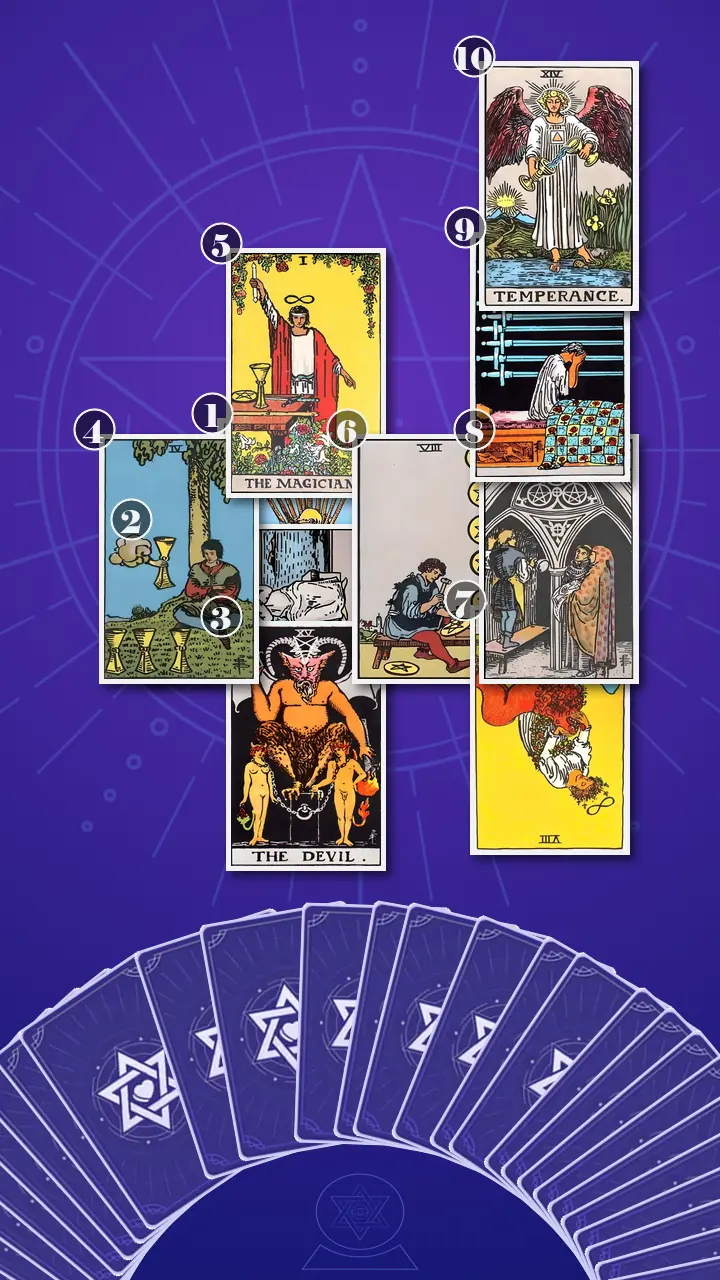
Reading the Map: From Overload to a Repeatable Start
Position 1 — The current experience in the moment
“Now we’re turning over the card that represents the current experience in the moment: what ‘200 due’ feels like in real time and how it shows up behaviorally,” I said.
Ten of Wands, upright.
It was almost too on-the-nose: a figure leaning forward under a bundle so heavy it blocks their face. No horizon, no perspective—just load.
“This,” I told her, “is exactly what you described. You open Anki planning to do a ‘quick review,’ see ‘200 due,’ and it instantly feels like you’re carrying the entire semester on your chest. You don’t see individual cards—you see a wall. So your nervous system reads the number as an emergency, and you start multitasking—settings, YouTube, Reddit—because anything feels better than standing still under that weight.”
I framed the energy plainly: “This is excess fire energy—too much urgency, too much responsibility, packed into one moment.”
Jordan let out a sound that was half laugh, half wince. “That’s… mean. Like, accurate, but mean.”
“It’s not judging you,” I said, keeping my voice calm. “It’s describing the load. And a load problem doesn’t get solved by thinking harder. It gets solved by resizing the container.”
Position 2 — The immediate blocker
“Now we’re turning over the card that represents the immediate blocker: what stops the first five minutes of action,” I said.
Two of Swords, reversed.
Before I even spoke, Jordan’s fingers did that tiny hover-motion in the air—like she was over the Start button again.
“Here’s the micro-scene,” I said, letting it play out with her. “Your finger hovers over Start. Then you back out to decide which deck is ‘most urgent,’ whether to bury new cards, whether your intervals are wrong, whether you should make a filtered deck. The real block isn’t time—it’s the feeling that choosing one next step might be the wrong one, so you keep choosing in circles.”
In energy terms, I kept it crisp: “This is blocked air. Thinking isn’t helping you start—it’s crossing you.”
I heard my own Wall Street past in my head for a second—an internal flashback to trading desks where people confuse analysis with safety. Back then, too, you could open ten spreadsheets and still not place the trade, because placing it means owning risk. The mind loves a spreadsheet when it’s scared.
“Optimizing can be a form of avoidance that looks productive enough to fool you,” I said.
Jordan gave a tight-lipped nod, then exhaled through her nose like she’d been caught. “I literally open three tabs. Settings. Reddit. And a YouTube ‘best workflow.’ And then it’s 11:20 and I hate myself.”
“That’s decision fatigue,” I said. “Not laziness. This card is basically saying: the discomfort is about choosing, not about capability.”
Position 3 — The underlying driver
“Now we’re turning over the card that represents the underlying driver: the deeper attachment that keeps the cycle running,” I said.
The Devil, upright.
Jordan went still. Not dramatic—just a pause, like her body recognized the topic before her brain could argue.
“This is the bind,” I said, and I kept my tone practical. “The due count becomes a hook: you feel shame, reach for a quick relief behavior—tweak settings, scroll productivity content, reorganize tags—feel better for an hour, and then feel worse later when the queue is bigger. You’re not trapped by the app. You’re trapped by the belief that the number defines your competence.”
“Loose chains,” I added, tapping the edge of the card lightly. “That matters. It means the exit exists. But the loop pays you in short-term relief, so it keeps recruiting you.”
Jordan’s jaw flexed. “It’s like… refreshing my bank account when I’m stressed,” she said, surprising herself. “It doesn’t fix anything. It just spikes the feeling.”
“Exactly,” I said. “Same dopamine mechanism. Same false control.”
Position 4 — Recent context
“Now we’re turning over the card that represents the recent context: the emotional tone or habit loop that led to the backlog building,” I said.
Four of Cups, upright.
“This is the drained season,” I told her. “You sit down to study feeling emotionally checked out. Even a simple 20-minute review looks pointless—‘not enough to matter.’ So you ignore the small helpful offer—a minimum-viable session—and stay stuck staring at what’s undone.”
I named the energy as deficiency—not of intelligence, but of emotional reward. “When you’re numb, you stop noticing that small starts actually work. You don’t believe the offered cup counts.”
Jordan’s eyes flicked to the side. “I’ve been sleeping like trash,” she admitted. “And then it’s like I’m trying to ‘repair’ the day at night. Like if I do enough, I’ll feel… clean.”
“That’s the trap,” I said gently. “Study becomes a moral rinse, not a skill.”
Position 5 — Conscious aim
“Now we’re turning over the card that represents your conscious aim: what you think you need in order to feel safe and ‘caught up’,” I said.
The Magician, upright.
“You want control,” I said, not accusing—just naming it. “The perfect workflow, the perfect deck setup, the perfect schedule. But you already have the real tools: one timer, one rule, one deck, and the ability to begin. The Magician moment is when you stop rearranging the table and actually use what’s on it.”
I watched Jordan’s shoulders drop slightly. The Magician is agency; it also exposes where agency gets outsourced to tools.
“A triple‑digit due count isn’t a character judgment,” I reminded her. “It’s just a queue.”
She whispered, almost like trying it on: “It’s just a queue.”
Position 6 — Next step (48 hours)
“Now we’re turning over the card that represents your next step in the next 48 hours: the smallest high-leverage move that gets spaced repetition moving again,” I said.
Eight of Pentacles, upright.
The shift in the room was immediate. Even the lamp hum felt less aggressive, like the environment had finally stopped yelling and started giving instructions.
“This is your craftsman card,” I said. “In the next 48 hours, you treat reviews like a craft: you set a timer, press Start, and do one card at a time without negotiating. You stop when the timer ends, even if the number isn’t zero. You’re training ‘showing up’—not trying to win a one-night battle.”
I leaned into the tactile language on purpose: “Workbench. One piece. Timer beep. The first 10 cards feel scratchy and uncomfortable—like your brain is protesting. Then the panic drops from an 8/10 to maybe a 5/10. You don’t feel caught up. You feel capable.”
Jordan’s face softened. “I could actually do that tonight,” she said, the way someone talks when they’ve finally found a door that isn’t locked.
“The goal isn’t zero,” I said, letting the phrase rewrite the rules. “The goal is a repeatable start.”
Position 7 — Self-positioning
“Now we’re turning over the card that represents self-positioning: how you relate to effort, discipline, and self-talk while studying,” I said.
Strength, reversed.
Jordan’s laugh came out sharp. “Oh. Yeah. That’s… me being horrible to myself.”
“This is harsh motivation,” I said. “You try to force yourself into studying with pressure and self-criticism, then you burn out and avoid the next session. It’s like your inner coach got replaced by an inner drill sergeant—and your nervous system keeps flinching before you even start.”
I named the energy as imbalance: “You have drive. But the regulation piece is missing. Without regulation, the drive becomes a spike-and-crash cycle.”
“You don’t need more pressure—you need a smaller promise you can keep,” I told her.
She didn’t respond verbally. She just uncrossed her arms, and her hands finally settled in her lap. It was the smallest sign of trust.
Position 8 — Environment and supports
“Now we’re turning over the card that represents environment and supports: tools, people, and constraints shaping your study reality,” I said.
Three of Pentacles, upright.
“This is structure and being seen,” I said. “When you study with one classmate, join a quiet co-study room, or even do a simple check-in text—‘Starting 25 min now’—the task gets lighter. It’s not motivation. It’s scaffolding.”
Jordan hesitated. “I mostly study alone. I don’t want people to know I’m… behind.”
“That’s real,” I said. “And you’re not asking for tutoring or judgment. You’re asking for a room with walls.”
Position 9 — Hope and fear
“Now we’re turning over the card that represents hope and fear: what you’re secretly trying to prevent or prove through clearing the queue,” I said.
Nine of Swords, upright.
“This is the 12:26 a.m. spiral,” I said quietly. “At night, your brain plays worst-case outcomes: failing an exam, falling behind, being ‘not cut out for this.’ You decide you must study perfectly tomorrow to make the fear stop.”
I framed the energy as excess air: “Thoughts get loud in the quiet. The worry feels urgent, but it doesn’t automatically create a workable plan. It creates pressure.”
Jordan pressed her lips together, eyes shiny but not crying. “Other people seem to handle this without spiraling,” she said.
“A lot of people spiral silently,” I replied. “And some people just post their 5 a.m. routine and leave out the human part.”
When Temperance Poured Between Two Cups
Position 10 — Integration outcome
I let the room get quiet on purpose. “We’re turning over the card that represents the integration outcome: what becomes possible when you practice a sustainable SRS relationship—not a perfect one.”
Temperance, upright.
The angel’s calm felt almost confrontational after the intensity of the other cards. One foot on land, one in water. A steady pour between cups. A path to the horizon that doesn’t require you to sprint.
Jordan stared at it like it was a dare.
Setup (the trap you’ve been living in): It’s late, you open the app, and “200 due” hits like a wave—so you do the thing that feels safer: settings, tags, one more “best intervals” thread. You’re trying to clear the whole backlog to feel safe, and if you can’t clear it all, your brain calls it failure.
Delivery (the sentence that changes the rules):
Not ‘zero the queue or you failed’; instead, mix small daily reviews like Temperance blending water between cups until balance becomes your default.
I stopped talking for a beat so the line could echo without me rescuing her from it.
Reinforcement (what changed in her body): Jordan’s breath caught—tiny freeze, like her nervous system had to decide if this was safe to accept. Her eyes unfocused for a second, like she was replaying a memory: the cursor hovering over Start, the click into Settings, the brief relief, the later shame. Then her face shifted—brows softening, mouth opening slightly, the expression people get when a rule they’ve been punished by turns out to be optional.
She rubbed her palms on her thighs once, as if trying to wipe off the idea of “zero or nothing.” Her shoulders lowered in a slow, reluctant release. And then—almost embarrassingly human—she let out a shaky exhale that sounded like a laugh without the punchline.
“But…” she started, and here came the surprise reaction—anger, not relief. “But that means I’ve been doing it wrong. Like, this whole time. I’ve been making it worse.”
I didn’t flinch. “It means you’ve been trying to feel safe,” I said. “With the tools you had. And your brain picked the strategy that gives short-term relief. That isn’t stupidity. That’s a nervous system.”
I leaned in slightly. “Try this once in the next 10 minutes: set a timer for 10–25 minutes, do one deck, and stop the moment it beeps. If your body gets buzzy or you feel panicky, pause and take two slow breaths—then decide freely whether to continue or close the app. The win is that you kept the promise you set, not how many you cleared.”
Then I asked the question I always ask when Temperance shows up—because Temperance is a practice, not a slogan. “Now, with this new lens, can you remember one moment last week where stopping on purpose would’ve helped? Where a small block would’ve been enough, but you chased ‘zero’ instead?”
Jordan blinked, slow. “Sunday night,” she said immediately. “I was at my kitchen table doing ‘reset night.’ I kept tweaking bury settings because I didn’t want to see how behind I was. If I’d done… even 15 minutes and stopped, I would’ve slept.”
That was the shift right there: from overwhelm and dread to a calm, repeatable rhythm. From “prove I’m not behind” to “train the habit that makes me steady.”
Temperance also gave me a clean place to use my own framework—because Jordan wasn’t just a student; she was a specific kind of learner. “In my Potential Mapping System,” I said, “you read like a Deep Thinker—you use analysis to feel safe. That’s a strength in medicine. But under stress, the strength becomes the trap: you keep thinking to avoid the emotional risk of starting.”
“Temperance isn’t asking you to stop being smart,” I added. “It’s asking you to blend your intelligence with pacing. A repeatable rhythm is how Deep Thinkers win.”
The One-Rule Session: Actionable Advice for the Next 48 Hours
I gathered the whole spread into one story, the way I used to summarize a messy situation on a trading floor—clean, structured, usable.
“Here’s what I’m seeing,” I said. “Ten of Wands is the overload: you treat ‘200 due’ like you must carry the whole semester right now. Two of Swords reversed is the start-line stall: decision paralysis disguised as strategy. The Devil is the deeper engine: shame plus quick relief behaviors that keep the queue scary. Four of Cups shows the drained season that built the backlog. The Magician is your conscious aim—control, competence, a system that ‘works.’ The pivot is Eight of Pentacles: small, defined craft sessions. Strength reversed is the self-talk issue that turns study into punishment. Three of Pentacles says you need some external structure. And Temperance is the outcome: a steady blend—effort and ease—so starting feels safe again.”
Then I named the blind spot plainly. “Your cognitive blind spot is thinking that feeling safe comes from zero due. But the spread is saying safety comes from keeping small promises. The transformation direction is clear: shift from ‘clear the entire backlog to feel safe’ to ‘complete a small, pre-set review block and stop on purpose.’”
“Okay,” Jordan said, eyes narrowed like she was negotiating with her own brain. “But what if I literally don’t have time? Like… I have labs, lectures, and then I’m dead.”
“That’s the most honest obstacle,” I said. “So we don’t solve it with willpower. We solve it with a smaller unit.”
I pulled in my own intervention tool—my 5-Minute Decision Tools—because Jordan needed a decision that didn’t trigger the Two of Swords spiral. “We’re going to choose a baseline using a tri-axis check: Advantage, Risk, Breakthrough,” I told her. “Not to overthink. To pre-decide.”
“Advantage: what baseline makes it easiest to start? Risk: what baseline is most likely to trigger rebellion or burnout? Breakthrough: what baseline actually changes your relationship with the queue?”
“Then we do weekly calibration,” I added. “Because your schedule is real, not theoretical.”
- Write the One-Line Rule (30 seconds)Before you open Anki today, write: “25 minutes or 40 reviews, whichever comes first.” Put it on a sticky note by your laptop or in your Notes app where you can’t ignore it.If 25 minutes feels impossible, shrink it to 10 minutes or 15 reviews. The rule still works because it removes negotiation.
- Run a Craftsman Session (10–25 minutes)Start a timer. Open ONE deck. Press Start. Do not touch settings, add-ons, tags, or Reddit until the timer ends.If resistance spikes in the first 60 seconds, tell yourself: “I’m only doing the next card until the timer beeps.” That first minute is the exact threshold you’re training.
- Stop on Purpose (60 seconds)When the timer ends, stop immediately—even if you want to “just finish the round.” Close the app and physically change location (kitchen for water, hallway, balcony, outside your building).Stopping is not failure. It’s boundary practice. You’re teaching your brain that starting doesn’t trap you.
- Set a 7-Day Baseline (5 minutes)Pick one daily minimum for the next week: either “15 minutes” or “25 reviews.” Put it on your calendar with a neutral name like “Baseline reps.” If you miss a day, do not make it up—return to baseline tomorrow.Expected urge: “baseline isn’t enough.” Answer it with: “Baseline is the non-negotiable minimum. Anything extra is optional.”
I watched Jordan’s face as she read the list. The skepticism was still there, but it had changed shape. It wasn’t “this won’t work.” It was “this might work, and that scares me because then I’d have to trust it.”
“Do a small block. Stop on purpose. Let compounding do the flexing,” I said, and I meant it as both strategy and self-respect.

A Week Later: The Quiet Proof
Six days later, Jordan texted me from Robarts Library.
“Did the 25 min / 40 reviews thing,” her message read. “Wanted to keep going. Stopped anyway. Walked to get water. Came back and did UWorld. Didn’t feel ‘caught up’—but I didn’t feel doomed.”
I imagined the scene: backpack heavy, hands cold from holding an iced coffee, that familiar library hush. The first ten cards still scratchy, still uncomfortable. But her breathing settling. The number not zero—and yet, the night not ruined.
It wasn’t a perfect streak. It wasn’t a heroic rescue session. It was something better: a system she could live inside.
That’s the real Journey to Clarity I see over and over—moving from decision fatigue and productivity shame into a calm, repeatable review rhythm where progress is measured by consistency, not perfection.
When the due count looks like a verdict, it makes sense that your hands reach for settings—because doing the cards risks confirming the fear that you’re falling behind and out of control.
If you let “done for today” be a deliberate choice instead of a defeat, what tiny review block would you be willing to complete—and then stop—just to prove starting can be safe?