From Turnitin Score-Shock to Steady Submitting: Before Deadline

Finding Clarity in the 11:58 p.m. Turnitin Load Bar
If you’ve ever submitted at 11:58 PM and watched the Turnitin similarity score load like it’s a court verdict, you know that specific kind of plagiarism anxiety that turns your brain into a courtroom.
Jordan met me on a grey Thursday night in Toronto—video call on their side, but I could still see it in their face: the blue-white laptop glow, the way their jaw stayed clenched even when they tried to smile. They described the same scene like it was muscle memory: Robarts Library, a quiet corner table, fluorescent lights that buzz like they’re mocking you, laptop fan whirring too loud in the silence, and that loading bar crawling across the screen as if it’s taking its time on purpose.
“I’m not even trying to cheat,” they said, hands moving in small, restless circles just out of frame. “But it feels like I have to prove I didn’t. That number turns my whole brain into a courtroom.”
I’ve heard different versions of this story—from undergrads to PhDs to people in their first corporate job sending a “final draft” to a manager. But Turnitin makes it uniquely visceral: a metric appears, and suddenly your body behaves like you’re under a spotlight you didn’t consent to. Jordan described it perfectly: tight shoulders, a sinking stomach, fingers that keep reaching for refresh like pulling a lever might change the outcome.
The core tension was clear, and it’s brutally human: they wanted to submit confidently and be judged on their ideas—while fearing they’d be accused of plagiarism and lose credibility, like one wrong citation could erase their right to belong in the room.
The fear didn’t look like a dramatic meltdown. It looked like a quiet, sticky panic—like trying to swim through cold syrup while your brain insists you should be moving faster.
I leaned forward, keeping my voice steady. “We can work with this,” I told them. “Not by forcing you to ‘be confident,’ but by mapping what gets triggered when that score shows up. Tonight is a Journey to Clarity—so the report becomes a tool you can interpret, not a verdict you have to survive.”

Choosing the Compass: The Celtic Cross · Context Edition
I invited Jordan to take one slow inhale—nothing mystical, just a nervous-system gear shift. While they held their question in mind, I shuffled slowly, the way I used to slow my hands before a high-stakes decision on a trading floor. Back then it was a number on a screen too—P&L, risk limits, volatility. Different context, same body response: metrics can hijack meaning if you let them.
“Today,” I said, “we’ll use a spread called the Celtic Cross · Context Edition.”
For readers who are newer and Googling how tarot works: this spread is useful when you need a chain, not a slogan—present trigger → deeper root → past imprint → integrative response. Jordan didn’t need a prediction about their grade. They needed to understand why a similarity score created decision fatigue and paralysis, and what to do in the moment it hit.
I explained the map in plain terms: “The first card shows what happens in the first minute—the loop. The crossing card shows the internal obstacle, the lens that turns a neutral tool into a threat. A card lower down shows the real wound underneath—what you’re afraid you’ll lose. And at the end, we don’t do fate. We do integration: the most empowering response that loosens the old fear script.”
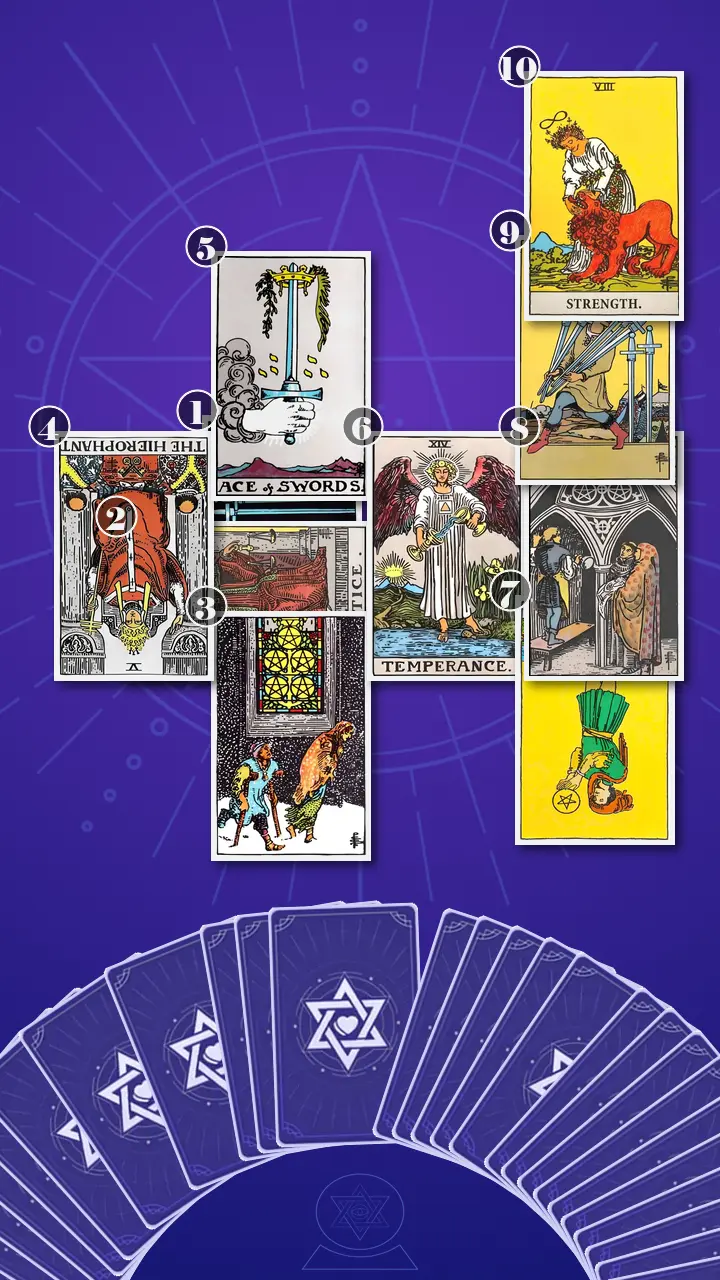
Reading the Map: When a Percentage Becomes a Courtroom
I laid the first two cards in the central cross. Even before I named them, Jordan’s gaze sharpened like they were bracing for bad news—shoulders slightly raised, chin tucked, the posture of someone waiting to be corrected.
Position 1: The Moment the Score Appears
“Now flipped,” I said, “is the card representing what happens in the moment the Turnitin score appears: the immediate mental/behavioral loop you drop into.”
Nine of Swords, upright.
In the Rider–Waite image, someone sits up in bed with their face in their hands, nine swords stacked on the wall like a scoreboard that won’t stop updating. In Jordan’s life, it translated cleanly: this is like when Jordan sees the Turnitin number and suddenly can’t sleep, replaying every sentence as if it’s evidence against them.
The energy here is Air in excess—thoughts sprinting, scanning, catastrophizing. Not helpful analysis. Threat monitoring. You refresh, you scan highlighted matches line by line, you rewrite, you rerun. Control behaviors that feel like responsibility.
I asked them a question I use a lot in both finance and tarot: “When the score appears, what’s the very first thing you do—refresh, zoom in, rewrite a sentence, google thresholds—and what story does that action quietly confirm?”
Jordan let out a small laugh—sharp, almost impressed by how accurate it felt. “That’s… kind of cruel,” they said, but not angry. More like: caught. “I refresh. Immediately. And the story is… ‘If I don’t check again, I’m being reckless.’”
I nodded. “Your brain turns into a courtroom because it thinks it’s protecting your belonging.”
Position 2: The Judging Lens That Turns a Tool Into a Threat
“Now flipped,” I continued, “is the card representing the main internal obstacle: the judging lens that turns a tool into a threat.”
Justice, reversed.
This is where the spread got painfully literal. Justice is scales and a sword: standards, evidence, accountability. But reversed, the scales don’t balance—they tip toward self-condemnation. And the sword stops being clarity; it becomes a weapon.
Jordan’s modern-life scenario was immediate: this is like when you treat the similarity percentage as a guilty/innocent verdict instead of a neutral report that needs interpretation.
Justice reversed is evaluation energy in a blockage state. You’re not comparing your work to the actual rubric; you’re comparing your work to the harshest imaginary court your fear can assemble at 1 a.m. You become judge, prosecutor, and defendant in the same breath.
I described it the way it plays out in real time—because naming the mechanism without shaming it is often the first relief:
“Laptop glow like stage lighting. Highlighted lines as exhibits. The rubric as case law. You refreshing like you’re asking the jury to come back with a different verdict. And underneath it all: you want to submit confidently, but you feel like you need to pre-empt accusation.”
Jordan’s eyes flicked down and away; their fingers stilled for the first time. “Yeah,” they said quietly. “I start writing comments to my TA in my head. Like… a defense statement.”
“That,” I said, “is the overcorrection risk here: turning your assignment into a legal brief. Over-citing, over-quoting, stripping your own voice. And it’s why you end up saying, ‘I don’t recognize my own writing.’”
I paused. “Let’s reality-check the standard. What standard are you afraid you’ll be judged by—is it the actual policy, or the fear-based version of it?”
Position 3: The Fear Under the Fear
“Now flipped is the card representing the deeper insecurity underneath the panic: what the score threatens at the level of belonging and worth.”
Five of Pentacles, upright.
The image is two figures outside in the cold, lit-up window nearby—warmth and belonging visible but unreachable. Jordan’s translation was stark: this is like assuming a high score means you’ll be treated as an outsider, so you try to earn back belonging by obsessively ‘fixing’ everything alone.
This isn’t about citations; it’s about exile. Pentacles are the body, the concrete world—where you belong, where you’re safe. The Five is scarcity: “What if one mistake puts me outside the door?”
I asked, gently but directly: “If you imagine being ‘outside the door’ academically, what do you think you’d lose—respect, options, identity, belonging? And whose approval does that map to?”
Jordan went still. Their mouth tightened, then relaxed. “It’s… not even my prof,” they admitted. “It’s like… the whole institution. Like if they think I’m dishonest, that’s it. I’m done.”
The room on my side was quiet enough that I could hear my own breath for a second. Environment has a way of joining the session: when the root is belonging, silence becomes a kind of mirror.
Position 4: The Past Fear Imprint Being Replayed
“Now flipped is the card representing the past fear imprint being replayed: the earlier authority/rules experience that taught you to equate mistakes with moral failure.”
The Hierophant, reversed.
The Hierophant is institutional learning, tradition, approved pathways. Reversed, it’s the shadow of that: gatekeeping, shame, conditional permission. Jordan’s modern translation hit like a caption under their whole academic life: your brain treats citation rules as a gate you must flawlessly pass through to ‘earn’ being taken seriously.
I used the echo technique here the way it naturally arrives—through sound, through tone:
“Do you remember the voice of the comment that started this kind of panic? Not the words, the tone. The coldness of ‘watch your sources.’ The way a policy page reads like a locked door when you’re already scared. The feeling of needing permission.”
Jordan swallowed. Their eyes watered, not dramatically—just that thin shine people get when something old gets named accurately. “A TA wrote that once. Just… ‘watch your sources.’ No explanation. And I swear I’ve been hearing it ever since.”
“You learned,” I said softly, “that rules weren’t guidance—they were a gate.”
Then I added the contrast that matters for the rest of the reading: “But standards are a craft tool—not a gate you have to bleed at.”
Position 5: The Clean Standard You’re Trying to Reach
“Now flipped is the card representing what you’re trying to achieve consciously: the clean, clear standard you wish you could meet to feel safe.”
Ace of Swords, upright.
This card is a single sword crowned, cutting through cloud—clarity as a decisive line, not a thousand edits. In Jordan’s life: this is when you stop chasing the ‘perfect’ percentage and focus on making one clear argument that sources support.
The Ace of Swords is Air in balance. It’s the opposite of the Nine of Swords spiral. It says: one clean thesis statement. One honest claim. Then your citations support it; they don’t replace it.
I asked: “If you had to write your thesis in one clean sentence—without defending it, over-explaining it, or hiding behind citations—what would it be?”
Jordan blinked like they’d been asked to stand up straight after months of hunching. “I… can,” they said, surprised. “I just don’t trust it unless the number is low.”
“We’re going to change that relationship,” I said. “Not by ignoring the tool. By putting it back in its lane.”
Position 6: The Next Likely Shift If You Stay Engaged
“Now flipped is the card representing the next likely shift if you stay engaged: the healthiest process step your system can move toward soon.”
Temperance, upright.
Temperance is the angel pouring between two cups: careful integration, no extremes. In Jordan’s world, it looked like this: you edit with a simple system—your voice stays present while sources are clearly credited, without compulsively rewriting everything.
This is the antidote to “panic loop.” Temperance is paced work: 25 minutes revising content, 10 minutes checking citations. Close the report. No reruns until the next cycle. It’s not productivity culture; it’s nervous-system pacing.
I pointed it out plainly: “The goal isn’t to eliminate similarity. The goal is to integrate: paraphrase with care, quote when needed, cite accurately, and keep your voice.”
Position 7: How You’re Showing Up In This Pattern
“Now flipped is the card representing how you’re showing up in this pattern: your self-talk and your typical response style under evaluation.”
Page of Pentacles, reversed.
The Page is student energy—steady learning. Reversed, it becomes insecurity dressed up as “being responsible.” Jordan’s translation was almost painful: you keep ‘studying’ the similarity report and doing tidy-up tasks, because taking the next real step would mean being seen.
This is Earth energy in deficiency: instead of grounded progress, you get procrastination disguised as productivity. Formatting headings. Reorganizing references. Tweaking margins. Anything that feels safe.
I asked the question behind it: “Are you waiting to feel ‘ready’ before you submit? And if so—what’s the invisible test you think you have to pass first?”
Jordan exhaled through their nose. “I’m waiting for my body to stop panicking,” they said. “Which… doesn’t happen.”
“Exactly,” I said. “So we build a process that doesn’t require your panic to disappear before you can finish.”
Position 8: The Supports You Can Actually Use
“Now flipped is the card representing external supports and pressures in your context: resources, mentors, or systems you can actually use.”
Three of Pentacles, upright.
Instant shift. Cathedral in the card, yes—but not as gatekeeping. As a workshop. As craft. As people building something together with plans in hand. In Jordan’s life: this is like emailing a TA, using the writing center, or asking a peer to sanity-check whether a paraphrase needs a citation.
I watched Jordan’s shoulders drop a fraction. Not relief like fireworks—relief like finally putting down a bag you forgot you were holding.
“This card,” I told them, “is the Courtroom-to-Workshop shift. You’re not meant to solve this alone at 1 a.m. Standards exist. Help exists. And using help isn’t a confession—it’s literally how the craft is learned.”
I gave them a micro-script they could steal word-for-word, because sometimes the hardest part is the first sentence:
“Hey—can I show you one flagged paragraph and ask if it needs a quote or just a citation?”
Jordan nodded, then hesitated. “I always feel like… if I ask, they’ll think I already did something wrong.”
“That’s the Five of Pentacles talking,” I said. “Fear of being outside the door. But this card says: you can walk toward the lighted window. You don’t have to freeze in the snow.”
Position 9: The Fear-Story and the Hidden Wish
“Now flipped is the card representing the fear-story and the hidden wish: what you’re afraid the score means, and what you wish it could guarantee.”
Seven of Swords, upright.
The figure carries swords and looks back—the nervous glance of “am I being watched?” In Jordan’s language: tweaking phrasing mainly to reduce the number while worrying what others will think, instead of simply citing clearly.
This is where the Turnitin similarity score anxiety gets its sharpest edge: not just fear of being wrong, but fear of being seen as sneaky. The wish beneath it is equally clear: you want the number to certify your worth. A blue-check of integrity. A permission slip that says “legit.”
I said one line I knew they needed: “Don’t rewrite your voice into witness protection.”
Jordan’s mouth twitched—half amusement, half grief. “That’s exactly what it feels like,” they admitted. “Like I’m trying to make my writing unrecognizable.”
When Strength Held the Lion: A Verdict That Isn’t One
I turned to the final card. “This,” I said, “is the integration direction—the most empowering way to respond so the old fear script loosens its grip.”
Strength, upright.
Before I even spoke, the energy in the session changed. It often does with Strength—not loud, just… quieter. Like the room remembers you have lungs.
And because this is my work—part tarot, part systems-thinking—I brought in one of my diagnostic tools. “I use something I call a Potential Mapping System,” I told Jordan. “It’s an energy profile that helps me spot how someone learns under pressure. Some people are Sprinters—stress makes them move fast and cut corners. Others are Deep Thinkers—stress makes them circle and double-check. You’re a Deep Thinker.”
Jordan looked up. “Is that… bad?”
“Not at all,” I said. “It’s a strength—when you’re regulated. When you’re contracted, it turns into rumination. Strength isn’t telling you to stop caring. It’s telling you to lead your nervous system instead of letting it lead you.”
Setup. I brought us back to their exact moment: it’s 11:58 PM, the submit button is right there, and you’re watching Turnitin load like it’s a verdict. Your jaw locks, your hands keep reaching for refresh, and suddenly your essay feels like evidence. You’re not editing—you’re trying to survive judgment.
Delivery.
Stop treating the Turnitin score like a courtroom sentence; start holding it like the lion in Strength—firm, gentle, and under your calm leadership.
I let the line sit there for a beat. No extra explanation. Sometimes the most respectful thing I can do is not crowd the insight.
Reinforcement. Jordan’s reaction came in a three-step wave. First: a small physiological freeze—breath paused, eyes fixed on one point like their brain was buffering. Second: the cognitive shift—gaze went slightly unfocused, like they were replaying all the times they’d treated a similarity report as a moral diagnosis. Third: the release—one long exhale, shoulders dropping, jaw unclenching with a faint click they didn’t know they were making.
“I hate that this is true,” they said, and for a second there was a flash of anger. “Because it makes me feel like… I’ve been doing it wrong the whole time.”
I met that with something steady. “Not wrong,” I said. “Protective. Your system built a strategy: ‘If I prosecute myself first, no one can surprise-accuse me.’ It kept you safe once. It’s just costing you too much now.”
Then I gave them the nervous-system close-up, the way Strength asks for it: “Cursor hovering over ‘Resubmit.’ Palms a little sweaty. Throat tight. Old script: ‘If the number is high, I’m unsafe.’ New script: ‘If something needs a citation, I can fix it.’ And the boundary phrase that ends the loop: One integrity pass, then I’m done for tonight.”
I looked at them and asked the question that turns insight into a lived memory: “Now, with this new lens—can you think of a moment last week when the report spiked you, and this could have changed what you did in the next five minutes?”
Jordan stared off to the side, then nodded slowly. “Tuesday,” they said. “I reran it four times. If I’d just… fixed one thing and closed it, I would’ve finished the conclusion.”
That was the shift I wanted them to feel in their body: moving from score-shock and tightening into grounded clarity about what’s actually required. Not from self-doubt to perfect confidence—just to steadier self-trust while revising and submitting.
The One-Integrity-Pass Plan: Actionable Next Steps for Turnitin Anxiety
I pulled the whole spread into one coherent story—the way I’d summarize a complex situation for a client back when I built investment memos:
“Here’s what’s happening. The moment the similarity score appears (Nine of Swords), your mind starts threat-scanning. Then Justice reversed turns the report into a moral courtroom: you become both accuser and accused. Underneath it is a belonging fear (Five of Pentacles)—the dread of being ‘outside the door.’ That fear is old: a gatekeeping imprint (Hierophant reversed) that taught you mistakes equal moral failure. But your real goal is clean clarity (Ace of Swords), and the path forward is paced integration (Temperance), supported by real humans and standards-as-craft (Three of Pentacles). The final move is Strength: calm leadership over panic, with boundaries.”
The cognitive blind spot in this pattern is subtle but powerful: you’re acting like the only way to be safe is to get the number low enough that you can’t be questioned. But academic integrity doesn’t work like that. The transformation direction is the key shift: from treating the score as a verdict about your character to using it as a neutral editing tool with clear, limited steps.
When Jordan asked, “Okay, but what do I actually do when I feel the spiral starting?” I gave them a plan that’s small enough to start tonight—because small, repeatable steps beat heroic all-nighters.
And I layered in my own intervention framework—something I call my 5-Minute Decision Tool. When panic wants you to refresh, you run a quick tri-axis check: Advantage (what do I gain?), Risk (what does it cost?), Breakthrough (what’s the smallest step that changes the trajectory?). Most refreshes have low advantage, high risk, and zero breakthrough. One integrity pass has the opposite profile.
- One-Paragraph Two-Pass CheckChoose one highlighted paragraph. Pass 1: rewrite for clarity in your own voice (no synonyms gymnastics). Pass 2: add only what’s needed—either a citation, or quotation marks + citation. Then stop.If your hand moves toward “rerun,” say out loud: “I’m only doing one paragraph.” Lower the barrier, keep it bounded.
- The 25/10 Citation Cycle (Temperance Mode)Set a timer: 25 minutes writing/editing content in Google Docs, then 10 minutes checking citations. Run Turnitin once per cycle—no reruns until the next cycle.If anxiety spikes at minute 3, close the tab and stand up. Your body settling is part of the workflow, not a distraction.
- Ask-a-Human Sanity Check (Three of Pentacles)Book one writing centre drop-in or go to one TA office hour. Bring one flagged paragraph and ask: “Does this need a quote, or is a citation enough?”Make it specific so it doesn’t feel like a confession. If emailing feels too big at night, draft it and schedule-send for morning.
Jordan made a face. “But I don’t have time for the writing centre. And honestly, it feels… embarrassing.”
“That’s real,” I said. “So we scale it down. Even sending one message is a workshop move.” I repeated the script and made it even smaller: “You can also message one classmate you trust with one screenshot and one question. Not the whole paper. One section.”
Then I gave them the boundary that turns Strength from insight into behavior: “Create a Gentle Submission rule. One final integrity pass—quotes + citations—then you click submit. No last-minute synonym swaps. Not because you don’t care. Because you do.”

A Week Later: Ownership, Not Certainty
Six days later, Jordan emailed me a screenshot—not of their score, but of a tiny checklist at the top of their doc: “Thesis sentence. One paragraph two-pass. One integrity pass. Then done.” Under it they wrote: “I ran the report once. Fixed one flagged paragraph. Closed it. I didn’t spiral. I actually finished the conclusion.”
They didn’t tell me the percentage, and that was the point.
The bittersweet part—the human part—was in the next line: “I slept through the night… but in the morning my first thought was still, ‘What if I missed something?’ Then I laughed a little, did the integrity pass, and submitted anyway.”
That’s the real Journey to Clarity. Not a life with zero fear—just a life where fear stops driving the keyboard.
When a Turnitin percentage makes your body tense like you’re under a spotlight, it’s not because you’re dishonest—it’s because some part of you learned that one mistake could cost you belonging.
If you treated the similarity report as a tool you can interpret (not a verdict you have to survive), what would your next small, calm step look like—just for one paragraph tonight?