From Deadline Pressure to Timely Submission: Breaking the 11 PM Edit Loop

Finding Clarity in the 9:38 p.m. Submit Hover
“If you’ve been hovering over a ‘Submit’ button since 9 PM and still somehow found time to adjust the margins again—hello, perfectionism–procrastination loop.”
Jordan said nothing for a second. On my screen, I watched them blink like I’d just read their browser history out loud.
They were in Toronto, curled into a corner of their condo couch, laptop balanced on their knees. The application portal glowed in one tab, their resume in another. Grammarly was open like a third witness. Every time the little green checks lit up, their shoulders stayed pinned up near their ears anyway. The room was quiet except for the laptop fan ramping up, that thin mechanical whir that always makes late-night stress feel louder than it is.
“It’s basically done,” they said, voice tight, “but it’s not done-done.”
I could see it in their body before they said it: the jaw set like they were biting down on the decision itself. The pressure in the room wasn’t dramatic—no tears, no big speech. It was more like a tight chest under a too-bright screen, like trying to breathe through a sweater collar that suddenly shrank.
“Okay,” I said gently. “You’re not lazy—you’re trying to manage uncertainty with edits. Let’s make tonight less about proving anything and more about finding clarity. We’re going to draw you a map you can actually follow between now and the deadline.”

The Celtic Cross as a Deadline Map
I invited Jordan to do something simple before we touched the cards—my usual pre-meeting 3-minute cosmic breathing. “Not because the universe needs it,” I said, “but because your nervous system does.”
We inhaled slow, like we were filling the ribs in all directions. Exhaled like we were fogging up a planetarium dome. By the third round, their shoulders dropped maybe half an inch. It wasn’t peace. It was space.
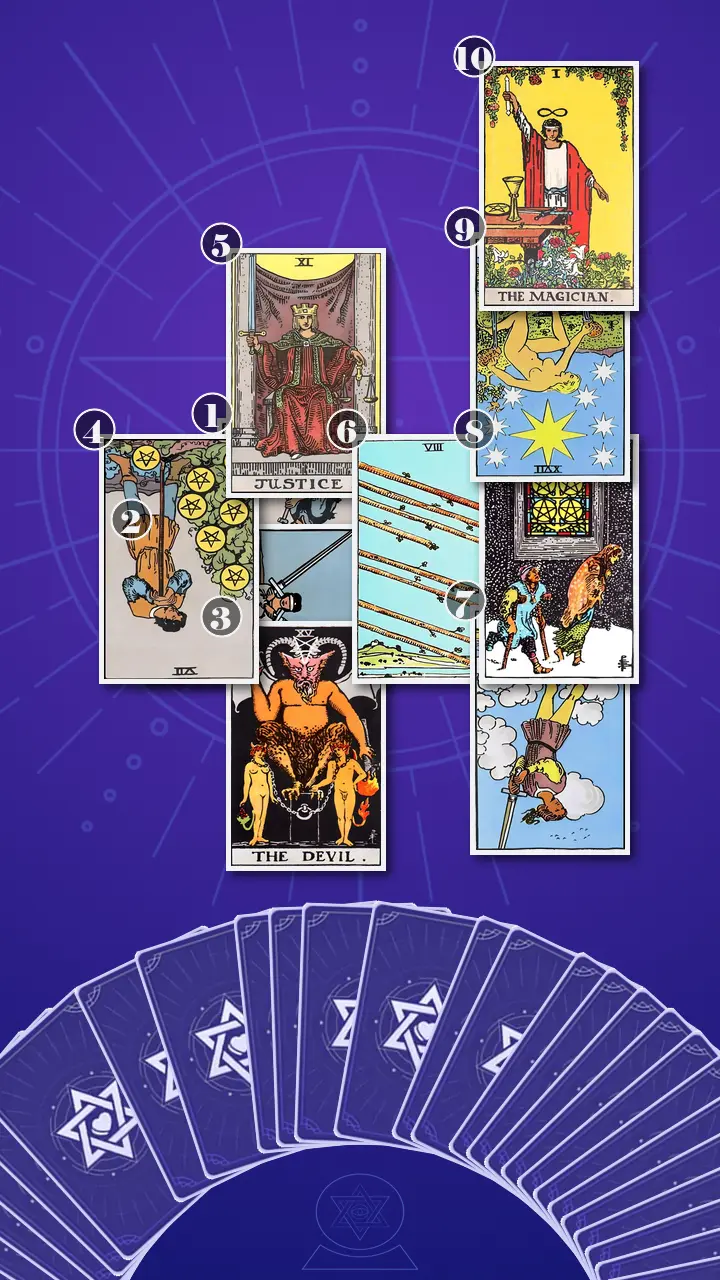
“Tonight, I’m using the Celtic Cross · Context Edition,” I told them, angling the camera so they could see my hands and the deck. “It’s the classic 10-card Celtic Cross, but it’s tuned for real life: deadlines, decision fatigue, and that spiral where ‘one more tweak’ pretends it’s a plan.”
For you reading this and wondering how tarot works in a situation this practical: I’m not predicting whether Jordan will get the job. This spread is for pattern recognition and next steps. It moves from the visible stuck moment (tonight) into the deeper fear powering it, then back out into a time-sensitive way to choose and commit.
“We’ll start with the center,” I said, “because it shows what you’re doing and what’s crossing you. Then we’ll drop into the root—what’s really driving the loop. And the pivot tonight is position five: your conscious aim, your definition of ‘ready.’ That’s where we’ll build a boundary around done.”
Reading the Map: The Loop That Feels Like “Work”
Position 1 — The current stuck moment tonight
“Now we’re turning over the card that represents the current stuck moment tonight: what you are doing and feeling right now around the application,” I said.
Eight of Pentacles, reversed.
“This is 10:30 PM energy,” I told them. “You’re doing ‘productive’ edits—spacing, swapping verbs, rephrasing the same bullet point—because the motion of improving feels safer than the moment of being seen. The workbench is your Google Doc, and the repeated pentacles are the same line you keep engraving, hoping repetition will buy certainty.”
Reversed, I explained, the energy isn’t a lack of effort. It’s effort that’s blocked—craftsmanship turning into diminishing returns. Like The Bear when precision stops being love for the work and starts being panic disguised as standards.
Jordan let out a quick laugh—sharp, almost embarrassed. “That’s… way too accurate,” they said. “Like, it’s kind of cruel.”
“Cruel would be telling you this is a character flaw,” I said. “This is a strategy. It just stops working after 9 PM.”
Position 2 — The immediate block
“Now we’re turning over the card that represents the immediate block: what makes it hard to press submit and commit to a version,” I said.
Two of Swords, upright.
“You’re keeping the application ‘alive’ by not deciding,” I said. “You’re mentally holding two swords—submit vs perfect—and staying blindfolded on purpose because seeing the deadline clearly would force a choice. The calm sea in the background is the illusion: you look composed, but you’re bracing at the chest like impact is coming.”
This is decision paralysis as emotional self-protection. A draft mode life hack that worked once—until the deadline made it a trap.
I watched Jordan’s hand drift to their sternum, like they were checking if the armor was still there.
“And here’s the thing,” I added, keeping my voice level. “The deadline is already a decision point. Not choosing is still choosing—just choosing the version where time runs out.”
Position 3 — The deeper driver underneath the perfectionism
“Now we’re turning over the card that represents the deeper driver underneath the perfectionism: the fear/belief powering the loop,” I said.
The Devil, upright.
Jordan went still in a way that told me the card landed before I said a word.
“Under the edits is a shame bargain,” I said. “‘If I make it flawless, I’ll be safe.’ The chain isn’t the recruiter—it’s the story that rejection equals a verdict on your worth. You’re working like you’re trying to negotiate with an imagined judge, not applying for a job.”
The Devil is excess attachment: to external validation, to control, to the idea that one document can protect you from feeling not-good-enough.
“The detail I always look for,” I added, tapping the edge of the card on my desk, “is that the chains are loose. That’s tarot’s way of saying: the pressure is real, but the grip is not absolute.”
Position 4 — What brought you here
“Now we’re turning over the card that represents what brought you here: the recent pattern that set up tonight’s pressure,” I said.
Seven of Pentacles, reversed.
“For weeks, you’ve looked at your progress and felt ‘not enough’ instead of ‘almost there,’” I said. “So you kept switching tasks—more advice, more templates, more comparisons—because letting the work ripen felt like losing time. That impatience is what set up tonight’s deadline pressure spiral.”
Reversed, this is deficiency in trust. Not in talent—trust in process. Trust that the draft you built is allowed to become a finished thing.
Jordan’s eyes flicked away from the screen, like they were replaying the last few evenings: r/resumes tabs, “just two minutes” on LinkedIn, half-written cover letters multiplying in Google Docs version history.
When Justice Held the Line
Position 5 — Your conscious aim for tonight
I let the room settle before I turned the next card. Even over video, I felt the shift—the way a reading goes quiet when it reaches the hinge.
“Now we’re turning over the card that represents your conscious aim for tonight: what ‘done’ actually needs to mean to you before the deadline,” I said.
Justice, upright.
“This is the antidote,” I told them. “Justice is decisive fairness. Self-accountability without self-punishment. Clean boundaries around ‘done.’”
Then I brought in my own way of seeing it—ten years of explaining orbital mechanics to crowds who want the stars to make sense.
“In the planetarium,” I said, “people always ask me, ‘Where exactly should I look?’ And I tell them: you don’t need to see every star. You need one reliable reference point—a bright one—to orient yourself. Tonight, Justice is your reference point.”
“And I want to run a quick Gravity Assist Simulation,” I added—my go-to tool when someone’s stuck in a career crossroads loop. “In spaceflight, you don’t burn fuel forever to feel ‘more prepared.’ You use a planet’s gravity to change trajectory with a clean, timed maneuver.”
“If you keep tweaking,” I said, “you get short-term relief—like a tiny burn that makes you feel in control. But the long-term impact is ugly: exhaustion, more errors, less confidence, and sometimes… no submission at all.”
“If you submit a fair, accurate version tonight,” I continued, “you get discomfort now, but you regain time, agency, and momentum. That’s the gravity assist: one decisive boundary that changes the whole path.”
Jordan swallowed. Their eyes were on the card like it was a mirror they didn’t fully want, but couldn’t look away from either.
Setup: It was late, the tab was still open, and they were staring at the submit button like it was a referendum on their entire career—while their body was already telling them this wasn’t about one bullet point anymore.
Stop treating ‘perfect’ as the entry fee, choose a fair and finished version, and let the scales of Justice define what’s truly enough tonight.
The silence after that sentence wasn’t awkward. It was weighty—like when a projector shuts off and the room realizes it’s been holding its breath.
Jordan’s reaction came in a chain: first, a tiny freeze—breath paused, fingers hovering midair above the trackpad. Then their gaze went unfocused for a second, like they were replaying every 11 PM renegotiation they’d ever had with themselves. Then, finally, a shaky exhale that softened their mouth and loosened the muscles at the sides of their jaw.
“But if I stop editing,” they said, and there was a flash of irritation under the fear, “doesn’t that mean I was… wrong to care?”
“No,” I said, instantly. “Caring is not the problem. Caring without a boundary is. Clarity is the goal tonight. Control is the temptation.”
I slid into the practical reinforcement, because Justice doesn’t soothe you with vibes—it gives you criteria.
“Do a 7-minute Justice Check,” I said. “Open the PDF (not the doc). Fix only factual errors—names, dates, titles. Then close the file. If you notice the urge to rewrite for vibe or tone, label it anxiety edit and skip it. If this feels too intense, pause at any point—take three breaths, come back, and only do the checklist line-by-line. Then upload the files before you debate again.”
“Now,” I asked softly, “with that lens—can you think of one moment in the last week when this would have changed how you felt?”
Jordan nodded once, slow. “Yesterday. I rewrote my opening paragraph three times because I thought it sounded… too junior. But it was accurate. It was fine.”
“That,” I said, “is you stepping from pressure into a grounded standard. From proving worth to submitting an honest snapshot.”
The Launch Window: Turning Edits into Motion
Position 6 — The next few hours
“Now we’re turning over the card that represents the next few hours: what changes when you choose to act rather than perfect,” I said.
Eight of Wands, upright.
“The second you commit, everything speeds up in a clean way,” I said. “Export PDF, upload, fill fields, final check, submit. The ‘message sent’ moment lands in your body as sudden quiet—like the room gets bigger once you’re not trapped in draft mode.”
I pointed out the poetic practicality of it: we had two eights tonight. The same intensity that fuels obsessive editing can also fuel a launch—once Justice sets the heading.
“And I’m going to say this like a flight directive,” I told them. “Upload first. Edit later is not an option tonight.”
Position 7 — Your role in the pattern
“Now we’re turning over the card that represents your role in the pattern: the mindset and self-image you bring to this submission moment,” I said.
Page of Swords, reversed.
“Your inner voice is acting like an anxious junior editor,” I said. “Scanning for threats, debating tone, refreshing requirements, rewriting the same sentence three ways. It mistakes vigilance for competence, so it keeps you mentally ‘on guard’ instead of letting you deliver a clear message.”
This reversed Page is excess mental motion—wind in every direction. Not useful wind. Just loud.
Jordan’s lips pressed together. “I literally refreshed the portal requirements like… eight times.”
“That’s the Page,” I said. “Alert stance, sword up, waiting for an attack that isn’t happening.”
Position 8 — The context around you
“Now we’re turning over the card that represents the context around you: external pressures, signals, and practical constraints shaping this choice,” I said.
Five of Pentacles, upright.
“The context is real,” I said. “Competitive postings, layoffs in the news, Toronto rent, and the feeling that opportunity is inside a lit window while you’re outside in the cold. That scarcity pressure makes perfectionism feel like a ticket—like one mistake could lock you out.”
Five of Pentacles is deficiency energy in the environment: not enough certainty, not enough cushion, not enough ‘room to be human.’
“It makes sense that your nervous system is acting like this matters a lot,” I said. “It does. But tonight you’re not solving the whole job market in one PDF.”
Position 9 — The hope and the fear at the core
“Now we’re turning over the card that represents the hope and the fear at the core of the hesitation,” I said.
The Star, reversed.
“You want this application to open a door,” I said, “but you’re scared it won’t matter—so hope turns into pre-emptive disappointment. You imagine rejection, then hunt for the ‘fatal flaw’ to justify the story.”
Reversed Star is blockage of guidance. Not guidance from the universe like a fortune cookie—guidance from you. Your own north star gets dimmed by comparison fatigue, by LinkedIn spirals, by that ‘Thrilled to announce…’ punch to the throat at 10:47 PM.
Jordan’s eyes glistened—not tears falling, just the shine that shows up when someone feels seen too precisely. “It’s like… I can’t access why I’m even applying anymore,” they said. “It’s just fear.”
“That’s the reversed Star,” I said. “And it’s temporary.”
Position 10 — Integration point
“Now we’re turning over the card that represents what you can realistically carry forward after tonight,” I said.
The Magician, upright.
“This is agency,” I said. “You already have what you need. After tonight, the healthier direction is: you treat your resume, examples, and experience like tools on a table—not evidence in a trial. You focus, choose your message, take the step, and trust you can adapt after you act instead of trying to control every outcome in advance.”
“Submitting is a step in a process—not a statement about your worth,” I added, because sometimes a sentence needs to be a handrail.
The One Boundary That Makes Tonight Possible
I leaned back and let the spread hold its shape for a moment.
“Here’s the story your cards are telling,” I said. “You’re in an Eight of Pentacles reversed loop—working hard, but on micro-edits that don’t move the outcome. Two of Swords keeps you in draft mode because choosing feels like stepping into judgement. Under that, The Devil is the gravitational pull: the belief that if you submit imperfectly, rejection will prove you’re not enough. And the outside world—Five of Pentacles—makes that fear louder because the market feels cold and high-stakes.”
“Justice is the pivot,” I continued. “Not as punishment—Justice as your inner adult who writes the rubric while you’re calm. It’s the key shift: from polishing to prove worth to submitting a clear draft that represents you honestly and on time. And Eight of Wands says the relief you want isn’t hidden in the next edit. It’s on the other side of action.”
“Your cognitive blind spot tonight,” I added, “is thinking you need to feel ready in order to submit. You don’t. You need a fair standard. A fair standard is not the same thing as a flawless standard.”
Then I gave them something they could do in minutes, not hours—my version of turning tarot into actionable advice.
- Justice Checklist (5 lines)Open Notes and write: (1) name + contact info correct, (2) dates consistent, (3) role title matches job, (4) one strongest result/example included, (5) file names clean (e.g., Jordan_Resume.pdf). Check each line once.If your jaw tightens, take 3 slow breaths and return to the checklist—no new tasks allowed.
- 7-Minute PDF-Only FixSet a timer for 7 minutes. View the PDF (not the Google Doc). Fix only factual errors (names, dates, titles). When the timer ends, close the file.When you feel the urge to rewrite for “tone,” label it “anxiety edit” and skip it.
- Eight of Wands Logistics ModeSwitch to logistics for 10 minutes: export PDFs, check formatting once in PDF view, upload files, fill fields. No rewriting during logistics mode.If clicking submit feels like a cliff, treat it like sending a normal email—same motion, smaller story.
Jordan stared at their screen, then at the sticky note they’d just grabbed, like it was suddenly a contract written by their calmer self.
“So basically,” they said, “I’m not negotiating with myself anymore.”
“Exactly,” I said. “Tonight is interstellar navigation. You pick coordinates, you burn once, you commit. You can adjust course later—but you can’t steer a ship that refuses to leave the dock.”

A Week Later: Ownership, Not Certainty
Six days later, I got a message from Jordan while I was walking through the planetarium lobby, the morning school groups already lining up. Their text was short enough to be brave.
“Submitted at 11:24. Did the checklist. Closed the doc. I slept.”
Then, a second message: “Woke up and my first thought was still ‘what if it was wrong?’—but it didn’t swallow the whole day. I made coffee and moved on.”
That’s what a real Journey to Clarity looks like most of the time: not a fireworks finale, but a quieter nervous system and a decision you can stand behind.
When the clock gets late and your chest gets tight, it’s easy to mistake “one more tweak” for safety—because part of you believes an imperfect application could expose you as not enough.
If you treated tonight’s submission as a clear snapshot—not a verdict—what’s the tiniest boundary you’d set around ‘done’ so you can let it leave your hands?