The 10:42 p.m. Tab Spiral—And the Weekly Mix That Stopped It

Finding Clarity in the 10:42 p.m. Tab Spiral
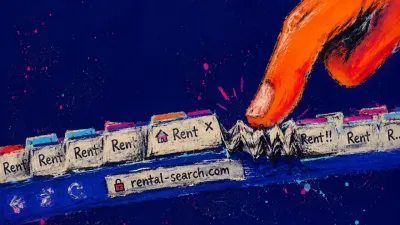
You keep a job board pinned during meetings, a budget spreadsheet open like a security blanket, and a dating app you check in tiny bursts—aka three-tab overwhelm.
Alex (name changed for privacy) said it like she was confessing something mildly illegal, then immediately tried to make it sound reasonable. “It’s not like I’m spiraling,” she added. “I’m… staying on top of things.”
On my screen, she was in bed in her Toronto apartment—10:42 p.m. on a Sunday—laptop angled on her knees. The glare from the screen turned her face a little too bright against the dark room. Somewhere off-camera, a radiator clicked like a metronome that didn’t care about her timeline. Her phone looked warm in her hand, like it had been living there all night.
She toggled—job listings → budget spreadsheet → dating app—like her thumb had learned the route faster than her nervous system could decide what it needed. And I could almost feel it through the call: a tight chest like bracing for impact, and that restless, buzzing energy in the hands that makes you want to do something, anything, as long as it looks productive.
“I just need one clean plan and then I’ll breathe,” she said. “But if I fix career and ignore money, I feel reckless. If I focus on money, I feel like I’m wasting my twenties. If I date, I’m like—shouldn’t I be getting my life together first?”
That was the engine of it: craving a clear plan for job, money, and dating versus fearing that committing to any one choice would expose her as incompetent, or—worse—behind.
“What if the problem isn’t that you’re behind,” I asked softly, “what if it’s that you’re trying to run three dashboards at once with no sleep?” I let that land for a beat. “We can use tarot like a diagnostic tool here—especially for decision fatigue and analysis paralysis. Not to hand you a destiny, but to show you the bottleneck in the system and a next step you can actually do this week. Let’s try to find clarity, not by adding more tabs… but by choosing a better rhythm.”
Before we touched a single card, I asked one grounding question—the kind that makes the room feel real again: “Which notification hits you hardest lately: a low-balance alert, a rent reminder, or seeing someone else’s engagement post?”

Choosing the Compass: Energy Diagnostic Map (7) for Three-Tab Overwhelm
I was calling from my tiny office behind the Tokyo planetarium’s dome—post-show quiet, the kind where you can still smell the warmed dust from the projectors. Star charts were stacked beside my tea like a second deck.
“Before we open the cards,” I told her, “let’s do something simple. Three minutes. No forcing calm—just giving your body a cue that we’re shifting gears.”
We did my Pre-meeting 3-minute cosmic breathing: inhale as if you’re pulling air down from the night sky; exhale as if you’re letting gravity take what you don’t need. By the second minute, her shoulders lowered a fraction. By the third, her hands stopped fluttering around the trackpad.
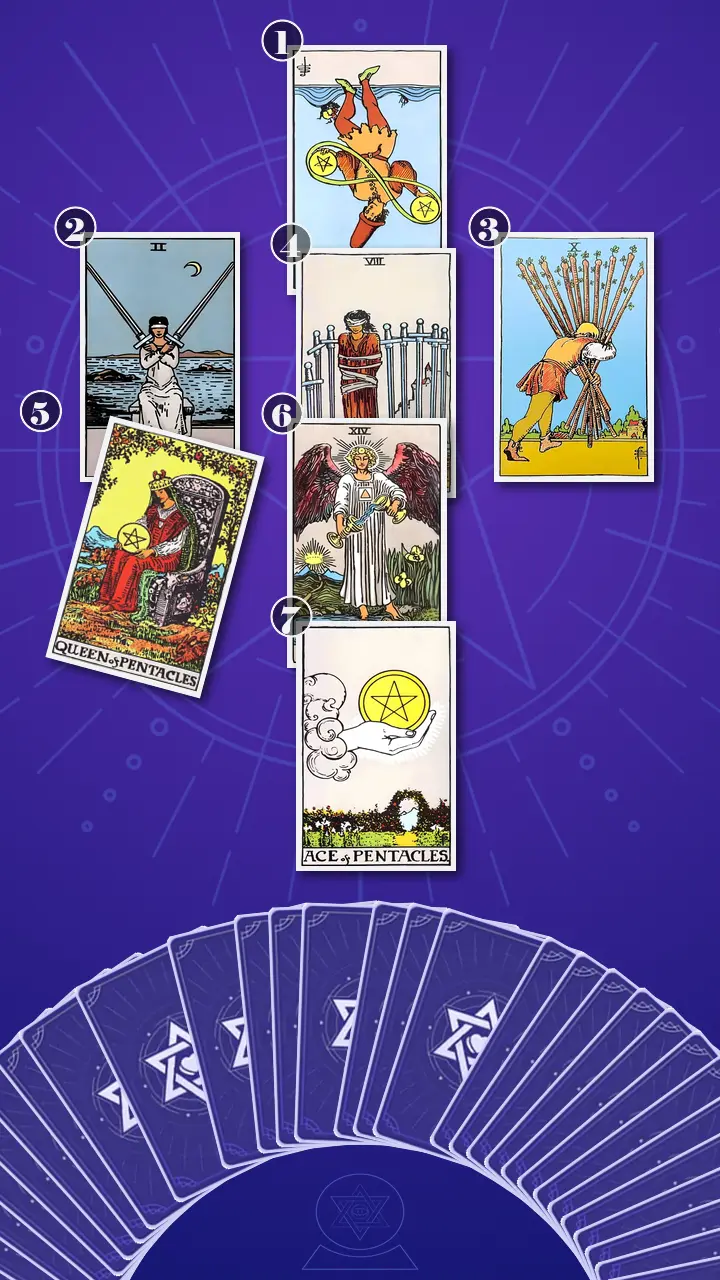
“Today,” I said, “we’ll use a spread I designed for exactly this kind of multi-domain overwhelm: the Energy Diagnostic Map (7) · Context Edition. It’s built for those moments when career, money, and dating aren’t separate problems—they’re one system that’s stuck.”
For you reading this: the rationale is practical. When your stress spans multiple life areas, a single ‘yes/no’ card pull can feel vague. A 7-position diagnostic spread separates surface noise from the actual bottleneck, then points to one integration lever and one grounded next step. It’s a way of asking: What’s loud? What’s split inside? What’s pressuring you from the outside? And what would restore flow?
I previewed the map so Alex could relax into the structure. “The first card shows the observable three-tabs behavior. The center card shows the core self-reinforcing trap. And near the bottom, we’ll look for the turning point—what integrating mindset changes everything—and then a single practical action you can complete within a week.”
Reading the Map: The Double-Two Trap and the Bottleneck
Position 1: The Presenting Overload Pattern
“Now flipped over,” I said, “is the card representing your presenting overload pattern across job, budget, and dating—the observable ‘three tabs’ behavior.”
Two of Pentacles, reversed.
I described the scene the card was already acting out in her life: “It’s 2:11 PM in a Zoom meeting, camera on. In one tab you refresh a job board ‘just to see what’s out there.’ In another, you nudge numbers in your budget spreadsheet because that coffee tap felt a little too casual. And in a third, you open the dating app because the quiet later feels loud. Switching gives you a hit of control—but nothing gets completed.”
Reversed, the Two of Pentacles isn’t ‘balance.’ It’s scattered Earth energy: too many practical priorities without a stable rhythm. Not a character flaw—an overloaded system. “You’re not lazy—you’re in draft mode across three different lives,” I said, using the exact phrase I’ve learned lands like a hand on the shoulder rather than a lecture.
Alex let out a half-laugh that cracked into something bitter. “This is literally my day,” she said, then immediately looked away from the camera, like she didn’t want to be seen recognizing herself. That was the first “unexpected reaction” I look for in a reading—not denial, but the kind of laugh that says, okay, fine, you got me.
“And notice the infinity loop in the card,” I added. “It reads like a refresh cycle. ‘Busy’ keeps looping. ‘Done’ never arrives.”
Position 2: The Inner Tug-of-War That Suspends Choices
“Now flipped over is the card representing the inner tug-of-war that keeps choices suspended and creates that stuck-in-comparison thinking.”
Two of Swords, upright.
“You tell yourself you’re being smart by keeping options open,” I said, “but it looks like holding your breath.” I kept it concrete: “You won’t commit to a job move because what if it’s the wrong company. You won’t commit to a budget system because what if it’s too strict. You won’t commit to dating because what if you pick someone and realize you should’ve been focusing on yourself.”
In the Two of Swords, Air energy is blocked—not a lack of intelligence, but a protective freeze. The blindfold isn’t ignorance; it’s avoidance of feeling. “Sometimes ‘keeping options open’ is just anxiety in a nicer outfit,” I said. “If it was truly keeping you safe, wouldn’t you feel safer by now?”
Her jaw tightened, then loosened. A small swallow. Her eyes went shiny for a second, like she was annoyed at the accuracy more than sad. “It doesn’t feel safer,” she admitted. “It feels… like I’m bracing.”
Position 3: The External Pressure That Amplifies Urgency
“Now flipped over is the card representing external pressure sources—work expectations, financial realities, social comparison cues.”
Ten of Wands, upright.
I pictured it with her, because she’d basically already described it: “You’re walking from Queen Street to the streetcar with your tote digging into your shoulder. Slack pings, a rent reminder, and a friend’s ‘we’re engaged!’ story all land in the same hour. You’re carrying five roles at once: employee, career strategist, accountant, future-partner-finder, and person who’s supposed to still have hobbies.”
This is Fire energy in excess: urgency and responsibility stacked until they block your view. “You’re not imagining the pressure,” I said. “But your nervous system is treating every pressure as equally immediate. And when everything is urgent, nothing is navigable.”
Alex nodded, once, hard. Like it hurt her neck to agree.
Position 4: The Core Blockage (The Self-Reinforcing Trap)
“Now flipped over,” I said, slowing down, “is the card representing the core mental-emotional blockage that maintains the cycle.”
Eight of Swords, upright.
The Eight of Swords always looks like a prison—and the cruel part is that the door is visible. “Late at night,” I said, “you make a private rule list that sounds responsible but acts like a cage: ‘I can’t date until I’m financially stable.’ ‘I can’t job hunt until my resume is perfect.’ ‘I can’t relax until I’ve planned next week.’”
Air energy here is blocked into prerequisites. Uncertainty feels like danger, so you tighten the rules. “One more spreadsheet tweak, then I’ll be ready,” I said, naming the loop precisely. “But the bind isn’t actually keeping you safe. It’s keeping you still.”
Alex’s reaction came in a three-step chain—the kind I trust because it’s body-first, not performative:
First, she froze: breath held, fingers hovering above the trackpad like she’d been caught mid-refresh.
Second, her gaze unfocused—like she was replaying the last ten nights in fast-forward: the laptop glow, the half-written messages, the ‘I’ll feel better if I just fix this.’
Third, she released it in a low, irritated exhale. “Yeah,” she said, almost annoyed. “That’s exactly the rule I live by.”
I leaned in, gentle but direct. “This is where I use one of my astronomy tools,” I told her. “I call it Dark Matter Detection. In space, dark matter is the unseen mass shaping everything’s orbit. In your life, the ‘dark matter’ is the overlooked factor shaping all three tabs: the belief that you must earn permission to act by achieving certainty first.”
“And the Eight of Swords shows loose bindings,” I added. “Not imaginary—real-feeling. But not absolute. There’s an opening between the swords. You’re allowed to rewrite the rule.”
Position 5: The Available Resource (Support Without Fixing Everything)
“Now flipped over is the card representing your available resource—a strength you can access without fixing everything first.”
Queen of Pentacles, upright.
I felt the whole reading soften here, like the room’s lighting changed. “This card is care-as-infrastructure,” I said. “A realistic Sunday grocery run. A weekly spending cap that includes one small joy. A 15-minute money check-in that ends with you closing the spreadsheet—on purpose. Phone on Do Not Disturb for 20 minutes. A warm drink. One low-key walk with a friend instead of doom-scrolling.”
Earth energy here is balanced: nourishment instead of punishment. “It’s not ‘optimize harder,’” I said. “It’s ‘support your system.’”
Alex’s face did something small but important—her eyebrows lifted, like she’d just been offered a kinder option she didn’t know she was allowed to want. “I could make this supportive instead of punishing,” she said quietly, almost surprised.
When Temperance Poured Between Two Cups: The Weekly Mix That Changes Everything
Position 6: The Key Transformation (Integration Rule, Not a Grand Plan)
“We’re flipping the turning-point card now,” I said, and the air between us felt suddenly still—the way it does in the planetarium right before the first stars appear on the dome.
“This is the card representing the key transformation: the integrating mindset that turns scattered effort into steady progress.”
Temperance, upright.
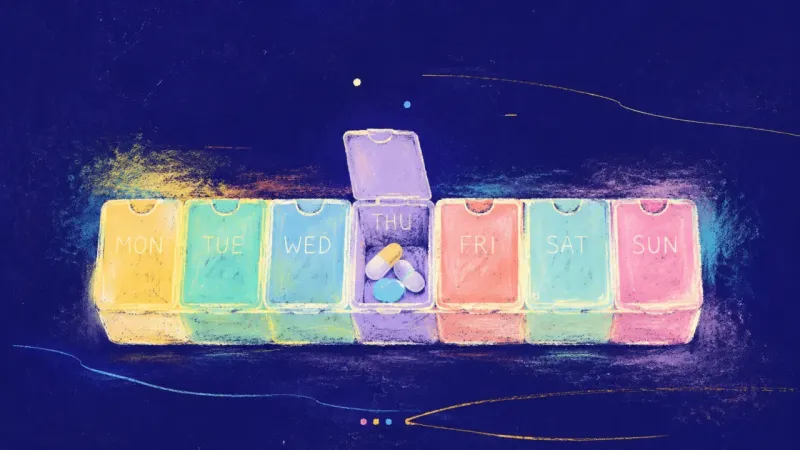
“Instead of three emergency lanes,” I began, “Temperance is a weekly cadence. One job-search container—Tuesday 7:30 to 7:55. One budget container—Thursday 6:15 to 6:30. One dating container—Saturday afternoon for 20 minutes. You’re not ignoring anything. You’re blending priorities into a system that doesn’t require constant checking.”
Temperance is Water and Fire learning to share a kitchen. It’s moderation as a skill, not a personality trait. “You don’t need a grand plan,” I told her, “You need an integration rule.”
Setup: I could see exactly where her mind wanted to go next—into the same high-stakes tunnel. She was caught in that familiar 10:38 p.m. laptop glow, bouncing between LinkedIn, her budget, and a half-written dating reply, trying to make a plan that would finally let her exhale. Choosing one thing felt like betraying the other two.
Delivery:
Stop trying to perfectly solve three lives at once, and start mixing your priorities on purpose, like Temperance blending two cups into one workable rhythm.
I let the silence sit there, clean and un-rushed.
Reinforcement: Her face went still first—eyes slightly wider, like her brain had to stop spinning to process the sentence. Then her shoulders dropped, not dramatically, but in that unmistakable way that says my body has been holding this up for me. Her hands, which had been buzzing all session, unclenched around the phone until it rested on the blanket instead of being gripped like a lifeline.
And then—another layer—her mouth tightened. A brief flash of anger, almost protective. “But… if I do that,” she said, voice sharper, “doesn’t it mean I’ve been doing it wrong? Like I wasted time?”
“No,” I said, firm and warm. “It means you built a nervous-system strategy that made sense at the time. Three tabs wasn’t a personality—it was a coping method. Temperance isn’t calling you out. It’s giving you a way to steer.”
This is where I folded in my other tool: “In orbital mechanics, we use something called a gravity assist. A spacecraft doesn’t brute-force its way with endless fuel. It borrows momentum—small, precise redirections that change the long-term trajectory. I call this the Gravity Assist Simulation: we don’t need you to overhaul your whole life. We need one small integration rule that, repeated, bends the path.”
“Now,” I asked her, “using this new perspective—think back to last week. Was there a moment when this could’ve helped you feel different? A moment where you were about to reopen the third tab?”
Alex blinked fast, then looked off to the side as if the memory was playing on the wall. “Wednesday night,” she said. “I opened Hinge because I felt lonely. Then I thought, ‘No, I should apply to jobs.’ Then I opened my spreadsheet because I felt guilty about ordering takeout.” Her voice softened into something almost relieved. “If I’d had a container—like… twenty minutes, on purpose—I wouldn’t have turned it into a verdict.”
That was the pivot: from anxiety-driven tab-switching and draft-mode paralysis to the first glimpse of a calmer, values-aligned rhythm built on completion and self-trust. Not perfect certainty—just steerable motion.
Position 7: The Next Grounded Step (One Seed Task You Can Hold)
“Now flipped over,” I said, “is the card representing your next grounded step—one concrete action that can make life feel manageable again within a week.”
Ace of Pentacles, upright.
“This is the hand offering one coin,” I said. “Not ten strategies. Not a life reset. One measurable action—done in one sitting.”
I watched her nod before I finished, like her body liked the simplicity even if her mind wanted to argue. “One seed task. One sitting. Completion over optimization,” I said, and this time she smiled—small, but real.
“And because your system gets spooked by sudden change,” I added, “we’ll do a little Spacecraft Attitude Adjustment. That’s just mental prep: you’re allowed to feel discomfort when you close two tabs. Discomfort isn’t proof you’re doing it wrong. It’s proof you’re steering.”
From Insight to Actionable Advice: The Weekly Mix and the One-Seed Momentum Method
Here’s the story the whole spread told when I stitched it together: On the surface (Two of Pentacles reversed), Alex is juggling three life domains in constant motion—busy, but not landing. Inside (Two of Swords), she’s protecting herself from the emotional weight of choosing, so “keeping options open” becomes the default. Outside (Ten of Wands), Toronto cost-of-living pressure, workplace expectations, and Instagram/LinkedIn comparison stack into a heavy, urgent bundle that blocks her view. At the core (Eight of Swords), she’s stuck in a prerequisite prison: “I can’t ___ until ___,” which keeps her safe from uncertainty but also keeps her stuck. Her resource (Queen of Pentacles) is care-as-structure—rhythm, routines, support. And the turning point (Temperance) is the integration rule: a weekly mix that prevents anxiety from scheduling her day. The Ace of Pentacles then lands it in reality: one seed task, completed, to rebuild self-trust.
The cognitive blind spot was subtle but powerful: she kept treating clarity like something you earn by optimizing every option. But the cards showed clarity comes from containment—choosing one container, finishing it, and letting completion create evidence that you can trust yourself.
“Closing a tab isn’t giving up—it’s choosing a container,” I reminded her. “You’re not picking a forever. You’re picking a week.”
Then I gave her next steps that were intentionally small—because small is what the nervous system can actually repeat.
- Close-Two-Tabs Timer (Within 48 Hours)Pick ONE domain (job or budget or dating). Set a 25-minute timer. Close the other two tabs/apps completely. Work only inside the chosen tab until the timer ends.If 25 minutes spikes anxiety, do the 10-minute version. When the timer ends, do a hard stop: close the laptop/app even if it’s unfinished. That boundary is the medicine.
- Draft Your “Weekly Mix” (Temperance Rule)Open your calendar (or Notion, if that’s your love language). Schedule three micro-containers on different days: 25 minutes job, 15 minutes budget, 20 minutes dating. Treat them like meetings with a start and end.This is an experiment, not a contract. If planning all three feels like too much, schedule just one container and call that a win.
- One Ace-of-Pentacles Seed Task (One Sitting)Choose one measurable action you can finish in one sitting: submit one job application, set one weekly spending cap category, or schedule one low-stakes date (coffee/walk) without turning it into a referendum on your future.Expect the thought “this is too small to matter.” That’s the Eight of Swords. Make the task smaller, not bigger, and let completion be the proof.
A Week Later: The Quiet Proof of a New Orbit
Six days later, I got a message from Alex: “I did the 25-minute job container. Closed everything else. Hit submit on one application. It wasn’t my dream role. I still felt weird after—but I slept.”
That last part mattered. Not because her life was solved, but because her body got a new data point: movement is possible without perfect certainty.
In a follow-up note, she told me her week wasn’t magically calm—she still woke up one morning with the first thought, what if I’m choosing wrong? But this time, she added, “I looked at my calendar block and went, ‘Nope. Saturday is dating container. Not right now.’ And I laughed a little.” Clear, but still tender.
For me, that’s the real Journey to Clarity: not a grand plan that eliminates uncertainty, but a steady rhythm that lets you hold uncertainty without panicking—then take one practical step at a time until self-trust starts to feel like gravity again.
When your chest is tight and your hands are buzzing, it can feel like choosing one next step means admitting you’re failing the other two—and that fear makes three tabs feel safer than one finished action.
If you let yourself build one gentle “weekly mix” instead of a perfect life plan, what’s the smallest container you’d want to complete first—just to prove to yourself that momentum is possible?
Author Profile