The Couch-to-Cleaning Sprint—And the Text I Stopped Explaining

The 8:17 p.m. “Don’t Be Selfish” Text
If you’re an early-career office person in a city like Toronto and you feel your jaw clench the second you sit down—because you can already hear a parent calling you “selfish” for resting—this is for you.
Jordan (name changed for privacy) showed up on my screen with that exact tension already living in her face. Not “stress” in the abstract—something more physical, like her body had memorized a threat. She kept swallowing as if she was trying to clear a knot from her throat.
She described a scene so specific I could practically smell it: 8:17 PM on a Tuesday in her condo living room. Tote bag dropped by the door. The microwave humming in the background. She sits down for “just 20 minutes,” and the couch fabric scratches her forearm as her phone lights up with her mom’s name. The screen glow hits her face, and her chest tightens like a seatbelt locking.
“It’s one text,” she said, almost laughing at herself. “Just, ‘Don’t be selfish.’ And I’m on my feet—scrubbing the sink, wiping counters that aren’t even dirty. I start building this… explanation. Like I’m presenting evidence.”
Her mouth tightened on the last word. I watched her jaw do that tiny clench people don’t notice until it’s been happening for years.
Her question was simple, but it carried a whole history inside it: “What belief fuels my guilt? Like—why does resting feel like a moral crime?”
Guilt sat in her body the way cold sits in your bones: not dramatic, just constant. It was as if the moment her body asked for a pause, an invisible judge banged a gavel.
“We’re not here to prove you’re a good person,” I told her gently. “We’re here to find clarity—where that guilt comes from, what it’s protecting, and what you can do next without turning rest into another job.”

Choosing the Compass: The Four-Layer Insight Ladder Tarot Spread
I asked Jordan to take one slow breath—not as a ritual for the universe, but as a handoff from the day’s noise into her own attention. While she breathed, I shuffled. The sound was steady, like rain on a window: repetitive enough to let the nervous system stop scanning for the next ping.
“Today I’m using a spread I call the Four-Layer Insight Ladder · Context Edition,” I said. “It’s built for moments like this—when the question isn’t ‘What will happen?’ but ‘Why does this keep happening, and how do I change it in real life?’”
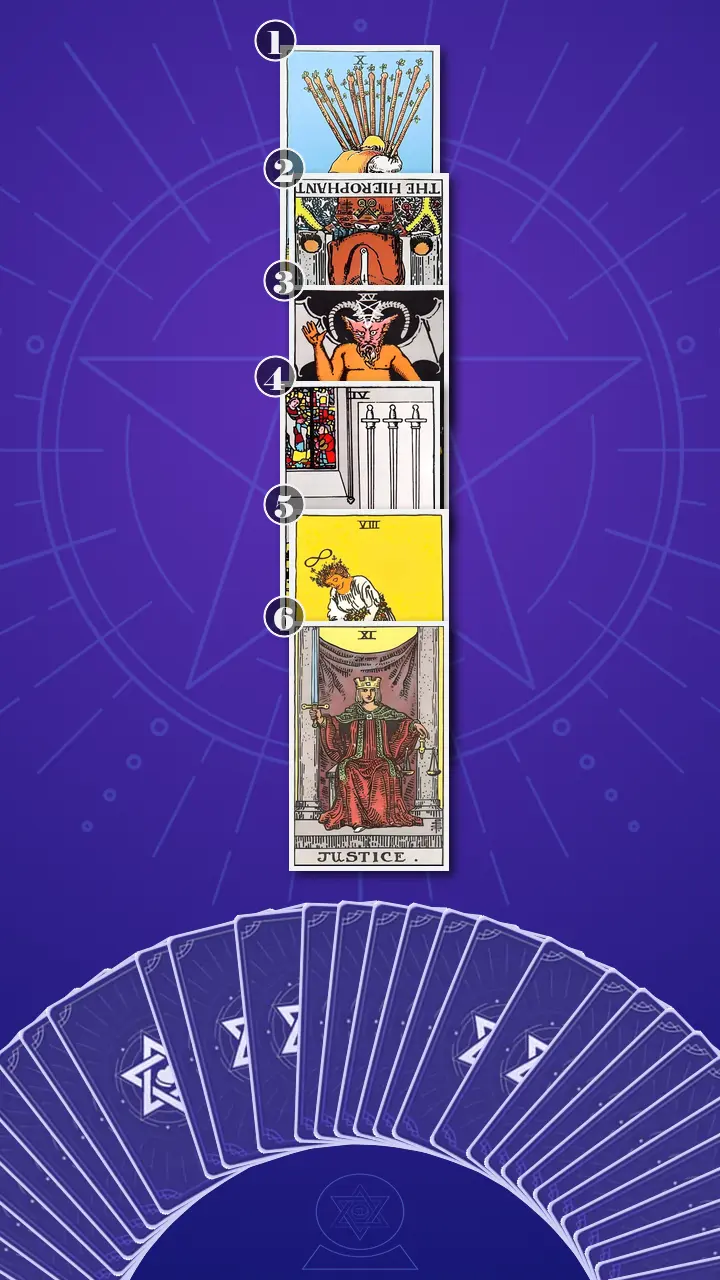
For you reading along: the Ladder works because guilt usually hits like a flash—immediate, bodily—but it’s learned. So we descend on purpose. Card 1 is the visible pattern. Card 2 is the outside message that trained the pattern. Card 3 is the belief underneath it—the hidden rule. Card 4 is the body’s truth, the neglected need. Then we climb back up with Card 5 (the inner antidote) and Card 6 (a grounded boundary you can actually use).
“Think of it like an elevator ride down to the basement,” I told Jordan, “then a staircase back into daylight. No pep talks. Just naming what’s true, layer by layer.”
When Strength Tamed the Inner Courtroom
I laid the six cards in a vertical line, like rungs. Jordan leaned closer, as if proximity could turn the verdict into mercy.
Position 1: The observable pattern — Ten of Wands (upright)
“Now we’re looking at the card that represents the observable pattern: what you do right when you try to rest and guilt spikes,” I said, turning it over. “Ten of Wands, upright.”
In modern life, this is painfully familiar: it’s 8:20 PM after a full day as a marketing coordinator. You sit down for the first time, then immediately pop back up to “just” unload the dishwasher, wipe the counters, and send one more email—because being seen resting (even by yourself) feels like failing a character test.
Energetically, Ten of Wands is excess—too much responsibility, too much carrying, too much “I’ll handle it.” And the detail I can’t ignore is that the wands block the figure’s view. Constant doing doesn’t just tire you out; it blocks your line of sight to what you actually need—food, sleep, quiet—until you’re already depleted.
Jordan gave a short, bitter little laugh. “That’s… rude,” she said. Then softer: “Yeah. That’s exactly what I do.” Her fingers pinched the edge of her sleeve, like she was trying to hold herself in place.
Position 2: The external message being absorbed — The Hierophant (reversed)
“Now we’re looking at the external message being absorbed—the authority or relationship language that frames rest as wrong,” I said. “The Hierophant, reversed.”
This card, in real life, is that quick call with Mom that turns into a moral lecture. Rest gets framed as laziness or selfishness. Even after you hang up, you can hear her voice in your head like it’s the official rulebook for what ‘good’ looks like.
Reversed, Hierophant isn’t “bad tradition.” It’s tradition that no longer fits. The energy here is blockage—your adult life is asking for one standard, and an inherited rulebook keeps grading you by another. The keys in that image are permission: who gets to decide whether you’re allowed to meet a basic need?
Jordan’s eyes flicked away from the cards. “I’m 27,” she said. “I pay my rent. And still… one comment and I’m auditioning to be ‘responsible.’”
“Stop auditioning for approval in your own living room,” I said quietly—not as scolding, but as a mirror held steady. “That’s the Hierophant reversed asking you to graduate into your own authority.”
Position 3: The belief fueling guilt — The Devil (upright)
“Now we’re looking at the belief fueling guilt,” I said. “The inner rule that turns rest into a moral problem. This is the root.” I turned the card. “The Devil, upright.”
Jordan didn’t flinch—she froze.
The modern-life translation is blunt: rest feels like something you have to pay for. If you didn’t hit an invisible quota—enough chores, enough overtime, enough emotional caretaking—then sitting down triggers shame. You over-explain your downtime, take on extra tasks, or keep working late to avoid the “selfish” label, even when no one is actively watching.
This is the energy of bondage. Not because you’re weak—because the belief is sticky. The chains look heavy, but they’re loose enough to slip off. And that’s the part most people miss when they’re in the loop.
I pictured what Jordan had described: the long text drafted like a legal brief, bullet-pointing meetings, commute time, errands. The “case” for her own exhaustion. Then the clause in the contract, hidden in plain sight: Rest is selfish unless earned.
“Guilt isn’t proof you’re wrong—it’s proof you learned a rule,” I said. “And the Devil is the learned rule made into a contract.”
Jordan swallowed hard, eyes glossy but angry. “So what—my guilt is fake?”
“Not fake,” I said, keeping my voice steady. “It’s real data. But it’s not a moral compass. It’s an alarm that goes off because the old contract auto-renews. Like a subscription you never meant to keep paying for—every time someone criticizes you, it auto-charges your nervous system.”
Then I asked the question that makes this card useful instead of scary: “Who benefits when you believe you must earn basic care?”
Jordan’s shoulders rose toward her ears, then dropped an inch, as if the question loosened something. “My mom benefits,” she said carefully. “Not in an evil way. But… it keeps me compliant. It keeps me ‘good.’”
Position 4: The body’s truth — Four of Swords (upright)
“Now we’re looking at the body’s truth,” I said. “What rest is actually for.” I turned the next card. “Four of Swords, upright.”
In modern terms: you put your phone on Do Not Disturb and take a protected 10–20 minute pause—no optimizing, no multitasking. Your mind keeps generating objections (“You should be productive”), but your body finally gets to downshift. The pause isn’t indulgence; it’s nervous-system maintenance that makes your next choices clearer.
The energy here is balance—not “collapse,” not “avoidance.” A deliberate pause. Thoughts can hover above you like those swords, but your body can still be supported beneath them.
Outside Jordan’s window, the light had gone thin and grey, Toronto winter doing its early-evening thing. I thought of the Highlands—how in winter the land doesn’t apologize for being quiet. It doesn’t earn its stillness. It simply turns toward recovery. That’s my Nature Empathy Technique in one sentence: seasons don’t negotiate their needs.
“The inner courtroom is loud,” I told her, “but it’s not the boss of your body.”
Jordan exhaled—small, like someone testing if it’s safe. “I don’t even know how to rest without optimizing it,” she admitted. “I’m like, ‘What’s the best rest protocol?’”
“That’s productivity cosplay,” I said, and she let out a surprised snort. “Four of Swords is the opposite. Rest isn’t a reward. It’s maintenance.”
Position 5 (Key Card): The antidote mindset — Strength (upright)
I paused before turning the next card. The air in the room felt quieter—not mystical, just focused, like both of us had finally stopped trying to win an argument and started listening for truth.
“This next one is the pivot,” I said. “The antidote mindset: the inner stance that helps you hold discomfort and stop outsourcing your worth.”
I turned it over. “Strength, upright.”
Jordan stared at it, and something in her face changed—like she’d been bracing for punishment and instead saw a hand held out.
In modern life, Strength is this: guilt spikes the second you rest—but instead of sprinting into chores, you stay with the sensation. You soften your jaw, breathe, and let the discomfort exist without treating it as a command. You choose rest as self-respect, even if someone else would disagree, and you don’t write an essay to justify it.
Energetically, Strength is steady power. Not force. Not fighting your guilt. Not obeying it. A calm relationship with it.
And this is where I use one of my own tools—what I call Generational Pattern Reading. Because when a parent calls rest “selfish,” it rarely starts with you. It often comes from a family story about survival: a household where being useful kept you safe, where softness got mocked, where exhaustion was mistaken for virtue.
“Jordan,” I said, “this guilt has an accent. It’s not just your voice. It’s a family rule that got passed down like a handed-me-down coat—still warm, but not tailored to your life.”
Her eyes went sharp. “But if I stop following it,” she said, heat rising, “doesn’t that mean I’m saying my mom was wrong? Like… everything she taught me?”
That was the unexpected reaction I hoped for—because it meant we’d hit the real hinge: loyalty versus self-respect.
“It can mean you’re updating the rule, not erasing her,” I said. “In healthy families, rules evolve. In stuck families, rules fossilize.”
The moment the lion showed its teeth
Setup: You know that moment when you finally sit down, your phone buzzes, and your body stands back up like it’s been trained?
Delivery:
Stop trying to earn permission through overwork; practice calm, steady self-leadership and tame the inner critic like Strength taming the lion.
Jordan’s breath caught—just for a second. Her fingers went still in mid-fidget, hovering over her sleeve. That was the freeze.
Then her gaze softened and unfocused, like her mind was replaying a week of moments: the couch, the phone glow, the sink scrubbed too hard, the Slack dot anxiety, the long texts typed like closing arguments. That was the recognition seeping in.
Finally, her shoulders lowered in a way that looked almost unfamiliar on her body. Her jaw unclenched—slowly, like a fist opening. She blinked hard, once, twice. “I hate how much I need permission,” she whispered, and the whisper sounded like grief and relief braided together.
“You don’t have to make the guilt disappear to choose differently,” I said. “Strength isn’t a pep talk. It’s a posture.”
I watched her take a longer exhale than inhale, the kind your body does when it stops preparing for impact. And right behind the relief, I saw the new vulnerability: the little dizziness of realizing you can choose, which also means you’re responsible for choosing.
“Now,” I said gently, “use this new lens and look back at last week. Was there a moment—one text, one evening—where you could have practiced 60 seconds of Strength instead of sprinting into productivity?”
Jordan nodded, slow. “Tuesday,” she said. “I could’ve sat back down for… even ninety seconds. I didn’t have to prove anything.”
And I named it for her, so it could become a path: “This is you moving from guilt-driven self-surveillance to quiet confidence in self-respect. Not overnight. But the first rung is real.”
Position 6: The grounded next step — Justice (upright)
“Now we’re looking at the grounded next step,” I said. “A boundary or practical agreement that makes rest real in daily life.” I turned the last card. “Justice, upright.”
In modern life, Justice is: you decide what’s fair for your life—like “weekday evenings after 8:30 are offline unless it’s urgent”—and you communicate it plainly. When Mom comments, you don’t argue about morality; you repeat the standard once and move on. Rest stops being a guilty exception and becomes part of your baseline agreements.
The energy here is structure. The seated figure doesn’t rush to explain. The scales don’t panic. The sword is clean truth. Justice says: make your rest a policy, not a debate.
Jordan’s mouth twitched. “That sounds… terrifying,” she admitted. “Like I’m going to be judged.”
“Maybe,” I said. “But you’re already being judged in your own head. Justice just makes the terms visible.”
From Insight to Action: A Rest Boundary That Doesn’t Need a Closing Argument
When I looked at Jordan’s whole Ladder, a clear story formed.
Ten of Wands showed the symptom: the instant you sit, you carry. Hierophant reversed showed the source of the pressure: an inherited rulebook that treats rest like a character flaw. The Devil revealed the mechanism: an invisible contract where worth is conditional and rest must be paid for. Four of Swords reminded us of the body’s truth: you need sanctuary, not more convincing. Strength offered the antidote: calm self-leadership that can tolerate someone else’s disapproval. And Justice gave the application: a fair standard, stated once, without defending.
The cognitive blind spot underneath all of it is this: you’ve been treating guilt like a verdict instead of a signal. So every evening becomes a trial you think you have to win.
The transformation direction is simpler—and harder at first: shifting from “I must earn rest to deserve respect” to “Rest is a basic need I can choose, even when someone disagrees.”
Then I gave Jordan the smallest, most realistic next steps—because clarity that can’t be lived is just another form of overthinking.
- Save two one-sentence scriptsOpen a phone note and save: (1) “I’m taking a quiet night to reset—talk tomorrow.” (2) “I’m resting so I can function. I’m not debating it.” Use one line only the next time your mom texts during your downtime—no extra details, no apology.If you feel the urge to add context, set a 2-minute timer, send the shortest version, and remind yourself: you’re communicating, not auditioning.
- Mute the thread for 60 minutesAfter you send the one-sentence boundary, mute the text thread for one hour and put your phone in another room. Let the discomfort wave rise and fall without turning it into a debate.If she escalates, use a neutral exit line later: “I’m going to get back to you tomorrow,” and actually follow through.
- Do a 10-minute Sanctuary Break (with a 3-minute plant check)One evening this week: notifications off, feet on the floor or lying down. Before you rest, spend 3 minutes checking one houseplant—touch the soil, notice if it’s dry, water it if needed. Then take a 10-minute “be supported” break with no optimizing.If guilt starts drafting a speech, label it: “earned-rest rule.” Take three slow exhales. If anxiety spikes, stop—this is practice, not punishment.
That tiny houseplant check is my quiet Home Energy Diagnosis in modern form: not another chore to prove worth, but a sensory cue that reminds your body what care looks like when it isn’t performance. Plants don’t earn water. They just need it.

A Week Later: Ownership, Not Certainty
A week later, Jordan messaged me a screenshot—one clean line to her mom: “I’m taking a quiet night to reset—talk tomorrow.” No paragraph. No defense. Below it: “Muted for 60 mins. Hands shook. Didn’t die.”
She told me she put her laptop in a closet for the evening, like it was a temptation she didn’t need to negotiate with. She did the Sanctuary Break on her bed with the lights dimmed, rain ticking against the window. The guilt showed up—tight chest, jaw trying to clamp—but she softened her face and let the wave crest without obeying it.
She slept a full night. In the morning, the first thought still arrived—What if I’m being selfish?—but this time she noticed it, exhaled, and got up without turning it into a trial.
That’s what I mean when I say this is a Journey to Clarity. Not certainty. Ownership. A shift from guilt-driven self-surveillance to quiet confidence in self-respect—built through tiny, repeatable choices.
When you finally stop moving and your chest tightens anyway, it’s because part of you is still trying to prove you’re lovable by staying useful.
If you didn’t have to win the argument to deserve a break, what’s one tiny way you’d let yourself be supported tonight?
Every reading at AceTarot is a Journey to connect with inner wisdom and empower next step.
Learn more about our Journey to Clarity.