From Overwhelm to a Sustainable Pace: One Boundary, One Protected Pause

Finding Clarity in the 11:33 p.m. Calendar Spiral
“You’re a full-time student in Toronto with a color-coded Google Calendar that looks like it should make life feel controlled—except you keep reopening it at 11:30 p.m. because the week still doesn’t fit,” I said, and I watched Alex’s mouth tighten in that way that’s halfway laughter, halfway surrender. “Classic calendar anxiety.”
They were calling from a tiny bedroom off-campus—11:33 p.m. on their end, the desk lamp too bright and too close, turning the air a little bleach-white. I could hear the radiator clicking like it was impatient with them. Their phone screen looked warm from constant use, and when they shifted their laptop, I saw it: Google Calendar on one side, Quercus tabs on the other, and a group chat thread climbing like ivy.
Alex’s shoulders sat up by their ears, jaw tight enough that I could almost feel it through the screen. Overwhelm, yes—but not the vague kind. The kind that buzzes in your chest like a phone on silent that won’t stop vibrating, even when you’ve put it face-down.
“My semester calendar is packed,” they told me. “I’m busy all day and somehow still behind. If I don’t plan it perfectly, the whole week collapses. And rest… honestly, it feels like something I have to earn.”
I nodded, gentle and direct. “You want a sustainable rhythm,” I said, “but you’re planning like rest is a reward you have to unlock—and like falling behind would be a character flaw. Let’s try something different tonight: not a lecture, not a ‘new you’ plan. Just a map. A Journey to Clarity.”

Choosing the Compass: The Celtic Cross · Context Edition
I asked Alex to take one slow breath—nothing mystical, just a clean transition—then to hold the question in a single sentence: What’s my next step for study-life balance when my semester schedule is already full?
As I shuffled, I explained what I was choosing and why. “We’ll use a spread called the Celtic Cross · Context Edition. People think of the Celtic Cross as dramatic, like it’s only for huge life decisions. But I like it for modern ‘I’m maxed out’ problems because it shows the whole chain: what’s happening, what’s driving it underneath, where your mind is in it, what your environment is doing, and—most importantly—what an ethical, actionable next step looks like.”
For anyone reading along: this is how tarot works when it’s practical. It’s not about predicting a fixed future. It’s pattern recognition with images—like storyboarding your current season so you can see the plot you’re stuck inside.
“The center card will show your current overload snapshot,” I told Alex. “The crossing card shows the main mechanism that keeps the schedule from stabilizing. And the card above—your conscious aim—often tells the truth about what ‘balance’ actually means to you, beyond what you’re telling yourself you should do.”
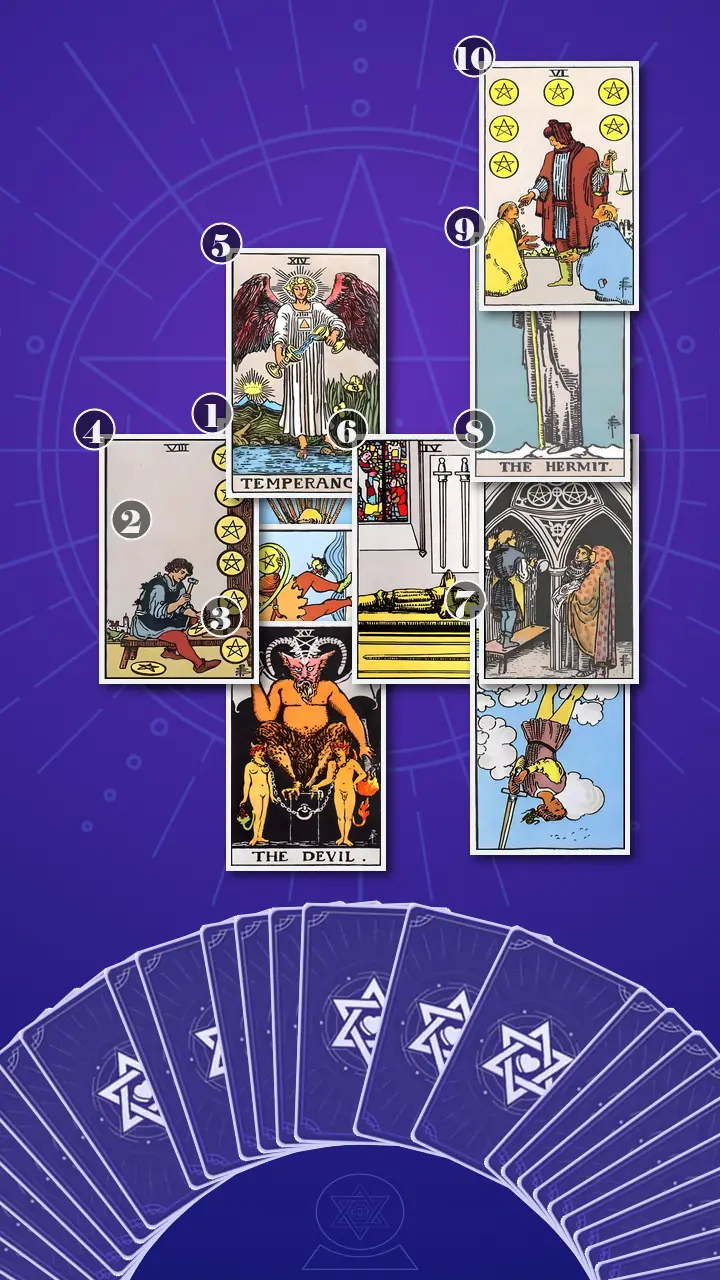
Reading the Map: Card Meanings in Context
Position 1: Current overload snapshot — Ten of Wands (upright)
“Now we flip the card that represents your current overload snapshot—the most visible study-life imbalance behavior and felt pressure right now.”
Ten of Wands, upright.
I angled the card toward the camera. “This is the classic image of carrying too much alone. The detail I always look at first is that the bundle blocks the person’s view. It’s not just heavy—it’s obstructing.”
“In modern life, this is you with a day that’s technically scheduled from morning to night… but the plan itself becomes so heavy you can’t even see the simplest next step. The wands are every ‘small’ deadline, every reading, every favor, every ‘I should probably’—all stacked until the path disappears.”
Alex let out a short breath that almost sounded like a laugh. “Okay,” they said, voice dry. “That’s… a little too accurate. Like, rude.” Their fingers pinched the bridge of their nose, then dropped. Bitter humor first, then relief—the body recognizing itself.
“It’s not a moral judgment,” I said. “It’s a snapshot. And it’s asking a very specific question: which two commitments are you holding out of guilt rather than genuine priority?”
Position 2: Primary imbalance mechanism — Two of Pentacles (reversed)
“Now we flip the card that represents the primary imbalance mechanism—what makes the calendar feel unworkable and keeps stability from forming.”
Two of Pentacles, reversed.
I didn’t even need to translate it slowly; the image did the work. “This is the juggle—except reversed, it’s the moment the rhythm breaks.”
“I want you to picture it as a fast-cut montage,” I told Alex, and I heard their chair creak as they leaned in. “Calendar drag-and-drop → Quercus refresh → group chat pings → Notion checklist edits → back to calendar. And the inner monologue is: ‘If I just rearrange it one more time, it’ll finally work.’”
The energy here is blockage. Not a lack of intelligence. Not laziness. A blockage of stability—because the more you juggle, the less stable you feel, and the less stable you feel, the more you juggle.
Alex winced like they’d touched a bruise, then exhaled—long, relieved, almost grateful. “That’s literally my night,” they said. “And it feels productive. Until it’s 12:20 and I haven’t started.”
I nodded. “A perfect schedule can still be an impossible schedule.”
“And this card warns about an overcorrection,” I added. “When you see the wobble, you might clamp down with an unrealistically strict routine and punish yourself for any deviation. That usually leads to a crash. The healthier fix is an anchor: one block you do not reschedule this week.”
Position 3: Deep driver — The Devil (upright)
“Now we flip the card that represents the deep driver—the belief or attachment fueling overcommitment and guilt around rest.”
The Devil, upright.
The room on my side felt quieter for a moment, like my studio in New York when the subway finally passes and the air settles. “This card gets dramatized,” I said, “but the real story is in the details. Look at the chains: they’re loose.”
“In your week, this is the ‘worth-output chain.’ The rule that says: if I rest, I’m irresponsible; if I say no, I’m disappointing; if I do ‘good enough,’ I’m risking being exposed as not competent. And because you’ve practiced that rule for years, it feels like reality.”
I softened my voice, not to coddle, but to be accurate. “If rest has to be earned, it will always feel unsafe.”
Alex went still—breath held for a second, eyes focused but far away, like they were watching a memory play behind my shoulder. Then their shoulders dropped a fraction. Not peace. Just truth landing.
“So,” I asked, “if you protected your sleep once this week, what story would your brain tell you about what that means about you?”
“That I’m… not serious,” they admitted. “That people will pass me.”
“That’s the chain,” I said. “Loose. But familiar.”
Position 4: What’s been shaping your pace — Eight of Pentacles (upright)
“Now we flip the card that represents what has been shaping your current pace—the recent pattern that built up the load.”
Eight of Pentacles, upright.
“This is the apprentice,” I said, “the person who gets good by doing the work again and again.”
Here the energy is balance—but with a shadow. “It tells me you’re not faking it. You really can focus. You really can build skill. You’ve probably had semesters where the steady grind worked because the workload still fit inside a human body.”
“But the downside is when a ‘grind identity’ becomes your only lever. Stress happens, and the only move you trust is: do more, polish more, stay up later.”
Alex nodded once, slow. “I used to do library sessions that worked,” they said. “Now it’s like I’m always studying, but never… done.”
Position 5 (Key Card): What balance means to you — Temperance (upright)
“We’re turning over the card that represents what balance means to you—your conscious aim, what you’re trying to embody this semester.”
For a beat, the radiator on Alex’s side stopped clicking. The absence of noise felt like the room was listening with us.
Temperance, upright.
I exhaled softly. “This is the bridge card in your spread. It’s the antidote to ‘juggle harder.’”
Setup: It’s 11:30 p.m. and you’re dragging blocks around Google Calendar again—trying to make tomorrow fit—while your shoulders are up by your ears and your brain is doing math it can’t finish. You’re stuck in the thought that discipline means squeezing harder, not designing better.
Not ‘juggle harder’—practice Temperance: pour your time in measured amounts, and let moderation be the method that breaks the overload.
Reinforcement: Alex’s first reaction surprised me. Their eyebrows pulled together and their voice sharpened. “But if I’m not juggling, I’m… failing,” they said. “Like, isn’t moderation just another word for ‘not doing enough’?”
I let the question sit. I’ve watched enough classic films to know you don’t cut away from the turning point. “No,” I said quietly. “Moderation is not a personality trait. It’s a method. And you’ve been using an all-or-nothing method on a semester that requires measured pours and buffers.”
I brought in my favorite diagnostic lens—one of my Master Study Techniques, borrowed from Einstein’s thought experiments. “Let’s do a quick thought experiment,” I said. “Assume the week’s hours are fixed. If we remove one hour of late-night re-planning and convert it into one protected recovery block, does your output go down… or does it become more efficient because your focus stops glitching?”
Alex froze in a three-step chain: their breath paused (like their nervous system was bracing), their gaze unfocused (like the last week replayed), and then their shoulders slid down with a shaky exhale. Not fully calm—more like the first time a tight knot loosens and you realize how hard you’ve been pulling.
“Okay,” they whispered. “I… I get it. I’m treating balance like it’s an aesthetic. Like the calendar has to look perfect.”
“Exactly,” I said. “Balance isn’t a calendar that looks perfect—it’s a week that includes recovery on purpose, so your effort stays effective.”
I guided them through a 10-minute Temperance check—concrete, not aspirational. “Open your calendar,” I said. “Pick one 60–90 minute study block you’ll protect this week, plus one recovery block—even 20 minutes. Label them literally: DO NOT MOVE. Then choose one task you’ll do at ‘good enough’ level, not your highest-polish version.”
Alex swallowed. Their eyes got a little red—not crying, just the body reacting to permission it doesn’t fully trust yet. “That makes me feel guilty,” they said, honest and almost annoyed at themselves.
“Good,” I replied, gentle but firm. “Not because guilt is good—because it’s a signal that we touched the chain. Take three slow breaths. You’re not forcing yourself to feel okay. You’re noticing the reflex.”
Then I asked the question that anchors the shift from your starting state to your desired state: “Now—with this new lens—think back to last week. Was there a moment when one protected pause would’ve changed your whole night?”
Alex nodded once. “Tuesday,” they said. “I could’ve stopped… and I didn’t.”
“This,” I told them, “is the first step from wired-tired control toward grounded confidence: choosing fewer essentials, setting one boundary, and protecting one recovery block as non-negotiable.”
Position 6: Next-step energy — Four of Swords (upright)
“Now we flip the card that represents next-step energy for the coming week—the most supportive immediate adjustment to restore bandwidth.”
Four of Swords, upright.
I deliberately changed the pace of my voice. “This card is a container,” I said. “A protected pause.”
I painted it in a modern scene, exactly as the card wants: “Library quiet floor. Headphones off. Phone face-down. One contained space where nothing new enters.”
Here the energy is medicine. A strategic withdrawal so your mind can reboot. “Protected stillness is a study strategy,” I said, and I watched Alex’s jaw unclench like it had been holding a secret.
“And if you want to make that block feel like a switch flips,” I added, offering a tool without making it a requirement, “try something consistent—same seat, same playlist. I sometimes use Mozart K.448 in my studio not as magic, just as a cue: this is the room where I focus.”
Alex’s shoulders lowered further. “This isn’t quitting,” they murmured, like they were practicing the sentence. “This is me making focus possible again.”
Position 7: Your role in the pattern — Page of Swords (reversed)
“Now we flip the card that represents your role in the pattern—how your attention and mindset are shaping the imbalance.”
Page of Swords, reversed.
“This is the Scout mind,” I said, “always scanning. But reversed, it’s scanning so hard it turns every notification into a tiny emergency.”
The energy here is excess—too much input, too much readiness, not enough conversion into finished work. “This is you checking the portal ‘just for a second,’ replying to the group chat, watching a productivity video, and suddenly 45 minutes are gone.”
I kept it simple. “Busy isn’t the same as finished.”
Alex made a face—half embarrassed, half relieved. “I hate how true that is,” they said.
“So today,” I replied, “we define what ‘complete’ means before you start. Not ‘study.’ A unit. A finish line.”
Position 8: External supports and pressures — Three of Pentacles (upright)
“Now we flip the card that represents external supports and pressures—what your semester environment is offering or demanding.”
Three of Pentacles, upright.
“This is the card that says: stop architecting balance alone,” I said. “Real support systems exist. Office hours. TAs. A group project with actual roles instead of vibes and panic.”
In modern terms: “Office hours are basically customer support for your course,” I told them. “Using them isn’t weakness. It’s efficiency.”
Alex let out a breathy laugh. “I’ve literally never thought of it like that.”
Position 9: The hope/fear tangle — The Hermit (upright)
“Now we flip the card that represents your hopes and fears—what you want from balance and what you worry will happen if you slow down.”
The Hermit, upright.
“This is such a student card,” I said. “The hope is quiet focus. The fear is that quiet equals missing out.”
I pointed at the lantern. “The Hermit isn’t carrying a floodlight. It’s one lantern: one clear priority that guides the next step, not every step. The hope is: please let me have one evening where my brain isn’t tracking everyone else’s pace on Instagram. The fear is: if I step back, I’ll fall behind.”
Alex stared at the card for a long moment. “I miss… doing one thing,” they said softly.
Position 10: Integration direction — Six of Pentacles (upright)
“Last card,” I said. “This is the integration direction—what study-life balance looks like when you commit to one boundary and one support request.”
Six of Pentacles, upright.
“This is fair distribution,” I told them. “The scales. In real life, it’s the moment you stop spending 100% of your energy in every category every day. It’s asking: where can you receive support, and where can you reduce output—without reducing your worth?”
And because this spread is practical, I gave them a scene: “One email to a TA. One role split in the group project. One plan that turns constant pings into one check-in time. Not because you’re failing—because you’re coordinating reality.”
The Temperance Buffer Plan: Actionable Advice for Your Next 48 Hours
I leaned back in my chair and let the whole spread become one coherent story—because that’s where the clarity lives.
“Here’s the plot,” I said. “The Ten of Wands is your present: overload so dense you can’t see the path. The Two of Pentacles reversed is the mechanism: the rescheduling treadmill, constant switching, the week changing faster than you can stabilize it. The Devil underneath explains why you can’t just ‘be reasonable’: your self-worth got chained to output. The Eight of Pentacles shows you earned your competence through real work—so of course you trust grinding. Temperance is the pivot: measured pours, buffers, ‘enough for this week.’ The Four of Swords operationalizes it: protected stillness to restore bandwidth. And the Three plus Six of Pentacles say the outcome isn’t superhuman solo effort—it’s collaboration and fair exchange.”
“Your cognitive blind spot,” I told Alex, “is thinking the failure is you, when the failure is the design: a plan with no recovery and no margin. And the transformation direction is clear: shift from ‘make everything fit’ to ‘choose the few essentials, set one boundary, and protect one recovery block as non-negotiable.’”
Then I gave them next steps that were small enough to start, but real enough to matter.
- The Shutdown Alarm (Tonight)Pick a fixed shutdown time you can actually keep (even if it’s later than ideal). Set a bedtime alarm on your phone—your stop-work alarm. When it goes off, you close Quercus, silence the group chat, and end the planning loop.Expect resistance (“This is irresponsible”). Treat it as a stress reflex, not a fact. If you slip one night, don’t punish yourself by tightening the schedule—reset the next day.
- One DO-NOT-MOVE Study Block + One Recovery Block (10 minutes today)Open Google Calendar and choose ONE 60–90 minute study block you will protect this week, plus ONE recovery block (even 20 minutes) you protect the same way. Label both literally: “DO NOT MOVE.” Then choose one task that will be “good enough,” not perfect.If guilt spikes, take three slow breaths. If it feels too activating, scale down: protect 25 minutes of study and 15 minutes of recovery instead of quitting the experiment.
- One Support Script (This week)Send one practical message: to a TA (“Can I confirm what matters most on the rubric for X?”), or to your group chat (“Can we assign owners for each section by tonight and set one check-in time?”). You’re not asking for special treatment—you’re building structure.Don’t overexplain. Keep it specific and calm. If you get a “no,” you still practiced the skill—and you can choose the next adjustment.
Before we ended, I offered one of my personal focus tools—not as homework, but as an optional shortcut. “If you want something tactile for that quiet block,” I said, “try my Manuscript Mindmaps trick: write your task title once normally, then once in mirror writing. It’s weird on purpose. It snaps your brain out of the ‘tabs open’ mode and into one-channel mode.”

A Week Later: The Quiet Proof
Six days later, Alex sent me a message at 9:41 a.m. Toronto time: “I set the shutdown alarm. I hated it for two nights. Then I did one quiet hour at Robarts, phone face-down, and I finished the outline in one sitting. Also—I emailed my TA. They were… nice? I can’t believe I waited this long.”
They added one more line: “I still woke up thinking, ‘what if I’m behind?’ But I didn’t spiral. I got up, ate something, and started the next defined unit.”
That’s what I love about a real Journey to Clarity. It doesn’t end with a perfect life. It ends with a system that finally treats you like a human—and a nervous system that begins to believe it.
When your calendar is packed wall-to-wall, it can feel like resting will expose you—like one protected pause is the moment everyone finally finds out you’re not as capable as you look.
If you trusted—just for this week—that your worth isn’t measured in how full your schedule is, what’s one tiny block of recovery you’d protect on purpose and let everything else flex around?