From Holiday Dread to Calm Firmness: A One-Sentence Ex Boundary

Finding Clarity in the 10:36 a.m. Notes Draft
Taylor came onto my video call from a tiny Toronto apartment, the kind where the kettle is basically the soundtrack of your morning and your winter coat has to live on a chair because there’s nowhere else for it to go.
They said, “I’m that person who opens Notes before a holiday and drafts a boundary line like it’s a work email—then deletes it because I don’t want to sound dramatic.”
I watched their thumb hover, almost out of habit, near their phone screen even now—as if the right sentence might appear if they stared hard enough. Their jaw flexed once, and they swallowed like their throat had suddenly gotten narrower.
“It’s always my sibling,” Taylor continued. “We’ll be at dinner, everyone’s doing the keep it light thing, and then they’ll drop my ex’s name like it’s trivia. I laugh, I pivot, I pretend it’s fine. And then—surprise—it comes back up again later because I never actually said no.”
The problem wasn’t that Taylor didn’t know what they wanted. It was the split that makes holiday boundaries feel like walking across ice: protect my peace and keep the holiday vibe smooth… versus risk tension by setting a firm boundary in the moment.
The dread showed up in the body first. Not as a big, dramatic panic—more like a hot mic sensation: like their whole nervous system was live-streaming to the table. Tight throat. Clenched jaw. The brain running three scripts at once, trying to make sure they sounded casual, unbothered, “emotionally intelligent.”
“You’re not overreacting,” I told them, keeping my voice gentle and plain. “You’re being put on the spot. And it makes sense you want a boundary that ends it without turning dinner into a courtroom.”
I paused, letting the call settle into something steadier. “Let’s use tarot the way I use star charts at the planetarium: not to predict a fate, but to map a pattern. We’ll find where the gravity is—and where you can change your orbit. Our goal is simple: finding clarity about what to say, and what to do next time your sibling pulls your past relationship back into the room.”

Choosing the Compass: The Celtic Cross · Context Edition
I asked Taylor to take one slow breath—not as a mystical ritual, but as a clean transition from spiraling to observing. While they inhaled, I shuffled. The sound was soft and dry through my headphones, like paper sliding under a desk lamp.
“Today,” I said, “we’ll use a spread called Celtic Cross · Context Edition.”
I like this version for a question like ‘What boundary ends it when my sibling brings up my ex at holidays?’ because it doesn’t pretend the problem is just a missing sentence. It’s a system: the on-the-spot freeze, the deeper belief about belonging, the old family script that gets reactivated, and that very human fear that one direct moment will ‘ruin the mood.’
If you’ve ever wondered how tarot works in real life, this is the piece people miss: the cards don’t hand you a magical line. They show you the mechanics of the loop—so your next step becomes practical and repeatable.
“Here’s the map,” I told Taylor. “The first card will show what happens in the exact second your sibling says your ex’s name. A deeper card will touch the belief that clamps your throat before you even speak. And one card—the near-future move—will give us the boundary style that actually works at a crowded table.”
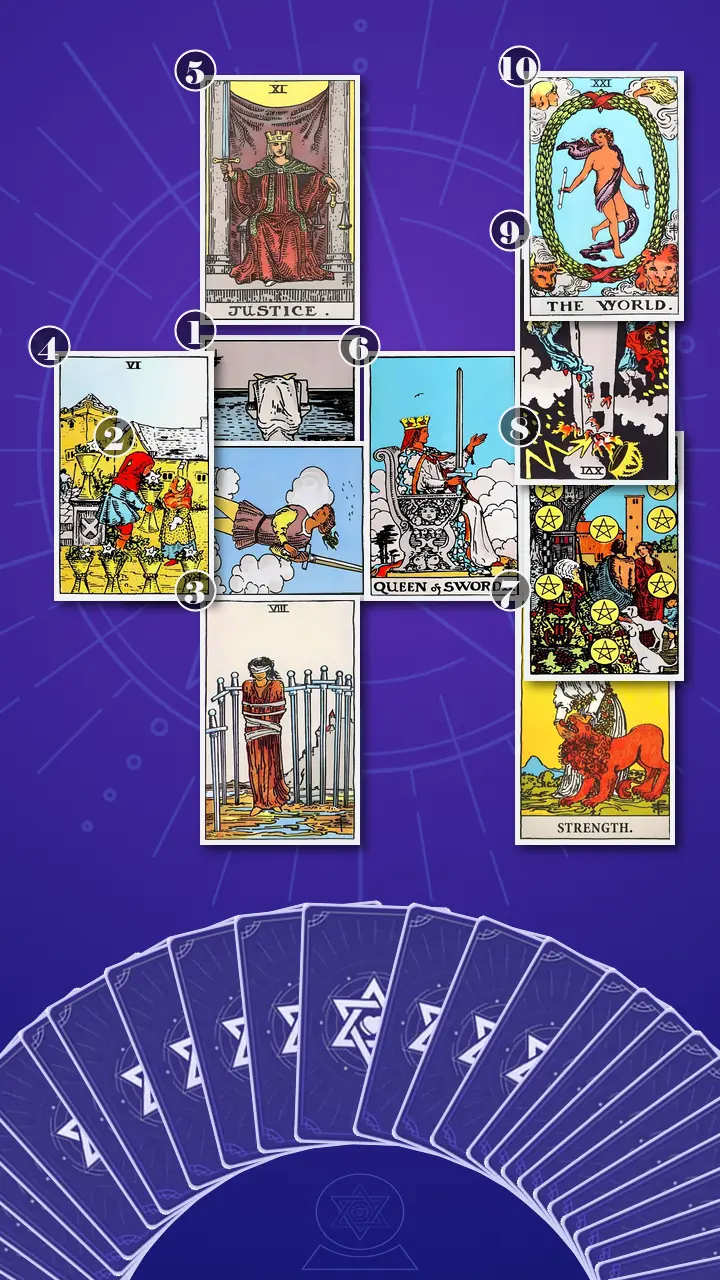
Reading the Map: Card Meanings in Context for a Holiday Boundary
Position 1: The on-the-spot moment
“Now flipping over,” I said, “is the card that represents the on-the-spot moment: what you do and feel when your sibling brings up your ex at holidays.”
Two of Swords, reversed.
This card always makes me think of a person trying to look calm while holding two opposing realities at once. In reversed position, the energy isn’t balanced—it’s blocked, and it leaks out later.
In modern life terms, it’s exactly what Taylor had described: sitting at the table, outwardly composed, while internally crossing off every possible sentence as “too much,” “too needy,” “too harsh,” until you end up saying… nothing at all.
It’s like your brain is running A/B tests on three versions of the same boundary line—while the moment passes. Like writing the perfect email draft and never hitting send.
Taylor gave a small, surprised laugh—sharp at the edges. “That’s so accurate it’s kind of rude.”
I nodded. “That laugh is the safe line your mouth picks when your mind can’t choose. The Two of Swords reversed isn’t a character flaw. It’s a pattern: you freeze, you deflect, you get thirty seconds of relief… and then you pay for it later.”
I could almost see the cut in their memory: the hard pivot to someone else’s job, the overbright dining room light, the phone warm in their pocket like a secret exit—then the rideshare home where the post-game analysis starts.
Position 2: The crossing communication dynamic
“Now,” I said, “this card represents the specific communication dynamic that makes it hard to end the topic cleanly.”
Page of Swords, upright.
The Page is conversation as weather: quick wind, quick pivots, a little too much entertainment value. Upright, the energy is excess—not necessarily malicious, but restless and sharp.
For Taylor, it looked like a sibling who brings up the ex the way some people toss out a controversial take on Twitter just to see what happens. “So how’s your ex these days?” with a half-smile. Like it’s harmless trivia. And suddenly the whole table feels like it’s listening.
“This is important,” I said. “The Page doesn’t respond to a long emotional essay. The Page responds to clean structure. If you meet wind with more wind—more words, more explanation—you just feed the storm.”
Taylor’s shoulders lifted an inch, then dropped. Like their body recognized the truth before their brain could argue with it.
Position 3: The underlying belief that controls your mouth
“Now we’re going under the table,” I said. “This card represents the underlying belief that keeps you from setting a direct boundary in front of family.”
Eight of Swords, upright.
Upright, this card is constriction—but the kind that’s partly internal. A story that says, I’m not allowed to speak plainly here.
In real life: “If I say anything, it’ll become a scene.” That thought alone keeps you seated and silent, even though you could step out of the loop. You can almost hear the silent subtitles you fear will appear above your head: too sensitive, making it weird, can’t take a joke.
This is where the Two of Swords reversed and the Eight of Swords lock together. Both have blindfold energy. Not because you don’t have words—because you don’t feel permitted to use them.
As I said that, Taylor did the exact thing the spread was describing: a slow exhale, then a small nod. “Yeah… that’s exactly it.”
My mind flashed, briefly, to orbital mechanics—the way a smaller body can feel trapped when it’s actually just caught in a stronger gravitational field. Not force. Not fate. Just a pattern of pull you can map and adjust.
Position 4: The family-history script the holidays reactivate
“Now flipping,” I said, “is the card representing the family-history pattern that the holidays reactivate and you fall back into.”
Six of Cups, upright.
This card is nostalgia with a catch. Upright, its energy is sticky familiarity: the easy slide back into old roles.
It’s the feeling Taylor named perfectly: going back home and suddenly feeling sixteen again—defaulting to being the “easy one” while the sibling gets to be the commentator. In the Six of Cups world, teasing is “normal,” callbacks are “cute,” and the line between private and public gets blurry because we’ve always talked like this.
“Your sibling might not even think they’re doing something intense,” I said. “The Six of Cups says: they’re replaying an old storyline because it feels familiar. But the card also gives you permission to update the script. What was once ‘normal’ doesn’t have to stay acceptable.”
Position 5: Your conscious standard—what’s fair at the table
“Now,” I said, “this card represents your conscious standard for what ‘fair’ and ‘appropriate’ conversation should be at the gathering.”
Justice, upright.
Justice is Air energy with structure—balance, not spin. It’s the feeling of deciding, ahead of time: I don’t owe anyone a conversation about my past relationship. And treating that decision as non-negotiable.
I leaned a little closer to the camera. “This is your ‘house rule’ card,” I said. “Not a speech. Not a trial. One policy line.”
In social terms, it’s like having a comment policy on your own life: you don’t argue with every commenter; you enforce the rule and keep posting your actual content. The relief is subtle but real—because you stop trying to convince the room, and start protecting the room from a topic that doesn’t belong there.
Taylor’s throat worked, like the tightness was loosening by a millimeter. “That sounds… fair,” they said, surprised. “Like I’m not attacking anyone. I’m just saying what’s on the menu.”
“Exactly,” I said. “Justice isn’t cold. It’s clean.”
Position 6 (Key Card): Your next best move—the boundary that realistically works
I let my hands rest on the deck for a beat. The way I do before a planetarium show when the lights go down and people get quiet—not because it’s mystical, but because attention matters.
“We’re turning over the most important card of this reading,” I said. “This one represents your next best move in the moment: the kind of boundary statement that can realistically work at a holiday table.”
Queen of Swords, upright.
The Queen of Swords is adult clarity. Upright, her energy is precision—not cruelty, not emotional shutdown. She’s the part of you that respects feelings while refusing to negotiate your limits.
In modern life, she’s Taylor saying: “I’m not talking about them,” then immediately asking their aunt about her trip—no apology, no story, just a redirect.
And this is where I brought in my own lens, the one I’ve used for years studying both starlight and human speech. “I call this Light-Year Communication,” I told Taylor. “At cosmic distances, you don’t get to send paragraphs. You send a signal that can survive distortion. A boundary sentence has to work the same way: short, calm, repeatable—because the room is noisy and people will mishear anything complicated.”
Setup. Taylor knew the moment: their sibling says the ex’s name like it’s casual, and their throat goes tight while their brain starts writing five different scripts at once—trying to manage everyone’s comfort and their own dignity at the same time.
Delivery.
Stop auditioning for the perfect explanation; raise one clear sword and redirect the room.
I let the sentence hang. Even through the screen, the call felt quieter—like someone had turned down the background hum.
Reinforcement. Taylor’s reaction came in layers. First, a micro-freeze: their lips parted, then closed again, like their body had reached for the usual over-explaining and found… nothing to grab. Second, their eyes unfocused for a moment—like they were replaying a specific dinner-table scene in HD, hearing their own laugh, feeling the jaw clamp, watching themselves disappear into “helping in the kitchen.” Third, emotion moved through: a short, almost irritated breath out. “But if I don’t explain,” they said, and there was a flash of defensiveness, “won’t I sound… cold? Like I’m the problem?”
“That’s the belonging fear talking,” I said gently. “The Queen of Swords isn’t asking you to be cold. She’s asking you to be final. A boundary isn’t an explanation. It’s a sentence you can repeat.”
I watched their shoulders drop—an inch, then another. Their jaw unclenched like it had been holding a coin between the teeth. There was relief, and also a kind of dizziness, like stepping out of a cramped room into fresh air: Oh. If I stop auditioning, I have to actually stand by one line.
“Try something for me right now,” I said. “Set a two-minute timer after this call. In Notes, write one line you can say at a crowded table—twelve words max. ‘I’m not discussing my ex today.’ Then say it twice in a normal voice. Add one redirect question you actually like: ‘How’s your new job going?’ or ‘What are you watching lately?’ And if your body tightens while practicing—pause. Drop your shoulders. Unclench your jaw. Stop after one rep. The goal isn’t hype. It’s familiarity.”
Then I asked the question that turns insight into memory: “Now, with this new lens—can you think of a moment last week when your sibling brought them up, and this one sentence would have changed how you felt in your body?”
Taylor blinked fast. “Yeah,” they said quietly. “It would’ve been… a two-second pause. Not a disaster.”
And that was the shift: not from confused to fearless—just from dread and self-monitoring to the first slice of grounded self-trust.
Position 7: The inner resource that keeps it calm
“Now,” I said, “this card represents the inner resource you can embody so the boundary lands without escalating.”
Strength, upright.
Strength is regulated courage—balanced Fire. It’s not “being unbothered.” It’s staying steady while bothered.
In Taylor’s world, it’s that moment when the throat tightens but they still speak evenly, refusing to let their sibling’s baiting energy dictate the volume of the room. Gentle and immovable at the same time.
“This is where your body matters,” I added. “Speak the boundary on an exhale, not an inhale. Lower volume reads as final. Higher volume reads as debate.”
Position 8: The holiday system—the room’s pressure
“Now flipping,” I said, “is the card representing the holiday system: family norms, pressures, and what the room rewards or resists.”
Ten of Pentacles, upright.
This is family gravity. Upright, it’s stable—tradition, hierarchy, the unspoken content policy of “no drama.” It explains why Taylor feels like one boundary sentence could topple the whole vibe.
This is where I naturally slipped into the diagnostic metaphor I’m known for at the planetarium: “I use something called Galactic Gravity Analysis,” I told Taylor. “Families are like orbit systems. The Ten of Pentacles is the big mass in the center—tradition. It pulls everyone back into familiar paths. Your sibling can swing by like a loud comet, but the deeper pull is the system rewarding ‘pleasant.’”
I pointed back to Justice. “So you use the system’s value in your favor. Your boundary isn’t rebellion; it’s protection: ‘I’m here to enjoy today with everyone. I’m not discussing my ex.’ That’s you contributing to the holiday—not threatening it.”
Position 9: Hopes and fears—the catastrophe reel
“Now,” I said, “this card represents what you’re most afraid will happen if you set the boundary, and what part of you hopes it will finally change.”
The Tower, reversed.
Reversed, the Tower is resistance to disruption. It’s the fear that one clear sentence will cause a blow-up. And it’s also the hidden truth: avoiding the small disruption now keeps the bigger disruption repeating later.
“Let’s play the preview reel,” I said. “Worst-case HD version: your sibling rolls their eyes, the table goes silent, everyone judges you, and the holiday becomes ‘a story.’”
I paused, then cut it hard. “Most likely real-life version: a two-second pause. Someone reaches for the gravy. Someone asks about work. The room moves on.”
I looked at Taylor. “A two-second pause is not a disaster.”
They let out a breath that sounded like they’d been holding it since their coat came off in that childhood hallway. “I always treat buffering like the whole internet is down,” they said, half-smiling.
“Exactly,” I said. “And this is you learning to let the page load.”
Position 10: Integration—when the topic becomes a non-option
“Last card,” I said. “This represents integration: how it feels and functions when the boundary becomes a consistent norm for you.”
The World, upright.
This is closure as behavior, not closure as performance. Upright, its energy is completion. Not proving you’re over it. Acting like it isn’t up for discussion.
In modern terms, it’s like closing a browser tab you keep refreshing out of habit. Like training an algorithm: what you engage gets served again. The World says: stop engaging, and the feed changes.
Taylor stared at the card for a moment, then nodded once—small, but firm. “I want that,” they said. “I want it to be boring.”
“Keep it boring,” I agreed. “Boring is what ends it.”
The One-Sentence House Rule: From Insight to Actionable Advice
I gathered the whole spread into one story for Taylor, the way I’d summarize a sky map for someone seeing Saturn’s rings for the first time.
“Here’s the pattern,” I said. “In the moment, you freeze (Two of Swords reversed) because your sibling’s delivery is quick and sharp (Page of Swords), and underneath that is the belief that being direct risks belonging (Eight of Swords). Holidays pull you into the old ‘easy one’ role (Six of Cups). But your real standard is clean fairness (Justice). Your best move is a short, repeatable boundary with an immediate redirect (Queen of Swords), backed by steady regulation (Strength). The room’s gravity wants ‘pleasant’ (Ten of Pentacles), and your fear imagines a blow-up (Tower reversed)—but what you’re actually building is closure through consistency (The World).”
“The blind spot,” I added, “is that you’ve been managing everyone else’s comfort like it’s your job. That’s what keeps the topic available. The transformation direction is the opposite: one clear, rehearsed sentence—repeated once—without over-explaining.”
Then I offered Taylor something I use in my own work bridging astronomy and conflict skills. “I have a strategy I call Solar Eclipse Mediation,” I said. “An eclipse isn’t a fight. It’s alignment—then a brief, decisive block—then the light returns in a new direction. That’s exactly the boundary sequence you need.”
- Write your 12-word boundaryIn your Notes app, write one sentence that fits your mouth (12 words max). Example: “I’m not discussing my ex today.”If it feels “too cold,” remember: it’s a policy line, not an emotional argument.
- Choose your redirect questionPick one neutral question you genuinely want to ask someone else at the table (not your sibling). Example: “How was your trip?” or “What are you watching lately?”Have the question ready like a bookmark—you’re turning the page, not starting a debate.
- Commit to the one-repeat ruleIf your sibling pushes, repeat the exact same sentence one more time. Then pivot to your redirect question and physically turn toward the next conversation thread.Don’t add new reasons on the repeat. New reasons invite cross-examination.
- Rehearse twice, not twenty timesWhile making tea or brushing your teeth, say the line out loud twice in a normal voice.If your throat tightens, pause, drop your shoulders, unclench your jaw, and stop after one rep.
- Use the “speak on the exhale” cueAt the table, exhale softly first, then say the boundary at a steady volume with a neutral face.Lower volume tends to read as final. Higher volume tends to read as drama.
“If you want one sentence to remember,” I told Taylor, “it’s this: Don’t audition for the perfect line. Pick the repeatable one.”

A Week Later: The Quiet Proof
A week later, Taylor messaged me after a smaller family get-together—nothing cinematic, just enough to test the new orbit.
“They did it,” the text read. “Sibling brought up my ex while we were passing food. My throat did the thing. I said, ‘I’m not discussing my ex today.’ There was a two-second pause. My uncle literally reached for the potatoes. I asked my cousin about their new job. It moved on.”
Then, underneath: “I didn’t die. I didn’t ruin anything. I was… present.”
It wasn’t a perfect ending. It was a real one: clear, slightly shaky, and still steady enough to hold. They slept through the night—and in the morning the first thought was still, “What if I sounded harsh?” Only this time, they noticed the thought, breathed out, and didn’t reopen the tab.
That’s what a Journey to Clarity looks like most days. Not fireworks—just the quiet proof that you can trust yourself to intervene cleanly, so you don’t have to carry the residue home.
And if you needed the reminder too: when you’re bracing at a holiday table like you’re on a hot mic, it’s not that you’re “not over it”—it’s that you’re tired of trading your peace for everyone else’s comfort.
If you didn’t have to explain yourself at all, what’s the one calm sentence you’d be willing to repeat once—and then let the room move on?