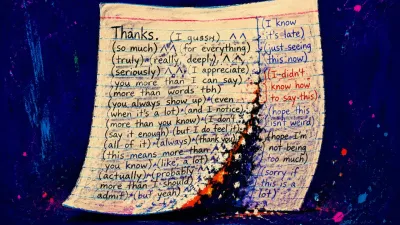
From Slack Doom-Refreshing to Steady Repair Steps After a Miss
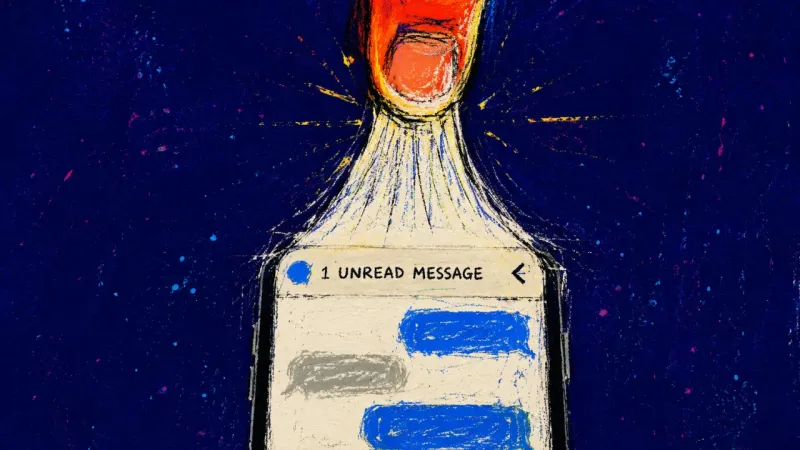
Catastrophizing Your Career After One Missed Deadline: The 11:48 p.m. Slack Courtroom
“You miss one deadline and suddenly you’re refreshing Slack like it’s a courtroom livestream—waiting for the verdict to drop.”
I said it gently, not to be clever, but because Taylor (name changed for privacy) flinched in that way people do when you name the thing they’ve been trying not to name.
On my screen, her Toronto condo looked like every late-night apartment I’ve ever known: harsh laptop glow cutting across a duvet, a mug of tea gone cold to the color of old pennies, the air a little too dry. At 11:48 p.m., she had three tabs open—Slack, email, and a campaign doc—and her thumb kept drifting back to refresh as if the next notification might explain her whole future. The streetcar squeal outside was faint, but the laptop fan was loud enough to feel accusatory.
“I know it’s one deadline,” she said, voice tight, like she was trying to keep it from shaking. “But the second it happens, my body goes—” She pressed a palm to her sternum. “Like someone is sitting on my chest. And my stomach does that fizzy, jumpy thing. Then I start rewriting my update. Five times. Ten. Like if I can get the tone perfect, it won’t… count.”
She swallowed. “I just want to be seen as competent. Reliable. Easy to work with. And the second I’m late, it’s like my brain says, ‘Cool, so you’re not cut out for this.’”
To me, her panic didn’t look dramatic. It looked mechanical—like a system stuck on a loop. Wired-but-tired eyes. Jaw clamped. Fingers moving faster than the mind they were trying to soothe. Panic, braided with shame and dread, the way a too-tight necklace sits right at the base of the throat.
“We’re not going to argue you out of caring,” I told her. “Caring is part of what makes you good at your job. But tonight, let’s try something else: let’s map the loop. Not to judge it—just to see it clearly. This is a Journey to Clarity, and clarity starts when the fog becomes a shape.”

Choosing the Compass: The Five-Card Cross Tarot Spread for Work Anxiety After a Mistake
I asked Taylor to put both feet on the floor and take one slow breath—not as a mystical ritual, but as a gear shift. Then I shuffled on camera, letting the sound of the cards become something steady in the room. When I work, I think of it the way I used to think about cataloguing finds on a dig: you don’t need drama, you need clean labels and a reliable method.
“For this,” I said, “I’m going to use a Five-Card Cross.”
For you reading along: this spread is perfect when someone is feeling stuck in a tight cognitive loop—especially career crossroads moments that aren’t actually about choosing between two jobs, but about choosing between two inner narratives. It’s a minimal structure that still gives a full diagnosis-to-action bridge: what’s happening now, what’s crossing you, what’s beneath it, what helps, and what you do next.
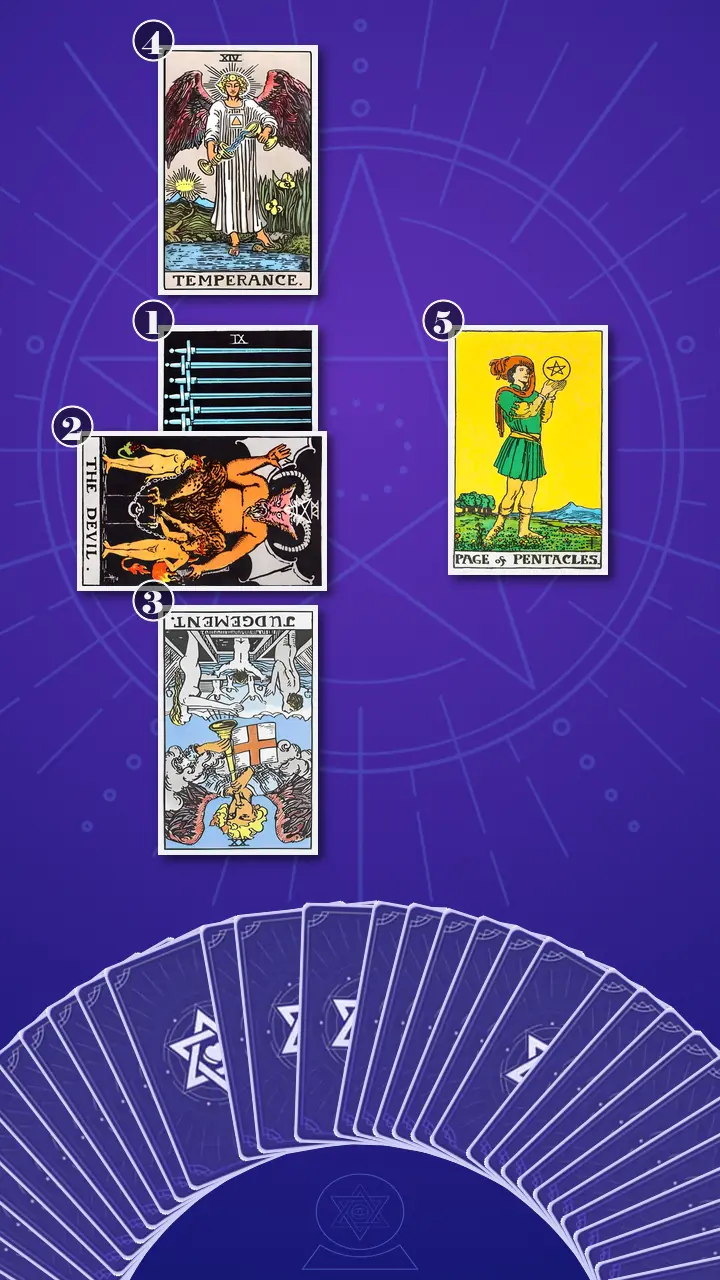
“Card one,” I told Taylor, “will show the current spiral—what this looks like day-to-day. Card two is what keeps the catastrophizing alive, the hook. Card three goes underneath—root cause. Card four is the regulating reframe, the healthiest counter-move. And card five is the next grounded step you can actually follow through on this week.”
She nodded, a little too fast. The nod of someone who wants a structure the way you want water after a long run.
Reading the Map: Card Meanings in Context When Your Brain Wants a Verdict
Position 1 — The current spiral: what it feels like after the miss
“Now we turn over the card representing the current spiral: the most visible thoughts and behaviors after the missed deadline,” I said, and flipped the first card.
Nine of Swords, upright.
The picture is blunt: a figure sitting up in bed, head in hands, swords hanging overhead like something you can’t turn off. In modern life, it’s after-hours and you’re in bed, but your brain is still in the project channel. You replay the missed deadline like it’s evidence that you’re secretly bad at your job. You’re not resting—you’re running an internal trial, cycling between doom forecasts and rewriting messages for tone.
Energy-wise, the Nine of Swords is Air in excess—thoughts not as tools, but as blades. It’s not “I made a mistake.” It’s “Let’s build a whole identity out of this.” That’s why your chest tightens and your stomach won’t settle: your body is responding to a threat your mind is manufacturing in high definition.
I let my voice stay calm. “A missed deadline is a moment. Your brain turns it into a verdict.”
Taylor surprised me—she gave a short laugh that wasn’t amusement so much as a release of pressure. “That’s… yeah. That’s exactly it,” she said, then winced. “It’s almost mean how accurate that is.”
I watched her eyes flick to her second monitor, then back to the card—like her attention had been trained to scan for danger, even here.
Position 2 — What keeps the catastrophizing alive: the hook that escalates it
“Now we turn over the card representing what keeps the catastrophizing alive—the immediate pressure pattern that escalates the story,” I said, and laid the second card across the first.
The Devil, upright.
In the Rider-Waite image, the chains around the figures are loose. That’s important. The trap is real—but it’s also participatory. In modern terms: you treat being seen as reliable like survival. So after the miss, you chain your self-worth to performance—extra tasks, extra availability, extra explaining. It looks like professionalism, but it’s really self-surveillance: trying to control perception so you don’t have to feel the risk of being judged.
This is the part of you that whispers, If I control the story hard enough, I’ll be safe. And then quietly collects its fee in sleep, focus, and accuracy.
“Here’s the line I want you to keep,” I said. “Over-explaining is anxiety in a blazer. It’s not that you’re dishonest. It’s that you’re trying to buy certainty with context.”
Taylor’s mouth opened on an “oh,” then shut again. She stared at the card like she’d just recognized her own handwriting on a contract she didn’t remember signing.
“I do that,” she admitted. “I write a novel. I’m like—‘Here’s what happened, here’s why, here’s the context, here’s what I learned, here’s how I’ll fix it, here’s me being available forever.’ And then I hit send and reread it until my heart is basically sprinting.”
“And the short-term relief,” I said, “is real. It feels like control. But The Devil asks the harder question: what is it costing you?”
She glanced down at her mug, as if noticing for the first time that it had been untouched for hours.
Position 3 — The root mechanism: the internal verdict that turns a miss into identity
“Now we turn over the card representing the root mechanism—the belief underneath that turns one missed deadline into an identity sentence,” I said, and placed the third card below the crossed pair.
Judgement, reversed.
Judgement upright is review and renewal. Reversed, it becomes an alarm that never shuts off. The trumpet turns into an internal notification you can’t mute. In modern life, instead of a normal debrief, you run a courtroom in your head. The missed timestamp becomes Exhibit A, and the only verdict you can imagine is “guilty.” You can’t extract a lesson without attaching it to shame, so your system stays on high alert—prepping a defense for a meeting that hasn’t been scheduled.
As I said that, I could almost see the late-night screen-glow reflected in her eyes. I could hear the phantom click of her trackpad on the Slack timestamp, over and over, like checking it could change the past.
“This,” I told her, “is accountability confused with self-punishment. Accountability says: What happened? What’s next? Self-punishment says: What does this prove about me? And Judgement reversed is the part of you that mistakes pain for progress.”
Taylor didn’t nod so much as fold inward for a second—shoulders drawing up, chin tucking, a tiny wince. Then she looked back up, eyes glossy but steady. “My brain does make it moral,” she said quietly. “Like I’m not just late. I’m… bad.”
I felt an old professional memory flicker in me—standing in a trench in Anatolia, brushing soil from a shard, hearing a student say, “So the site is ruined?” The instinct to go from one broken piece to total collapse is human. It’s also wrong. An excavation teaches you proportion: one fragment is data, not destiny.
When Temperance Poured Between Two Cups: The Sentence That Changed the Night
Position 4 — The regulating reframe: the counter-move that restores proportion
I slowed my hands before turning the next card. “This,” I said, “is the hinge. The antidote.”
“Now we turn over the card representing the regulating reframe—what restores proportion and self-trust without pretending the deadline didn’t matter.”
Temperance, upright.
Temperance is the opposite of the spiral. An angel pours between two cups—measured, patient, unbothered by urgency. One foot on land, one in water: practicality and emotion at the same time. In modern life, it’s you stopping the dramatic attempt to erase the mistake and instead regulating the response: one contained check-in time, one clean status update, one focused work block. Two truths held at once—“I missed it” and “I can repair it”—without collapsing into extremes.
But before I went further, Taylor’s eyes flashed with something like resistance. Her breath caught, and her fingers froze above her keyboard. “Okay, but—” she said, heat rising in her voice. “If I don’t fix it perfectly, isn’t that basically admitting I’m not good enough? Like… if I’m not flawless, I’m done?”
There it was: the moment when insight threatens the old survival strategy. I didn’t argue her out of it. I anchored her in it.
Setup: You know that moment at 11:48 p.m. when Slack is open, your email draft is half-written, and you’re rereading your last message like it’s evidence in a trial? That’s exactly where Temperance meets you—not to tell you you’re fine, but to stop the trial from hijacking the entire night.
Delivery:
Stop treating one missed deadline like a life sentence—start mixing reality and repair like Temperance pouring between two cups.
I let that sit. The apartment behind her was quiet enough that the refrigerator cycle became audible, like the room itself was holding the pause with us.
Reinforcement: Taylor’s reaction came in layers—exactly the way the nervous system changes its mind, one small vote at a time. First: a physical freeze. Her shoulders stayed high, and her breath stalled halfway in. Second: the cognitive seep. Her gaze went unfocused, as if she were replaying the Slack thread, the timestamp, the imagined “quick call?” that hadn’t even happened yet. Third: the emotional release—an exhale she didn’t plan, long enough to fog the bottom of her water glass. Her shoulders dropped a few millimeters. Not relief, not yet—more like the first loosening of a knot.
“I keep trying to perform reliability,” she said, voice softer, “like three polished updates and zero actual progress.” She pressed her fingertips to her temple. “And I tell myself: If I don’t fix the feeling, I can’t fix the situation.”
“And Temperance flips it,” I said. “I can contain the feeling and still take one grounded step. That’s the entire move.”
This is where my own training comes in—my Skill Archaeology. I’ve spent years unearthing what people don’t realize they have, because it’s buried under panic-silt and self-criticism. “Taylor,” I said, “your overlooked talent isn’t ‘never being late.’ It’s your ability to repair. You’re already trying to repair—just through the wrong tool: the tool of over-explaining.”
“So we authenticate the right relic,” I added, borrowing my own framework without making it a lecture. “Not every impulse is evidence. Some are just alarms.”
Then I guided her through what I call a Temperance Reset—ten minutes, not to punish, but to regulate.
“Set a timer for ten minutes,” I said. “First three minutes: one sentence—What happened, in plain facts. No adjectives. No self-roasts. Next three: one sentence—What I’m making it mean. Last four: draft a two-line update you could send: (1) status + revised ETA, (2) next concrete step. And if your body spikes—tight chest, nausea, shaky hands—you stop early. This is regulation practice, not penance.”
Then I asked the question that turns insight into lived memory: “Now, using this new lens—can you think of a moment last week when this would’ve changed how you felt?”
Taylor blinked, slow. “Yesterday,” she said. “Right after I sent the late doc. My manager just reacted with a thumbs-up. That’s it. And I still spent four hours prepping for a meeting that didn’t exist.”
“Exactly,” I said. “This isn’t just about a deadline. It’s the shift from panic-driven catastrophizing and identity-level self-verdicts to regulated accountability—repair-focused follow-through and steadier self-trust. Temperance doesn’t erase the miss. It makes the miss survivable.”
Position 5 — The next grounded step: a practical move that rebuilds trust
“Now we turn over the card representing the next grounded step—what you can do this week that rebuilds reliability in reality,” I said, and turned the final card to the right.
Page of Pentacles, upright.
The Page holds one pentacle with full attention. It’s the opposite of tab-chaos. In modern life, it’s apprentice mode: pick the next tangible deliverable, define what “done” means, complete it. You rebuild your sense of reliability through one small, high-quality follow-through—like doing one clean rep—rather than trying to win back trust through frantic overperformance.
Energy-wise, this is Earth: slow, real, repeatable. It’s not glamorous. That’s why it works.
Taylor’s face changed here—less dramatic than people expect, but more important. Her eyes steadied. Her jaw unclenched like she’d just noticed she was biting down. “One thing,” she said, almost to herself. “Just one thing I can finish.”
“Reliability isn’t a vibe you perform,” I told her. “It’s a pattern you build.”
The One-Page Repair-and-Learn Protocol: Actionable Advice for Missed-Deadline Spiraling
When I stitched the spread together for her, the story was clean: the Nine of Swords showed the mental storm—thoughts stacking like notifications you can’t turn off. The Devil showed why the storm sticks: your self-worth gets chained to performance, so control feels like survival. Judgement reversed revealed the engine underneath—an internal courtroom that mistakes shame for accountability. Temperance offered the regulating reframe: mix reality and repair. And the Page of Pentacles grounded it in one small, finished deliverable—proof through follow-through.
The cognitive blind spot, as I saw it, was this: Taylor believed the way back to trust was to sound trustworthy—more context, more apologizing, more availability. But in most teams, trust is rebuilt through a quieter currency: clear updates and consistent delivery.
The transformation direction was equally clear: a shift from proving you’re flawless to running a small repair-and-learn protocol—name what happened, propose the next step, measure progress by follow-through rather than perfection.
To make it usable, I borrowed another field-tested metaphor from archaeology: Megalith Transport. Ancient builders didn’t move a ten-ton stone with one heroic heave. They used rollers. Levers. Rhythm. Your career repair is the same: small, repeatable mechanics.
- The Two-Line Update RuleWrite a two-line status update (max 300 characters) to your lead: “Status + what’s next + revised ETA.” Send it once—no five rewrites, no autobiography of context.If your brain screams “not enough,” label it: catastrophizing. Then choose clarity over reassurance—shorter is usually more professional.
- One-Window Checking Boundary + 45-Minute SprintPick one check-in window for Slack/email today (e.g., 11:00 a.m. and 4:00 p.m.). Outside that window, close the tab and do one 45-minute single-task sprint on the next deliverable.Your nervous system will try to “doom-refresh” anyway. Treat the urge like a loose chain: you can notice it without obeying it.
- The Courtroom-to-Lab Debrief (10 Minutes, Three Bullets)After work, do a neutral post-mortem: three bullets only—(1) cause of delay, (2) signal you missed, (3) one guardrail you’ll test next week. Facts first, story second.Before you start, ask my “Relic Authentication” question: Is this debrief for learning—or for self-punishment? If it’s punishment, stop and return to one fact.
I ended with a boundary that sounds almost too simple, which is why it’s so effective: “One clean update. One real deliverable. Then you’re done for tonight.”

A Week Later: Ownership, Not Certainty
Six days later, Taylor sent me a message. It wasn’t long. That was the point.
“I did the two-line update,” she wrote. “My manager replied ‘thanks’ and asked for the revised ETA. No drama. I set Slack to one window. I finished one asset. I still felt shaky, but I slept.”
The bittersweet part—the real part—was the next line: “I woke up and my first thought was still, ‘What if I messed it up again?’ But this time I caught it. I did the facts vs story thing. Then I made coffee.”
That’s what clarity often looks like in real life: not a grand epiphany that deletes anxiety, but a quieter kind of ownership. A regulated response. A repair step. A system that doesn’t turn one late deliverable into a whole career obituary.
And if tonight, one late deliverable makes your chest go tight and your brain starts writing a whole career obituary, it’s not because you don’t care—it’s because you’ve been treating reliability like something you must prove flawlessly, or lose entirely.
So I’ll leave you with the question I asked Taylor, and the one Temperance asks all of us in modern work life: If you didn’t have to erase the mistake tonight—only contain the spiral and take one realistic repair step—what would that next step look like for you?
Author Profile