Procrasti-Cleaning Before Big Tasks—Try a Version 0.1 Start to Build Momentum

Finding Clarity in the 9:10 a.m. Desk Reset
If you’re a hybrid-tech worker who says “I’m not procrastinating, I’m just getting set up,” but somehow you’ve cleaned your desk twice and still haven’t opened the doc—welcome to productive procrastination.
Taylor (name changed for privacy) showed up to my café a few minutes before the lunch rush, the kind of morning where Toronto feels like it’s vibrating under glass—streetcar brakes, wet pavement, and everybody walking fast like they’re late for something invisible.
She described it like a scene she’d watched too many times: 9:10 a.m. on a Wednesday in her condo, laptop open on the kitchen table, ready to start a high-visibility UX spec. The kettle clicks off. The air smells like dark roast. The overhead light has that faint electrical buzz. She sees one crooked sticky note and a faint coffee-ring smudge—then her shoulders creep up and her jaw locks. “Two minutes to reset,” she tells herself. And suddenly she’s wiping the surface, aligning the monitor, re-stacking papers. At 10:05, the desk looks immaculate. The doc is still blank.
“I care,” she said, almost annoyed at herself. “That’s the problem. I want to start and be proud of what I make… and then I’m terrified the first messy version will prove I’m not actually good.”
The pressure in her sounded like walking around with a too-tight backpack strap—everything technically manageable, but cutting off circulation. Performance pressure doesn’t always feel like panic; sometimes it feels like a clenched jaw doing “responsible” things.
I slid her an espresso and kept my voice soft. “We’re not here to shame the cleaning. We’re here to figure out what rule the cleaning is protecting—and what your next step is, so starting stops feeling like a test.”

Choosing the Compass: The Four-Layer Insight Ladder
I asked her to take one slow breath—not as a mystical thing, just a nervous-system handoff from spiraling to observing. Then I shuffled, the way I’ve done between cappuccinos and conversations for years: steady, familiar, like aligning cups on a shelf.
“Today I’m going to use a spread I like for this exact ‘why do I do this?’ loop,” I told her. “It’s called the Four-Layer Insight Ladder · Context Edition.”
For anyone reading along: this spread works because the question isn’t What will happen? It’s What belief is driving this behavior, and what’s the smallest next step that breaks the loop? Four cards is the minimum structure that moves cleanly from habit → old rule → reframe → action, without turning self-reflection into another way to overthink.
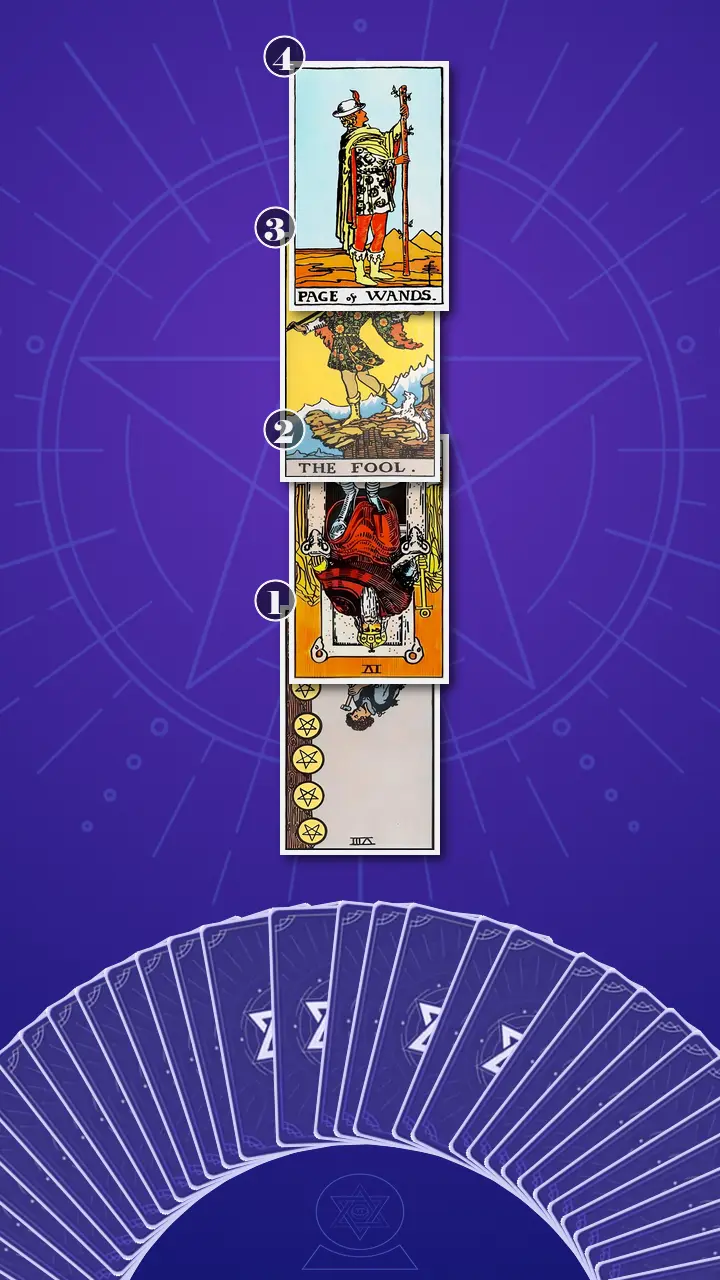
In this ladder, the first card names the observable pattern (what you do instead of starting). The second card reveals the old internal rule—the “should” acting like a bouncer. The third card is the pivot: the reframe that restores permission to start imperfectly. The fourth card is your grounded next step within a week—something testable, not inspirational.
Reading the Map: When the Workbench Becomes the Project
Position 1 — The observable procrastination pattern
“Now flipping over is the card that represents the observable procrastination pattern: what you do instead of starting.”
Eight of Pentacles, in reversed position.
This card immediately speaks in workbench language. In modern life, it’s painfully specific: you sit down to do real work—a UX write-up, a prototype, a difficult decision—and your brain redirects you into craft vibes. Cleaning the desk, re-sorting pens, renaming layers, reorganizing the project folder. It looks like discipline… until you realize the workbench has become the project and you’re still staring at a blank page.
Reversed, the Eight of Pentacles is craft energy in blockage. Not laziness—misdirection. Your effort is real, but it’s being spent where you can’t be judged.
I said it in the simplest way I know: “A clean desk can be a comfort. It can also be a gatekeeper.”
Taylor let out a small, half-guilty laugh, the kind that lands somewhere between “called out” and “thank God it’s not just me.” Her fingers rubbed at a dry patch on her knuckle like she’d been holding cleaning wipes again.
Position 2 — The old rule that grants or withholds permission to begin
“Now flipping over is the card that represents the old internal rule/standard that grants or withholds permission to begin.”
The Emperor, in reversed position.
When The Emperor is reversed, I don’t hear “power.” I hear policy. An internal authority voice running your workday like a manual: “No draft until you can guarantee it won’t look sloppy.” And the more visible the task gets—Slack ping, calendar reminder, “review with PM tomorrow”—the more that internal manager tightens the rules.
It’s almost a Severance vibe: being managed from inside your own head.
This is control energy in excess. Control-as-safety. Control-as-worthiness. So cleaning becomes a quick way to feel competent without risking a messy first draft.
I gave her a scriptable prompt, because reversed Emperor needs language: “Finish this sentence: I’m only allowed to start if ____.”
She stared at the tabletop for a long beat. Chest tight. Then she nodded once, like something clicked into place against her will. “I’m only allowed to start if… everything is under control. And I can do it well.”
I watched her jaw unclench a millimeter as the rule became words instead of background noise. Naming breaks the spell. A rule you can name is a rule you can negotiate.
“And here’s the hard truth,” I added gently, no scolding. “If you can’t start messy, you’re not chasing excellence—you’re chasing safety.”
Her eyes flicked up to mine, sharp and a little hurt, then back down. That discomfort was real—and useful.
When The Fool Stepped Off the Cliff
Position 3 — The key reframe that dissolves the rule and restores self-trust
I slowed down before turning the next card. The café noise softened in my awareness—milk steaming, a spoon against ceramic—like the room itself was giving us a little space.
“Now flipping over is the card that represents the key reframe that dissolves the rule and restores self-trust to start imperfectly.”
The Fool, upright.
In modern life, The Fool looks like this: the cursor blinking in a blank doc while your hand hovers over the disinfectant wipe. The inner monologue goes, If I start messy, it’ll show → if it shows, I’ll be judged → if I’m judged, I’m not safe.
And then The Fool flips the whole thing with one clean contrast: Version 0.1 isn’t a verdict; it’s a flashlight.
Here’s where my café brain kicks in—my signature way of diagnosing these loops. I call it Knowledge Filtration, like a coffee filter. When you pour water over grounds, the filter’s job isn’t to make the water feel “ready.” It’s to let the essential move through and catch what doesn’t belong. Your nervous system right now is using cleaning as a filter—but it’s catching the wrong thing. It’s filtering out the draft, the very material that would teach you what to do next.
Setup (the trapped moment): Taylor was stuck in that exact loop—wanting to start because she cared, but needing the environment to feel perfectly governed before she could touch the vulnerable first attempt.
Delivery (the sentence that changes the relationship):
Not “I start when everything is perfectly under control,” but “I step off the cliff with a light pack and let the first draft teach me.”
I let the words hang there for a second, like crema settling.
Reinforcement (what changed in her body): First, she went still—like her breath paused mid-chest. Her fingers froze around the warm cup. Then her gaze unfocused, as if she was replaying ten different mornings: the Slack ping, the calendar reminder, the wipe in her hand. And then something softened. A quiet exhale, almost a laugh—surprised and a little bitter. Her shoulders dropped in a way you can’t fake. She blinked hard, eyes shining but not spilling. “Oh,” she said, voice smaller. “That’s… exactly what I do.”
I nodded. “Readiness isn’t a feeling you wait for—it’s something you generate by moving first, even in a small way.”
I leaned in just enough to make it practical. “Now, with this new lens—can you think of a moment last week when you reached for the wipe, or started renaming Figma frames, and if you’d treated the first attempt as version 0.1, you would’ve felt different?”
She swallowed, then nodded again. “Tuesday. 9:12. I opened Figma, PM pinged for an update, and I… reorganized layers for forty minutes.”
“That’s the bridge,” I said. “Not from messy to perfect. From control-seeking performance pressure to curiosity-led momentum and grounded self-trust—one tiny step at a time.”
Lighting the First Signal Fire
Position 4 — A concrete next step within a week
“Now flipping over is the card that represents a concrete next step you can take within a week that turns insight into momentum.”
Page of Wands, upright.
This card doesn’t ask you to become fearless. It asks for a micro-initiation: one 25-minute block where you produce a concrete artifact—send the message, draft the outline, sketch the flow—before you do any tidying. Not a monument. A signal flare.
Page of Wands is Fire in balance: enough spark to start, not so much it turns into pressure. It’s curiosity over performance—“What happens if I start before I feel ready?” instead of “Can I prove I’m good?”
Taylor nodded… and then gave me an unexpected, very real objection. “But I honestly can’t find even five minutes,” she said, a little too fast. “My mornings are meetings, my afternoons are reviews, and if I don’t reset my desk it feels… chaotic.”
I didn’t argue with her calendar. I stayed with the mechanism. “Then we make the experiment smaller and cleaner,” I said. “Because the point isn’t time. It’s permission.”
I tapped the table once, like calling a shot. “Start small. Learn fast. Then decide what deserves polish.”
From Insight to Action: The Version 0.1 Practice Policy
Here’s the story the Four-Layer Insight Ladder told—cleanly, like a well-pulled shot: you’re stuck in productive-looking procrastination (Eight of Pentacles reversed) because an old internal permission rule is running your day like a compliance department (Emperor reversed). That rule says control comes first, so cleaning becomes the safest way to feel competent. The pivot is The Fool: treat beginnings as experiments, not performances—create readiness through motion. Then the Page of Wands lands it: one small initiation that creates a real artifact and proves you can start without perfect conditions.
The cognitive blind spot is subtle: you’ve been treating “feeling ready” as the prerequisite for action, instead of seeing that action is what creates readiness. Your desk isn’t the enemy. The desk became the bouncer because the rule made it one.
To ground it, I gave Taylor two small, testable moves—no heroics, no hustle-guru energy. Just a new policy you can actually follow.
- The 10-Minute Ugly Draft Sprint (Version 0.1)Before you touch the desk, set a timer for 10 minutes. Open the exact file you’re avoiding (doc or Figma) and make one intentionally imperfect artifact: 3 bullets, a messy wireframe, a rough flow. When the timer ends, stop and write one line: “Next tiny step: ____.” Then walk away on purpose.Expect your brain to argue (“This is sloppy,” “Ten minutes won’t matter”). That’s the old rule trying to stay in charge. If anxiety spikes, scale down to 5 minutes or 3 bullets—your only job is to create something editable.
- The Permission-to-Begin Sticky NotePut a sticky note where you usually start cleaning. Write: “I’m only allowed to start if ____.” Under it, write: “I’m allowed to start when I can name one tiny step.” Once this week, when your hand reaches for the wipe, pause and read it out loud (quietly is fine).Don’t try to defeat the rule—name it like debugging. No self-insults. Treat it as a borrowed policy you’re allowed to update.
- The Page of Wands 25-Minute Curiosity BlockPick one 25-minute block this week and produce one small thing: send the Slack message, draft the outline, sketch the flow. End with two lines in your notes: “What I learned:” and “What I’ll try next:” (no rating your worth).Stop when the timer ends—even if you finally feel like continuing—so your nervous system learns you can start without perfect conditions.
And because I’m a coffee person to the bone, I added one practical “café strategy” that fits my own toolbox: my Latte Memory Technique. I told her, “If you’re already making coffee, use that moment. Write ‘Version 0.1’ on a sticky note while the milk steams—same movement every time. Let it be your foam-art reminder: this first pass is practice.”

A Week Later: The Quiet Proof
A week later, Taylor messaged me a photo—not of a perfect desk, but of a very imperfect screen. A Figma frame labeled, unapologetically: Version 0.1. Under it she’d typed three rough bullets like scaffolding.
Her note was short: “I did 10 minutes before cleaning. My brain hated it. Then I realized I actually knew what to do next. I still cleaned after, but it didn’t feel like I was earning permission. It felt like… support.”
That’s the journey to clarity I love most: not dramatic reinvention, just the quiet proof that you can move first and let readiness catch up. The Four-Layer Insight Ladder isn’t about predicting your future—it’s about updating the internal policy that decides whether you’re allowed to begin.
When starting feels like a referendum on your competence, cleaning your desk becomes the only place you can feel in control—until the clock moves and the pressure comes back louder.
If you didn’t have to earn permission through perfect setup, what would your smallest ‘version 0.1’ look like—something you could start in the next 10 minutes and let teach you what to do next?