I Thought I Had to Sound Exceptional—Then Wrote a Progress Report Instead

Finding Clarity in the 9:38 p.m. Draft Spiral
If you’re a grad student in a city like Toronto and a scholarship renewal email turns into a three-hour rewrite session where you never hit send—welcome to achievement-anxiety mode.
Maya (name changed for privacy) appeared on my screen with the light of her laptop bleaching out the warm tones of her apartment. It was 9:38 PM there—Toronto-night quiet, the radiator doing that sharp little click-click like a metronome, and the faint hum of street traffic pressing up against the window. She had the renewal email open in one tab and the scholarship criteria page in the next, like she was cross-checking her pulse against an instruction manual.
Her fingers kept hovering over the keyboard and then retreating to backspace. I watched her jaw shift like she was chewing on a sentence that wouldn’t go down. When she tried to say “I accomplished…,” her throat caught—like the words were a too-big pill and she couldn’t swallow without gagging.
“I know I did things this term,” she said, a little too fast, “but none of it feels like it counts on paper.” She glanced off-screen—probably at the draft—then added, quieter: “If I send a normal email, it’s like I’m admitting I’m normal.”
I let that land. In my day job, I guide people through the night sky at a Tokyo planetarium—ten years of watching what happens when a room full of strangers goes quiet under a dome of stars. There’s a specific kind of silence that happens when someone is about to see something true. Maya had that silence in her shoulders: lifted, braced, waiting for impact.
“I get why this feels heavy,” I said. “You want to secure the renewal by clearly presenting what you’ve done… but the moment you put yourself on record, it starts feeling like a verdict on whether you deserve the money—and the place you’ve built in your program.”
Her eyes flicked back to the camera. A tight little laugh escaped. “Yeah. That’s… painfully accurate.”
“Okay,” I said gently. “Let’s make this a Journey to Clarity. Not ‘how do we write the perfect email,’ but ‘what pattern are you in—and what’s the next doable step out of it.’”

Choosing the Compass: The Four-Layer Insight Ladder for Scholarship Renewal Email Anxiety
I asked Maya to take one slow breath—not as a mystical ritual, just as a clean transition from spiraling to observing. While she exhaled, I shuffled my deck the way I do before every reading: steady, deliberate, like setting a telescope’s focus ring before you look for a faint star.
“Today, we’ll use a spread called the Four-Layer Insight Ladder · Context Edition,” I told her. “It’s built for questions like yours—when you’re not asking ‘what will happen,’ but ‘what is happening inside me when I freeze?’”
For you reading this: this is why this spread works so well for achievement-anxiety and self-advocacy under evaluation pressure. The left column isolates the loop—surface behavior, then the evaluation lens, then the root attachment that makes the whole thing feel life-or-death. The right column builds the exit ramp—regulation, the key reframe, and a practical next step you can actually do within a week.
“We’ll read it like a ladder,” I said. “Down the left side first—what you do, what you think the rules are, and what fear is underneath. Then we cross over to the right—what settles your nervous system, what changes the whole frame, and how to send something grounded.”
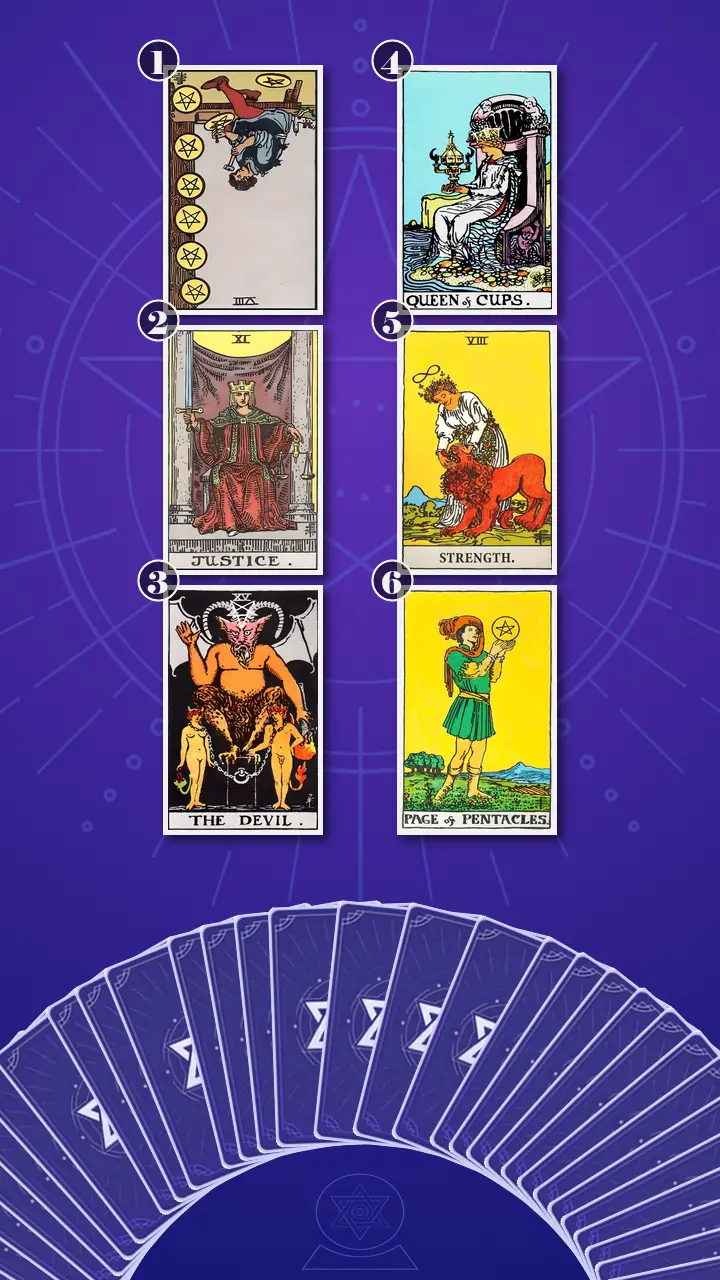
Reading the Map: How Tarot Works When You Feel Stuck
Position 1 — Surface pattern: what your hands do on the keyboard
“Now we’re turning over the card that represents the surface pattern: the concrete achievement-anxiety behavior that shows up while drafting the scholarship renewal email.”
Eight of Pentacles, reversed.
In my mind I saw the classic image—someone bent over a bench, repeating the same motion, pentacles lined up like a performance wall. And immediately, Maya’s reality snapped into place: 10:47 PM, swapping ‘completed’ for ‘successfully completed,’ reordering bullets, rereading the same sentence until it feels impressive enough. Reopening the criteria page like it’s going to hand her the exact phrase that makes her safe.
This is Earth energy—work ethic, craft, diligence—but in a blocked state. The work is real, but the flow is stuck. It’s craft turned into compulsive polishing because finishing feels like stepping onto a stage.
“This is the loop,” I said, keeping my voice calm and nonjudgmental. “Edit → tiny relief → doubt → edit. Your brain thinks it’s doing ‘responsible drafting,’ but it’s actually doing self-worth management.”
Maya let out that same tiny, bitter laugh again. She pressed her lips together, then nodded once, like she’d just been caught on camera. “That’s literally me rewriting the subject line for 40 minutes,” she said. “Like I’m A/B testing my personality until it converts.”
“Exactly,” I said. “Stop drafting a flawless identity. Start documenting real impact.”
Position 2 — Evaluation lens: the courtroom you didn’t agree to enter
“Now we’re turning over the card that represents the evaluation lens: the perceived rules, standards, or scrutiny shaping how the email feels.”
Justice, upright.
Maya’s shoulders tensed before I even finished naming the card—like her body recognized the idea of being weighed and measured. In Justice, the scales and the sword are clean and simple: criteria and decision. But when anxiety gets involved, that simplicity can become sharp.
Her modern-life version was immediate: Maya reads the renewal instructions like she’s in court. She’s not just answering a prompt—she’s building a case. She highlights the criteria, then silently adds a hidden one: “And I must sound exceptional or I’m out.”
Justice here is Air energy in a too-tight state: hyper-analytical self-auditing, negative forecasting, and “what if this proves I don’t belong.” It’s not that standards are bad. It’s that the standards have quietly turned into a sentence.
“A rubric isn’t a courtroom—unless you make it one,” I said. “So let’s do a quick internal cross-examination.”
I narrated two columns out loud, like I was writing them in the air:
What the renewal actually asks for: clear progress, clear impact, clear next steps.
What your anxiety is asking you to prove: that you’re exceptional as a person, that you never slip, that you’re not ‘needy,’ that your story is flawless.
Maya’s eyes softened—still serious, but less frantic. “Where did I even get that rule?” she murmured, half to me, half to herself.
Position 3 — Root driver: the chain under the perfectionism
“Now we’re turning over the card that represents the root driver: the deeper belief that turns a practical email into a threat to self-worth.”
The Devil, upright.
The Devil always changes the room. Even through a screen, the energy gets heavier—not because the card is ‘bad,’ but because it refuses to let us pretend. I’ve seen this card in readings for breakups, for burnout, for binge-scrolling at 2 a.m.—and for exactly this: the moment a normal administrative process gets welded to identity.
Maya’s scenario was painfully clear: her draft isn’t blocked because she lacks achievements—it’s blocked because the email has been welded to her sense of deservingness. Every time she writes a clean bullet, her mind raises the bar: “Okay, but is it impressive enough?” The chain is the moving goalpost.
“The chain isn’t the committee,” I said softly. “The chain is the rule you made up that says funding equals worth.”
Here, the energy is concentrated and binding. Like a browser tab you can’t close—an always-on scoreboard. And it shows up in the body exactly the way Maya described: chest tight, jaw clenched, and that sticky throat when it’s time to claim impact.
Maya went still—one of those silences that isn’t empty. She swallowed. Her gaze dropped to the bottom of her screen, unfocused, like she was replaying the last week of drafts and deletions. Then she nodded once. No smile this time. Just: “Yeah. That’s the chain.”
Position 4 — Regulating resource: the inner climate shift
“Now we’re turning over the card that represents the regulating resource: the inner capacity that helps your nervous system settle enough to write clearly and honestly.”
Queen of Cups, upright.
I exhaled when I saw her. Water in the spread—finally. The Queen of Cups holds a lidded cup: feelings contained, not dumped into the email as self-defense. The shoreline behind her is calm. Not numb. Calm.
Maya’s modern-life version is simple, almost boring, which is exactly why it works: she pauses before typing and notices her body—tight chest, tense hands, stuck throat. Instead of forcing “better wording,” she shifts into a steadier internal tone, like talking to herself the way she’d talk to a friend: specific, kind, not dramatic.
This is emotional regulation as a balancing energy. Not a pep talk. Not “just be confident.” More like: your system comes out of fight-or-flight long enough to do the actual task.
“Switch the camera from the laptop screen to your nervous system,” I told her. “Feet on the floor. Warm mug. One breath before you type. That’s not fluff—that’s the difference between writing like a human and writing like a defendant.”
Maya’s shoulders lowered a fraction. She reached for a mug off-screen—when she brought it back, her hands looked steadier. “I hate that this helps,” she said, almost embarrassed. “But it does.”
When Strength Took the Wheel: The Reframe That Breaks the Loop
Position 5 — Key shift: self-leadership under evaluation pressure
“Now we’re turning over the card that represents the key shift: the most important inner reframe that breaks the achievement-anxiety loop and restores self-leadership.”
As I turned the card, the planetarium memory hit me—hundreds of nights watching people try to control the sky with their expectations. You can’t grip the stars into place. You can only learn the rhythm and stand under it with steadiness.
Strength, upright.
The room felt quieter. Even the radiator on Maya’s end seemed to pause between clicks. Strength isn’t the energy of forcing yourself. It’s the energy of staying present. A gentle hand on a lion: the inner critic is loud, but it doesn’t have to drive.
Setup (the familiar trap): You know that moment when it’s 9:41 PM, your renewal email is open, and you keep rewriting the same two lines like the right wording will finally make you feel safe?
Delivery (the turning sentence):
Stop wrestling your draft into perfection and start holding your inner critic gently, like Strength’s steady hand on the lion, while you write what’s true and send it.
There was a beat of silence—long enough for the sentence to echo.
Maya’s reaction came in a chain of three small, unmistakable steps. First: a freeze—her breath caught, and her fingers stopped mid-hover above the trackpad. Second: the cognitive seep—her eyes went slightly unfocused, like she was watching herself hover over “Send” in her own memory. Third: emotion finally moved—her shoulders dropped on a shaky exhale.
Then the unexpected thing: her brows pulled together, and she looked almost angry. “But if that’s true,” she said, voice tight, “doesn’t that mean I’ve been… doing it wrong? Like I wasted all this time?”
“No,” I said immediately, steady and clear. “It means you were trying to get safety the only way your system knew: by controlling the output. That’s not ‘wrong.’ That’s protective. Strength just offers a different kind of protection—self-led, not fear-led.”
I leaned into my signature lens—what I call Black Hole Focus. “In astrophysics, the event horizon is the boundary where you stop getting information back. Past it, you don’t ‘try harder’ and get more certainty—you just lose energy. Perfectionism is your email’s event horizon.”
“So Strength looks like drawing the boundary before you cross it,” I continued. “One honest draft. One revision. That’s your event horizon. Past that point, you’re not improving the message—you’re feeding the black hole.”
Her face softened again. Not fully relaxed—more like someone setting down a heavy bag and realizing their hand is still cramped from carrying it.
“Now,” I said, “I want to give you something very concrete, because your nervous system needs proof, not vibes.”
I guided her through the practice exactly as it came through in the reading: set a 10-minute timer. Open a blank doc and write a facts-only mini-draft with this structure: (1) 1 sentence: what you worked on this term; (2) 3 bullets: one output + one impact + one collaboration (dates/counts if you have them); (3) 1 sentence: next step for the coming term. No adjectives. No ‘I’m excited to…’. When the timer ends, stop—even if it’s imperfect.
“And if your chest tightens or your jaw clenches,” I added, “hand on your sternum. Three slow breaths. Remind yourself: I’m allowed to send a finite summary. You can choose one revision later, but you’re not allowed to reopen it tonight.”
Then I asked her the integration question while the card’s meaning was still warm in the air: “Now, with this new lens—can you think of a moment last week when you hovered over ‘Send,’ felt that spike, and reopened the doc ‘one last time’? If Strength had been driving, what would have happened instead?”
Maya swallowed. “Tuesday,” she said. “I could’ve… just stopped. Like, actually stopped.” Another exhale. “Courage can look like one honest draft and one revision. That feels disgusting and relieving at the same time.”
“That’s how you know it’s real,” I said. “This is the shift from achievement-anxiety and perfectionistic self-surveillance to calm self-leadership. Not overnight. But right here.”
Position 6 — Actionable next step: make it a deliverable, not a performance
“Now we’re turning over the card that represents the actionable next step: how to draft and send the renewal message in a grounded, doable way within the next week.”
Page of Pentacles, upright.
The Page of Pentacles is the energy I trust when someone says, “Tell me what to do when I’m stuck.” It’s not glamorous. It’s practical follow-through. The page holds one pentacle at chest level—one tangible proof at a time.
Maya’s version is beautifully unromantic: treat the email like a simple deliverable. Three bullets with dates/outputs. One sentence about what’s next. Attach what’s requested. Schedule the send so your brain can’t turn reopening the draft into a nightly ritual.
This is Earth energy in functional balance. Not “convince them you’re amazing.” Just: communicate what happened, what changed because of it, and what you’re building next.
The Courtroom-to-Progress-Report Switch: Actionable Next Steps
When I looked back across the whole ladder, the story was almost painfully coherent.
The Eight of Pentacles reversed showed the visible habit: you keep polishing because “send” feels like exposure. Justice showed the lens: you turned a rubric into a courtroom and added extra rules no one asked for. The Devil revealed the engine: worth-binding—funding as proof of belonging—so your mind keeps moving the goalposts. Then Queen of Cups returned choice by regulating your nervous system. Strength delivered the key reframe: gentle self-leadership under evaluation pressure. And Page of Pentacles made it real: facts, structure, done.
The cognitive blind spot was this: you keep trying to solve a nervous-system problem with more evidence. But the fear isn’t missing information—it’s the belief that a finite summary could “prove” you’re not enough.
The transformation direction is simpler (and harder): shift from proving you deserve the scholarship to documenting your impact with one honest draft and one revision.
To make this actionable, I offered Maya a framework that blends my astronomy brain with your very human grad-student reality. I call it a Planetary Memory Palace: let the scholarship criteria be the Sun, and let each bullet “orbit” one criterion. No extra planets. No hidden moons. Just a clean system that doesn’t drift into anxiety-space.
- 90-Second Nervous-System Reset (Queen of Cups)Before you open the draft: feet flat, shoulders down. Inhale for 4 counts, exhale for 6 counts, three rounds. Then write one private sentence: “It makes sense this feels high-stakes; funding is safety.” After that, write the next sentence as a fact anyway.If opening your laptop spikes you, do the first sentence in your phone Notes app. The goal is steady, not inspired.
- 20-Minute Evidence Dump (Eight of Pentacles, rebalanced)Set a 20-minute timer and list everything you did this term—messy, unranked, no wording polish. Include “small” things: meetings, drafts, code fixes, TA improvements, literature reviews. Don’t decide what counts yet.Expect the thought “this is too normal.” That’s the Devil tugging the chain. Keep listing anyway.
- Three-Bullet Renewal Draft + One Revision Rule (Strength → Page of Pentacles)Draft a “facts-only” email: 1 sentence on what you worked on; 3 bullets written as action + output + impact (include dates/counts if you have them); 1 sentence: “Next term, I’m focused on ___ (one concrete deliverable).” Then do exactly one timed revision pass (15 minutes) and schedule the send.Use Black Hole Focus: treat “one revision” as your event horizon. After that, you’re not improving—you’re soothing anxiety. Close the doc for the night.

A Week Later: The Quiet Proof
Six days later, I got a message from Maya while I was walking through the planetarium’s darkened dome before the first show. The projector was warming up, that low mechanical purr that always reminds me: the sky is beautiful, but it’s also a system—repeatable, navigable.
Her text was short: “Did the timer thing. Wrote the three bullets. One revision. Sent it at 11:00 AM like it was a deliverable. I didn’t die.”
Then, a second message: “I still woke up and thought, ‘What if it wasn’t enough?’ But I made coffee, read the email I sent, and it sounded… normal. And clear. And I didn’t hate myself.”
That’s the kind of clarity I trust—the kind that doesn’t promise certainty, but does return you to yourself. From achievement-anxiety and perfectionistic self-surveillance to calm self-leadership and grounded pride after pressing send.
When an email starts to feel like it has to prove you deserve your place, your body treats the draft like a verdict—tight chest, clenched jaw, and that stuck-in-your-throat feeling right before you say something true about your own work.
If you didn’t have to sound extraordinary to be legitimate, what would your most honest three-bullet version of this term look like—just for you, just as facts?