The 11:03 a.m. Pomodoro Reset—And the Moment I Tried Re-entry

Finding Clarity in the 11:03 a.m. Reset
You’re a 20-something in a hybrid knowledge job who can redesign a whole Notion setup in ten minutes—but you keep restarting your Pomodoro because the first two minutes weren’t “clean” (hello, all-or-nothing productivity).
Jordan (name changed for privacy) came onto my video call from their downtown Toronto apartment, shoulders already slightly raised like they’d been bracing for impact. Behind them: a tiny desk by the window, Figma open, a 25:00 timer sitting there like a dare. I could hear the radiator click through their laptop mic and the faint whirr of a fan fighting for its life.
“It’s ridiculous,” they said, and the way they said it was almost a whisper aimed at their own throat. “I start, then a Slack ping hits—or I take a sip of coffee—and my brain goes, cool, ruined. Then I reset. Sometimes I reset three, four times. By the time I’m ‘ready,’ I’m already behind and kind of… mad at myself.”
The frustration wasn’t abstract. It sat in their jaw like a clenched hinge, with that jittery stop-start energy—like a browser tab that keeps reloading, never actually letting the page finish.
I nodded, letting a beat of silence do its job. “I hear two things at once,” I said. “You want consistent progress and follow-through. And you’re scared that imperfect focus is going to prove something—like you don’t have discipline, or you’re not competent.”
They blinked, then gave me a tight little smile. “Yeah. If it’s not a clean session, it doesn’t count.”
“Okay,” I said, gently. “Then our goal today isn’t perfect focus. It’s clarity—specifically, a way to stay inside the work container even when your attention wiggles. Let’s map what’s actually happening.”

Choosing the Compass: The Transformation Path Grid (6)
I work odd hours because my day job is guiding shows at a Tokyo planetarium—ten years of explaining celestial motion to school groups has trained me to respect rhythm more than intensity. Toronto morning, Tokyo night: two points on the same spinning planet.
I asked Jordan to take one slow breath, not as a ritual for “magic,” but as a clean handoff—like stepping out of one app and into another without losing your place. I shuffled while they held the question in mind: Pomodoro keeps resetting—what’s my next step past all-or-nothing?
“I’m going to use a spread I built for loops like this,” I told them, turning my camera down to the table. “It’s called the Transformation Path Grid (6) · Context Edition.”
For anyone reading along: this issue isn’t about predicting the future or choosing between two options. It’s a self-reinforcing mechanism—trigger, belief, reset ritual, brief relief, longer-term cost. A simple Past–Present–Future reading can describe the timeline, but it often doesn’t give you a practical lever to pull today. This six-card grid does: it maps pattern → blockage → root, then builds a bridge into change with catalyst → action → integration.
“The first card shows the surface pattern—what the resets look like and what they protect you from feeling,” I said. “The middle cards show what locks it in place and what’s driving it underneath. And the bottom row is where we get your next step: the turning point, the behavior shift, and what ‘better’ actually feels like from the inside.”
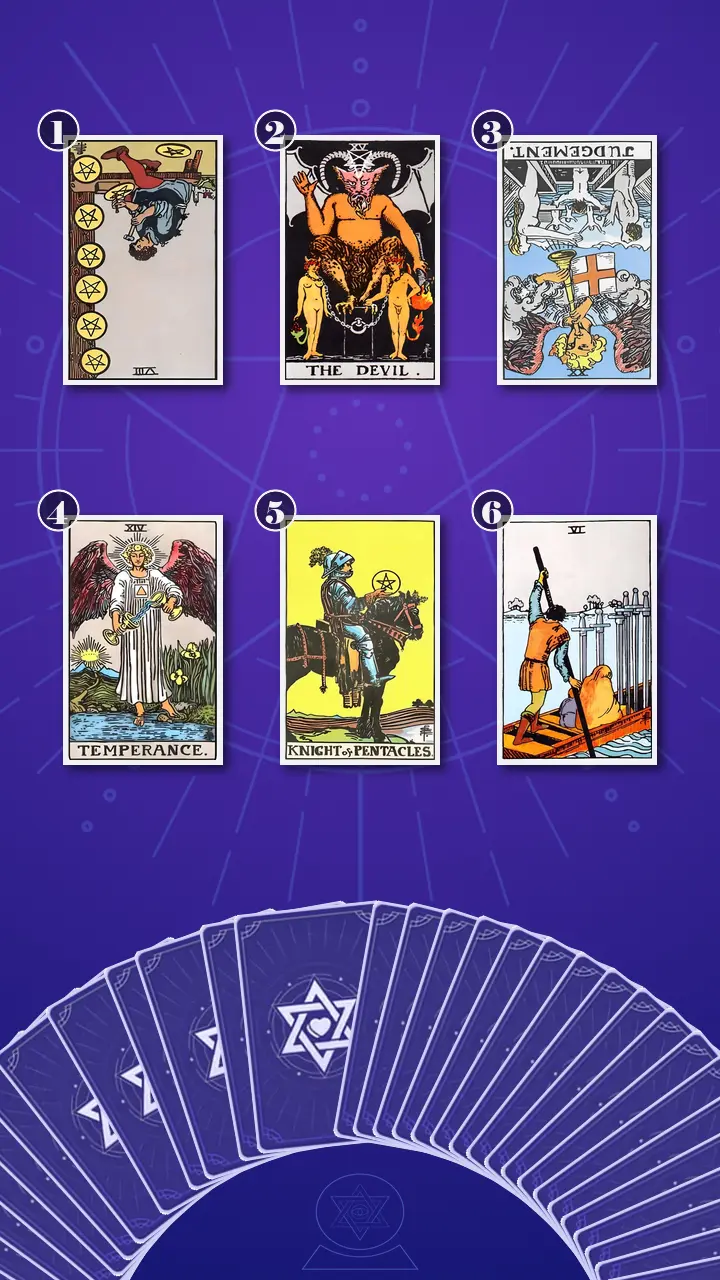
Reading the Map: Reps, Chains, and the Inner Verdict
Position 1: The Setup Ritual That Replaces the Reps
“Now flipped over,” I said, “is the card representing Surface pattern: the observable Pomodoro-reset behavior and what it’s protecting you from feeling in the moment.”
Eight of Pentacles, reversed.
I didn’t have to reach for a metaphor—this card hands you a workbench. “This is painfully literal,” I said. “It’s 11:00 AM, you’re about to start a design task. You open the doc, set 25:00, and then immediately start calibrating—re-opening the same tabs, re-reading the same brief, switching playlists, adjusting your task list headings. The moment it doesn’t feel like a perfect start, you reset, like the first two minutes are a test you must pass before you’re allowed to do real work.”
Reversed, the Eight isn’t a lack of talent. It’s interrupted practice—craft energy that keeps getting yanked back to “prep.” The energy here is blocked: your attention isn’t failing, it’s being diverted into control rituals that look productive and feel safer than a messy first rep.
I watched Jordan’s face as I spoke—then it happened: a half-laugh that had a bitter edge to it.
“That’s… rude,” they said, still smiling. “Accurate. But rude.”
“I’ll take accurate,” I replied, warm but steady. “And I’ll add this: You’re not bad at focus—you’re stuck in a reset ritual. There’s a difference.”
Position 2: When Structure Becomes a Cage
“Now we’re looking at The immediate blocker: what keeps the all-or-nothing loop locked in place when you try to start.”
The Devil, upright.
“This is the timer-as-judge dynamic,” I said. “Your Pomodoro timer stops being a tool and starts acting like a scoreboard for your worth. One tiny interruption makes you feel caught—like you’re chained to keeping it clean. The reset button becomes a compulsive escape hatch: if you restart, you don’t have to sit in the feeling of ‘I drifted,’ which your brain translates into ‘I’m not disciplined.’”
The energy of The Devil isn’t “bad.” It’s excess: too much pressure, too much identity tied to metrics. In a modern workday full of Slack pings and context switches, your brain grabs a simple binary—pass/fail—because it’s easier than uncertainty.
I leaned in a little. “If your timer app had a UI like a courtroom, it would literally flash Verdict across the screen. And the reset button would be your confession ritual. In your head it goes: ‘If I keep going after that slip, it means ___ about me.’ Control versus compulsion. Structure versus cage.”
Jordan’s breathing shifted—small, but real. First, a pause. Then their shoulders dropped a millimeter. Then a quiet, almost embarrassed “oh.”
“Yeah,” they said. “It’s like… if I continue, I’m agreeing that I’m the kind of person who can’t focus.”
“Exactly,” I said. “Not minutes. Identity.”
Position 3: The Replay That Tries to Restart Your Worth
“Now flipped over is The root driver: the deeper belief about self-worth, discipline, or evaluation that fuels the resets.”
Judgement, reversed.
“This is what happens after you hit reset,” I said. “After you reset, you mentally replay what went wrong like you’re reviewing game footage—the moment you checked a message, the moment you got distracted, the moment you ‘ruined it.’ You keep trying to re-start until you feel redeemed—like you need an internal stamp of approval before effort counts.”
Reversed Judgement is deficiency of self-acceptance. It’s the inner evaluation system staying unresolved, so you keep searching for a redo. I let the sentence land, then said it plainly: “You’re not restarting the task—you’re restarting your worth.”
Jordan went quiet. Their eyes moved off-screen, like they were watching the last ninety seconds of their own morning replay in their head. Then they nodded once, slow.
“I hate that you’re right,” they said. “It feels… moral. Like I have to be cleared to continue.”
I thought of the planetarium dome—how we don’t punish the sky for having clouds. We wait. We adjust the brightness. We keep the show going. “Then it makes sense you keep searching for a ‘perfect start,’” I said. “A perfect start feels like a verdict you can live with.”
When Temperance Steadies the Pour
Position 4: The Turning Point That Doesn’t Demand Perfection
When my fingers slid the next card forward, the room felt quieter—even through a screen. “We’re flipping the card that represents The turning point: the energy that can interrupt the loop without demanding perfection.”
Temperance, upright.
“Here’s the middle option your brain has been acting like doesn’t exist,” I said. “You stop chasing the perfect vibe and start practicing a middle move: when you drift, you don’t erase the session—you adjust and continue. You pause once, jot a tiny note about what pulled you, take one breath, and return from the remaining minutes. The win becomes staying inside the container, not proving you can be pristine.”
Temperance is balance—regulation over purity. It’s the thermostat, not the on/off switch.
Setup. Jordan’s familiar scene played between us: they sit down, hit 25:00, and two minutes in there’s a Slack ping or a random thought. Their jaw tightens. They reset—again—because starting messy feels like proof they’re not disciplined.
Delivery.
Stop treating one distraction as a reason to start over, and start blending your attention back into the task like Temperance’s steady pour.
I let the silence hang for a beat, like you do after a planetarium show when the stars fade and people need a second to remember they have bodies.
Reinforcement. Jordan’s reaction came in a chain, not a single emotion. First: a tiny freeze—breath caught, fingers tightening around their mug. Second: their eyes unfocused, as if their brain was scanning all the times they’d hit reset like it was pulling up a timeline. Third: an exhale that sounded like a door unlocking, immediately followed by a flash of anger.
“But—” they said, voice sharper. “If I do that, doesn’t it basically mean I’ve been doing it wrong? Like I’m just… accepting mediocre work?”
“I’m glad you said that,” I replied. “Because that’s The Devil talking through a productivity costume. It’s not asking for better work—it’s asking for a clean identity.”
I tipped my head slightly. “In astrophysics we have a concept called an event horizon—a boundary. Inside it, different rules apply. My signature lens for focus is what I call Black Hole Focus: we don’t chase perfect motivation; we define a boundary you can stay inside. Your Pomodoro is the event horizon. Slack pings, random thoughts, a sip of coffee—those are just objects passing by. They don’t get to collapse the whole system.”
Jordan’s shoulders lowered, slow this time, like they were being given permission to stop performing. Their mouth twitched—half relief, half disbelief.
“So the point is… I stay inside the container,” they said, quieter. “Even if it’s messy.”
“Yes,” I said. “And I want to name the exact shift we’re practicing: Shift from “a Pomodoro must be perfect to count” to “a Pomodoro is a container I stay inside even when my mind wiggles.””
I slid the practical drill across the table, keeping it gentle and specific, the way you’d teach someone to find Polaris—one recognizable star at a time:
10-minute “No-Reset Re-entry” drill (stop anytime if it spikes anxiety):
1) Start a 10-min timer (not 25).
2) The first time you drift, pause once (don’t reset). In a sticky note or Notes app, write exactly 5 words: “Pulled by: ___; returning now.”
3) Resume from the remaining minutes.
4) When the timer ends, write one line: “I returned when ___.”
Boundary: If you catch yourself negotiating rules (“but it doesn’t count”), you’re allowed to label it “Inner Judge” and continue without arguing with it.
Then I asked the question that turns insight into lived memory: “Now, with this new frame—container, not verdict—think back to last week. Was there a moment when a Slack ping or a thought showed up, and this would’ve changed what you did next?”
Jordan stared at the card, then nodded. “Tuesday. I reset because I answered one message. If I’d just… re-entered, I probably would’ve finished the wireframe.”
“That’s your proof,” I said. “Not that you’re perfect—just that the door exists.”
And I named the deeper arc for them, out loud: “This isn’t really time management. It’s a move from tense, shame-tinged self-monitoring to continuity-based calm and self-trust. One re-entry at a time.”
Continuity Beats Purity: The Knight Who Builds Trust
Position 5: The Next-Step Behavior You Can Repeat on an Average Day
“Now we’re flipping The next-step behavior: a concrete way to work that builds consistency and self-trust.”
Knight of Pentacles, upright.
“This is boring consistency,” I said, and Jordan smiled because they knew exactly what I meant. “You pick one repeatable, low-drama routine you can do even on a low-motivation day: one block, one tiny ‘done,’ no optimization until after. Instead of starting over to feel fresh, you keep a steady pace—showing yourself you can follow through without needing hype or perfection.”
The Knight’s energy is balance trending slightly toward deficiency of excitement—and that’s the point. If your nervous system craves dramatic fresh starts, the Knight trains reliability instead.
“Think TTC,” I added, because we were in Toronto now. “You don’t restart the whole Line 1 ride because one stop is loud and chaotic. You stay on. Your job is to return, not to be pristine.”
Position 6: The Calmer Crossing
“Last card: Integration—what ‘better’ looks like internally when you apply the new approach over time.”
Six of Swords, upright.
“Distractions still show up,” I said. “Thoughts, messages, noise. But they stop being emergencies. Because you’re returning instead of resetting, your mind gradually feels safer. This is a passage from rough water to calmer water—not by forcing the sea to stop moving, but by changing how you steer.”
Jordan nodded, and for the first time their face looked less like it was trying to win a trial. More like it was listening.
The No-Reset Re-entry Protocol (and Why It Works)
I pulled the whole spread together the way I’d describe an orbit: not with moral judgment, but with cause and effect.
“Here’s the story your cards tell,” I said. “At the surface, Eight of Pentacles reversed is the interrupted apprentice: you keep polishing the bench because you’re treating the first minutes like an exam. The Devil shows the lock: the timer became a moral scoreboard—structure turned cage—so the reset gives quick relief. Judgement reversed is the engine under that: a harsh inner verdict you’re trying to avoid, so you keep replaying and restarting to feel cleared. Temperance is the leverage point: blend and continue. The Knight makes it real: one small promise kept. And the Six of Swords is the outcome: not perfect silence, but calmer water because you stopped letting distraction decide whether you count.”
“Your cognitive blind spot,” I added, “is thinking the reset is about productivity. It’s actually about self-protection. The reset button isn’t fixing time—it’s trying to protect you from a verdict.”
“So the direction is simple,” I said, looking Jordan in the eye through the camera. “Continuity over purity. Don’t reset the clock. Re-enter the task.”
Then I gave them actionable advice—small enough to start today, concrete enough to survive a real Slack ping.
- Do the 10-minute No-Reset Re-entryToday, set a 10-minute timer (not 25). The first time you drift, pause once and write a 5-word re-entry note (e.g., “Pulled by Slack—back to Figma”), then resume from the remaining minutes.Expect “this doesn’t count” to pop up. Name it “streak brain,” and keep going anyway.
- Build a one-line “Re-entry” sticky notePut a sticky note on your monitor that says: (1) one breath (2) one click back (3) one sentence/one shape. Use it every time you catch your finger hovering over reset.If writing feels like too much, make the third step absurdly small: “add one placeholder rectangle.”
- Define “done for this block” before you startBefore you hit start, write one sentence: “Done = ____.” Example: “Draft two screens,” “Write 6 bullets,” or “Send the rough email.” Finish that before you optimize playlists, tools, or headings.Make it boring on purpose. No new app/system for 7 days—only reps.
I layered in one of my communication tools, because it fits naturally here: “If a distraction is genuinely important, use what I call Shooting Star Notes,” I told them. “Thirty seconds. Capture the thought in the smallest possible line, then let it burn up in the atmosphere. You don’t give it a whole new orbit.”

A Week Later: The Quiet Proof
Six days later, Jordan emailed me a screenshot—just a Notes app line and a timer photo. The note said: “Pulled by Slack—returning now.” Under it: “I returned when my jaw clenched.”
“I still drift,” their message said. “But I’m not restarting my self-worth. I did one messy 10-minute block each day. It’s weirdly calming.”
They didn’t describe fireworks. They described something better: a small, steady crossing.
They finished a block, then sat alone at their desk for a minute—no triumphant playlist, no perfect routine post. Just a quieter chest. The next morning the first thought was still, “What if I mess it up?”—but this time they exhaled and opened the doc anyway.
That’s the Journey to Clarity I trust most: not certainty, but ownership. Not a flawless streak, but a practiced return.
When one tiny distraction makes your jaw clench and your finger hover over “reset,” it’s not just about time—it’s that split-second fear that a messy start means something messy about you.
If you let a Pomodoro be a container instead of a verdict, what’s the smallest way you’d practice “returning” today—one breath, one sentence, one click back?