From Overwhelm Paralysis to Steadier Pacing: One Money Move + One Study Move

Finding Clarity in the 9:41 p.m. Canvas → Bank App Spiral
If you’re a college student in NYC trying to juggle midterms and rent, and you keep opening Canvas → bank app → TikTok like it’s a problem-solving sequence (spoiler: it’s not), you’re not alone in this overwhelm paralysis.
Taylor showed up on my screen with that specific Sunday-night sheen in her eyes—the one you get when the week ahead is already leaning on your chest. She was in a bedroom that was basically a desk with a bed attached. I could hear a radiator click like it was counting seconds. Somewhere beyond her door, a roommate laughed, bright and careless. Her laptop fan had that thin, constant whir that sounds like panic wearing a disguise.
“It’s… midterms and rent due the same week,” she said, and the words came out fast, like she’d been holding them under her tongue all day. “And I have no energy. I sit down to start and my brain just… tab-hops. Canvas. Bank app. Notes. Then I’m on Reels and it’s midnight.”
I watched her hand drift to her chest without her noticing. Her shoulders stayed lifted, as if she was bracing for impact. The feeling in her body wasn’t abstract anxiety—it was like she was trying to walk through the city in a coat that had been soaked through, heavy at the seams, dragging down her arms and legs. Every time she thought about rent or a grade, you could see a small tightening at her throat, as if the air itself had a late fee.
“You want to prove you can handle school and adulthood,” I said gently, “and at the same time, one slip feels like it could snowball into financial instability and failure. That collision is brutal on the nervous system.”
I took a slow breath on purpose so she’d have something to match. “Let’s make this a Journey to Clarity. Not ‘fix your whole life tonight.’ Just: what’s your next step past overwhelm—based on what’s actually happening, not what you think you should be able to do.”

Choosing the Compass: How the Celtic Cross Works for Overwhelm Paralysis
I was calling from a small staff room at the Tokyo planetarium, where I spend most of my days explaining celestial motion to school groups—how a planet doesn’t panic and sprint across the sky, it follows a path that repeats. The irony isn’t lost on me: people come to the dome to feel soothed by a universe that keeps its rhythm, and then we step outside and try to live like we’re immune to gravity.
“Before we pull cards,” I told Taylor, “we’re just going to do one thing: focus the question.” I invited her to take one breath in through her nose and let it out slower than she wanted to. Not as a mystical ritual—more like hitting ‘reset’ on a browser that’s frozen.
I shuffled slowly. “Today I’m using a spread called the Celtic Cross. It’s not because it’s dramatic—it’s because it’s good at multi-factor situations like yours. It separates the present overload, the immediate stressor, the deeper root under the to-do list, and then shows the simplest workable opening. It also distinguishes what’s happening inside you from what resources exist around you. When rent stress carries shame, that distinction matters.”
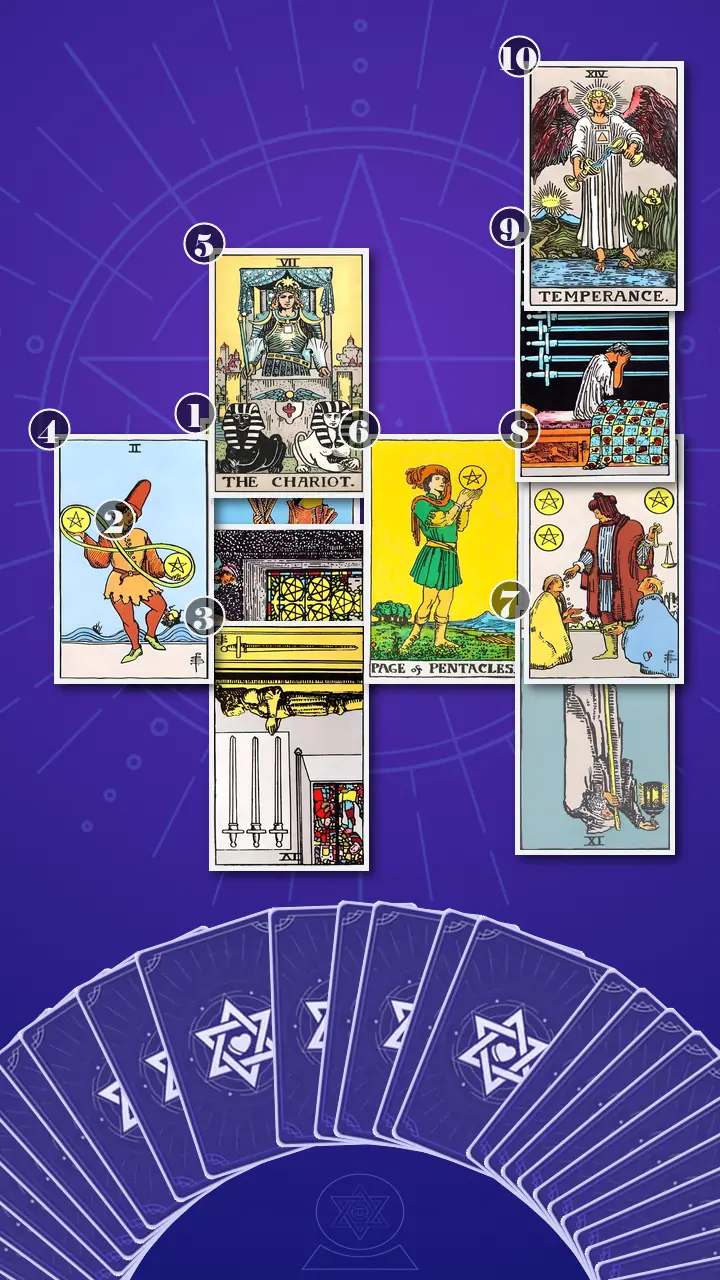
“Here’s the map,” I continued, orienting her to the structure so she wouldn’t feel lost. “The first card shows what your overwhelm looks like in real time. The crossing card shows the pressure point making everything harder. The root card shows what’s draining your capacity underneath it all. And the final card doesn’t ‘predict your fate’—it points to the most stabilizing direction if you follow the practical path forward.”
Reading the Map: Tarot Card Meanings in Context
Position 1 — Your current overwhelm pattern in daily behavior
“Now flipped,” I said, “is the card that represents your current overwhelm pattern in daily behavior—what ‘midterms + rent + no energy’ looks like in real time.”
Ten of Wands, reversed.
“This card always makes me think of a laptop with fourteen tabs open,” I said, “three notification dots screaming for attention, and then that low-battery warning that feels weirdly personal. It’s the moment where your brain says, ‘If I pick the wrong thing first, I’ll waste time… so I pick nothing.’”
Reversed, the Ten of Wands isn’t just ‘busy.’ It’s overload shutdown. The energy here is a blockage: you’re carrying so many invisible obligations at once that even the essentials slip out of your hands. The figure on the card can’t even see where they’re going—the wands block the line of sight. That’s you when Canvas, your rent portal, and your bank balance all feel like the same emergency.
“If everything is urgent, nothing gets started,” I added, because sometimes naming the mechanism is the first mercy.
Taylor let out a tight, bitter little laugh. “That’s… yeah. That’s exactly what I do.” Her eyes flicked away from the screen like the accuracy was almost rude, and then she exhaled—small, but real.
Position 2 — The immediate pressure point making everything harder
“Now we’re looking at the immediate pressure point—the most active obstacle right now.”
Five of Pentacles, upright.
“This is the rent card in the most human way,” I said. “Two people in the snow, outside a lit window. The cold isn’t just weather—it’s scarcity. It’s that instant drop in your stomach when you open your banking app and your brain decides you’re alone in it.”
In energy terms, this is Earth insecurity amplified: rent stops being ‘admin,’ and becomes a threat signal. Studying stops being ‘learning,’ and becomes survival—like your score will determine whether you get to stay inside the warm building of adulthood.
“The trick of this card,” I told her, “is that the window is lit. Support exists. But shame convinces you not to walk toward it.”
Her jaw tightened, just a fraction. “I hate that you said shame, but… yeah.”
Position 3 — The hidden driver beneath the overwhelm
“Now flipped is the card for the hidden driver beneath the overwhelm—what’s draining your capacity underneath the to-do list.”
Four of Swords, reversed.
“This is the burnout mechanism,” I said plainly. “Not the aesthetic version. The actual one.”
I kept my voice calm, almost clinical, because this isn’t where you need poetry—you need permission. “Reversed, it’s being horizontal but still braced. Jaw tight. Shoulders up. Eyes open to the glow of the phone. You tell yourself, ‘I’ll rest after I fix it,’ and then ‘rest’ turns into more stimulation. So your nervous system never climbs down.”
In energy terms: recovery is deficient. And when recovery doesn’t land, focus can’t land either. Your brain isn’t refusing to work because you’re lazy—it’s conserving power because it thinks it’s in danger.
Taylor went quiet, then said a small, surprised, “Oh.” Her shoulders dropped half an inch, like her body recognized itself in the description before her mind could argue.
Position 4 — The recent pattern that set the stage
“Now we’re looking at what you’ve been doing recently that led to this moment.”
Two of Pentacles, upright.
“This is the juggling card,” I said. “And to be clear: it’s not an insult. It says you’ve been adapting. You’ve been trying.”
But the infinity loop around the pentacles is the tell. “It’s like switching between two Spotify playlists mid-song—rent panic, midterm panic—so neither song ever finishes. You stay busy, but you don’t feel safe.”
In energy terms: it’s a skill that turns costly when your battery is already low. Multitasking becomes motion without traction.
Taylor nodded slowly. “I keep thinking if I just keep both balls in the air, I’m fine. And then… I’m not.”
Position 5 — Your conscious goal or pressure story
“Now flipped is your conscious goal—what you think you should be able to do.”
The Chariot, upright.
I smiled a little, because I know this archetype intimately. In the planetarium, I’ve watched people stand under a dome of stars and still try to control the universe with willpower. “This is the part of you that believes control equals safety,” I told her. “The two sphinxes pull in different directions—midterms and rent—and you’re trying to steer without letting anyone see you strain.”
The Chariot’s energy is strong, but it can go excessive: you start believing the only acceptable solution is to power through. No rest. No asking. No pacing. Just grip tighter.
My own internal flashback came quick and sharp: ten years ago, training as a guide, timing my voice to the projector’s movement—if I rushed, the constellations didn’t become clearer. They became noise. “Discipline isn’t always pressure,” I said to Taylor. “Sometimes it’s steering your attention like it matters.”
Position 6 — The near-term opening (the next workable step)
“Now we’re looking at the near-term opening—the kind of next step that becomes available if you stop spiraling and start moving.”
Page of Pentacles, upright.
“I love this card for exam weeks,” I said. “It’s the Student-Builder. One pentacle. One task. Fully held.”
Modern translation: “You stop trying to fix your whole semester tonight. Instead you do one concrete unit: five practice questions on one topic, timed. Or one budget number written down without drama. The Page doesn’t do heroic bursts. The Page does repeatable reality.”
In energy terms, this is grounded Earth as solution: measurable steps that rebuild trust through proof, not through suffering.
Taylor’s face softened—like she could picture it. “That feels… annoyingly doable,” she said, and there was the tiniest edge of relief in her voice.
Position 7 — Your internal stance and self-talk
“Now flipped is your internal stance—how you’re relating to the situation.”
The Hermit, reversed.
“This is isolation disguised as independence,” I said. “It’s staring at an unsent email draft to a TA, or typing ‘Hey, about rent timing—’ in the roommate group chat, then backspacing because it feels embarrassing.”
Reversed, the lantern isn’t lighting the path. It’s turned inward until it becomes a private interrogation lamp.
“Needing support isn’t failing—it’s resource management,” I said, carefully, because this is where shame likes to hide.
Taylor’s reaction came in a three-step ripple: her breath paused; her eyes unfocused for a second like she was replaying a memory; then she blinked hard and swallowed. “I have… an unsent message right now,” she admitted, almost annoyed at herself.
Position 8 — External factors and resources (support around you)
“Now we’re looking at your environment—what support or constraints exist around school and rent.”
Six of Pentacles, upright.
“This is the hinge,” I told her. “This is you walking toward the lit window.”
It’s scales in one hand: fairness. Exchange. Not begging. Not confessing. Just logistics and balance. “Office hours. Tutoring schedule. Payment plan FAQ. A neutral roommate timing text. This card says the world may be more flexible than your panic is allowing you to see.”
In energy terms, this is the first believable unlock: not motivation—options. The kind that reduce uncertainty so your brain can stop treating everything like an immediate threat.
Taylor leaned closer to her screen, like she wanted to climb into the card. “I haven’t even checked the bursar site,” she said. “I keep… refreshing my bank balance instead.”
“That makes sense,” I said. “Refreshing anxiety feels like action. But it doesn’t change the variables.”
Position 9 — Your mental loop (hopes and fears)
“Now flipped is your hopes and fears—the loop your mind gets stuck in.”
Nine of Swords, upright.
“This is 3 a.m.,” I said, and Taylor’s face did that immediate recognition wince. “Phone warm in your palm. Sheets twisted around your legs. You’re mentally retaking the exam, redoing your budget, rehearsing every possible failure.”
In energy terms, Air is excessive: thoughts overhead like a rack of swords. The fear is obvious—‘What if I fail?’ But the hope is hidden: part of you believes that if you keep worrying, you’ll stay in control. Like worry is a job you can’t quit.
“What problem are you trying to solve with worry,” I asked, “that would be better solved with one concrete action in the morning?”
She looked down. “I think I’m trying to solve… uncertainty. Like if I worry hard enough, I’ll be prepared.”
“Exactly,” I said. “But worry doesn’t prepare. It depletes.”
When Temperance Spoke: The Firebreak Between Rent Panic and Midterm Panic
“We’re turning the final card now,” I told her, and I slowed down on purpose. In the planetarium, when I cue the moment a meteor streaks across the dome, I’ve learned silence is part of the lesson. “This one is your integration—your most stabilizing direction if you follow the practical path forward.”
Temperance, upright.
“Temperance is the opposite of ‘win the week in one night,’” I said. “It’s regulated pacing. Mixing. The angel pours between two cups like it’s normal to have two realities at once—school and money—without either one flooding the room.”
And here, I brought in the framework that’s become my signature as both an astronomy educator and a tarot reader: “I call this Black Hole Focus,” I said. “In astrophysics, an event horizon is the boundary where things get pulled in—past it, you don’t ‘half fall.’ Your attention works like that too. When your night turns into rent-tab → Canvas-tab → TikTok-tab, you’re skimming the edge of the event horizon and losing energy to constant switching. Temperance is you choosing where the horizon is on purpose: one small money orbit, one small study orbit, and then you let the rest drift until tomorrow.”
Her brows knit, like she wanted to argue. I could almost hear the Chariot in her head revving its engine.
Setup (the moment right before the shift): Taylor was stuck in that late-night place where her phone felt like a heating pad for panic. She’d been jumping between her bank app and her lecture slides like the right tab would magically make her feel capable—like there was a hidden ‘correct priority’ that would stop her chest from tightening.
Delivery (the sentence that has to land):
Stop trying to win the week in one night; start pouring your attention in the right proportions like Temperance’s cups.
I let the words sit there. No extra explanation for a beat.
Reinforcement (what I saw happen in her body): Taylor’s reaction didn’t start as relief—it started as friction. First, she went still, like her whole system froze to check whether this meant she’d been doing it “wrong.” Then her mouth pulled tight and she blurted, sharper than she meant, “But if I don’t push hard, doesn’t that mean I’m basically admitting I can’t handle it?”
That was the unexpected truth underneath the overwhelm: not laziness—identity.
I nodded. “I hear that. And I’m going to challenge it gently: pacing isn’t quitting. It’s steering. The Chariot doesn’t prove strength by snapping the wheels off. It proves strength by getting you home.”
Her breath hitched. Then came the three-step release chain: (1) her shoulders stayed high for one more second, as if waiting for punishment; (2) her gaze unfocused, like she was watching her own Sunday nights replay; (3) she exhaled, long and shaky, and her shoulders dropped so visibly that even her hoodie collar shifted.
“Okay,” she whispered, and the word sounded like her body believed it before her brain fully did.
“Let’s make this real,” I said, and I guided her through the Temperance exercise exactly as a container, not a performance. “Set a 10-minute timer. For 5 minutes, write two lines on paper: (1) ‘Money: the smallest stabilizing step I can do today is ___.’ (2) ‘Midterms: the smallest focused step I can do today is ___.’ For the next 5 minutes, do the first step of whichever line feels most doable—open the rent portal and check the exact due date/options, or open one practice set and do just Question 1. If your chest tightens and you start spiraling, pause and take one slow breath with: ‘I’m allowed to do the smallest real thing.’ You can stop at 10 minutes. The win is movement, not finishing.”
She blinked fast, eyes glassy but not falling apart—more like the relief had surprised her. “That’s… so much less than what I’ve been trying to force,” she said.
“That’s why it works,” I replied. “Temperance is a firebreak. Your brain is treating rent and midterms like two fires—Temperance is the firebreak.”
Then I asked the question that turns insight into self-recognition: “Now, with this new lens—can you think of a moment last week when this would’ve changed how you felt? Even five percent?”
Taylor stared at the ceiling like she was searching a timeline. “On the train,” she said. “I had notes open and then I remembered rent, and I just… spiraled. If I’d done one tiny money check and then one question… I wouldn’t have lost the whole commute.”
“Exactly,” I said. “This is a shift from frozen overwhelm toward calmer focus with realistic limits. Not perfection. Sustainable momentum.”
The One-and-One Rule: Actionable Advice for the Next 48 Hours
I brought the whole spread together the way I’d explain a night sky to a room full of students: not as ten separate facts, but as one pattern you can navigate by.
“Here’s the story your cards are telling,” I said. “You’ve been juggling (Two of Pentacles) until the system hit overload (Ten of Wands reversed). Rent pressure puts a scarcity lens over everything (Five of Pentacles), and because real recovery hasn’t been landing (Four of Swords reversed), your mind tries to solve safety through force (The Chariot) and worry (Nine of Swords). The hidden trap is doing it alone (Hermit reversed). The leverage point is re-entering fair support and concrete options (Six of Pentacles). The opening is small, measurable work (Page of Pentacles). And the integration is Temperance: a repeatable mix.”
“Your cognitive blind spot,” I added, “is that you keep making plans like you’re a person with unlimited energy. Your transformation direction is the opposite: triage. One minimum viable action for money and one for studying—then stop. Let that be enough for today.”
Taylor grimaced. “But what if I literally can’t even fit it in? I have a shift tomorrow, and then class, and then—”
“That’s real,” I said immediately. “So we don’t make a plan that requires a fantasy version of you. We make a plan that respects gravity.”
“Here are your next steps,” I said, keeping them unglamorous on purpose—because unglamorous is repeatable.
- The Two-Minute Support Ask (Six of Pentacles)Today, send one message—no backstory. To a TA/classmate: “Hey—what topics would you prioritize for the midterm review?” Or, if rent timing involves roommates: “Quick check—are we all paying on the same day this month? I’m planning my timing.”If shame spikes and you start adding explanations, delete everything except the single sentence and hit send before you renegotiate it.
- One Page-of-Pentacles Study Unit (25 minutes)Set a Pomodoro for 25 minutes. Pick ONE subject and complete ONE concrete set (e.g., 5 practice questions). No rereading slides as a substitute—this is about proof of movement.Friction-reducer: phone in another room or Focus mode. If 25 minutes feels impossible, do 10 minutes. Still counts.
- The Temperance Pacing Mix (3-day experiment)For the next 3 days, do a 2-block daily mix: 25 minutes study + 10 minutes rent/admin, then stop. Decide the end time before you start so your brain can’t bargain at midnight.Use “Shooting Star Notes” if a panic-thought hits: take 30 seconds, jot the thought on paper, and return to the timer. Capturing it is enough—you don’t have to solve it mid-block.
“One money move. One study move. That’s a real day,” I reminded her. “Not a perfect day. A real one.”
And because Taylor’s mind was still hungry for structure, I offered one optional tool from my own strategy kit. “If your topics feel like a pile of random rocks,” I said, “try my Planetary Memory Palace. Put your midterm subjects into a solar system: the biggest, most test-heavy topic is ‘Jupiter.’ The smaller subtopics are ‘Mars’ and ‘Venus.’ Your goal isn’t to visit every planet tonight. It’s to land on one planet and collect one sample.”
A Week Later: Ownership, Not Certainty
Six days later—Tokyo morning for me, late NYC night for her—Taylor sent a message that was short enough to be honest.
“Did the one-and-one thing,” she wrote. “Messaged my TA. Did 5 practice questions. Checked the rent portal once and screenshot the payment plan info. Didn’t fix everything, but I’m not frozen.”
I pictured her at that same tiny desk, but with a different kind of light in the room—the kind that shows up when you stop trying to prove you’re superhuman and start acting like someone worth stabilizing.
Clear-but-vulnerable is how change often looks at first: she told me she slept through the night for the first time in weeks, then woke up and her first thought was still, “What if I mess this up?”—but this time, she exhaled and opened one practice question anyway.
That’s the Journey to Clarity I trust most: not certainty, but ownership. Not winning the week in one night—building a rhythm you can return to.
When midterms and rent hit at the same time, it can feel like you’re trying to prove you’re capable while your body is on 1%—and every ‘small’ slip starts to sound like evidence you’re not safe.
If you let “enough for today” be one money move and one study move—what would you choose as your smallest honest pair?
Every reading at AceTarot is a Journey to connect with inner wisdom and empower next step.
Learn more about our Journey to Clarity.