From Lecture Backlog Overwhelm to a Boring, Reliable Study Rhythm

The Tuesday-Night Backlog Wall (and the “can’t press play” freeze)
If you’re a Toronto uni student who opens the course page with good intentions, sees a long dated list of lecture recordings, and immediately feels that tight-chest “I’m so behind” drop (hello, Sunday Scaries), I already know the moment you mean.
Jordan booked me from a shared house near campus, but when we met on video it was 8:47 p.m. on a Tuesday for them—the exact time when the day is technically over and your brain starts tallying what you didn’t do. The blue-white glare of their laptop lit the underside of their cheekbones. Somewhere off-screen, a roommate laughed, the thin wall doing its best impression of privacy. Jordan’s cursor hovered over the course page like it was standing at the edge of a pool that looked too cold.
“I open Quercus,” they said, voice flat in that way that tries to make stress sound normal, “and the list just… keeps going. Week 3, Week 4, Week 5. I click one, switch to 2x, then I’m suddenly in Messages. Or Instagram Stories. Like my thumb is trying to rescue me.”
They swallowed, and I watched their shoulders creep up a millimeter at a time. “Lecture recordings are piling up,” they said. “What’s my next step to catch up? Because I keep planning, and I don’t actually watch.”
The feeling in their body wasn’t abstract at all. It was a tight chest like a seatbelt that locks when you brake too hard, and a heavy, sinking drop in the stomach—like the moment the TTC dips into a tunnel and your phone signal stutters.
“Okay,” I told them, gently on purpose. “We’re not here to shame you into discipline. We’re here to understand the loop—why you freeze right before you press play—and to leave with one next step you can repeat in your real life. Let’s make a map through the fog. Let’s find clarity the practical way.”

Choosing the Compass: a Past-Present-Future tarot spread for school stress
I live in Tokyo, and most nights I’m a tour guide under a planetarium dome—teaching kids and exhausted adults why planets look like they “wander,” why eclipses are predictable, why the same sky can feel different depending on the season. After hours, the projector room is quiet in a way that makes thinking easier. That’s where I did Jordan’s reading: a desk with star charts, a mug of cooling tea, and a deck of tarot that has been shuffled through a decade of people needing a next step more than a miracle.
“Before we pull cards,” I said, “take one breath and aim it at the exact moment you bail—when you see the list, when you hit play, or three minutes in.”
They closed their eyes for half a second. “It’s when I see the list. It hits like a wall.”
I shuffled slowly. Not as a mystical performance—more like a gear shift. A transition from spiraling to observing. “Today we’ll use a classic Past–Present–Future spread,” I explained, because their question was time-oriented and practical: how the backlog formed, what’s keeping them stuck now, and what realistic next step rebuilds momentum without burning them out.
For readers: this three-card timeline works so well for “lecture backlog paralysis” because it doesn’t let the mind turn the situation into an infinite puzzle. It forces a clean arc—origin → blocker → next step. Card 2 becomes the bottleneck in the pipeline, and card 3 becomes the exit ramp.
“We’ll read the left card as what created the pile-up,” I told Jordan. “The center as what’s happening at the exact moment you could begin. And the right as the most workable rhythm for the next phase—something you can actually do on a Tuesday, not just in a fantasy ‘perfect weekend.’”
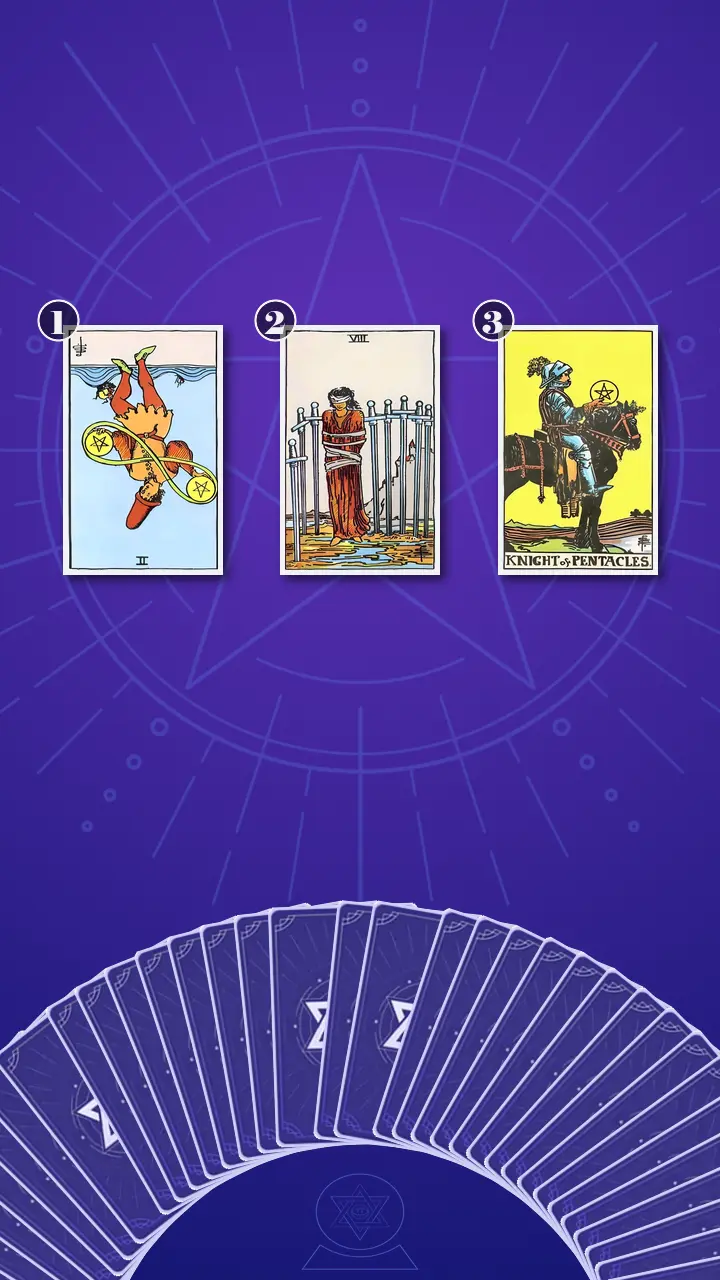
Reading the Map: from juggling to the narrow mental gate
Position 1 — Backlog origin: what habits and pressures built the pile-up
“Now flipped over,” I said, “is the card representing Backlog origin: the concrete habits and pressures that caused the lecture recordings to pile up.”
Two of Pentacles, reversed.
In the card, the juggler keeps two pentacles moving in an infinity loop, knees bent, never quite stable. Reversed, it’s not “you’re bad at time management.” It’s the energy of juggling tipping into constant reshuffling—motion that mimics progress.
“This,” I said, “is like when you keep switching between courses, tabs, and playback speeds—reordering, time-blocking in Notion or Google Calendar, optimizing your study apps—so your energy goes into managing the system instead of actually watching and retaining.”
I watched Jordan’s face as recognition landed. They let out a short laugh that had a bitter edge to it—an unexpected reaction that was half relief, half ‘wow, called out.’
“That’s… kind of brutal,” they said. “Because I’ll spend twenty minutes deciding whether to do 1.5x or 2x like that’s the real work.”
“Planning is not the same as progress—especially when planning is how you avoid starting,” I replied, not scolding, just naming the mechanism. “The reversed Two of Pentacles isn’t accusing you. It’s saying real life kept bumping your routine—roommates, noise, social invites, deadlines—and your solution became more juggling.”
Energetically, this is Earth in imbalance: practical structure gets wobbly, so your brain tries to compensate by constantly rearranging the pieces. The infinity loop ribbon is the tell: the backlog can feel endless because you’re stuck in coordination mode.
Position 2 — Current blocker: the trap right before you press play
“Now we turn over the card representing Current blocker: the specific mental/behavioral trap that keeps you from pressing play and following through,” I said.
Eight of Swords, upright.
I always pause a beat with this card, because it’s so physical. The blindfold. The loose bindings. The narrow enclosure of swords that looks like a cage—until you notice there’s open ground beyond it.
“This is the ‘tabs are open but nothing is playing’ problem,” I told Jordan. “You technically have access. You have options. But your standards put you in a blindfolded state: I’m not allowed to start unless it’s the right lecture, the right mood, the right focus. So the course page becomes a mini-trial.”
I leaned in. “Right before you close the tab, what’s the exact thought that lands hardest—‘I’ll do it properly later,’ ‘I don’t even know where to start,’ or ‘If I can’t catch up, what does that say about me’?”
Jordan’s shoulders lifted again, like their body answered before their words. Their cursor hovered mid-air on the screen share, not clicking anything. “It’s the last one,” they admitted. “Like… if I’m behind, it means I’m not disciplined. I can’t be trusted with my own goals.”
I let that sit without rushing to soothe it away. “Your backlog isn’t a moral failing. It’s a friction problem,” I said. “And the Eight of Swords is what friction feels like when it turns into a rule.”
They went through a tiny three-step reaction chain I’ve seen in a hundred different forms: first, a brief freeze—breath held; then cognition leaking in—eyes unfocusing as if replaying every late-night ‘I’ll catch up this weekend’ plan; then a small emotional release—an almost-silent, “Oh.”
“Notice something important,” I added, pointing to the card on my side of the camera. “The bindings are loose. The space is open. The feeling is trapped, but the situation isn’t locked.”
“So what’s the way out?” Jordan asked, and the question had a sharpness to it—like they were bracing for a lecture about self-control.
“A gate,” I said, simply. “One decision rule so your brain doesn’t renegotiate daily. No scanning. Pick a rule. Press play.”
When the Knight of Pentacles Put Down a Lantern: the boring rhythm that rebuilds trust
Position 3 — Next step: the sustainable action pattern that actually catches you up
I could feel the shift in the room—even through screens. The planetarium projector behind me clicked softly as it cooled, like punctuation. “We’re turning over the most important card in this reading,” I told Jordan. “The one that answers: what’s your next step?”
Knight of Pentacles, upright.
The knight sits steady. The horse doesn’t bolt. The pentacle is held at chest level like a single, chosen priority. Behind him, a plowed field waits—row by row, not glamorous, but real.
“In modern life,” I said, “this is you becoming boring on purpose: a daily lecture window like brushing your teeth—no debate, no perfect mood required. One chunk. Stop on purpose. Log the timestamp so restarting is frictionless.”
Setup
Jordan nodded, but I could see the old pattern trying to sneak back in—eyes darting as if searching for the ‘best’ way to do the boring thing perfectly. Their mind was still stuck at that course page wall: chest tight, bargaining about order, three tabs deep, anything but pressing play.
Delivery
Stop trying to save the whole semester in one night and start plowing one straight furrow at a time like the Knight of Pentacles.
Reinforcement
The sentence landed like gravity. Jordan’s face did that micro-flicker I’ve learned to watch for: first their eyes widened a fraction, then their jaw unclenched like they’d been biting down without noticing. Their shoulders stayed lifted for one more second—habit—then dropped, slowly, as if their body finally got permission to stop performing urgency.
They frowned, not because they disagreed, but because it was almost offensive how simple it sounded. “But… that means I can’t ‘fix it’ in one push,” they said, and there was a flash of anger in it—an unexpected edge. “Does that mean I messed up too badly?”
“It means the rescue-mission fantasy has been keeping you stuck,” I said, calmly. “And you’re allowed to choose a different physics.”
This is where I used my own framework—what I call Black Hole Focus. In astrophysics, an event horizon is a boundary: past it, nothing escapes—not because of willpower, but because the system has rules. “For the next seven days,” I told Jordan, “we create an event horizon for your attention. Set a 10-minute timer. Open the course page and do not scan the full list. Click the oldest recording (or the one tied to the next tutorial). Watch exactly 10 minutes at 1.25x–1.5x. When the timer ends, stop on purpose and write one line: ‘I stopped at 12:43; key point: ____.’ If your chest tightens or shame spikes, exhale, and you can end the experiment—no forcing it.”
I let a beat of silence do its work. “Now,” I asked, “with this new perspective, think back to last week. Was there a moment when you were hovering over ‘play’—and this would have made it feel different?”
Jordan stared slightly past the camera, like they were looking at the TTC window reflection version of themselves. “Sunday,” they said, softer. “On the streetcar. I made a perfect plan in Notes and then closed it because it felt like… a verdict.” They inhaled, deeper this time. “Ten minutes feels… survivable.”
That was the turn: not from ‘I’m fixed’ to ‘I’m fine,’ but from overwhelm-and-guilt paralysis (“I need the perfect plan or it doesn’t count”) to steady self-trust built through small, repeatable follow-through. A small step—but in the right orbit.
The Rule-Then-Play Method: actionable advice that fits a real week
I pulled the three cards together into one story, the way I’d explain a constellation to a group under the dome.
“Here’s the arc,” I said. “The backlog didn’t form because you don’t care. It formed because your routine kept getting bumped, and you tried to juggle harder (Two of Pentacles reversed). That instability fed a narrow mental gate—an approval process in your head called ‘perfect order’ (Eight of Swords). The exit isn’t more analysis. It’s Earth energy restored: a steady, boring rhythm that proves you can trust yourself again (Knight of Pentacles).”
“Your cognitive blind spot,” I added, “is thinking you need a heroic rescue mission to earn relief. But the transformation direction here is smaller and stronger: shift from ‘I need to clear the whole backlog’ to ‘I only need a reliable next 30 minutes and a simple tracking system.’”
Jordan made a face—half laugh, half panic. “But I don’t even have thirty minutes. Between classes, roommates, everything… I barely get five.”
“Good,” I said, and I meant it. “Then we start with five. We’re not negotiating with reality. We’re designing around it.”
- Book the “Lecture Appointment”Pick one daily lecture window for the next 7 days (even 10 minutes). Put it in Google Calendar like a real appointment—e.g., 4:30–4:40 p.m. in the library, or 9:10–9:20 p.m. with headphones in your room.Your brain will argue “too small to matter.” Treat that as the Eight of Swords voice doing its job. Lower the bar further if needed—consistency beats intensity.
- Set one Gate Rule (so you stop renegotiating)Choose one: (A) Oldest-first, or (B) Next-assignment-first. Write it at the top of your Notes/Notion page in ALL CAPS. When you catch yourself scanning, say: “Rule, then play.” Click within 10 seconds.This is a friction-killer, not a perfect strategy. If the rule ever needs changing, change it between sessions—not mid-session.
- Leave a Timestamp Trail + a 30-second “Shooting Star Note”At the end of each session, log: course + video title + timestamp where you stopped + one sentence you understood (15 seconds is fine). If you want extra structure, use my Planetary Memory Palace: each course is a “planet,” each lecture gets a quick “moon note” with a timestamp, so you always know where to re-enter orbit.Stop on purpose—so tomorrow is easy. The goal is a frictionless restart, not an A+ note-taking system.
“This is how tarot works in real life,” I told Jordan. “It doesn’t shame you into motivation. It names the bottleneck, then gives you a structural workaround. Your backlog isn’t a character flaw—it’s a system with a choke point.”

A Week Later: ownership, not certainty
Six days later, Jordan messaged me a screenshot that looked almost too plain to be inspiring: three lines in Apple Notes.
“POLI SCI — Week 3 — stopped at 18:12 — ‘Key point: legitimacy isn’t the same as legality.’”
“ECON — Week 4 — stopped at 09:47 — ‘Key point: marginal means the next unit.’”
“I did ten minutes,” they wrote. “Then I stopped. On purpose. And weirdly… I didn’t hate myself after.”
It wasn’t a dramatic transformation montage. They didn’t clear the whole backlog. They didn’t become a productivity influencer. They just proved, in a quiet way, that their next step didn’t require a perfect plan—only a repeatable one. That’s what a Knight of Pentacles win looks like: small, grounded, and stubborn in the best way.
When I think about Jordan now, I think about orbital periods. You don’t move a planet by yelling at it. You change its path with steady, consistent forces applied over time. This was their Journey to Clarity: from shame-driven avoidance to calm consistency—one short session, one logged timestamp, one returned-to tomorrow.
Because when you’re staring at a backlog, it can feel like you’re not just behind on lectures—you’re on trial for whether you can be trusted with your own life.
If you didn’t have to ‘save the whole semester,’ what would a reliable next 30 minutes look like for you—today, in the place you actually live?