From a Post-B Shame Spiral to Grounded Effort Without Self-Punishment

The 11:58 p.m. Grade Portal Refresh
If you’ve ever refreshed the grade portal like it’s a stock ticker the second an exam drops—and felt that instant stomach-drop when it’s a B—welcome to the validation loop.
Taylor (name changed for privacy) sat cross-legged on her bed in a small Toronto apartment, laptop open on the duvet like it was a second heartbeat. The blue light made the room look colder than it was. A radiator clicked in that inconsistent way that makes silence feel even louder. Her phone was warm in her hand from being gripped too long, thumb hovering over Quercus like the page might magically rewrite itself if she refreshed one more time.
“It’s a B,” she said, like she was confessing to something. Her jaw looked locked in place, and when she swallowed, I could see the little muscle jump in her throat. “I know it’s… objectively fine. But it doesn’t feel safe.”
She tried to laugh it off and couldn’t. The sound came out tight, almost bitter. “A B feels like I got caught not being as smart as people think.”
What she was describing wasn’t simple disappointment. It was shame that felt physical—like her body had turned into a courtroom bench and she was waiting for a sentence to land.
I leaned in a little, not to dramatize it, just to meet her where she was. “Okay,” I said gently. “Let’s not argue with your feelings tonight. Let’s map the mechanism. We’re here for clarity—so a grade stops becoming a trial and starts becoming information you can use without punishing yourself.”

Choosing the Compass: The Four-Layer Insight Ladder
I asked Taylor to take one slow breath—not as a ritual, just as a gear shift. Then I shuffled while she held her question in mind: After I get a B, what validation loop makes me spiral?
“Today,” I told her, “I’m going to use a spread called the Four-Layer Insight Ladder · Context Edition.”
For anyone reading along who’s ever wondered how tarot works in a practical way: I treat a spread like a decision map. This one is minimal on purpose, but it still captures the whole system—what you do right after the grade posts, what keeps repeating, what belief is running the show, what fear is underneath, what inner move changes everything, and what you can do this week.
The Ladder layout is straight down, like walking down a staircase into the basement of a pattern and then stepping back out onto solid ground. In this reading, we’ll pay special attention to three rungs: the validation hook (what applause your nervous system is chasing), the inner rulebook (the hidden grading policy in your head), and the key shift (the move that breaks the loop).
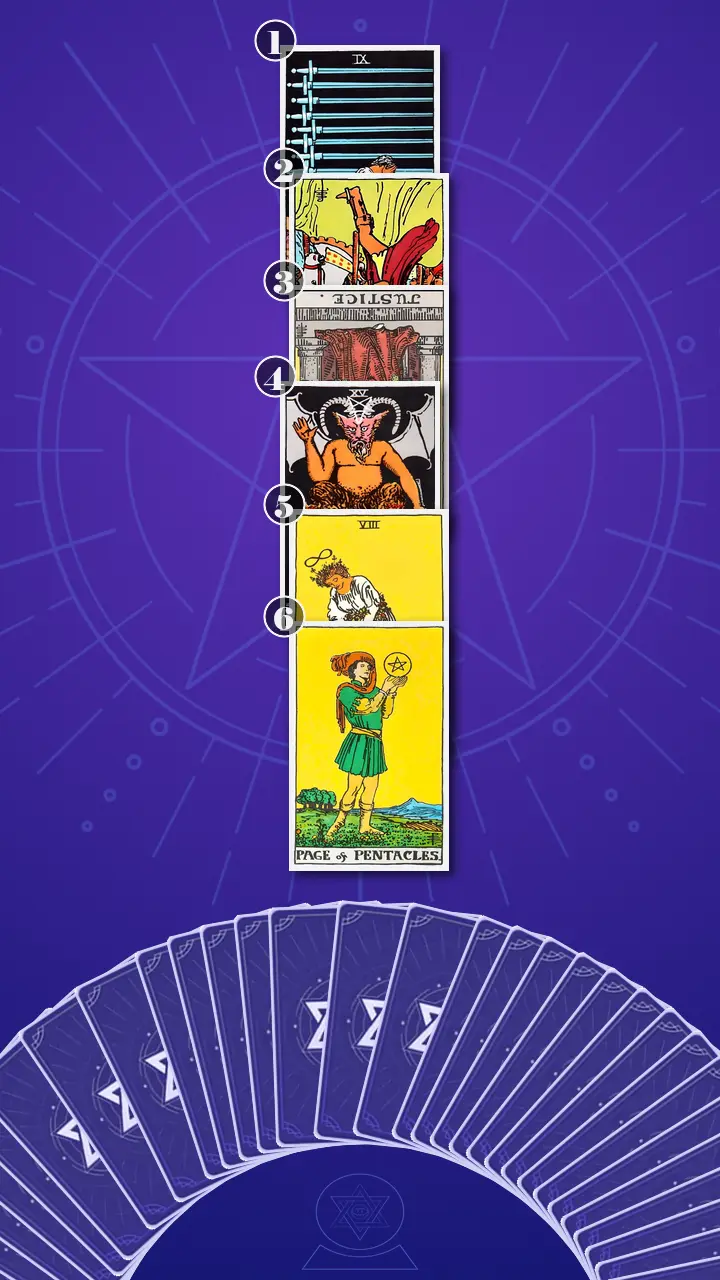
Reading the Ladder: What’s Actually Happening After the B
Position 1: The observable spiral
“Now flipping over,” I said, “is the card that represents the observable spiral—what you do and think right after getting a B.”
Nine of Swords, upright.
I didn’t have to reach for anything abstract; the card was basically already living on her bed.
“It’s after midnight and you’re in bed, but your mind is fully at work,” I said, using the scene exactly as it shows up in real life. “You keep reopening the grade portal and rereading the same feedback like it’s a character evaluation. Your jaw is clenched, your chest feels buzzy, and the loop is: ‘If I’d just… then… but what if…’”
I paused and let the air sit there for a second. “This isn’t a review. It’s an interrogation.”
Taylor let out a small, sharp laugh—recognition with a sting. “That’s… too accurate,” she said. “It’s like I’m trying to find the exact line in the feedback that explains why I’m secretly not good.”
“Exactly,” I said. “And the energy here is excess Air—too much mind, too many tabs open. The Nine of Swords isn’t ‘you being dramatic.’ It’s your nervous system trying to regain control by thinking harder, when thinking harder is the thing that keeps you awake.”
Position 2: The validation hook
“Now we’re moving to the validation hook—what kind of recognition you’re trying to secure, or fear you lost.”
Six of Wands, reversed.
“This card is the moment your brain stops asking ‘What can I learn?’ and starts asking ‘What does the crowd think?’” I said. “You don’t just want to do well—you want the result to look like a headline.”
I watched her glance—almost involuntarily—at her phone.
“After the B,” I continued, “you scan for external cues: who got an A, who’s posting wins, who’s celebrating. Instagram Stories become a scoreboard. LinkedIn internship announcements become evidence. And you consider mentioning your grade ‘casually’—not because you want advice, but because you want to feel safe in the room again.”
Her thumb hovered like she could feel the exact impulse in her hand. She winced, but she didn’t look away. That mattered.
“Here’s the block,” I added. “Reversed Six of Wands is when you can’t absorb the win. And if you can’t absorb the win, you’ll keep chasing louder proof.”
Taylor’s mouth pulled into something like a half-smile, half-grimace. “I literally typed ‘lol got a B’ in my group chat last week,” she admitted. “And then I stared at the typing bubbles like it was… like a verdict.”
Position 3: The inner rulebook
“Now flipping over is the inner rulebook—the belief system that turns a grade into a personal verdict.”
Justice, reversed.
Justice reversed has a particular sound in modern life: the click of a tab reopening at 1:30 a.m. because the mind is building a case.
“This,” I said, “is the courtroom mindset.”
And then I gave it to her plainly, because she needed plain. “You read the rubric and comments like a legal document and start building a case against yourself. Exhibit A: the question you missed. Exhibit B: the sentence in the feedback. Exhibit C: the idea that a B ‘proves’ you’re slipping.”
I let my voice go a touch cooler—analyst mode—because Justice wants structure. “The energy here is blockage—a tilted evaluation system. The scales aren’t balanced. They’re rigged against you.”
Taylor’s eyes narrowed like she was suddenly seeing the mechanism rather than the grade. “So the problem isn’t the B,” she said slowly. “It’s… the rule I apply after.”
“Yes,” I said. “Name the rule as one sentence. What does your brain say?”
She didn’t even need time. “Anything less than an A means I’m slipping.”
“Friend test,” I said, keeping it grounded. “Would you sentence a friend in your program with that rule after a tough exam?”
She went still—breath caught, eyes unfocusing for half a second like she was replaying a memory—and then she shook her head once. “No,” she said. “I’d tell her she’s human.”
“Right,” I replied. “This is the line I want you to remember: A B isn’t a verdict—it’s data. Your inner judge is the one putting you on trial.”
Position 4: The root attachment
“Now we’re at the root attachment—the deeper fear underneath the loop.”
The Devil, upright.
Even before I spoke, Taylor’s shoulders lifted like she braced for something unflattering.
“The Devil isn’t ‘you’re bad,’” I said, because I refuse to let that card moralize anyone. “It’s compulsion. It’s the part of you that knows a B is fine—and still feels pulled to do something that proves you’re still exceptional.”
I used the modern scene exactly: “Recheck. Compare. Overwork. Post. Hint. Ask. The discomfort feels unbearable unless it’s replaced by a new ‘A moment.’”
Then I told her the truth I’ve watched so many high-achieving students quietly live inside: “You’re not addicted to achievement—you’re addicted to the moment it makes you feel safe.”
Taylor let out a breath that sounded like she’d been holding it since high school. “That’s disgusting,” she said, and there was a flash of anger in it—not at me, but at the trap. “So what, I’m just… shallow?”
Here was the unexpected reaction—heat instead of softness—and it deserved respect.
“No,” I said immediately. “You’re not shallow. You’re trained. You learned a system where being impressive bought you protection—attention, belonging, not being dismissed. The Devil shows the chain, but look closely: the chains are loose. The trap isn’t that you can’t leave. It’s that leaving feels terrifying without a new source of safety.”
When Strength Spoke: Intensity vs Steadiness
Position 5: The key shift
I let myself slow down before turning the next card. It wasn’t theatrical. It was because this rung changes the whole ladder.
“Now flipping over,” I said, “is the key shift—the inner move that interrupts the loop and changes your relationship with validation.”
Strength, upright.
For a second, the apartment went unusually quiet—no radiator click, no hallway footsteps—like the environment itself decided to listen.
Setup: Taylor was still stuck in the old binary: either she punished herself hard enough to feel “back on top,” or she risked the terror of feeling ordinary. Her brain wanted intensity because intensity feels like control. The B had turned into a threat, and her whole system was reaching for a fast way to feel untouchable again.
Delivery:
Not “tame yourself with harsher rules”—choose Strength: calm the lion of shame with steady self-respect, then act from that calm.
I didn’t rush to explain it. I let the sentence hang, the way a line in a film hangs right before the scene changes.
Reinforcement: Taylor’s reaction came in a chain—small, precise, unmistakably human. First, her breath paused, like her body didn’t know whether to accept kindness as a strategy. Then her eyes went slightly out of focus, the way they do when someone is watching their own habit from the outside for the first time. Then—finally—she exhaled long and low, shoulders dropping as if they’d been carrying a backpack she forgot she put on.
“I keep thinking strength is… more,” she said quietly. “More hours. More rules. More ‘fix.’”
“Most people do,” I replied. “But here’s the line I want to tattoo on the inside of your week: Intensity is not the same thing as strength.”
And this is where I brought in my own lens—my signature way of diagnosing patterns without turning them into shame. “When I was studying classic films in New York, my mentors used to talk about ‘the thought experiment’—what changes if you change one assumption. Einstein did it with physics. We can do it with your grades.”
“Two versions of you,” I said, holding the Strength card between us. “In Universe A, a B means: ‘I’m replaceable.’ So you refresh, compare, rewrite your life at midnight, and you call that discipline. In Universe B, a B means: ‘I got feedback.’ You still care. You still adjust. But you don’t put yourself on trial. Which universe actually produces better learning—and which one produces better sleep?”
Taylor’s lips parted like she was about to argue, then didn’t. Another exhale. “Universe B,” she admitted. “But it feels like if I choose that, I’m letting myself off the hook.”
“Strength isn’t letting yourself off the hook,” I said. “It’s switching hooks. From the crowd’s approval to your own self-respect.”
I leaned closer, voice gentle but exact. “Now, with this new frame, think back to last week. Was there a moment—maybe right after you saw the grade—where this would’ve changed how your body felt?”
She nodded once, slow. “The second I opened the portal again,” she said. “I wanted the number to stop meaning what it meant.”
“That,” I told her, “is you moving from shame-driven validation chasing toward steady self-respect. Not perfect. Not forever. Just one step.”
Position 6: The one-week grounding step
“Now the last rung,” I said. “This card represents the one-week grounding step—a practical behavior that builds self-trust through process rather than proving.”
Page of Pentacles, upright.
“This is apprentice mode,” I said. “Camera zooms in from the social feed to one open notebook page.”
I used the card’s modern translation exactly: “You treat the B as feedback for skill-building. One week, one grounded habit: review errors once, write one question for office hours, do one focused practice block. You track consistency, not worth.”
Page of Pentacles energy is balance—Earth in the best way. Not numb. Not dramatic. Just: show up, do the rep, stop on purpose, trust the process.
Taylor’s face softened into something almost suspiciously calm. “I can do that,” she said, like she didn’t fully trust that “doable” was allowed.
The Courtroom-to-Sanctuary Reset: Actionable Advice for the Next 7 Days
I summarized what the Ladder showed us, weaving it into one coherent story so it didn’t stay abstract.
“Here’s the arc,” I said. “A B hits, and the Nine of Swords spins up—late-night rumination masquerading as responsibility. Then Six of Wands reversed pulls in the crowd: you look for external confirmation that you’re still impressive. Justice reversed turns it into a trial: you sentence yourself with a hidden rule. And The Devil is the basement chain underneath it all: the belief that being exceptional is the only way to feel safe. Strength breaks the chain by becoming the calm authority in your own mind, and Page of Pentacles turns that calm into one small, repeatable practice.”
“Your cognitive blind spot,” I added, “is that you keep treating harsher control as the same thing as discipline. But your transformation direction is different: move from ‘grades decide my value’ to ‘grades are feedback I can use without putting myself on trial.’ That’s not lowering standards. That’s choosing a fair standard.”
Then I gave her next steps that were small enough to start—because the point isn’t a new personality, it’s a new loop.
- The 10-Minute Strength ResetRight after a grade posts, set a 2-minute timer. Sit upright, feet on the floor. Put a hand on your jaw or chest and name what’s here (“shame spike,” “panic,” “comparison pull”). Write one sentence: “A B is feedback, not a verdict.” Then do one 6-minute Earth action: open the assignment and list 3 missed concepts or draft a single office-hour question. When the timer ends, stop on purpose.Your brain will call this “not enough.” That’s the inner courtroom talking. Keep it tiny on purpose; tiny is how you break compulsions.
- Quiet Wins (7 Days), PrivateStart a private note titled “Quiet Wins (7 days).” Each night, log one effort-based win (e.g., “Did 25 minutes even though I didn’t feel impressive”). Don’t post it. Don’t mention it in the group chat. Let it belong to you.If you miss a day, don’t “make up for it.” Just resume the next day. Consistency beats drama.
- One-Pass Feedback Review (12 Minutes)Set a 12-minute timer. Skim comments once. Write 3 bullets: (1) what worked, (2) what didn’t, (3) one adjustment. Close the tab when the timer ends.Re-reading past that point isn’t learning—it’s self-harm-by-analysis. A timer is a boundary, not a punishment.
And because my work is also about building tools you can actually use, I offered her one of my favorite focus strategies—something tactile, a little art-studio, very Page of Pentacles. “If your mind keeps racing back to the grade,” I said, “try what I call Manuscript Mindmaps: take one sentence—‘Grades are feedback, not a verdict’—and write it once normally, then once in slow mirror writing. It forces your brain out of the prosecution loop and into the body for two minutes. It’s not magic. It’s a pattern interrupt.”

A Week Later: Ownership, Not Certainty
Six days later, Taylor messaged me. Not a paragraph. Not an apology. Just: “Did the 12-minute review. Closed the tab. Drafted one office-hours question. Didn’t tell the group chat. Felt weirdly… calm?”
She still cared about her grades—she was never trying to become indifferent. But she’d stopped treating herself like evidence.
In her follow-up note, she added one line that made me trust the shift was real: “I woke up the next morning and my first thought was still ‘what if I’m slipping?’—and then I actually laughed a little, like, okay, hi old courtroom. Not today.”
That’s the quiet proof of a Journey to Clarity: not a perfect mindset, but a new authority. Strength doesn’t erase ambition. It just refuses to use self-punishment as fuel.
When a single B makes your jaw lock and your stomach drop, it’s rarely about the grade—it’s about the quiet terror of feeling ordinary, and the way you start putting yourself on trial to earn back “safe.”
If you didn’t have to prove you were exceptional this week to deserve peace, what’s the smallest, most grounded next step you’d actually try—just as an experiment?