From KPI Hypervigilance to Calm Agency: Rewriting the Gold-Star Script

Finding Clarity in the 8:12 a.m. Dashboard Glow
If you refresh the KPI dashboard before a standup like it’s studying the night before an exam, that’s not “being data-driven”—that’s performance anxiety in spreadsheet form.
Jordan (name changed for privacy) sat across from me with their laptop still half-open, like closing it would tempt fate. They were 27, Toronto-based, early-career ops analyst at a company that had recently rolled out a KPI dashboard with the kind of sterile, bright UI that makes every number feel like it has a tone of voice.
They described Wednesday, 8:12 a.m. in their condo kitchen: laptop cracked open before the inbox, dashboard loading with that white glow. Fridge motor humming. Faint street noise through the window. Coffee smelling genuinely good—yet their chest tightened anyway. “Just a quick look,” they’d told themselves, and then their brain did the math: gold star or not?
“The dashboard went live,” Jordan said, rubbing their jaw like they were trying to unlock it. “And now I open it… constantly. Like, before Slack. Before anything. If the numbers are down, it feels like I’m down.”
I watched the way their shoulders hovered a little too high, as if they were bracing for impact that never arrived. The pressure wasn’t abstract—it sat in their body like a zip tie pulled a notch too tight: jaw set, chest boxed in, fingers twitching with that restless urge to check, fix, and prove.
“A KPI dashboard can be a tool and still mess with your nervous system,” I told them. “Let’s not shame the impulse. Let’s map it. Our whole goal today is clarity—so you can treat the dashboard as information, not a verdict.”

Choosing the Compass: How Tarot Works in a Tracked Workplace
I’m Lucas Voss. I used to sit on Wall Street trading floors where everything had a number attached to it—P&L, risk, time, even your reputation. I later went through Oxford Business School, and I didn’t leave that training behind when I became a Tarot reader at 33. I just stopped pretending humans are spreadsheets.
For Jordan, I didn’t want a vague “past-present-future” spread. This wasn’t about fate. This was about a loop—trigger, behavior, relief, cost—and the lever that breaks it.
I asked them to take one slow breath, feel their feet on the floor, and hold the question in plain language: “KPI dashboard went live—what ‘gold star’ script is running me now?” I shuffled slowly, not as a performance, but as a focusing mechanism—like clearing your tabs before you start troubleshooting.
“Today we’ll use an original layout I call the Transformation Path Grid (6) · Context Edition,” I explained. “It’s designed for exactly this kind of metric-driven self-worth spiral—where a system triggers an automatic script, and the script starts driving your day.”
For you reading this: the reason I like a six-position grid here is simple. Classic three-card advice spreads often blur root cause and pivot into the same slot—and KPI perfectionism loves that blur. This grid forces separation: (1) the visible habit, (2) the immediate blockage, (3) the root belief, (4) the pivot that restores agency, (5) a career-friendly boundary you can try this week, and (6) what integration actually looks like in real life.
“We’ll read across the top row first,” I said, “to see the runaway background process. Then we’ll drop down to the bottom row, where you choose what to run on purpose.”
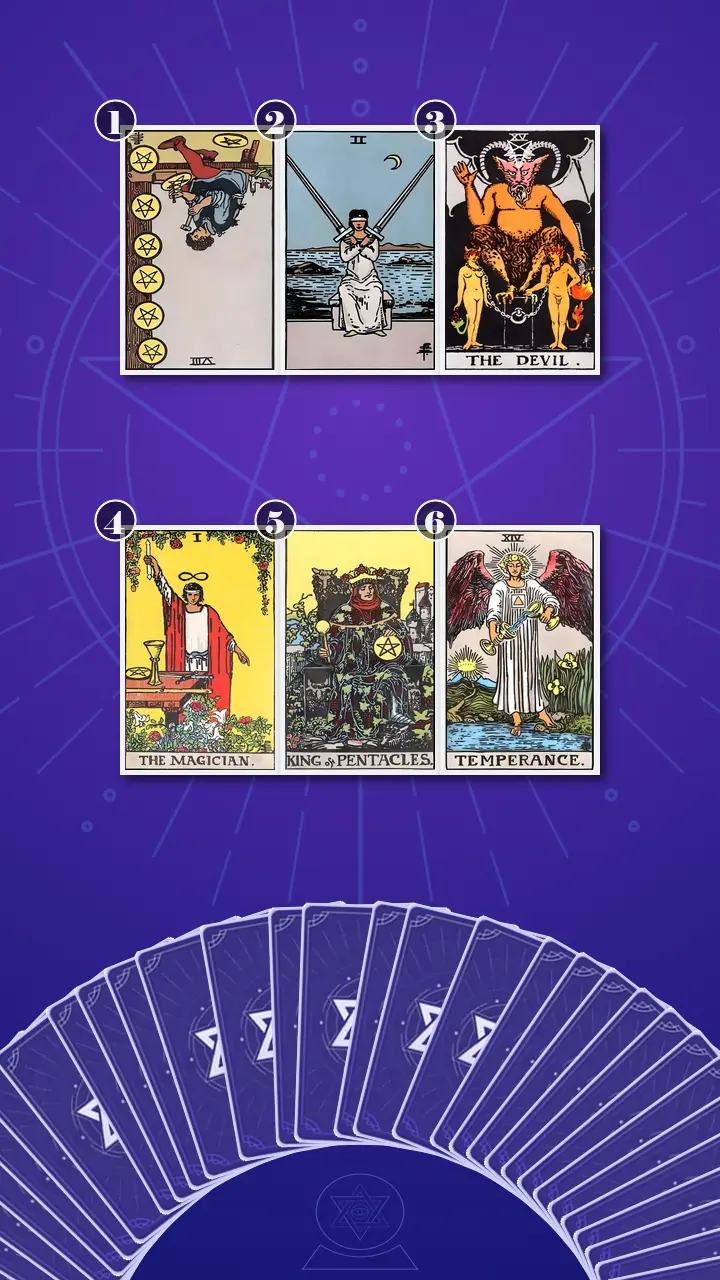
Reading the Top Row: The Loop That Tightens
Position 1 — Surface reaction: what the ‘gold star’ script looks like on camera
I turned over the first card. “Now we turn over the card that represents surface reaction: the most observable way the ‘gold star’ script shows up now that the KPI dashboard is live.”
Eight of Pentacles, reversed.
“This is the craftsman at the bench,” I said, tracing the row of pentacles with my finger. “Except reversed, the craft turns into grinding. The work keeps getting polished past the point of usefulness.”
And I gave Jordan the modern translation exactly as it landed: “You’re reworking the same deliverable—the same ops doc, the same slide, the same Slack update—because the dashboard is live and you’re trying to make your value register instantly. You do one more tweak, one more micro-optimization, and then refresh to see if it counted yet. Like polishing for a gold star instead of finishing for impact.”
In energy terms, this is Earth energy in blockage: effort is there, skill is there, but it’s contracted—trapped in “prove it, prove it, prove it.”
Jordan let out a laugh that surprised even them—short, bitter, almost a cough. “That’s… wow. That’s actually kind of brutal.”
They did a tiny three-step tell: first the laugh, then a sharp inhale as if the card had exposed them, then their thumb pressed hard into the hinge of their jaw like they were trying to loosen a clenched gear.
“It’s brutal because it’s familiar,” I said gently. “But also: it means we’re not dealing with laziness. We’re dealing with a nervous system trying to earn safety through measurable output.”
Position 2 — Primary blockage: the stuck point you keep bumping into
I turned over the next card. “Now we turn over the card that represents primary blockage: what freezes you or narrows your options when you try to relate to KPIs in a healthy way.”
Two of Swords, upright.
“This is the ‘I’m fine’ posture,” I said. “Crossed arms over the chest, blindfold on, staying neutral so you don’t have to choose.”
I anchored it in the lived scenario: “You know the dashboard is ‘just data,’ but you can’t bring yourself to define what good performance means in human terms—so you default to whatever the dashboard tracks. You keep goals fuzzy, avoid the clarifying convo, and then act busy so no one can say you’re not trying. The stuck point isn’t effort—it’s the decision you’re postponing.”
Here’s what it sounds like as an internal script—because this card is basically a transcript: If I choose, I can be wrong; if I don’t choose, the dashboard chooses.
In energy terms, this is Air energy in deficiency: not a lack of thinking—too much guarded thinking with no commitment. Tabs everywhere, nothing saved.
Jordan’s eyes dropped to the table, then back to the card. Their shoulders lowered a millimeter, the way they do when someone names the thing you’ve been calling “being realistic.”
“Yeah,” they said quietly. “I keep it vague so I don’t have to risk being measurable on my terms.”
Position 3 — Root script: what the dashboard is really triggering underneath
I turned over the third card. “Now we turn over the card that represents root script: the deeper fear-belief combo underneath the gold-star chasing.”
The Devil, upright.
I didn’t dramatize it. I didn’t need to. Jordan’s body already knew.
“The KPI dashboard has started to function like proof-of-worth,” I said. “A dip feels like you’re in danger. A rise feels like temporary permission to relax. You bargain with the system—more checking, more tweaking, more busy-looking work—because you’re trying to buy safety.”
“And I want you to hear this line cleanly,” I added, meeting their eyes. “You’re not addicted to numbers—you’re addicted to the safety you hope the numbers will prove.”
The Devil’s chains are famously loose. That’s the symbol I cared about most here. Not because the workplace isn’t real—of course it’s real. But because the tightest part of this loop isn’t the tool. It’s the agreement you’ve signed in your head: if the graph dips, I dip.
In energy terms, this is attachment—Earth and desire in excess, but pointed at the wrong god. The dashboard becomes a mood ring, a heartbeat monitor, a social media like-count that hijacks your nervous system.
Jordan swallowed. Their throat bobbed. Their hands went still for a second—like a brief system freeze—then one palm flattened on the table as if to ground themselves.
“That’s exactly it,” they whispered. “This isn’t about productivity. It’s about safety.”
When The Magician Took the Mouse Back
Position 4 — Key pivot: the hinge that returns authorship
I let the quiet sit. In my Wall Street years, I learned that the most dangerous moment isn’t the market move—it’s the second you start believing the screen is the whole world. A Bloomberg terminal can make you forget there’s a body attached to the decisions. KPI dashboards can do the same.
I turned over the fourth card. “Now we turn over the card that represents the key pivot: the mindset shift that returns authorship—how to use the dashboard without being used by it.”
The Magician, upright.
The room felt like it had more oxygen in it. Even the light seemed less accusatory, as if the screen-glow in Jordan’s memory had dimmed a notch.
Setup (the trapped moment): It’s 4:55 p.m., five minutes before your 1:1, and your finger’s already hovering over refresh—like the dashboard can tell you whether you’re safe to exist at work today. That hovering isn’t strategy. It’s a plea for a gold star you can’t control.
Delivery (the sentence that flips the power):
Not “the dashboard runs me”; I choose the tools and the meaning—like The Magician deciding what belongs on the table.
I watched it land in Jordan in a three-step wave. First: a freeze—breath held, eyes slightly wider, like their brain had opened a file it didn’t expect. Second: a replay—focus drifting past me as if they were scrolling back through every refresh, every pre-meeting check, every night-in-bed “just one last look.” Third: an exhale that actually moved their shoulders down, the first real unclenching I’d seen since they arrived.
“But if I do that,” they said, and there was a flash of resistance—anger, almost grief—“doesn’t it mean I’ve been… letting it control me? Like I did it wrong?”
“No,” I said, firm in the way I am when someone tries to turn insight into self-punishment. “It means you adapted to a tracked environment. Your nervous system chose the fastest available proof. That’s not ‘wrong.’ It’s just expensive.”
“The Magician is about reclaiming the table,” I continued. “Wand, cup, sword, pentacle—will, emotion, thought, and material reality. In modern work terms? Communication (Slack), planning (calendar), execution (tasks), measurement (dashboard). Right now measurement has been sitting in the CEO chair.”
“And I want to add something from my old life,” I said. “I use a lens I call Human Capital Valuation. On Wall Street, we’d never value a company off a single day’s stock chart. We’d look at fundamentals: capabilities, defensibility, operating rhythm, leadership. Your worth at work is the same. KPIs are one signal—not your market cap.”
Jordan blinked hard, then nodded, eyes wet but steady. Their voice came out smaller and clearer. “So… metrics can inform me. They’re not allowed to define me.”
“Exactly,” I said. “Metrics are allowed to inform you. They’re not allowed to define you.”
Then I guided them through the pivot in the simplest, most concrete way—because agency isn’t an affirmation, it’s a design choice.
“Do a 90-second Authorship Note right now,” I said, sliding a notepad toward them. “Two lines.”
“(1) ‘This dashboard is for ___.’ Pick one: feedback, prioritization, or communication.”
“(2) ‘This dashboard is NOT allowed to measure my ___.’ Pick one: worth, intelligence, or belonging.”
Jordan wrote slowly, like the words had weight. When they finished, they stared at the lines, and their face softened into something that looked like relief and responsibility at the same time—the dizzy moment after you put down a heavy bag and realize you’ve been carrying it for years.
“Now,” I asked, keeping my tone gentle but precise, “use this new lens and look back at last week. Was there a moment—one refresh, one rewrite, one pre-1:1 spiral—where this sentence could have changed what you did next?”
Jordan’s eyes went to the side. “Tuesday night,” they said. “In bed. The number dipped and I—” They stopped, then tried again. “I could’ve just… closed it. I could’ve waited. It didn’t have to mean anything about me.”
And that, right there, was the shift: not from anxiety to perfect calm, but from being owned by a tool to owning your choices around it. From pressured hypervigilance toward steadier self-trust.
Boundaries You Can Sit In
Position 5 — Actionable next step: building a career-friendly structure this week
I turned over the fifth card. “Now we turn over the card that represents the actionable next step: a realistic, career-friendly way to rebuild structure and boundaries around metrics this week.”
King of Pentacles, upright.
“This is stewardship,” I said. “Not rebellion. Not ‘I refuse KPIs.’ It’s: I manage my attention like it’s a resource.”
In energy terms, this is Earth energy in balance: stable, sustainable, protective of what matters. The opposite of the reversed Eight of Pentacles grind.
I described it in a way Jordan’s manager would understand: “A weekly cadence. Clear ownership: what you control versus what you influence. And boundaries that lower compulsive checking without tanking performance.”
Then I reached for one of my most practical frameworks—something I used to do before the market opened, and something I now repurpose for clients in metric-heavy roles.
“I want you to borrow a strategy I call a Trading Floor Opening Simulation,” I said. “Not because you’re a trader. Because your mornings have become a pre-market panic.”
“Before you open any dashboard, do a 60-second ‘opening bell’: sit upright, feet on the floor, one slow exhale longer than your inhale. Then choose one priority and the tool you’ll use for it—doc, spreadsheet, message, task list. Only then do you decide whether the dashboard is needed.”
Jordan’s mouth twitched into a small, pragmatic smile. “That feels… doable. Like I’m not pretending the dashboard doesn’t exist. I’m just not letting it run the day.”
“Exactly,” I said. “If it needs constant refreshing, it’s not insight—it’s self-scoring.”
Position 6 — Integration: what balanced metrics actually feels like
I turned over the sixth card. “Now we turn over the card that represents integration: what it looks like when your relationship with KPIs is balanced and sustainable.”
Temperance, upright.
Temperance is the moment data stops flooding the self. The angel pours between two cups—measured, deliberate. One foot on land, one in water. Reality and humanity, in the same workflow.
“This is you looking once, adding context, making an adjustment, and closing the tab,” I said. “Not because you’re above it. Because you’re integrated.”
And I gave them the endpoint as a line they could actually live by: “Curiosity in, context out, shame nowhere in the workflow.”
Jordan nodded slowly, like they were picturing a Tuesday night where Netflix didn’t pause for a graph. “That’s the version of me I want,” they said. “Still competent. Just not constantly scored.”
The Refactor: From Insight to Actionable Advice and Next Steps
I leaned back and stitched the whole grid into one coherent story—because that’s what Tarot does at its best. It doesn’t predict your future. It reveals your pattern, and then shows you where choice can enter.
“Here’s the arc,” I said. “Top row: the dashboard goes live, and your craft flips into compulsive polishing (Eight of Pentacles reversed). Then you protect yourself with a stalemate—staying vague so you can’t be wrong, which lets the dashboard choose by default (Two of Swords). Underneath it all is The Devil: the belief that a number can grant or revoke safety, belonging, worth. Bottom row: The Magician returns authorship—tools on the table, meaning chosen on purpose. The King of Pentacles turns that into structure. Temperance is the sustainable rhythm.”
“Your cognitive blind spot,” I added, “is that you’ve been treating measurement as a substitute for definition. You’ve been optimizing for visibility because visibility feels safer—when what you actually want is impact you can be proud of. The transformation direction is clear: from chasing approval through measurement to consciously defining what the measurement is for—and what it will never be allowed to measure.”
Then I gave Jordan the smallest possible set of experiments—because in a dashboarded workplace, the goal isn’t to win a philosophy argument with your anxiety. The goal is to build a boundary your body can follow.
- Two KPI Windows (Context Only)Pick two 10-minute blocks this week (e.g., Tue 11:30 a.m. + Thu 4:30 p.m.) and put them in Google Calendar as “KPI Review (Context Only).” Outside those windows, close the tab—no dashboard open in the background.If that feels impossible, start with ONE window. Add friction: log out, remove the bookmark, or use a separate browser profile named “Review Only.” The point isn’t refusing measurement; it’s refusing 24/7 self-scoring.
- The 90-Second Authorship NotePin a one-sentence purpose where you’ll see it before you check: “This dashboard is for feedback/prioritization/communication—NOT for measuring my worth/intelligence/belonging.” Read it once before every KPI window.If you catch yourself thinking “This is childish,” label it as your Two of Swords moment (protection), not failure. Do one slow exhale before deciding what to do next—choice is the pivot.
- The 3-Line KPI Context Update (Your Mini Prospectus)Every Friday, send to yourself (or your manager, if appropriate): (1) what moved, (2) why it likely moved, (3) what you’re doing next week that may not show up immediately. This frames numbers with reality instead of panic.Keep it boring on purpose. Boring is King of Pentacles energy. Consistency beats adrenaline proving.

A Week Later: Ownership, Not Certainty
Six days later, Jordan messaged me: “Okay, I did it. I scheduled one KPI window. I removed the bookmark. I still wanted to check—like, physically—but I waited.”
They added a screenshot of their Friday note. Three lines. Plain. No apology language. No frantic footnotes. A tiny, unglamorous proof of agency.
The bittersweet part was real, too—because change is never a clean movie montage: they said they’d slept through the night, but in the morning their first thought was still, What if I’m behind? Then they read their pinned note and felt their jaw loosen. “Not gone,” they wrote. “Just… quieter.”
I told them what I tell anyone trying to find clarity at a career crossroads in a tracked environment: “This isn’t about never caring. It’s about choosing what you care for. Data can move without moving your worth.”
And if I leave you with anything from Jordan’s Journey to Clarity, it’s this: Tarot didn’t fix their KPIs. It helped them debug the script—so they could stop living for gold stars and start designing a sustainable, self-respecting operating system.
When a number dips and your body tightens like you’re about to get called on in class, it’s not that you don’t trust your skills—it’s that you’re scared the system will turn your worth into a score you can never fully control.
If you let the dashboard be information—but not a verdict—what’s one tiny boundary or definition you’d want to try this week, just as an experiment?