The Planner Gift That Felt Like a Verdict—And the Week I Stopped Restarting

Finding Clarity in the Tuesday-Night Spiral
You do the Sunday night reset—fresh planner page, new week energy—then by Tuesday you’re already spiraling into “I’m behind” Sunday Scaries mode again.
Jordan (name changed for privacy) said it like it was a punchline they were tired of telling. They were 27, non-binary, and sitting across from me in my small reading nook with the posture of someone bracing for a grade they didn’t study for.
They described the scene with the precision of a memory that’s been replayed too many times: 8:47 PM on a Tuesday in their Toronto apartment kitchen, planner open under a buzzing overhead light, phone screen still warm from doomscrolling, and the smell of delivery fries hanging in the air like evidence. Their shoulders had crept up toward their ears while their eyes got stuck on one unchecked box—yesterday’s—like it was a stain that couldn’t be scrubbed out.
“My parents got me this goal planner,” they said, tapping the corner of their tote. “It’s sweet. I know it’s sweet. But then… habits slide. Money slides. Dating turns into swiping in bed and then I ghost when it gets real.”
Their hand drifted to their chest, not dramatically—just a small, automatic check-in. The feeling sounded like shame, but it looked like a tightness you’d get from standing too close to a teacher’s desk, waiting for them to call your name.
“I know what I’m supposed to do,” Jordan added, eyes flicking up to see if I’d judge them. “I just can’t make myself keep doing it.”
I nodded slowly, letting that land without trying to fix it too fast. “I hear two forces pulling at you,” I said. “You want a structured, improving life—and at the same time, the moment structure feels like it’s judging you or taking away your autonomy, your whole system fights it.”
In the planetarium where I work, I teach people how orbits don’t fail because a planet is ‘bad’—they fail when forces don’t balance. “Let’s do the same here,” I told them. “Not to diagnose you as a problem, but to map the forces. Our whole journey today is for clarity—so the next step feels livable, not performative.”

Choosing the Compass: The Energy Diagnostic Map Spread
I asked Jordan to take one breath that actually reached their ribs—no big spiritual performance, just a nervous system reset. Then I shuffled slowly, the way I do before a night sky show: steady hands, steady pacing, so the room catches up to itself.
“Today I’m going to use a spread I call the Energy Diagnostic Map (7) · Context Edition,” I said. “It’s built for exactly this kind of question—when three different life areas are sliding, but you can feel there’s one shared trigger underneath.”
For anyone reading along and wondering how tarot works in a practical sense: spreads are basically structured questions. This one separates (1) the surface symptoms, (2) your inner tug-of-war, (3) the outside pressure, (4) the core blockage that keeps repeating, and then it moves into (5) a usable resource, (6) the key transformation, and (7) one grounded next step. It’s compact enough to be actionable—like “what do I do this week?”—but still reveals the system behind the loop.
“The center card is our control panel,” I told Jordan, placing the fourth position down first. “That’ll show the real mechanism. Then we’ll arc across what’s visible, what’s split inside, and what pressure is sitting on top. Finally, we’ll ground into what you can actually do without turning your life into a pass/fail test.”
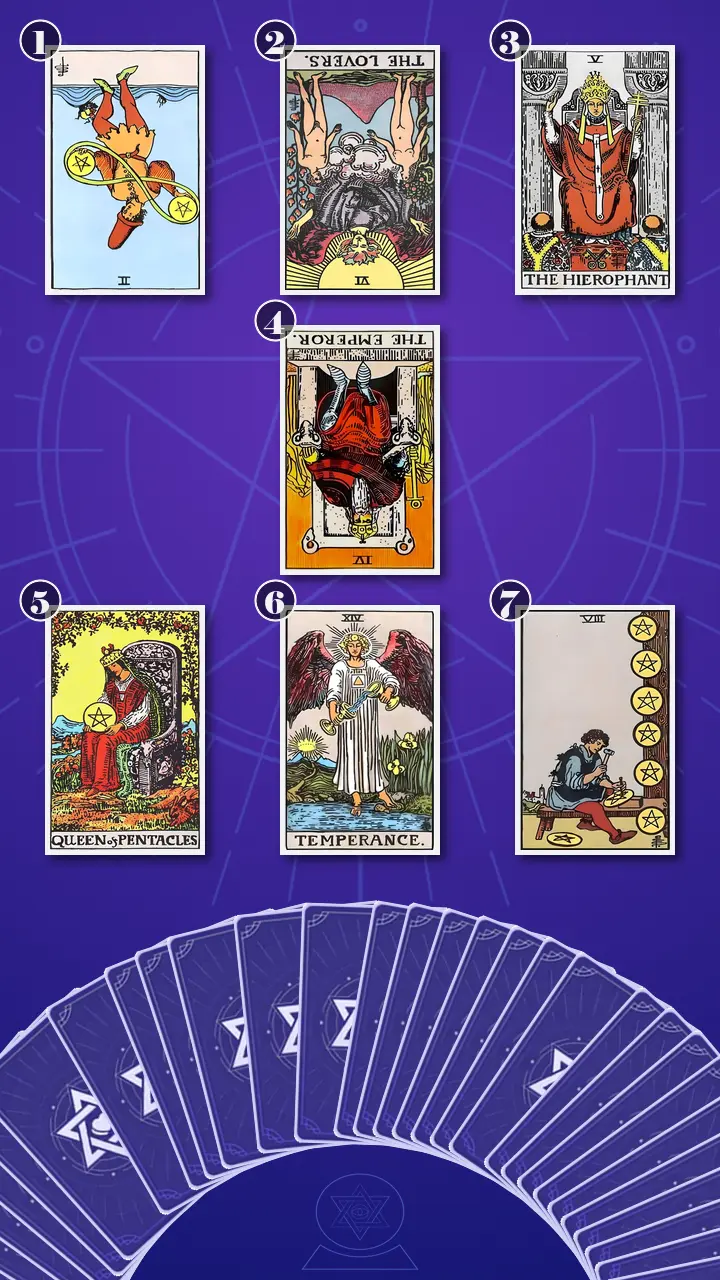
Reading the Map: Card Meanings in Context
Position 1 — Surface symptom: what’s visibly sliding
“Now flipped open is the card that represents the surface symptom: the most visible way the struggle shows up across habits, money, and dating in day-to-day behavior.”
Two of Pentacles, reversed.
“This is the ‘too many tabs open’ card,” I said, angling it toward them. “In modern life, it’s you juggling habits, money, and dating like three browser tabs you keep switching between. You start the week with a color-coded plan, miss one day, and then quietly let the whole week unravel while telling yourself you’re ‘catching up.’ Money becomes tiny leaks—takeout, little treats, subscriptions—and dating becomes late-night swiping because it’s the easiest form of ‘progress’ that doesn’t ask for consistency.”
Reversed, the energy isn’t balanced juggling—it’s blockage and overload. The waves in the background aren’t dramatic for nothing; they’re the meetings that run late, the “I’ll just scroll for a minute,” the Tuesday-night crash when your brain is out of RAM.
Jordan gave a short laugh that sounded like it came with a bruise. “That’s so accurate it’s kind of rude,” they said, then immediately covered their mouth like they’d said something wrong.
“Not rude,” I said gently. “It’s data. And it’s not three separate failures—it’s one pattern showing up in three places.” I paused, then added the line I wanted them to really hear: “Don’t restart the week—salvage it.”
Position 2 — Inner tug-of-war: the values split
“Now flipped open is the card that represents the inner tug-of-war: the values conflict or mixed motivation that pulls you in two directions.”
The Lovers, reversed.
“This isn’t only romance,” I said. “Reversed, it often shows misalignment—choices anchored to what reduces guilt fast or looks ‘adult’ from the outside, instead of what you genuinely value.”
I kept it concrete, because that’s where tarot is useful: “So you agree to routines that sound responsible, budgets that feel punishing, and dates that give validation… then you drift because none of it felt like a real yes. You want calm consistency, but your nervous system keeps choosing the option that offers immediate relief.”
That’s splitting energy—like living two stories at once: “I should” and “I want.” The card isn’t accusing; it’s naming the fracture line.
“Which goal this week feels like a real yes?” I asked. “Not forever. Just this week.”
Jordan stared at the card, then said quietly, “I want money to feel… neutral. Like I could open my bank app and not feel sick.”
I nodded. “Your body gave you the answer faster than your brain. That’s useful.”
Position 3 — External pressure: the ‘should’ script
“Now flipped open is the card that represents external pressure: where family expectations, cultural scripts, or ‘shoulds’ are shaping the plan and the self-judgment.”
The Hierophant, upright.
“This card is the planner gift in a single image,” I said. “Not because your parents are villains—more because tradition and authority, even well-meaning, can turn into a scoreboard.”
I referenced their actual life: “The planner becomes a symbol, not just a tool. You open it and suddenly you’re not planning—you’re being assessed. The ‘good life’ script—steady habits, clean budget, polished dating life—hovers over every box you fill in, and normal human inconsistency turns into self-judgment.”
In my head, I flashed to a familiar scene at work: I stand under a dome full of stars and watch people tilt their chins upward, searching for the right constellation as if the sky is a test. I’ve learned to say, “There’s no failing the night sky.” Jordan needed that same permission.
“When you hear that voice in your head—‘Real adults do this’—who does it sound like?” I asked.
Jordan’s jaw flexed once. “My dad,” they said. “Or… my idea of my dad. Even when he’s not saying it.”
Position 4 — Core blockage: the repeating mechanism
“Now flipped open is the card that represents the core blockage: the deeper mechanism that keeps the cycle repeating even when motivation is present.”
The Emperor, reversed.
I let myself be blunt, because this is where people get unstuck: “Any structure that feels like surveillance makes you shut down.”
“Yeah.” Jordan’s voice was quick, almost defensive. “I hate feeling managed. Even when I’m the one managing myself.”
“That sentence is this card,” I said. “Reversed Emperor is collapsed self-authority. Not weakness—conflict. You either go hyper-control—strict schedule, no-fun budget, trying to lock down clarity in dating—or you quietly rebel—avoid the planner, hide small purchases from yourself, keep dating ambiguous so nobody expects consistency.”
I watched their hands while I spoke. Their fingers tightened around their water bottle. Then they loosened. Then tightened again. A nervous system negotiating control.
“Here’s the inner monologue I hear in this card,” I continued, using the echo technique I’d planned to use: “The moment it feels like surveillance, I disappear.”
Jordan nodded hard—sharp, involuntary. Their eyes shone with that particular mix of recognition and irritation, like someone just named a habit they thought was a personality flaw.
“And this is the contradiction driving everything,” I said, grounding it: “If I follow rules, I lose myself; if I don’t, I lose stability.” I paused. “A plan you hate will always get sabotaged—quietly or loudly.”
As an astronomer, I couldn’t help adding my own lens—my Galactic Gravity Analysis, the tool I use to interpret family dynamics the way I interpret orbits. “In orbit models,” I told them, “a body can’t stay stable if there’s a huge gravitational pull it didn’t choose—especially if it’s trying to compensate by speeding up, slowing down, and constantly correcting. Your parents’ ‘gravity’ isn’t evil. But if your life plan is built around their mass—approval, check-ins, ‘serious adult’ standards—your system will keep doing emergency maneuvers. That’s what your Tuesday-night crash is: orbital strain.”
Jordan exhaled like something had finally been put in the right category. “So I’m not lazy,” they said, more like a question than a statement.
“You’re not lazy,” I said. “You’re in a power struggle with a structure you didn’t fully consent to.”
Position 5 — Usable resource: what helps without needing approval
“Now flipped open is the card that represents the usable resource: an inner strength or supportive approach you can access without needing external approval.”
Queen of Pentacles, upright.
The vibe in the room shifted, even visually. Outside my window, the late-day light softened, and the kettle in my kitchenette clicked as it finished boiling—small, domestic sounds that felt like permission.
“Your way out isn’t harsher discipline,” I said. “It’s stewardship.”
I translated it into Jordan’s life: “Think: a neutral money check-in with tea. An automatic transfer that runs without willpower. A small home setup that makes the right thing easier—snacks, laundry flow, a walk route. You treat routines like care for future-you, not proof of worth.”
This card’s energy is balance—grounded Earth that doesn’t need drama to be real. It’s the opposite of planning as performance. It’s home maintenance. It’s ‘I deserve a system that supports me.’
Jordan’s shoulders dropped a fraction. Their face softened in a way I recognized: not full relief—more like “maybe this isn’t a character trial.”
When Temperance Poured Between Two Cups
Position 6 — Key transformation: the reframing that unlocks movement
I touched the edge of the next card before turning it, deliberately slowing down. “We’re flipping the hinge of the whole reading,” I said. “The card that changes how the rest behaves.”
“Now flipped open is the card that represents the key transformation: the most important reframing that shifts the pattern from compliance/rebellion into sustainable self-leadership.”
Temperance, upright.
For a moment, the room felt unusually still—the way it does in the planetarium when the lights go out and the artificial night appears. People always stop fidgeting then, like their bodies know they’ve entered something bigger than a to-do list.
Setup: I saw Jordan in that Tuesday-night moment again: planner open, one missed box, chest tightening as if a single imperfect day had become a verdict about their entire adulthood. They were trapped between “I should be disciplined” and “I need to feel free,” and every attempt to fix it swung them to an extreme—perfect Monday fantasies, then shutdown Tuesday reality.
Delivery:
Stop treating your life like a pass/fail test you have to ace for approval; start blending what you want with what you can sustain—like Temperance slowly pouring two cups into one workable rhythm.
I let a beat of silence sit there. No extra explaining yet. Just room for the sentence to hit.
Reinforcement: Jordan’s body reacted in a three-part sequence I’ve learned to watch for—like a tiny eclipse moving across their face. First, a freeze: their breath caught, and their fingers hovered mid-tap on the water bottle label. Then, cognition seeped in: their eyes unfocused, as if their brain was replaying a dozen weeks of “Monday reset → Tuesday collapse” at high speed. Finally, the release: their jaw unclenched, their shoulders sank, and they let out a shaky exhale that sounded like, “Oh.”
But the next emotion wasn’t only relief—it was a flash of anger, honest and sharp. “But if that’s true,” they said, voice rising, “doesn’t it mean I’ve been doing it wrong this whole time? Like… I’ve wasted years?”
I met that without rushing to soothe it away. “It means you were using the only tool you were handed,” I said. “The tool was ‘prove you’re serious.’ And it worked just long enough to keep you in the loop.”
I leaned in slightly, lowering my voice the way I do when I’m guiding someone to spot Saturn through a telescope: “Temperance isn’t about being less ambitious. It’s about calibration. Not punishment.”
“Here’s a practice I want you to try, right now, in a tiny version,” I said, following the energy of the card and the reading’s design. “Set a 6-minute timer. On your notes app, write: (1) One rule you truly consent to for the next 7 days, (2) the smallest version you can do on a bad day, and (3) what counts as ‘done once.’ If your chest tightens while writing, pause, unclench your jaw, and stop early if you want—consent applies to this exercise too.”
Jordan blinked rapidly—eyes glassy, not quite crying. “Okay,” they whispered, and I watched their shoulders stay down as they typed, slower than usual, like they were letting their body agree.
Then I asked the question that makes the insight usable: “Now, with this new perspective, think back to last week. Was there a moment—maybe Tuesday night—where this would’ve changed what you did next?”
Jordan stared at Temperance. “Yeah,” they said. “I would’ve… done one thing. Not ‘fix the week.’ Just… one thing.”
“That,” I said, “is the step from living under a performance review into building a self-led rhythm. This isn’t only about a decision. It’s a move from shame-driven overthinking to a first, grounded kind of self-trust.”
Position 7 — Next grounded step: the smallest repeatable rep
“Now flipped open is the card that represents the next grounded step: the smallest repeatable action that turns insight into a concrete routine this week.”
Eight of Pentacles, upright.
“This is apprentice mode,” I said. “Not ‘be a new person by Monday.’ More like: build proof with reps.”
I made it specific: “In real life, it’s a simple daily or twice-weekly practice block. Two minutes in the bank app. Twelve minutes of a habit. One intentional dating move. Repeated.”
The energy here is balance through repetition. No drama, no grand reset. Just a craftsperson showing up at the workbench. I could almost see Jordan’s nervous system liking it—because apprentices are allowed to learn. They’re not graded as if they’re CEOs.
“Track minutes, not moral worth,” I added, and Jordan gave a small, real smile—like that sentence didn’t demand perfection, only presence.
The One-Card Rhythm: Actionable Advice You Can Actually Repeat
I gathered the spread into one coherent story, because that’s the moment tarot becomes practical: the narrative answers “why is this happening?” without blaming the person.
“Here’s what I see,” I told Jordan. “The Two of Pentacles reversed shows the visible crash—too many tabs, too much juggling, and the whole week unraveling after one slip. The Lovers reversed reveals why the juggling never stabilizes: your choices aren’t anchored to your values; they’re anchored to approval and guilt relief. The Hierophant explains the pressure: the planner isn’t just paper, it’s a ‘good adult’ script. The Emperor reversed is the engine: structure feels imposed, so you fight it—either through rigid control sprints or quiet rebellion. Then the Queen of Pentacles offers a different resource—care-based stewardship. And Temperance is the bridge: integration. Consent. A rhythm you can sustain on a Wednesday.”
I named the blind spot gently: “Your cognitive blind spot is that you’ve been treating inconsistency as a moral verdict—evidence you’re not capable—instead of a signal that the structure isn’t something you consent to.”
“The direction of transformation is clear,” I said. “Move from ‘following a plan to prove you’re good enough’ to ‘practicing small commitments you actually consent to and can repeat.’”
Then I gave Jordan a short list—small steps, not a new personality.
- Minimum Viable Structure Index CardTonight, write three rules you genuinely agree to for the next 7 days (not forever): one habit, one money move, one dating move. Example: “One 15-minute movement session,” “One bank check-in,” “One intentional dating step.” Keep it on a single index card where you’ll actually see it.If you catch yourself trying to make it pretty for 40 minutes, pause and ask: “Am I building a life, or performing control?” Choose the ugliest version that you’ll still do.
- Two-Minute Bank App Check (with a timer)Once this week, set a 2-minute timer. Open your bank app → look at balances → name one next action out loud (e.g., “Pay $25 toward my card” or “Cancel one subscription”) → close the app when the timer ends.If anxiety spikes, you’re allowed to stop at the login screen. Getting closer without forcing is still progress.
- One Intentional Dating RepChoose one: send one clear message to someone you actually like; or schedule one low-pressure coffee/walk date; or update your profile with one values-based line so matches align better.Make it “done once.” No streaks. No overexplaining. Consistency starts as a single rep you can repeat later.
Before we ended, I added one more tool from my own communication kit—because the planner is wrapped up with family gravity. “If your parents check in and it spikes the ‘I’m being graded’ feeling,” I said, “use what I call Light-Year Communication: answer like you’re sending a clean signal across a distance.”
“Short. Kind. Boundaried,” I continued. “Something like: ‘It’s going. I’m focusing on three small weekly reps right now—less perfect, more consistent. I’ll tell you what I learn.’ That keeps you in charge without turning it into a fight.”

A Week Later: Ownership, Not Certainty
Eight days later, I got a message from Jordan. “Did the two-minute bank check,” it read. “My chest did the thing, but I didn’t run. Also put $10 on auto-transfer. And I asked someone on Hinge to grab coffee—no spiraling, just asked.”
They added, almost as an afterthought: “I still woke up this morning thinking, ‘What if I mess it up?’ But then I looked at the index card and… it felt manageable. Like I’m not restarting my life every Monday.”
I sat with that for a moment, the way I sometimes sit alone in the planetarium after the last show, when the projector hum fades and the room is just quietly dark—proof that not everything has to be loud to be real.
This was Jordan’s journey to clarity: not a perfect system, but a structure they actually consented to—calibrated, repeatable, and kind enough that their nervous system didn’t have to fight it.
When your planner feels like a verdict, even the smallest missed checkbox can tighten your chest like you’re about to be judged—so you shut the whole thing down just to feel like you still belong to yourself.
If you let ‘being in charge’ mean choosing one tiny rule you actually consent to (and repeating it once), what would you want that first rep to be this week?
Every reading at AceTarot is a Journey to connect with inner wisdom and empower next step.
Learn more about our Journey to Clarity.