Refreshing the Org Chart—Then Learning to Lead My Focus
The Slack Ping That Turned a Chart Into a Verdict
You’re a mid-level tech PM in Toronto and a new org chart in Slack just turned your brain into a full-time analyst of titles, reporting lines, and who’s ‘close to leadership’ now.
Jordan (name changed for privacy) didn’t say that as a joke. They said it the way people confess they’ve been chewing the inside of their cheek for days. On our video call, their camera showed a Toronto condo corner—neutral wall, a half-full water glass, and the kind of laptop glow that makes skin look a little too pale.
They described it like an iconic scene I’ve heard in a hundred modern variations: 9:06 AM on a Monday, radiator clicking, Slack already lit up, and the org chart link sitting there like a dare. The blue light felt harsh. Their jaw tightened as they zoomed in on titles. Fingers hovered over the trackpad, restless—like the next click might finally make them feel safe.
“I know it’s just a chart,” they told me, voice low, almost annoyed at themselves. “But it doesn’t feel like just a chart. If my title doesn’t move, it’s like I’m invisible. And now I can’t focus. I keep rewriting my status updates like I’m pitching a TV show.”
What they called “caring too much” I recognized immediately as a very specific engine: wanting recognition and security in the hierarchy vs fearing you’re being quietly deprioritized or seen as replaceable. It’s the corporate version of treating a subway map as a mirror—reading routes as a verdict on who you are.
The feeling in their body wasn’t abstract. It was a tight chest and jaw, restless hands, and a buzzy pressure behind the eyes when they tried to focus—like trying to do deep work while a phone vibrates on the desk all day: not loud enough to justify stopping, loud enough to keep you split.
“You’re not dramatic,” I said, and I meant it. “You’re reacting to a system that makes worth feel negotiable. Let’s see if we can turn this fog into a map—something that gives you clarity and a next step you can actually do this week.”
Choosing the Compass: A 2x3 Grid for Reorg Anxiety
I asked Jordan to take one slow breath—not as a ritual, but as a boundary. A way of telling the nervous system, we’re not sprinting for answers right now. While they held their question in mind, I shuffled the deck on camera in my Cambridge study, where books and small labeled fragments from digs sit behind me like quiet witnesses.
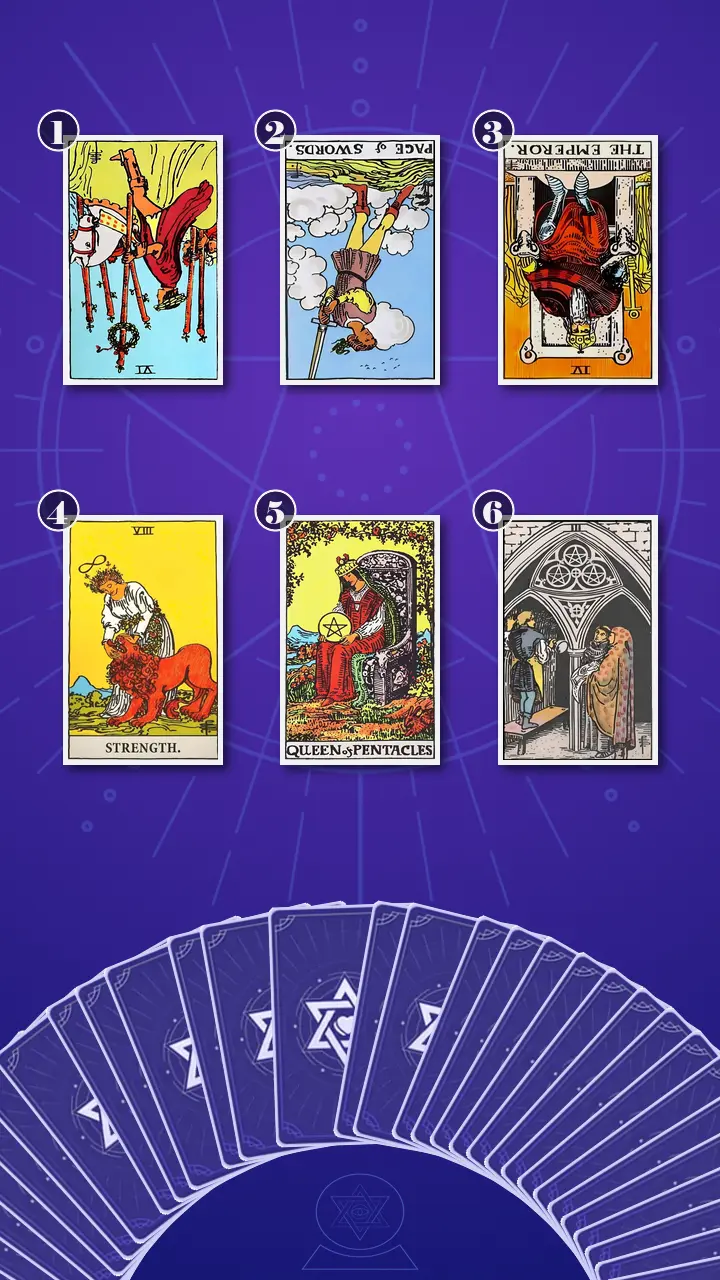
“Today I’m using a spread I call the Transformation Path Grid (6) · Context Edition,” I explained. “It’s a simple 2x3 storyboard. The top row shows the loop—symptom, blockage, root. The bottom row shows the exit ramp—turning point, grounded action, integration.”
For readers who wonder how tarot works in a situation like this: I’m not asking the cards to predict what your company will do. I’m using structure to separate a messy inner experience into parts you can work with. Reorg anxiety feels like one giant weather system. This grid breaks it into: what’s happening on the surface, what habit keeps it going, what fear is fueling it, and what lever actually changes your day-to-day behavior.
“Card 1 will name how status anxiety is hijacking your attention right now,” I told Jordan. “Card 3 will show the deeper fear the org chart is poking. And Card 4 is the pivot—the inner shift that brings your focus back.”
Reading the Map: From Head Noise to Hands-On Clarity
Position 1 — The visible symptom: The Loop That Feels Like ‘Being Strategic’
“Now turning over,” I said, “is the card representing the visible symptom: how status anxiety is hijacking attention and shaping day-to-day behavior at work right now.”
Six of Wands, reversed.
I nodded toward the card’s classic imagery—victory, the raised wand, the watching crowd—and translated it directly into Jordan’s Monday morning. “The org chart drops in a Confluence link and suddenly your day turns into a visibility audit,” I said. “You’re not reading it for logistics—you’re reading it like a social verdict: who got a cleaner title, who moved closer to a VP, whose box got bigger.”
In reversed form, the Six of Wands isn’t a lack of ambition. It’s ambition trapped in a scoreboard. The energy is in excess and unstable—fire that wants recognition, but can’t hold confidence without applause. “You start polishing a status update like it’s a PR release,” I continued, “then stall on the actual backlog item that would create real impact. You’re chasing the feeling of being seen, but the scoreboard never stops moving.”
Jordan let out a small laugh that wasn’t really laughter. Their shoulders lifted, then dropped. “Okay,” they said, blinking hard. “That’s… too accurate. Like, borderline rude.”
“It’s accurate because it’s common,” I replied. “This is what a new org chart does when your brain equates visibility with safety. It turns normal career awareness into a public leaderboard you didn’t consent to.”
Position 2 — The active blockage: Information Grazing That Eats Deep Work
“Now turning over,” I said, “is the card representing the active blockage: the thought habit, information pattern, or reflex that keeps pulling you out of deep work.”
Page of Swords, reversed.
“Your brain turns into an investigative journalist with a deadline,” I said, and Jordan’s eyes flicked downward—like they could see their own browser history reflected in the table. “You refresh Slack threads, scan meeting invites for who’s included, and re-open the org chart ‘just to confirm’ something you already saw.”
The Page of Swords is mental alertness. Reversed, that air-energy becomes blocked and scattered—vigilance without landing. It shows up as clipped, scanning thoughts: Why wasn’t I on that invite?Who reports to who now?Did they remove my team?Am I missing something?
“You draft three versions of the same update in your head—one humble, one confident, one strategically impressive—then post none of them,” I continued. “The blockage isn’t lack of skill. It’s information grazing that keeps you in reaction mode instead of build mode.”
Jordan went very still. Then they exhaled like they’d just realized they’d been holding their breath. Their hands—restless until now—finally settled on the edge of their desk.
Position 3 — The root driver: When Structure Gets Mistaken for Safety
“Now turning over,” I said, “is the card representing the root driver: the deeper fear about power, safety, or worth that the org chart is touching.”
The Emperor, reversed.
My mind did what it always does with the Emperor: it went to stone. Not metaphorically—literally. I’ve spent years with my palms on ancient walls, reading the difference between a stabilizing structure and a collapsing one. The Emperor is the part of us that loves a clear chain of command and sturdy edges. Reversed, it shows what happens when we outsource our inner authority to the system.
“Under the reorg, you’re treating structure like safety,” I said. “If the reporting line is unclear, your nervous system reads it as danger; if your spot isn’t ‘up’ enough, it feels like you’re one reprioritization away from being labeled nonessential.”
I watched Jordan’s jaw tighten—exactly where they’d described it. “There’s an internal manager voice here,” I said gently, “the rigid Emperor in shadow. It says: Show me the chain of command or we’re not safe. And then you try to control perception—extra meetings, extra documentation, extra certainty-seeking—because it feels safer than admitting you want security and recognition.”
I paused and gave them a sentence to hold onto, the way you hand someone a railing on a steep staircase: “An org chart is a logistics map, not a worth report.”
Jordan swallowed. Their eyes went glassy for a second, then focused again. “That… lands,” they said quietly. “I hate how much I’ve been letting it be a mood ring.”
When Strength Spoke: The Calm Manager of Your Nervous System
Position 4 — The key shift: The Micro-Pivot That Reclaims Focus
The air in the room changed—not dramatically, but noticeably, the way it does when someone finally tells the truth in a meeting. “We’ve reached the pivot,” I said. “Now turning over is the card representing the key shift: the most transformative reframe or inner capacity that loosens the loop and reclaims focus.”
Strength, upright.
“This is the moment you catch your hand reaching for the org chart tab—and you don’t obey it,” I told them. “You name what’s happening—status anxiety—take one slow breath, and decide to lead your attention like a calm manager, not a panicked intern.”
In my own work, I have a framework I call Skill Archaeology: we unearth overlooked talents that get buried under noise. And Strength is, frankly, an archaeologist’s card. You don’t excavate a fragile relic with force. You don’t dominate the site. You steady your hands, brush gently, and work with patience—because the goal is retrieval, not performance.
Jordan’s eyes narrowed—not in disagreement, but in that “I’m trying not to cry on a work call” way. They were stuck in a very familiar mental scene:
It’s 9:12 PM in your Toronto condo, laptop glow on your hands, Slack quiet for a second—and you still can’t stop toggling back to the org chart like it’s going to finally explain where you stand.
Stop trying to dominate the story with external proof—start steadying your nervous system and guiding your ambition gently, like Strength calming the lion.
Jordan’s reaction came in a chain, not a single emotion. First: a physical freeze—their breath caught and their cursor stopped moving midair. Second: the cognitive shift—their gaze unfocused for a beat, like their brain was replaying every time they’d rewritten an update to sound “bigger.” Third: the emotional pushback. “But—” they said, a flash of heat in their voice, “if I stop doing that… doesn’t that mean I’ve been wrong? Like I’ve been wasting time?”
“It means you’ve been trying to survive,” I said. “And survival strategies are not moral failures. But they do have costs.”
I watched their shoulders drop half an inch. Their jaw unclenched, then tightened again, then unclenched—like a muscle learning a new pattern. Their eyes went a little red at the edges. “Okay,” they whispered. “So what does Strength look like in my actual day?”
“It looks small,” I said. “A manual override for your attention.” I offered them the simplest version of the ‘Strength Pause’: set 90 seconds, write two lines—Facts and Stories—then pick one task that makes your work visible through substance. “Treat the anxiety as a signal,” I added, “don’t treat it as a command.”
Then I asked the question that turns insight into memory: “Now, with this new perspective, think back to last week—was there a moment when the org chart pulled you in, and this would have let you feel different?”
Jordan nodded slowly. “Thursday,” they said. “I kept checking who got looped into a leadership thread instead of finishing a decision doc. I was trying to feel… positioned. I could’ve just… finished the doc.”
That was the bridge: from status-driven comparison spirals and compulsive monitoring to calm self-trust and self-defined success. Not a personality transplant—just one clean pivot toward steadier focus.
Position 5 — The grounded next step: Treat Attention Like an Asset
“Now turning over,” I said, “is the card representing the grounded next step: one practical approach to stabilize attention and build self-defined security this week.”
Queen of Pentacles, upright.
“You build security the boring, effective way,” I told Jordan, “protected focus blocks, a real lunch, fewer performative meetings, and one tangible deliverable that exists even if nobody claps.”
This is earth-energy in balance. Where the Page of Swords reversed scatters you into a hundred micro-checks, the Queen gathers you into a schedule you can live inside. “You stop letting Slack dictate your nervous system,” I said, “and you start treating attention like an asset.”
I could almost see Jordan testing the idea against their calendar. Their face softened, then tightened with a practical worry. “But what if I miss something important?”
“Then we design for that,” I said. “Not with all-day monitoring. With boundaries.”
Position 6 — Integration: Healthy Status With Receipts
“Now turning over,” I said, “is the card representing integration: what ‘healthy status’ looks like when the lesson lands—how to relate to hierarchy without losing yourself.”
Three of Pentacles, upright.
“Healthy status shows up as being the person people trust to ship and collaborate with,” I said, “not the person constantly broadcasting their importance.”
The Three of Pentacles is the opposite of lonely performing. It’s shared artifacts—blueprints, docs, decisions, shipped work. Recognition that has receipts. “You align with stakeholders, clarify scope, and make your contribution easy for the right people to see,” I told them. “You’re no longer performing for the whole crowd; you’re building with the people who actually touch the work.”
I let myself be a little wry, because sometimes a clean phrase cuts through the fog: “Stop living in the 6—win the room. Start living in the 3—build the work.”
The Craft-Over-Chart Method: Actionable Next Steps for This Week
Here’s the story the six cards told, in plain language. The new org chart lit a fire in you (Six of Wands reversed): visibility equals safety. Your mind tried to control that fire by turning into constant monitoring (Page of Swords reversed): tabs, threads, invites, LinkedIn “Thrilled to announce…” spirals. Underneath, the real fear wasn’t vanity—it was outsourced authority (Emperor reversed): if the structure doesn’t confirm my value, I’m not safe. Strength restored agency by moving power back into your body and attention. Then the Queen and Three of Pentacles grounded it into routines and collaborative proof.
The cognitive blind spot is subtle: you’ve been treating hierarchy changes as if they’re personal verdicts—and trying to argue your case by over-documenting and over-performing. The transformation direction is cleaner: move from “prove I’m positioned well” to “define what success looks like this week and take one concrete step that makes my work visible.”
I offered Jordan three small experiments, borrowing another of my field habits—what I call Relic Authentication. In archaeology, we don’t trust the first story we hear about an object; we test it against evidence. Your anxiety deserves the same respect: listen, verify, then choose.
- Set Two Daily “Signal Windows”Pick two 10-minute blocks (e.g., 11:30 AM and 4:30 PM) to check the org chart/Slack announcements. Outside those windows, keep the org chart tab closed and notifications muted except DMs.If two windows feels impossible, start with one today. Widen to 15 minutes rather than abandoning it—this is training steadiness, not willpower.
- Run a “Facts vs Stories” Check (90 seconds)When you feel the urge to scan, open a note titled “Facts vs Stories.” Add exactly one line under Facts (verifiable) and one line under Stories (predictions). Then choose one next task and work on it for the remaining time.Put a sticky note on your laptop: “Check later—build now.” Expect your brain to protest; that protest is the loop, not a prophecy.
- Visibility Without PerformingDo one substance-based “visibility action” per day: post a crisp update once (Outcome → Next step → Ask) to the right channel or to 2–3 key people. No rewrites after the first clean pass.Keep it to five sentences max so you can’t over-polish it. Remember: legibility to the right people beats performance to the whole org.
If Jordan wanted to take it further, I added a final frame—my Megalith Transport strategy: when something feels too heavy to move, you don’t muscle it alone. You break it into stones you can carry. One doc header today. One decision bullet tomorrow. One stakeholder ask the next day. That’s how focus comes back: not by winning the chart, but by moving the work.
A Week Later: The Quiet Proof of Finding Clarity
Six days later, Jordan messaged me a screenshot—nothing flashy. Two calendar holds labeled “Non-negotiable build time.” A Notes app page titled “Facts vs Stories.” And a Slack update posted once, unedited, with a clear outcome and a simple ask. “I didn’t spiral,” they wrote. “I wanted to. But I did the 90-second thing. Then I shipped.”
They added one line that felt bittersweet in the way real change often does: they finally slept through the night, but woke up and still thought, What if I’m wrong?—and then, instead of opening Slack, they made coffee and opened their doc anyway.
That’s the Journey to Clarity I trust. Not certainty. Ownership. Not pretending hierarchy doesn’t matter—just refusing to let hierarchy run your nervous system.
When the org chart shifts, it can feel like your worth is being renegotiated in real time—so your body goes tense, your brain starts scanning, and you can’t tell whether you’re staying sharp or quietly panicking.
If you didn’t need the org chart to tell you you’re safe, what’s one small thing you’d choose to build—or make visible—this week anyway?