The Zipper Stalled in the Fitting Room—and I Didn’t Cancel Plans
The Size Tag Verdict: When Jeans Trigger a Sudden Self-Worth Crash
If you’ve ever ordered the same jeans in two or three sizes and still felt like the tag was going to decide your entire mood, welcome to the size-tag spiral.
Jordan (name changed for privacy) came to me from Toronto with that look I recognize immediately—the one that says, I know this is irrational, and it still owns me. They were 27, a junior marketing specialist, the kind of person who can juggle a fast-paced downtown office and still remember everyone’s birthday… and yet a zipper moment could take them down faster than any deadline.
They described a Wednesday night like it was a crime scene report.
“9:18 PM,” they said, almost laughing at themself. “CN Tower glow through the blinds. My phone is basically a space heater from all the tabs. The denim smells like shipping plastic. I pull the zipper up and it stalls, and it’s like—” They swallowed. “Like my throat just… shuts.”
In my mind, I could see it: harsh overhead light flattening everything, a slightly warped mirror angle that makes your body feel like it’s being judged by a funhouse. The tag scratching a fingertip when you check it—twice—like the number might change if you consult it more respectfully. The bedroom floor turning into a denim graveyard.
Jordan’s face flushed as they spoke, as if their nervous system was replaying it on demand. Their stomach tightened, their hand hovering unconsciously near their chest.
“It’s literally just a tag,” they said. “But it ruins my whole night.”
I let that land before I answered, because shame hates silence but needs it, too.
“I believe you,” I said. “And I want you to hear this clearly: that kind of instant crash isn’t a character flaw. It’s your body reading a moment as threat and trying to regain control.”
They blinked, like that phrasing made the room a little bigger.
“Because I’ll go straight into… research mode,” they admitted. “Size charts, reviews, Notes app lists of which brands are ‘safe.’ And then I’m cancelling plans like, ‘I’ll go once I feel normal again.’”
What they were describing—the tight throat, the hot face, the heaviness in the chest—wasn’t vanity. It was the exhausting feeling that belonging had become something to earn with a number. Wanting to feel comfortable and confident in their body, while fearing that not fitting a certain number proved they weren’t worthy. That contradiction was the engine behind everything.
I nodded once, slow. “Let’s treat tonight like a journey to clarity. Not ‘how do we get you into a specific size,’ but: why does this tag hit like a verdict, and what do we do next—in the moment—so your night stops shrinking around denim.”
Choosing the Compass: The Transformation Path Grid (6)
I asked Jordan to take one breath with me—just one—and to hold the question gently, like you hold something hot without flinching: Why does my self-worth crash when I see a jeans size tag, and what’s next?
While I shuffled, I kept my tone practical. I don’t treat Tarot like it’s delivering fate; I treat it like a mirror with structure. A way to make a messy internal system visible.
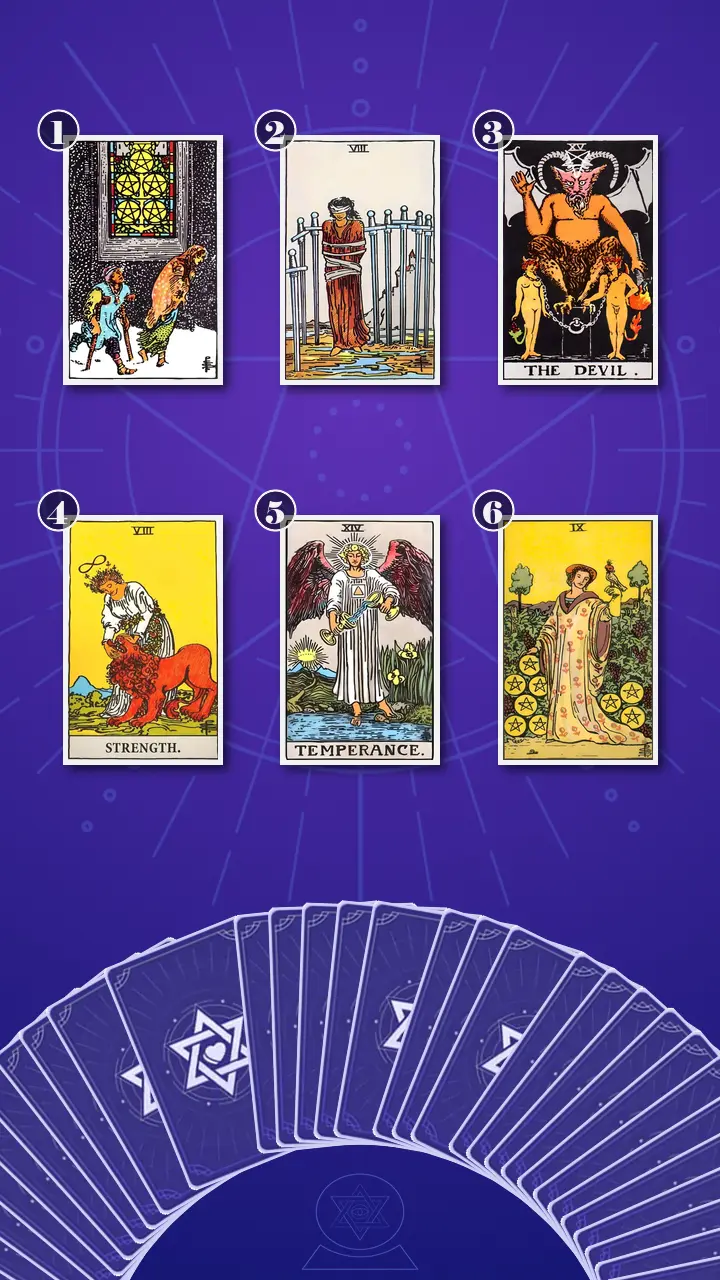
“Today we’re using a spread I call the Transformation Path Grid (6) · Context Edition,” I told them, laying the cards in a clean 2x3 grid. “Top row diagnoses the spiral—what happens, what keeps it looping, what’s underneath. Bottom row is the pivot—what interrupts it, what you practice, and what integration can actually look like.”
For you reading this: I choose this spread because a jeans-tag spiral isn’t a simple past-present-future story. It’s a loop—trigger → shame → control-seeking → temporary relief → more fixation. A classic three-card spread is too thin. A full Celtic Cross can add noise and imply external fate. This grid keeps the reading grounded in psychology, pattern recognition, and actionable next steps.
“We’ll start with the card that shows the exact jeans-tag moment,” I said, tapping the top left space. “Then the blockage—what keeps you stuck in ten-tabs mode. Then the root belief—the hidden rule you’re obeying even when you don’t agree with it.”
Jordan’s hands tightened around their coffee cup. “Okay. That sounds… uncomfortably accurate.”
Reading the Map: The Worth-Crash System in Six Cards
Position 1: The immediate lived experience
“Now we’re turning over the card that represents the immediate lived experience—the exact moment the jeans size tag hits.”
Five of Pentacles, upright.
The image is two figures limping through snow, heads bowed, outside a warm stained-glass window. And I felt Jordan’s shoulders rise just looking at it—like their body recognized the scene before their mind did.
“This is the moment you go from ‘I’m a person having a Wednesday’ to ‘I’m outside the warm room of my own life,’” I said. “Like the tag decides you don’t belong in the confident, put-together version of adulthood.”
I anchored it in their reality, because Tarot only works when it speaks in context: “It’s 6:45 PM after a long day downtown. You’re under overhead light that makes everything feel sharper. The waistband presses, and suddenly your brain goes, ‘Okay, so I’m not one of those people.’ And then your plans disappear—dinner, friends, your actual night—and it becomes about how to disappear: different outfit, different angle, different you.”
In energy terms, this is Earth (Pentacles) in scarcity. Not “I need different jeans,” but “I’m shut out.” It’s worth crashing into deprivation.
Jordan gave a short laugh that sounded like it scraped on the way out. “That’s… brutal. Like, accurate, but brutal.”
“Good,” I said gently. “Not brutal as in judgment. Brutal as in: the card isn’t gaslighting you. It’s naming the nervous-system exile.”
Position 2: What keeps the worth-crash looping
“Now we’re turning over the card that represents what keeps the worth-crash looping—the reflex that turns a tag into an identity verdict.”
Eight of Swords, upright.
The blindfold. The loose bindings. The circle of swords like a fence made of thoughts.
“This is the ten-tabs trap,” I said. “Tape measure on the bed. Notes app list of which brands ‘run small.’ Screenshots of reviews. You feel trapped until you find the one perfect answer that makes the discomfort disappear—but every new review contradicts the last, so you keep scrolling like the night can’t move forward until you solve your body like a math problem.”
Jordan winced and then—exactly as the echo predicts—smiled with discomfort. “I literally have a Notes folder called ‘Denim.’ Like it’s a work project.”
“That makes so much sense,” I said. “Because intellectualizing is a brilliant defense. It gives you something to do when the real feeling is too exposed.”
I leaned in a little. “Here’s the rule template I want you to catch in real time: ‘I can’t ___ until I ___.’ Like, ‘I can’t go out until I feel acceptable.’ Or ‘I can’t relax until I know my real size.’”
In energy terms, this is Air (Swords) in excess—hyper-analysis, courtroom thinking, evidence gathering. Like trying to debug your entire identity using inconsistent app metrics. Different brands are different operating systems, and your brain is demanding a single universal truth from the chaos.
“And the blindfold?” I asked. “That’s you searching for certainty while refusing to feel the feeling.”
Jordan’s gaze dropped to the table. Their thumb rubbed the rim of the cup—fast, then slower. Recognition without self-attack is the first crack in the cage.
Position 3: The underlying root
“Now we’re turning over the card that represents the root—the deeper belief that made the tag feel dangerous in the first place.”
The Devil, upright.
I’ve pulled this card for people on cruise ships in the middle of the Atlantic—under endless sky and no land in sight. Even there, with nothing but ocean and wind, the human mind will try to bargain for safety with an invisible contract. I felt that old memory flicker: travelers staring at a buffet like it was a moral exam. Different setting, same ancient deal.
“The Devil here isn’t ‘you’re bad,’” I said. “It’s the worth-for-control subscription. The invisible contract that promises: ‘If I comply—if I’m smaller, more polished, more controlled—I’ll be safe. I’ll be taken seriously at work. I’ll be easier to love. People won’t judge.’”
I pointed to the loose chains around the figures’ necks. “These chains are learned. They’re not welded on. That matters.”
Jordan’s jaw tightened, then released. “It makes me angry,” they said quietly. “Because I don’t even believe that consciously. Like, I’d never say it to a friend. But my body acts like it’s… true.”
“That’s the Shadow,” I said—bringing in my Jungian lens without turning it into jargon. “Not the evil part of you. The protective part you had to build to belong. The Devil plus Eight of Swords is a classic combination: a hidden contract running the show, and a mental cage that keeps you obedient to it.”
In energy terms, The Devil is intensity in attachment—a sticky belief system that keeps pulling you back even when it hurts. And once it’s triggered, social media becomes a recommendation algorithm: the more you feed the comparison loop, the more your feed serves you ‘evidence’ that keeps you stuck.
I let my voice sharpen, but kindly. “Stop negotiating your dignity with denim.”
Jordan looked up fast, like that line startled them awake.
When Strength Spoke: The Lion in the Fitting Room
Position 4: The turning point energy
I rested my fingertips near the bottom-left card—the pivot point of the grid. “We’re about to turn over the most important card in this reading,” I said. “This is the inner stance that interrupts the spiral without needing the number to change first.”
The room felt quieter. Even the city noise outside my window—sirens, distant traffic—seemed to drop back, like the air itself was listening.
Strength, upright.
In the card, a woman gently closes a lion’s mouth. No violence. No domination. Just steady presence. Power without force.
I anchored it in Jordan’s lived scene: “Harsh overhead lighting. Zipper halfway. The tag scratching your finger. Hot face, tight throat. And instead of launching into research or self-attack, you pause. Hand on chest. Slow exhale. A respectful sentence. You might still change jeans, but you don’t turn it into a punishment. You walk out the door without needing the tag to approve you first.”
Strength is Fire, but not explosive Fire. It’s Fire as contained courage—nervous-system steadiness under trigger.
Here’s where I used my Energy State Diagnosis, the way I was trained to read shifting currents—first on Venetian canals, later on ships crossing time zones: environment, relationships, self.
“Jordan, your energy leak has three exits,” I said. “Environment: harsh light, mirrors, the phone glowing like an interrogation lamp. Relationships: that quiet workplace polish standard, the casual ‘being good this week’ talk, the TikTok fit-check culture that turns bodies into ratings. And self: your inner courtroom trying to earn belonging through evidence.”
“Strength doesn’t argue with the courtroom,” I continued. “It doesn’t win the case. It changes the jurisdiction. It says: ‘This is a body moment, not a trial.’”
The Aha Moment (Setup)
Jordan nodded too fast at first—like they wanted to make it true by agreement. But I could tell they were still caught in the familiar panic: 9:40 PM, bedroom floor covered in denim, phone hot from ten open size-chart tabs, staring at a tag like it’s about to tell you who you’re allowed to be tomorrow. The urgency to fix it tonight. The fear that if they stop, they’ll lose control and people will notice.
The Aha Moment (Delivery)
Stop trying to win a fight with your body, and start practicing gentle courage—like the woman who calms the lion without force.
I let a beat of silence hang in the air—long enough for the sentence to echo in their chest, not just their mind.
The Aha Moment (Reinforcement)
Jordan’s reaction came in layers, like a wave rolling in.
First: a small freeze. Their breath paused mid-inhale, fingers hovering above their cup as if the muscles forgot what they were doing.
Second: a soft unfocus behind the eyes—the look of someone replaying a hundred private scenes at once: the Eaton Centre fitting room fluorescents, the bedroom mirror angle, the late-night Reddit threads, the quiet decision to cancel plans because the waistband felt like a sentence.
Third: the release. Their shoulders dropped, not dramatically, but like a backpack sliding off one strap at a time. A long exhale came out shaky, then steadied. Their eyes watered, and they blinked hard, a little annoyed at themself for tearing up.
Then—an unexpected flare, the kind that’s honest: “But if I stop fighting… doesn’t that mean I was wrong? Like I wasted all this time?” There was anger in it. Grief, too.
I kept my voice calm. “It means you were trying to feel safe with the tools you had. The point isn’t to prove past-you wrong. It’s to stop paying for a subscription that never pays out.”
I leaned in just slightly. “Now, with this new lens: can you think of one moment last week when this could have changed how you felt? One tag-trigger where, if you’d chosen gentle courage instead of evidence gathering, your night might not have shrunk?”
Jordan swallowed, then nodded. “Monday morning,” they said. “I changed outfits twice because my inbox was buzzing and I was already late, and I still… stood there scanning myself. If I’d done this—even sixty seconds—I think I would’ve left on time.”
That was the shift happening in real time: from shame-driven worth crashes and comparison spirals to calm self-respect and self-held worth under trigger. Not a personality transplant. A new micro-choice under pressure.
Temperance’s Middle Way, Nine of Pentacles’ Quiet Proof
Position 5: A practical, embodied next step
“Now we’re turning over the card that represents your one-week experiment—the practical, embodied next step.”
Temperance, upright.
An angel pours water between two cups. One foot on land, one in water. A path leading toward sun. The opposite of extremes.
“Temperance is the end of ‘fix it now’ energy,” I said. “It’s recalibration. You adjust without turning it into a moral referendum.”
I brought in my Venetian strategy because it fits this card like it was painted for it. “In Venice, if you fight the water, you lose. But you can regulate the currents. Temperance is you learning to regulate your inner canal currents—so one waistband moment doesn’t flood the whole evening.”
In energy terms, Temperance is balance. Not suppression. Not spiraling. A steady middle way.
Position 6: Integration
“Now we’re turning over the card that represents integration—what it looks like when worth is self-held rather than tag-held.”
Nine of Pentacles, upright.
A figure in a walled garden—composed, self-contained. Pentacles on the vine like something cultivated over time. This is not loud confidence. It’s private ease.
“This is you leaving the apartment in jeans that feel okay—maybe not ‘perfect’—and still feeling attractive, capable, present,” I said. “Not checking the tag later to reassure yourself. Focused on your plans, your friends, your walk to the streetcar. Your actual life.”
Jordan’s expression softened, but with a hint of fear behind it—the vulnerability of imagining ease without conditions. “That sounds… nice,” they said, like it was a place they weren’t sure they were allowed to enter.
“You are,” I said. “And it won’t be perfect. But it can be real.”
From Insight to Action: The No-Drama Denim System
I pulled the whole grid together for them, like tracing a route on a map.
“Here’s the story these cards tell,” I said. “A jeans tag hits, and you drop into the Five of Pentacles—instant exile, scarcity, ‘I’m outside.’ Then the Eight of Swords kicks in: you try to think your way out—size charts, reviews, measuring—because certainty feels like safety. Underneath is The Devil: the old contract that says belonging is earned by being the ‘right’ kind of body. Strength breaks the contract in real time—not by winning an argument, but by refusing to negotiate your dignity. Temperance turns that refusal into a weekly practice—small blends, boundaries, no extremes. And Nine of Pentacles is the outcome: you’re back inside your life.”
“Your blind spot,” I added, “is thinking the problem is lack of information—like the right chart will fix the feeling. But the actual shift is this: a tag is brand-specific data, and your worth is non-negotiable.”
I made it concrete, because that’s the only kind of clarity that holds under fluorescent lighting.
Here’s what we agreed Jordan would try—practical, low-stakes, and designed to interrupt the comparison-and-control loop. This is also what I’d call the Transformation Path Grid (6) tarot spread for body-image triggers and self-worth spirals (with a Strength Pause reset) in real life: you diagnose, pivot, and practice.
- The Strength Pause (7 minutes)When the tag/zipper spike hits, sit on the edge of the bed (or the closed toilet lid), feet on the floor. One hand on your chest, one on your lower belly. Exhale for 6 counts, three times. Say: “This is a data point, not a verdict.” Then do one boundary: close size-chart tabs for 10 minutes or put the jeans back on the hanger and step away.If your brain argues “this is cheesy,” treat that as the Eight of Swords loop—not a reason to quit. You’re practicing a new response, not trying to fix your body in one sitting.
- Jeans Data vs Jeans Story (Temperance note)Make a two-column note titled “Jeans Data vs Jeans Story.” Under Data: brand, rise, stretch %, comfort rating 1–10. Under Story: the sentence your mind says (“I’m failing”). Do this once this week after a try-on—no more than 5 minutes.Information is allowed. Verdicts are optional. If you feel activated, stop at labeling the Story and walk away.
- One-metric outfit choice (function over number)Pick an outfit using one non-number metric: “Can I sit, breathe, and walk to the streetcar without thinking about my waistband every 30 seconds?” Commit to that outfit for the first 30 minutes of your plan.If you want an extra boundary, mute/unfollow one account that reliably triggers body-morality vibes for 7 days—just long enough to stop feeding the comparison algorithm.
I added one Modern Life Adaptation tweak I’ve seen work for people who live on their phones: “If you need something to do with your hands during the no-tabs window, organize ten photos in your camera roll. Not a ‘glow-up.’ Just a digital detox through photo album organization. It gives your nervous system somewhere neutral to land.”

A Week Later: The Quiet Proof
Six days after our session, Jordan messaged me. No long essay. Just: “Had a tag-trigger. Did the Strength Pause. Still annoyed. But I went to dinner anyway.”
They told me they left the condo in jeans that weren’t their favorite number. They didn’t celebrate loudly. They just sat on the streetcar, watched the city pass, and felt a strange, calm pride—like they’d stopped giving a clothing brand voting rights over their dignity. The next morning, the first thought was still, What if I’m wrong?—but this time, they noticed it and didn’t obey it.
That’s what I call a journey to clarity: not certainty theater, not overnight transformation—just the first real evidence that your worth can be self-held, even when the trigger shows up.
When a tiny jeans tag can make your throat go tight and your whole night shrink, it’s not vanity—it’s the exhausting feeling that belonging is something you have to earn with a number.
If the tag could only be information—not approval—what’s one small, real-world choice you’d let yourself make tonight without renegotiating your worth first?
Every reading at AceTarot is a Journey to connect with inner wisdom and empower next step.
Learn more about our Journey to Clarity.