Easy-Class Shame at Midnight Registration—Choosing by Fit, Not Proof

The 12:13 a.m. Enroll Button
It’s course registration night and you’ve got the catalog, your degree audit, RateMyProfessor, and a color-coded spreadsheet open—and somehow the only class that fits your life perfectly is the one that makes you feel ashamed for wanting it (hello, Sunday Scaries).
Jordan said that to me on a late Zoom call from Toronto, and I could hear the smile that wasn’t really a smile. On their end, it was 12:13 a.m.—they were sitting on their bed with a warm laptop pressed into their thighs, one desk lamp throwing a tired yellow circle onto the wall while the rest of the room stayed in the screen’s blue glow. Every few seconds, I heard the faint click of a trackpad: catalog tab, degree audit tab, RateMyProfessor tab, Notes app titled “Fall Plan.”
“The ‘easy A’ description makes my shoulders drop for, like, half a second,” they admitted, eyes fixed slightly below the camera like they were watching their own cursor hover. “And then my stomach tightens. Like I just… confessed something.”
I watched their jaw set the way people brace for a hit that hasn’t happened yet. Shame can feel like that—like a thick, hot film on the tongue, turning relief into something you have to spit out before anyone sees you swallow it.
“You’re not stuck because you can’t choose,” I said gently. “You’re stuck because the choice feels like a character test. Let’s make this less of a trial and more of a map. We’re aiming for clarity—practical clarity you can use tonight, not a vibe.”

Choosing the Compass: The Transformation Path Grid (6) for Decision Paralysis
I asked Jordan to take one slow breath with me—not as a mystical thing, just as a nervous-system reset. “One inhale,” I said. “One exhale. Let your body be part of the data.” Then I shuffled on my side of the screen, the soft snap of cards sounding like a metronome in my New York studio.
“For this,” I told them, “I want to use a spread called the Transformation Path Grid (6) · Context Edition.”
And here’s why that matters if you’ve ever Googled ‘tarot spread for academic shame and decision paralysis’ at 1 a.m.: this isn’t really a question about predicting which class will be ‘best.’ It’s about identifying the internalized rule that makes one option feel morally unsafe. This spread gives us a clean arc—present behavior → blockage → root rulebook → reframe → action step → integration—without drowning you in ten cards and ten new things to overthink.
I also previewed the three positions I knew would hit hardest: the surface trigger (the exact moment you freeze), the blockage (what makes “easy” feel like a threat), and the turning point (the reframe that creates a third option beyond “hard = worthy” vs “easy = lazy”).
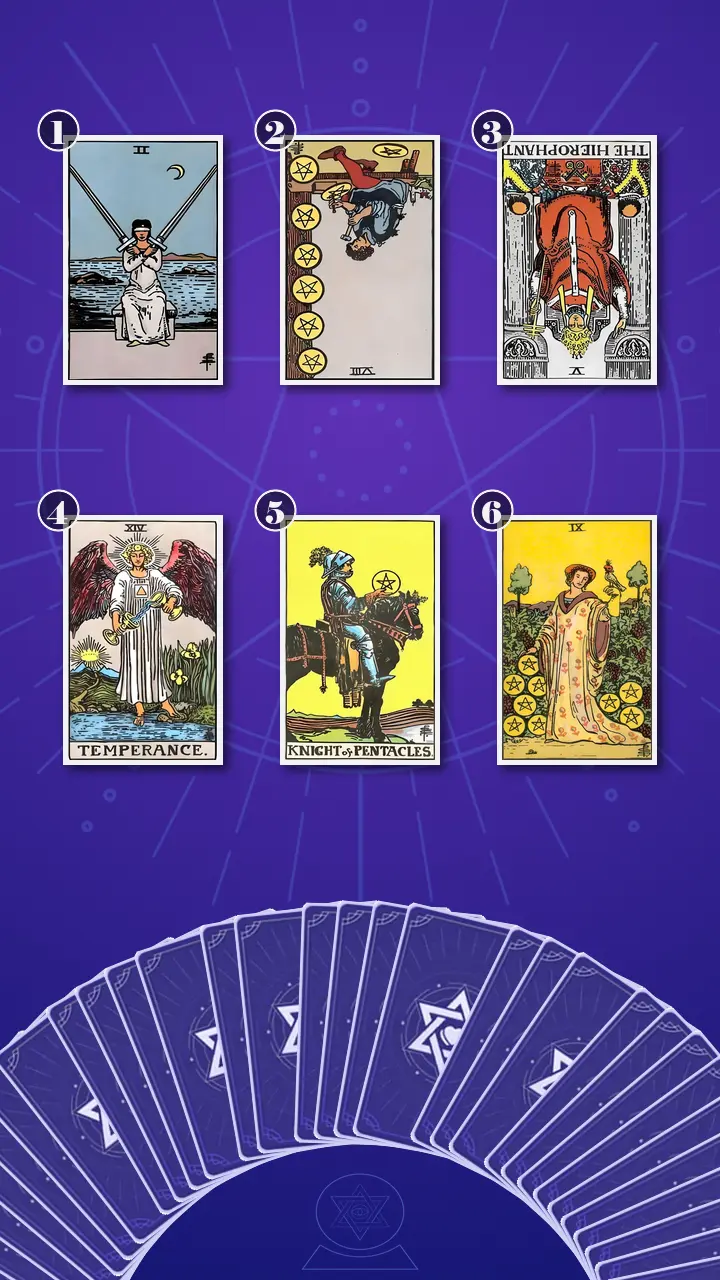
Air That Won’t Move: The First Three Cards in Context
When I laid the grid out, the top row felt like a diagnostic screenshot of Jordan’s night: tense, bright, endlessly scrollable. The bottom row waited like a different operating system.
Position 1: The Freeze at the Enroll Button
“Now we’re turning over the card that represents Surface trigger + observable behavior when the course catalog is open—the moment you freeze or back out.”
Two of Swords, upright.
I tapped the screen lightly. “This is midnight in your room, catalog open, cursor hovering over ‘enroll.’ You keep toggling between two tabs: the manageable class you’d probably enjoy and the brutal one that looks impressive. You tell yourself you’re just being responsible and gathering data, but your jaw is tight and your shoulders are braced—because clicking feels like delivering a verdict on your own character.”
In Tarot terms, the Two of Swords is often called “indecision,” but I’ve never liked that label. Upright, it’s more like self-protection disguised as neutral analysis. The energy isn’t missing—it’s blocked. Air (thought) is crossing itself over your chest like, “Nope. Not safe.”
Jordan let out a small, startled laugh—bitter around the edges. “That’s… kind of brutal,” they said. Then, quieter: “But yeah. I keep calling it ‘research.’” Their fingers rubbed the rim of their water bottle, fast enough to squeak.
Position 2: The Mechanism That Makes “Easy” Feel Unsafe
“Now we’re turning over the card that represents what is actively blocking a clean decision—the self-worth mechanism that makes ‘easy’ feel unsafe.”
Eight of Pentacles, reversed.
“This one is big,” I said, and I kept my voice plain on purpose. “You treat workload like moral currency. The heavier the syllabus, the safer you feel—like you’ve paid for your spot. So you delete anything labeled ‘easy,’ stack advanced classes, and keep optimizing the schedule until it feels punishing enough to be respectable… even though you know it risks another exhausted, resentful semester.”
Reversed, the Eight of Pentacles isn’t “you don’t work hard.” It’s work pointed at the wrong target. Effort becomes a receipt you wave around to buy legitimacy. The energy is in excess, but it’s also misdirected—like practicing scales for ten hours because you’re scared to play the song.
I mirrored the echo I could see in Jordan’s shoulders. “I can practically picture it: 1:07 a.m., editing the same color-coded spreadsheet, deleting the ‘easy’ option like it’s contraband. ‘If it looks light, it looks suspicious → if it looks brutal, it looks respectable.’ Learning versus proving.”
Jordan exhaled—small, involuntary. “Oh. Yeah.” Another half-laugh, this time more recognition than humor. “I literally delete it like I’m hiding evidence.”
Position 3: The Borrowed Rulebook Behind the Shame
“Now we’re turning over the card that represents the deeper rulebook behind the shame—where the ‘easy = bad’ story comes from.”
The Hierophant, reversed.
“This,” I told them, “is the invisible audience.”
“You’re not just choosing classes—you’re trying to pass an invisible inspection. You picture an authority—a professor, an employer, an admissions committee, even just the vibe of ‘serious people’—reviewing your timetable. The shame around ‘easy’ spikes because it feels like breaking a rule you didn’t consciously agree to, but still fear violating.”
Reversed, the Hierophant is that moment you realize the rule might not even be yours. The energy here is rigid tradition losing its grip, but it doesn’t let go quietly. It guilt-trips you on the way out.
I leaned in a little. “I use a browser metaphor for this: you didn’t open a tab called ‘Judge Me’, but it’s running in the background, draining your battery.”
Jordan went still—breath held, eyes unfocusing like they were rewinding a memory. Then their shoulders lowered a fraction. “Wait,” they said, almost to themself. “Whose voice is that?”
When Temperance Poured Between Two Cups
I let the silence do some work. In my studio, a radiator clicked once—an old-building sound that always reminds me: systems run even when you’re not watching. Jordan’s inner gatekeeper had been running for years.
Position 4 (Key Reframe): The Third Option Beyond “Hard” vs “Lazy”
“Now we’re turning over the card that represents the key reframe that dissolves the shame—the turning point that opens a third option.”
Temperance, upright.
“Temperance is the Alchemist,” I said. “Not in a ‘sparkles’ way—in a proportions way. Kitchen, recipe card, mixing bowl. It’s also a pacing card: building a semester like a training plan—hard days plus easy days—so you actually get stronger instead of injured.”
This is where I brought in my favorite tool—what I call Einstein’s thought experiment, but for self-worth. “Let’s do a quick mental experiment,” I told Jordan. “Imagine two parallel Jordans.”
“In Universe A, you choose the ‘brutal’ class load because it looks impressive. You get a short hit of respectability, then you live in chronic catch-up. In Universe B, you choose a mix: one stretch class, one requirement-efficient class, one manageable class that protects your bandwidth. Same intelligence. Same seriousness. Different design. Which universe actually produces learning?”
Jordan swallowed. Their eyes stayed on the card. “Universe B,” they said, like it hurt to say it.
The Aha Moment
Jordan was still stuck in the old logic: If I pick what fits, I’m admitting I’m not real. It was midnight-catalog math where relief counted as suspicious evidence, and every “easy” option looked like it could expose them as not serious enough.
Stop treating your schedule like a moral test and start blending challenge and ease like Temperance pouring between two cups—measured, intentional, and sustainable.
Something moved across Jordan’s face in three small steps. First: a physical freeze—breath catching, fingers hovering above the trackpad like they’d been caught mid-crime. Second: the idea seeped in; their gaze went distant, like they were picturing their calendar not as a battlefield, but as a container. Third: the release—an exhale that sounded almost like a laugh, except their eyes went glossy. Their shoulders dropped, and their jaw unclenched in a way you could actually see on camera.
“But…” they said, and the word came out sharper than they expected—brief anger, brief resistance. “If that’s true, doesn’t it mean I’ve been doing it wrong?”
“It means you’ve been doing what the inner gatekeeper said would keep you safe,” I answered. “That’s not ‘wrong.’ That’s protection. The question is whether it still works.”
I paused, then asked softly, “Now, with this new lens—can you think of one moment last week when you felt relief about an easier option, and shame immediately tried to shut it down? What would have changed if you’d treated that relief as information, not evidence?”
This was the shift in real time: from meritocracy shame and self-policing to the first flicker of quiet self-trust—choosing by outcomes, capacity, and alignment instead of pain-as-proof.
The One-Click Follow-Through (and the Tabs You Close)
Position 5: The “Boring, Effective” Next Step
“Now we’re turning over the card that represents a concrete next step you can implement immediately—for enrollment and follow-through.”
Knight of Pentacles, upright.
“This card is a love letter to the unsexy choice,” I said. “You set a simple rule: one final check for scheduling conflicts, then you enroll and close the tabs. No late-night re-trial. You add the class to your calendar, set one reminder for the first week, and let consistency build confidence—because you’re done needing the decision itself to feel morally perfect.”
The Knight’s energy is steady Earth in balance. Not grind-for-status. More like: show up, do the reps, let time do the talking.
Jordan nodded once. It wasn’t dramatic, but it looked like their spine remembered it was allowed to hold them up. “I don’t need the perfect choice,” they repeated slowly, trying it on. “I need a chosen choice.”
Position 6: What Success Feels Like When It’s Not Self-Punishment
“Now we’re turning over the card that represents integration—what alignment looks like after the choice.”
Nine of Pentacles, upright.
“A few weeks into the term,” I said, “you’re not panicking every Sunday. Assignments get done without all-nighters, and you still have energy for friends, sleep, movement, and actual curiosity. It doesn’t look dramatic, but it feels quietly competent—like stability itself is proof of skill.”
In the Nine of Pentacles, discipline exists—but it’s trained attention, not punishment. Boundaries, not bracing.
Jordan’s expression softened into something almost unfamiliar: not excitement, not dread—just a calm “okay.”
From Verdict to Design: Actionable Advice You Can Use Tonight
I pulled the story together for them the way I’d edit a short film: cut the noise, keep the throughline. “Here’s what your cards say in plain language,” I told Jordan. “The Two of Swords is the freeze—your brain calling it ‘research’ while your body braces for judgment. The Eight of Pentacles reversed is the choke point—effort being used as moral currency, so ease feels suspicious. The Hierophant reversed is the root—an inherited gatekeeper rulebook running in the background. Temperance is the reframe—proportions, not verdicts. And the Knight and Nine of Pentacles are the path—commit, then build quiet competence.”
“Your cognitive blind spot,” I added, “is thinking that difficulty is the only reliable proof of seriousness. But the transformation direction is different: outcome-over-optics scheduling. You choose by what you want to learn and what you can actually sustain—not by what would look impressive in someone else’s timeline.”
- The 3-Line Temperance RubricBefore you enroll, write three lines: (1) One outcome I want this semester (ex: “learn Python basics”), (2) My realistic weekly bandwidth (hours + energy, ex: “15 hours/week outside class”), (3) One non-negotiable life need (sleep, therapy, movement, relationships). Then choose the class mix that fits those lines—even if an “easy” label tries to argue.If shame spikes, don’t debate it—label it (“meritocracy shame”) and return to the rubric. If screens trigger spiraling, do this on paper.
- The Temperance Mix Rule (One Stretch, One Efficient, One Manageable)Pick your courses by design: one class that genuinely stretches you, one that covers a requirement efficiently, and one that feels manageable or enjoyable. You’re building a livable semester, not a LinkedIn post optimized for applause.If you feel guilty about the manageable one, say out loud: “Relief isn’t evidence. It’s information.” Then keep building the mix.
- The 24-Hour “Chosen Choice” ProtocolSet a 24-hour decision window. Do one final check for scheduling conflicts, then click enroll. Immediately screenshot your schedule and save it as “Chosen” (not “Final Draft”). Within 10 minutes, do one follow-through action: add class times to your calendar or bookmark the syllabus page.Expect your brain to reopen the case (“What if the other class was more impressive?”). Pre-plan a one-check limit, then close the tabs. Pick the class. Close the tabs. Let consistency do the talking.
I offered them one extra tool from my own practice—my Manuscript Mindmaps trick. “If the inner gatekeeper gets loud,” I said, “write your Temperance Rubric in mirror writing for two minutes. It slows the courtroom voice just enough for the real information to come through. You’re not doing it to be artsy. You’re doing it to interrupt the automatic script.”

A Week Later: Quiet Competence, Not Loud Suffering
Eight days later, Jordan messaged me: “I did the 24-hour window. I enrolled. I saved the screenshot as ‘Chosen’ and closed everything.”
They added, “I didn’t feel triumphant. I felt… weirdly calm. And then I stared at the empty tab bar for a full minute like I didn’t know what to do with myself.”
Later, they told me they’d sat alone by a campus café window while rain streaked the glass—no doomscrolling, no re-litigating. Just a warm coffee and a calendar that finally looked like something a human could live inside. Their first thought that morning was still, What if I picked wrong? But this time, they noticed the thought, exhaled, and kept eating their bagel anyway.
That’s the Journey to Clarity I trust most: not a personality makeover, not instant confidence—just the moment your body stops bracing and your choices stop needing to be a punishment to count.
When you’re staring at the course catalog and your stomach tightens at the thought of an “easy” class, it’s not laziness—it’s the fear that if you stop suffering, you’ll stop being respectable.
If you didn’t need your schedule to prove anything about you, what would the most honest mix of challenge and support look like for this one semester?