Pass/Fail Deadline Spiral to a Fair Rule You Can Submit Tonight

The 12:07 a.m. Portal Tab (and the Jaw You Can’t Unclench)
If you’re a final-year student in a competitive program and the pass/fail portal closes tonight, but you’ve refreshed the policy page so many times it’s basically muscle memory, this is for you—hello, deadline-driven choice paralysis.
Jordan appeared on my screen at 12:07 a.m. from a small Toronto bedroom, overhead light off, face lit by the cold glow of a laptop. The grade-change portal was already open behind them—deadline banner at the top like a neon sign you can’t look away from—and their phone kept flashing Discord notifications on the bedsheet. I could practically hear the fluorescent anxiety of it through the mic: the laptop fan whining, the tiny click-click of a trackpad, the silence in between like a held breath.
“I’m not even trying to be perfect,” they said, rolling their jaw side to side like it was stuck. “I just don’t want to be stupid about this. It feels like one click decides my whole future, and I hate that.”
I watched their cursor hover over confirm, then dart away—portal to LMS grade estimate to a Reddit thread titled something like Will P/F ruin grad school? to a Google Sheet tab labeled, with brutal honesty, FINAL DECISION.
The core contradiction landed in the room as cleanly as a cup on a saucer: protect your GPA and mental bandwidth versus the fear that choosing pass/fail will signal you’re not capable. And the feeling underneath wasn’t just stress—it was that tight-chest, locked-jaw pressure that spikes every time the portal loads, like your body thinks you’re about to be cross-examined.
I told them, softly, “This isn’t you being flaky. This is you trying to avoid an irreversible-feeling trade-off. Tonight we’re not predicting your transcript. We’re going to map the decision—so you can choose in a way you can stand behind and then actually sleep.”

Choosing the Compass: How the Decision Cross Spread Works
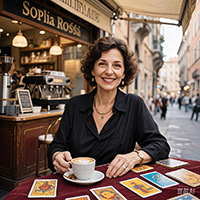
I’m Sophia Rossi—yes, that Sophia, the one with the little Italian café that’s been waking up the street with coffee aroma for twenty years. Students have always come to my counter with the same look: eyes bright from caffeine, shoulders tight from pressure, trying to turn life into a solvable equation before the deadline hits.
When I read tarot, I don’t treat it like fate. I treat it like a decision-support tool: a way to slow the spiral down, name the real trade-off, and get you actionable next steps when your brain is stuck in “research mode.”
For Jordan’s pass/fail vs letter grade deadline decision, I chose a spread I use specifically for A-vs-B crossroads: the Decision Cross.
Here’s why this spread works when you’re thinking, “pass/fail deadline tonight and I can’t decide”: it doesn’t let the reading become “which option is better.” Instead, it separates the two paths clearly and forces a vertical spine through the middle—criteria and next step—so you end with a decision rule and a plan, not more opinions.
In this layout:
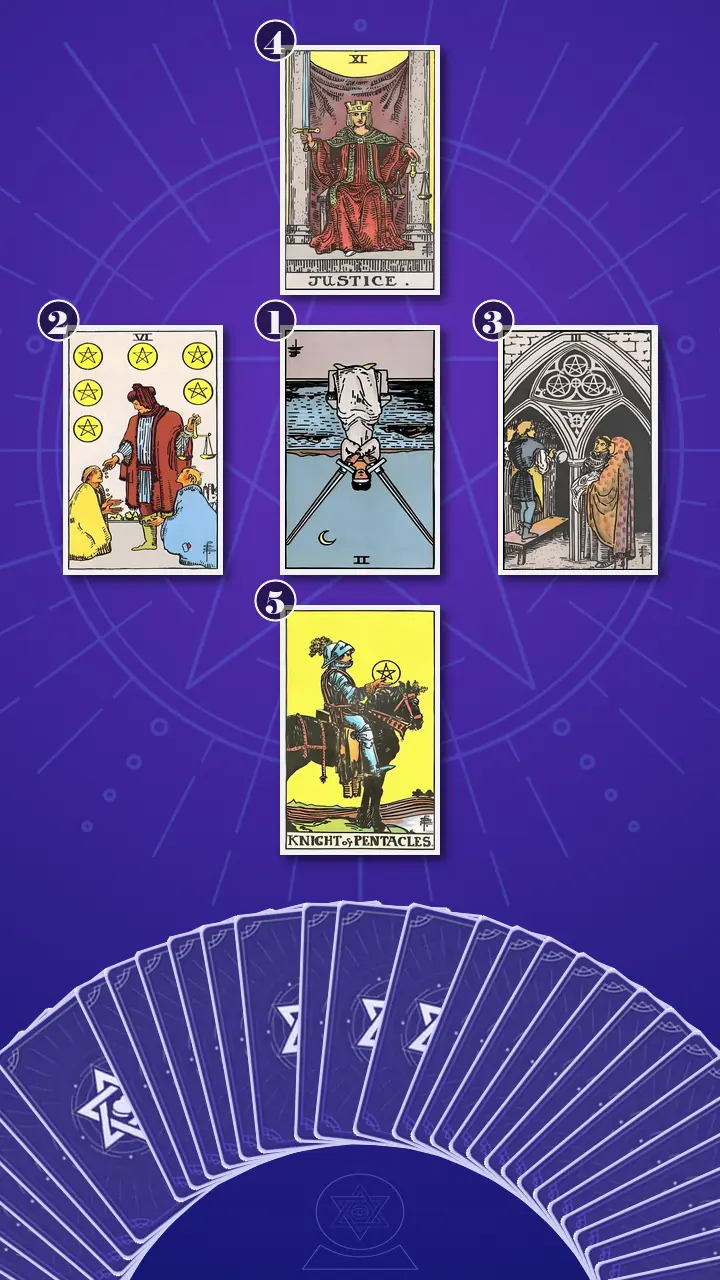
Card 1 sits at the center: the current decision knot—the exact portal-night behavior that’s stalling you.
Card 2 and Card 3 stretch left and right: Option A (switch to pass/fail) and Option B (keep the letter grade).
Card 4 sits above: the decision criteria—the truth you need to anchor in before you choose.
Card 5 sits below: the next step—what stabilizes you within 24 hours, no matter what you pick.
Reading the Map: Five Cards, One Deadline, Zero Risk‑Free Answers
Position 1 — The Current Decision Knot: Two of Swords (reversed)
I turned over the first card and said, “Now we’re looking at the card that represents your current decision knot: the specific, observable way the deadline choice is stalling you right now.”
Two of Swords, reversed.
In the old image, a figure sits blindfolded with two swords crossed over their chest—like they’re trying to hold two incompatible outcomes at once. Reversed, the blindfold starts to slip, but instead of instant clarity, you get overwhelm: too much input, too many tabs, too much pressure.
I nodded toward Jordan’s screen. “This is literally you tonight: the portal open on your laptop, Discord on your phone, and a part of you trying to stay ‘objective’ by not clicking anything. But the card is blunt: more tabs isn’t more clarity. Each new policy PDF or Reddit thread buys you thirty seconds of relief—not thirty percent more certainty.”
I could see it land because their mouth pulled into a tiny laugh—sharp, almost embarrassed.
“That’s… actually kind of mean,” Jordan said, and the laugh turned bitter at the end. “Like you’re watching my browser history.”
I stayed gentle. “It’s not mean. It’s accurate. And accuracy is how we get out.”
Then I took it closer, because this is where the shame hides: “Your chest tightens not because you can’t decide. It tightens because you’ve made the decision mean something about you. Like you’re choosing a grading format—or you’re trying to choose a version of yourself nobody can criticize.”
Jordan swallowed. Their eyes flicked away from the screen for a second, like looking directly at the card was too intimate. That pause—tight, honest—was the sound of the loop being seen as a loop.
Position 2 — Option A (Switch to Pass/Fail): Six of Pentacles (upright)
“Now we turn over the card that represents Option A: switching to pass/fail—what this path supports and what it helps you protect in this moment.”
Six of Pentacles, upright.
In the picture, there are scales in one hand and coins being given with the other—balance, redistribution, practical support. I said, “This card doesn’t read as ‘hiding.’ It reads as rebalancing. Switching to pass/fail here looks like choosing a legitimate safety net—like deciding you’re not going to white-knuckle one metric while the rest of your life is already stretched thin.”
I watched Jordan’s shoulders, which had been creeping upward all call, soften a millimeter. Not relaxed—just less braced for impact.
“You’re allowed to decide based on what you can actually sustain,” I added, and I meant it. “This is the card that asks: if pass/fail gives you back a resource this week—time, sleep, focus—what do you do with that resource on purpose?”
“Sleep,” Jordan said immediately, then made a face like they weren’t sure they were allowed to say it out loud.
“That’s not a guilty answer,” I told them. “It’s an intelligent one.”
Position 3 — Option B (Keep the Letter Grade): Three of Pentacles (upright)
“Now we turn over the card that represents Option B: keeping the letter grade—what this path supports and what it asks you to tolerate.”
Three of Pentacles, upright.
This card is craftsmanship and evaluation: a person working while others review the plans. I translated it into Jordan’s world: “Keeping the letter grade looks like choosing to be measured because you want the clean signal. You want your transcript to function like a portfolio—proof you can do the work and be evaluated on it.”
“Yes,” Jordan said too fast, then corrected themselves. “I mean… yeah. I don’t want it to look like I took the easy way out.”
“That sentence is the pressure this card brings,” I said. “Three of Pentacles can be healthy when it’s about real readiness and pride in your work. But it gets spiky when it turns into performance as self-protection.”
I asked them, “If you keep the letter grade, is it because you’re ready to be evaluated on the work you’ve done—or because you’re trying to outrun the fear of being judged for choosing pass/fail?”
Their eyes unfocused for a second, like they were replaying their last week in fast-forward—every LinkedIn internship post, every casual ‘I switched to P/F lol’ in Discord.
“Both,” they admitted, quiet.
“That’s honest,” I said. “And honesty is a criteria.”
When Justice Spoke: The One Fair Rule That Ends the Doomscroll
Position 4 — Decision Criteria: Justice (upright)
Before I turned over the fourth card, the café behind me went unusually still. The espresso machine had finished its cleaning cycle; even the street noise felt like it leaned back. I said, “We’re turning over the core of this reading now—the card that represents the decision criteria: the truth you need to anchor in (facts, values, trade-offs) before you choose.”
Justice, upright.
Justice holds scales and a sword—measure what matters, then cut through noise. “This is the part of you that stops treating the choice like a popularity contest,” I told Jordan, “and starts treating it like a fair decision under constraints. Policy wording. Realistic grade range. Your real goal. Then a plain-language verdict.”
Setup—because the moment matters: It’s midnight, the portal tab is already open, and you’re doing that thing where you keep flipping between your LMS grade estimate and a Reddit thread—like one click is going to brand you forever.
Stop chasing a risk-free answer and make a fair ruling, like Justice holding the scales steady and the sword upright.
Jordan’s reaction came in a chain, not a single emotion. First: their breathing paused, like their body needed a second to make room for the idea. Their hand froze mid-scroll over the trackpad, finger hovering as if it might touch something hot. Second: their gaze went slightly blank—not checked out, but inward, like they were finally seeing the loop as a loop instead of a personal failing. Third: the exhale came, low and slow, as their shoulders dropped in a small, involuntary release.
“But…,” they started, and I saw the flash of resistance—almost anger. “If I decide like that, doesn’t it mean I wasted all this time? Doesn’t it mean I was just… spiraling for no reason?”
I held the line without shaming them. “No. It means you were trying to feel safe. Your brain was doing the thing brains do under uncertainty: collecting more input, like reading every Reddit thread about the ‘perfect’ phone plan until the billing cycle ends. It’s not stupid. It’s just not effective.”
And this is where my café life and my tarot life overlap—my Knowledge Filtration skill. I said, “In coffee, we don’t drink the grounds. We use a filter. Tonight, Justice is your filter. One official source. One personal rule. Everything else—Discord takes, rumor-based threads—that’s just extra grounds making the cup muddy.”
I guided them into the simplest “courtroom” version of the decision: “Keep one tab open: the official policy page. Close the rest. Then write one sentence like a ruling. Not a manifesto.”
Then I asked the question that makes the insight real: “Now, with this new lens—criteria over interpretation-fear—think back to last week. Was there a moment when you felt your jaw clench at the portal and you could’ve said, ‘This is not a personality test. This is a trade-off’? What would you have done differently in that exact minute?”
Jordan blinked hard, like the memory had sharp edges. “Tuesday. At Robarts,” they said. “I opened the spreadsheet and kept adding columns. If I had a rule, I would’ve stopped at… one column.”
“Exactly,” I said. “This is you moving from deadline-fueled, self-worth-based indecision to criteria-based confidence and calm follow-through. Not because you see the future—because you stop putting your self-worth on trial.”
Position 5 — Next Step: Knight of Pentacles (upright)
“Now we turn over the card that represents your next step: the most stabilizing action you can take within the next 24 hours, regardless of which option you pick.”
Knight of Pentacles, upright.
This Knight doesn’t sprint. The horse is steady. The coin is held like a commitment. I said, “This is the unglamorous, stabilizing workflow: submit the choice, screenshot the confirmation, and then move immediately to one controllable task. This is how you stop your brain from reopening the case file.”
Jordan let out a sound that was half relief, half disbelief. “So you’re saying the ‘next step’ isn’t ‘find one more definitive answer’.”
“Exactly,” I said. “The next step is boring-but-effective. Like shipping a v1.”
Then I added something I’ve learned from twenty years of watching students try to out-caffeinate uncertainty—my Focus Period Diagnosis lens: “Also, it’s 12 a.m. Your nervous system is not at its best decision-making temperature right now—especially if you’re running on iced coffee and adrenaline. Give yourself a 10-minute focus window, then execute. You don’t need to ‘feel certain.’ You need to complete a sequence.”
I heard the tiny click of Jordan’s trackpad like a metronome, slower now, less frantic. Their eyes were on the portal again—but this time they looked like a person holding a tool, not a person holding a grenade.
From “What If” to Actionable Advice: The Fair Ruling Method
I leaned back in my chair, the smell of espresso still warm in the air, and stitched the whole spread into one clean story for Jordan.
“Here’s what I see. You started in Air that’s crossed and inverted: Two of Swords reversed—analysis paralysis, portal-night tab flipping, trying to stay neutral until certainty appears. Then Earth shows up with two real, workable paths: Six of Pentacles says pass/fail can be a resource rebalance, a safety net that returns sleep and focus. Three of Pentacles says a letter grade can be a clean signal of craftsmanship—if it’s chosen from readiness, not fear. Justice is the spine through the middle: facts and values first, not rumors and imagined judgment. And the Knight of Pentacles finishes it: commit, document, and follow through with one practical hour of work.”
I looked at Jordan and named the blind spot I hear in so many students: “Your cognitive blind spot tonight is treating this like a referendum on your capability—like one grading option proves you’re competent and the other proves you aren’t. But a grading option is a trade-off, not a personality test. The transformation is: stop trying to guarantee the ‘best transcript’ and choose based on one fair rule—your goal and risk tolerance—then put energy into what you can still control today.”
Then I gave them the simplest, most executable next steps—because clarity without action is just another tab open.
- The One-Source Boundary (Coffee Filter Rule)Open your university’s official grading policy page and copy/paste the exact wording about pass/fail visibility and GPA impact into a Notes app. Close Reddit and mute Discord for 20 minutes.If you feel the urge to “just check one more thread,” label it: grounds, not water. You don’t have to obey the urge.
- Write a One-Sentence RulingSet a 10-minute timer. Write: (1) your top priority for this course (pick ONE), (2) your realistic grade range, (3) “Given my goal, I’m choosing ___ because ___.” Keep it boring and defendable.If your chest tightens, take three slow breaths first. You can pause and come back—this is about steadiness, not force.
- Submit + Screenshot (Close the Case)Make the selection in the portal, submit the form, and immediately screenshot the confirmation. Save it to a folder named “School Admin” or “Receipts.”Say out loud, “I submitted.” Feelings can exist—but no re-litigating tonight.
- The 60-Minute Builder SprintRight after you submit, start a 60-minute focus sprint on the next controllable task (problem set, draft paragraph, practice questions). Put it in your calendar: “60-min focus sprint.”This trains your nervous system: decision → action → relief. If 60 feels impossible, do a 20-minute version and stop when the timer ends.

A Week Later: Ownership, Not Certainty
Six days later, I got a message from Jordan while I was opening the café—unlocking the door, grinding beans, the first hiss of steam curling into the quiet street.
“I did it,” they wrote. “I used the one-source boundary. Wrote the ruling. Submitted. Screenshot saved in ‘Receipts.’ Then I actually did the 60-minute sprint. I didn’t magically feel calm, but I stopped reopening the portal in my head.”
And then, in a second text: “I slept. Like a real sleep.”
It wasn’t a movie ending. It was something better: a small, steady proof.
Clear but still a little tender—Jordan told me they woke up the next morning after sleeping a full night, and their first thought was, “What if I’m wrong?” They stared at the ceiling for three seconds… then opened the ‘Receipts’ screenshot, exhaled, and made coffee anyway.
That’s the Journey to Clarity I trust: not certainty, but ownership. Not perfect prediction, but a fair rule and calm follow-through—Justice handing the verdict to the Knight, who builds one step at a time.
When a deadline turns into a referendum on your capability, even a simple portal choice can make your chest tighten—because it’s not really about grades, it’s about whether you’ll blame yourself forever for not predicting the future perfectly.
If you trusted yourself to choose one fair rule—and then just build from there—what would your next small, boring, stabilizing step be in the next 24 hours?