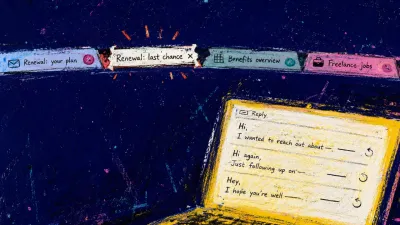
The "Growth plan" invite—and a values-first way out of IC vs manager gridlock

The Calendar Invite That Hit Like a Personality Test
Jordan (name changed for privacy) came onto my video call from Toronto with the kind of stillness that isn’t calm—it’s containment. They told me the whole spiral started with a calendar invite titled “Growth plan — Monday 9:00”. The words looked harmless. Their body didn’t buy it.
They described Tuesday night like it was a loop they’d been trapped in for weeks: 10:52 p.m., condo living room, HVAC humming, laptop fan whirring like a tiny judge. Notes app open to a doc titled “IC vs Manager.” Bullets rearranged, then rearranged again, as if the right order would finally unlock certainty. Slack opened, one message drafted to their manager, then saved as a draft. Their phone felt warm from the LinkedIn scroll, and every “thrilled to announce…” post made their stomach drop in a way they hated admitting.
“I can fix complex problems under pressure,” they said, rubbing their sternum like they were trying to smooth something down under the skin. “But this—this makes my chest tight. If I say yes, I’m managing people. If I say no, I look unambitious. If I wait, I’m… paying for it anyway.”
I recognized the exact tension: wanting growth and recognition, while fearing the loss of autonomy—and the particular terror of being publicly new at something that isn’t measurable the way specialist work is. It’s career crossroads energy, but with a corporate tech twist: the ladder looks like one narrow bridge, and everyone insists it’s “the next level.”
What I saw in Jordan wasn’t indecision as laziness. It was apprehension masquerading as strategy—like their nervous system had turned into a browser with ten tabs open, the fan screaming, the battery draining, and no one willing to hit “Confirm purchase.” Their shoulders were practically up by their ears. Their still body had a restless buzz underneath it, like a subway platform hum trapped in the chest.
“We’re not here to force a perfect answer,” I told them. “We’re here to find clarity you can actually stand inside. Let’s make a map through the fog—one that respects your values, your energy, and what your body already knows.”

Choosing the Compass: The Decision Cross Tarot Spread
I asked Jordan to take one slow breath in, and one slow breath out—nothing mystical, just a clean transition from spiraling to observing. While I shuffled, I invited them to hold the question in a single sentence: “Do I take the management-track promotion, or stay a specialist on purpose?”
“For this,” I said, “I’m using a classic spread called the Decision Cross.”
For you reading this: when someone is stuck in an IC vs manager track decision—especially when there’s decision paralysis and first-time manager anxiety—more cards often adds more noise. The Decision Cross is lean by design. It maps the present stuck pattern, contrasts the two paths, names the hidden driver underneath the debate, then offers a values-based key and one grounded next step. It’s not a predictive verdict about your promotion. It’s a practical framework for how tarot works in real life: it shows the pattern you’re living inside, and where to apply leverage.
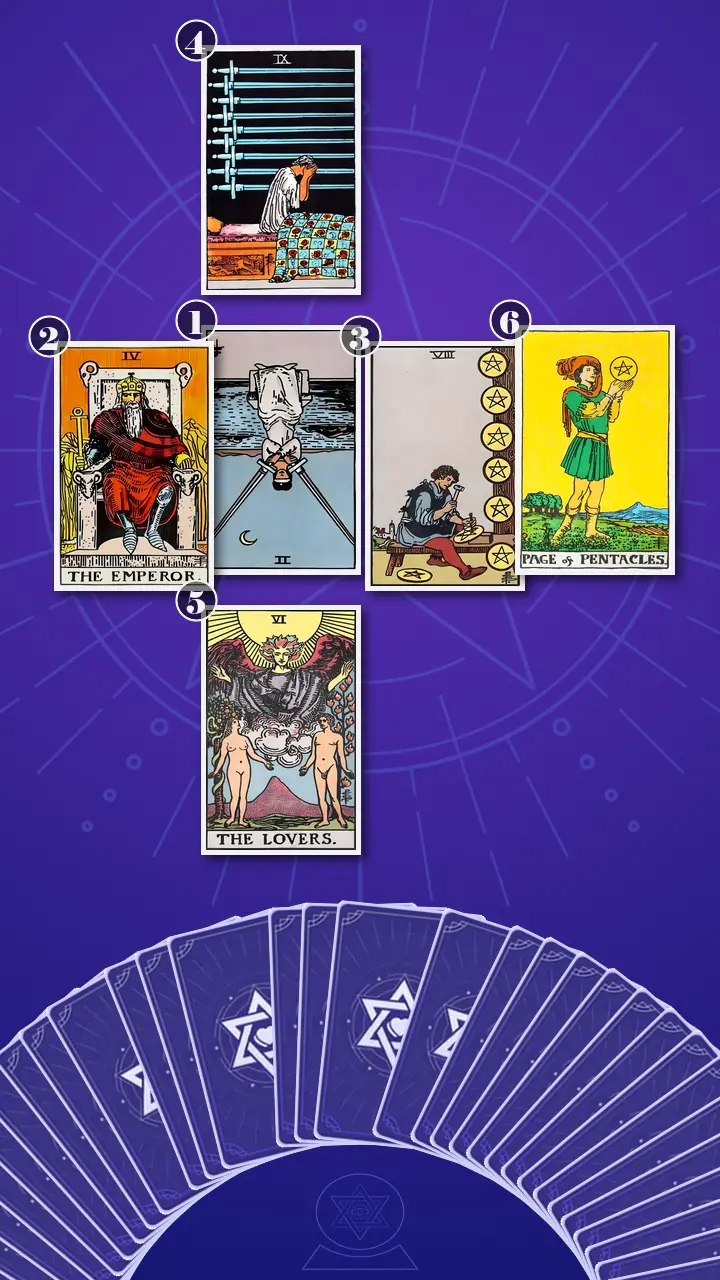
“Here’s what we’ll look at,” I continued. “The first card is the current stuck point—how the paralysis shows up in your actual week. Then we’ll pull one card for Path A: stepping into people management, and one for Path B: staying a specialist. Above them, we’ll name the hidden fear or need that’s driving the whole evaluation. Below, we’ll find the decision filter—the key. And finally, we’ll end with a grounded next step you can do within a week, no matter what you choose.”
Reading the Map: Two Paths, One Nervous System
Position 1: The current stuck point—how the paralysis shows up right now
“Now turning over,” I said, “is the card that represents the current stuck point: how the decision paralysis shows up behaviorally right now.”
Two of Swords, reversed.
I didn’t have to reach far for the modern translation because Jordan had already been living inside it: a Wednesday night in a Toronto condo, laptop open to a Google Doc titled “Promotion decision,” rearranging the same bullets like the right order will magically make you feel certain. Drafting a Slack to your manager—then saving it as a draft because every version feels like it reveals too much. Telling yourself you’re being “thoughtful,” while your shoulders stay up and you can’t fully relax because you’re still holding both doors with your body.
In reversed position, this card reads like a blockage breaking into leak. Upright, the Two of Swords can be calm neutrality. Reversed, the blindfold slips—meaning you’re not actually neutral anymore—but the crossed arms stay locked, meaning you’re still trying to protect yourself from the feeling of choosing. The energy is contracted: tight chest, tight shoulders, restless buzzing while sitting still.
I framed it the way I often do for high-performing specialists: “This is a two-tab life moment. One tab is your spreadsheet—your pros/cons doc, levels, compensation bands. The other tab is your reputation. And you keep toggling between them like you’re reviewing a legal contract for loopholes: If I commit, I can be wrong. If I don’t commit, I can pretend I’m still safe.”
Jordan let out a small laugh that sounded like it had a sharp edge. “Okay,” they said, almost wincing. “That’s… too real. The unsent draft part is actually haunting me.”
I nodded. “And here’s the line I want you to remember, because it’s not a moral judgment—it’s just physics: Not choosing is still a choice—you just pay in stress instead of action.”
Position 2: Path A—stepping into people management (what it’s really asking)
“Now turning over,” I said, “is the card that represents Path A: stepping into people management—what this role is really asking of you.”
The Emperor, upright.
Jordan’s eyes flicked to the side like they were already picturing their calendar.
“Management,” I told them, “isn’t emotional caretaking; it’s structure, boundaries, and decisions.”
And the card’s modern scene landed exactly there: your calendar becoming a wall of 1:1s, hiring debriefs, and ‘quick syncs’ that aren’t actually quick. You’re the person who decides what “good” looks like, documents expectations, and says the slightly uncomfortable thing early so it doesn’t become a full-blown conflict later. The question isn’t “Can I be charismatic?” It’s “Can I be consistent and boundaried without turning controlling?”
Energetically, The Emperor is structured Fire—authority that holds. In balance, it’s the steady leader who creates guardrails so the team doesn’t crash. In excess, it becomes control. In deficiency, it becomes avoidance of responsibility. For Jordan, the dread wasn’t actually about “being everyone’s therapist.” It was about being the operating system: setting standards, holding boundaries, and tolerating that you can’t personally execute every task the way you can as an IC.
They paused, the tension in their jaw shifting. “Oh,” they said slowly. “That’s… boundaries and decisions. Not constant caretaking.”
“Exactly,” I replied. “This card isn’t demanding you become a different personality. It’s asking if you’re willing to learn a different kind of competence.”
Position 3: Path B—staying a specialist (what it preserves and develops)
“Now turning over,” I said, “is the card that represents Path B: staying a specialist—what this path preserves and develops.”
Eight of Pentacles, upright.
The relief in Jordan’s face was immediate, subtle, almost involuntary—like someone finally loosened a too-tight watchband.
I gave them the lived-in translation: staying a specialist can feel like the clean dopamine of measurable progress. A ticket gets solved, a system gets optimized, a dashboard finally makes sense. Headphones on, IDE/Slides/SQL open, time moving fast because the task is trackable. You can point to the output. You can be “the go-to” without having to be the authority in a room.
In energy terms, this is Earth in balance: mastery, craft, tangible learning. It’s a valid growth path when chosen intentionally. The only shadow question—the one the Eight of Pentacles always asks when it shows up in a fork like this—is gentle but sharp: are you choosing craft because you love it, or because it hides you from visibility?
Jordan swallowed, then gave me a look that was half honesty, half resignation. “I do love the craft,” they said. “But I also… love not being perceived.”
“Thank you,” I said. “That’s not a flaw. That’s data.”
Position 4: Hidden driver—the deeper fear shaping both paths
“Now turning over,” I said, “is the card that represents the hidden driver: the deeper fear/need shaping how you evaluate both paths.”
Nine of Swords, upright.
Jordan’s eyes widened a fraction, like their brain recognized itself in the image before I said a word.
I described it in the most modern way I know: at 2:07 a.m., your brain runs a full internal incident report—What if I mishandle conflict? What if someone quits? What if my director realizes I’m not leadership material? You replay imaginary conversations like you’re preparing for cross-examination, not a normal career chat. In the morning, nothing has happened—yet your body acts like you’ve already failed.
This is Air in excess: thought loops so sharp they start to feel like evidence. The Nine of Swords is your mind pinning up imagined screenshots until they look like facts. It’s not really about the role description. It’s about the punishment: Can I tolerate being a beginner in public without calling myself a fraud?
As a Jungian psychologist, I’ve seen this pattern a thousand times in different clothes: the fear isn’t “I might struggle.” The fear is “If I struggle, it means I am not who I thought I was.”
Jordan’s breathing went shallow for a moment. Their shoulders tensed, then dropped a millimeter, then tensed again—the body negotiating with the truth.
“So,” I asked softly, “when you picture struggling as a new manager, what’s the feared headline your brain writes about you—one sentence, no editing?”
They stared down at their desk. “That I was only ever good at my own tasks,” they said. “And now everyone knows.”
I let that sit in the air, like a bell tone after it’s struck. “That’s the real driver,” I said. “Not ambition. Not gratitude. Exposure.”
When The Lovers Spoke: From Status Test to Integrity Choice
Position 5: The key decision filter—what helps you choose well
I felt the room inside the call get quieter—not because anything changed externally, but because we were about to touch the hinge of the whole story.
“Now turning over,” I said, “is the card that represents the key decision filter: the values and relationship-to-self that help you choose well.”
The Lovers, upright.
Before I interpreted it, I said the sentence that often breaks the spell for corporate high-achievers: A promotion isn’t a personality test.
The Lovers, here, isn’t about romance. It’s about alignment—choosing in a way you can respect when nobody’s clapping, when LinkedIn is closed, when it’s just you and your own inner witness. The modern scene is exactly that: the decision loosens when you stop rehearsing what sounds impressive and start asking what you can live with on a random Tuesday. Imagine saying yes with clear boundaries—training, expectations, support—and notice if your chest softens or tightens. Imagine saying no while choosing an intentional specialist path—scope, mastery, impact—and notice the same. The “right” answer is the one that keeps you in integrity with your values.
In energetic terms, The Lovers is balance through truth. Not “which option is safest,” but “which option is honest.”
Setup. I mirrored Jordan’s exact loop back to them: it’s 10:52 p.m., you’re still tweaking the same “IC vs manager” doc, and your chest tightens when you picture the meeting where you have to say a clean yes or no. The not-choosing has started to feel like choosing stress.
Delivery.
Stop treating this as a status test; choose the path that feels mutually aligned—like The Lovers choosing a commitment you can stand inside.
I paused. I let the sentence hang there the way I used to let a ship’s horn echo across Venetian water—long enough for the body to hear it, not just the mind.
Reinforcement. Jordan’s reaction came in a three-beat chain. First, a tiny freeze: their inhale snagged, like their ribs forgot how to expand for a second. Then their eyes unfocused, staring past the screen, as if replaying every late-night draft and every imagined meeting. And then, slowly, their face softened—cheeks unclenching, shoulders dropping as if gravity finally got permission.
“But if I choose based on that,” they said, and there was a flash of heat in their voice—an unexpected edge—“doesn’t it mean I’ve been doing it wrong? All this time? Like… I’ve been making my whole life a scoreboard?”
I didn’t rush to soothe it away. “That anger makes sense,” I said. “Because the status test has been demanding perfection from you. It’s been pretending to be ‘career strategy,’ but it’s really been a self-worth trial.”
This is where I used my Choice X-Ray—my way of looking at decisions multi-dimensionally, beyond the obvious pros and cons. “When I put this choice under the X-Ray,” I told them, “I don’t just look at salary or title. I look at hidden costs and hidden benefits: your energy, your autonomy, your relationship to being seen, your capacity to be a beginner, and what kind of person you become in each environment.”
“Under that lens,” I continued, “management isn’t just ‘more money, more authority.’ The hidden cost might be deep work oxygen. The hidden benefit might be learning boundaries and leadership as a structure skill. Staying specialist isn’t just ‘safety.’ The hidden benefit might be true mastery and impact. The hidden cost might be letting fear of visibility keep choosing for you.”
Then I guided them into the micro-check I trust because it makes values real in minutes, not months. “Open Notes,” I said. “Ten minutes. Values-first.”
“Write: (1) three non-negotiables for your next six months—energy, autonomy, learning, impact, boundaries—one line each. (2) one thing you refuse to sacrifice—sleep, deep work blocks, kindness, whatever is sacred. (3) one tiny management rep you could try this week.”
“And if your body spikes—tight chest, buzzing—pause. That’s data, not a test.”
I watched Jordan’s shoulders drop again, this time more decisively. Their eyes looked wet but steady—relief mixed with the strange vulnerability that comes after you stop negotiating with yourself.
“Now,” I asked, “with this new frame—integrity instead of status—can you think of a moment from last week when this would have changed how you felt?”
Jordan nodded slowly. “When I saw that LinkedIn post,” they said. “I made it mean I’m behind. But… that wasn’t about my values. That was about panic.”
“Exactly,” I said. “This is the shift from fear-driven over-analysis to values-based clarity. Not certainty. But clarity you can breathe inside.”
Position 6: Grounded next step—what builds clarity within a week
“Now turning over,” I said, “is the card that represents the grounded next step: one practical move that builds clarity and self-trust within a week.”
Page of Pentacles, upright.
The Page is the student of real-world competence. Earth energy. Measurable reps. A product MVP instead of a lifetime subscription.
I gave Jordan the lived scenario: instead of deciding your entire identity, you run a one-week experiment. Ask your manager if you can mentor one junior, co-lead one project meeting, or take ownership of one process decision—and define what “good” looks like for that single rep. Treat leadership as a learnable skill with feedback loops, not a personality verdict. Leave the week with real data—what drained you, what energized you, what support helped—instead of more tabs open.
“Trade ‘perfect certainty’ for one week of real evidence,” I said, and I watched Jordan’s mouth pull into the smallest, most relieved smile. Not happy. Not fixed. But moving.
The Air-to-Earth Reset: Actionable Next Steps for the IC vs Manager Track Decision
I summarized what the cards had revealed as a single coherent story, because this is where tarot becomes actionable advice: the Two of Swords reversed showed the present symptom—indecision disguised as productivity, paid for with stress. The Nine of Swords named the hidden engine—catastrophic rehearsal and fear of being publicly new. The Emperor and Eight of Pentacles clarified the fork honestly: management is structure-and-boundaries leadership; specialist work is mastery-and-impact craft. And The Lovers made the whole decision cleaner: choose through integrity, not external approval.
The cognitive blind spot I named for Jordan was simple: they were treating the promotion like an irreversible verdict on their identity as “the reliable expert.” That frame guaranteed paralysis. The transformation direction was equally simple (and harder, because it’s emotional): shift from “I must pick the one correct path” to “I can choose based on values and run a small real-world experiment that builds evidence and self-trust.”
Then I offered a plan that would move their nervous system from Air (rumination) to Earth (one concrete action). I used one of my cruise-era tools—my Reality Testing approach—because on a ship, you don’t decide where to dock by vibes alone. You test conditions, check timing, and make the next best move with the information you can actually collect.
- The Integrity Filter (10 minutes)Open Notes and write your top 3 non-negotiables for the next 6 months (e.g., autonomy, learning, impact, energy). Then write one sentence for each path: “I can respect myself here because…” Circle one value you refuse to trade for a title.If you catch yourself picking what’s easiest to explain to LinkedIn, pause—that’s the “status test” impulse. Set a timer and stop when it rings.
- The 20-Minute Reality-Check Message (send, don’t perfect)Send one simple note to your manager: “I’d love 20 minutes to talk through expectations and growth paths—are you free Thursday or Friday?” This buys time with clarity instead of silence.Lower the bar: you’re not sending a final decision, you’re scheduling the conversation that creates real information.
- One-Week Evidence Experiment (one leadership rep)Choose one low-stakes rep this week: mentor a junior for 30 minutes, co-lead one meeting segment (agenda + recap), or ask for a clear 30/60/90-day success definition for the promoted role. Track: What energized you? What drained you? What support would make it sustainable?If your brain says “not enough,” label it as a symptom of wanting certainty. You’re collecting data, not proving worth.

A Week Later: Quiet Proof Without a LinkedIn Post
Five days later, Jordan messaged me. No long paragraph. Just: “Sent the meeting request. Also volunteered to run the retro agenda next sprint. I was shaky for the first minute, then it was… fine.”
They added, almost as an afterthought: “And I archived the pros/cons doc for 48 hours like you said. My chest finally unclenched a bit.”
That’s what I mean by a Journey to Clarity: not a dramatic reinvention, but a small, real shift—from living in drafts to living in evidence; from fear as the decision-maker to values as the filter. The cards didn’t tell Jordan who to be. They helped them stop treating a promotion as a referendum on worth, and start treating it as a direction they could test with integrity.
When growth is on the table, it can feel like your chest tightens because you’re not just choosing a job—you’re trying not to lose the one version of yourself that’s always felt safe: the reliable expert.
If you let this be an experiment instead of a verdict, what’s one small rep you’d be willing to try this week to gather real evidence about what you want?
Author Profile