From Submit Panic to a Fair Rule: Choosing HSA vs PPO Tonight
Finding Clarity in the 10:45 p.m. Portal Countdown
If you’ve ever stared at a benefits portal countdown that says “Open enrollment ends tonight” and suddenly felt like one click could wreck your finances, this is for you.
Alex joined my Zoom call from a fourth-floor walk-up in NYC. They were in sweatpants, laptop balanced on their knees, the radiator hissing like it had opinions. The blue glow from Google Sheets made their eyes look glassy and overworked. Their cursor kept drifting toward “Submit,” then flinching away, like the button was a trapdoor.
“I know it’s just a benefits choice,” Alex said, and their laugh came out thin, more air than humor. “But it feels like a personality test I could fail. HSA plan or PPO. If I pick wrong and something happens next year… it’s expensive. And it’s on me.”
I watched their jaw work as if it was chewing on numbers for comfort. Their shoulders were almost touching their ears. Their hands couldn’t stay still—trackpad, phone, back to trackpad—like their nervous system was trying to swipe away uncertainty the way you might swipe away a bad headline.
What sat between us wasn’t a math problem. It was a contradiction with teeth: wanting to make the most responsible choice for next year vs. fearing you’ll get trapped by surprise medical costs if you choose wrong.
“Okay,” I said gently, keeping my voice steady. “We’re not here to prove you’re a perfect adult. We’re here to find clarity you can live with tonight. Let’s draw you a map—one that respects uncertainty without letting it run your life.”
Choosing the Compass: The Decision Cross Tarot Spread
I asked Alex to take three slow breaths—not as a mystical ritual, just as a nervous-system handoff. “Put one hand on your jaw,” I said, “and see if you can unclench for the length of an exhale.” When their shoulders dropped a millimeter, I began to shuffle.
“Tonight we’ll use a spread called the Decision Cross,” I told them. “It’s built for exactly this kind of A vs. B choice under a deadline—HSA plan vs PPO—where the real need isn’t prediction. It’s a fair standard, values alignment, and follow-through.”
To you, reading along: this is how tarot works at its most practical. Not as fortune-telling, but as a structured way to surface what’s already happening—on your screen, in your body, in your assumptions—so you can choose cleanly instead of spiraling.
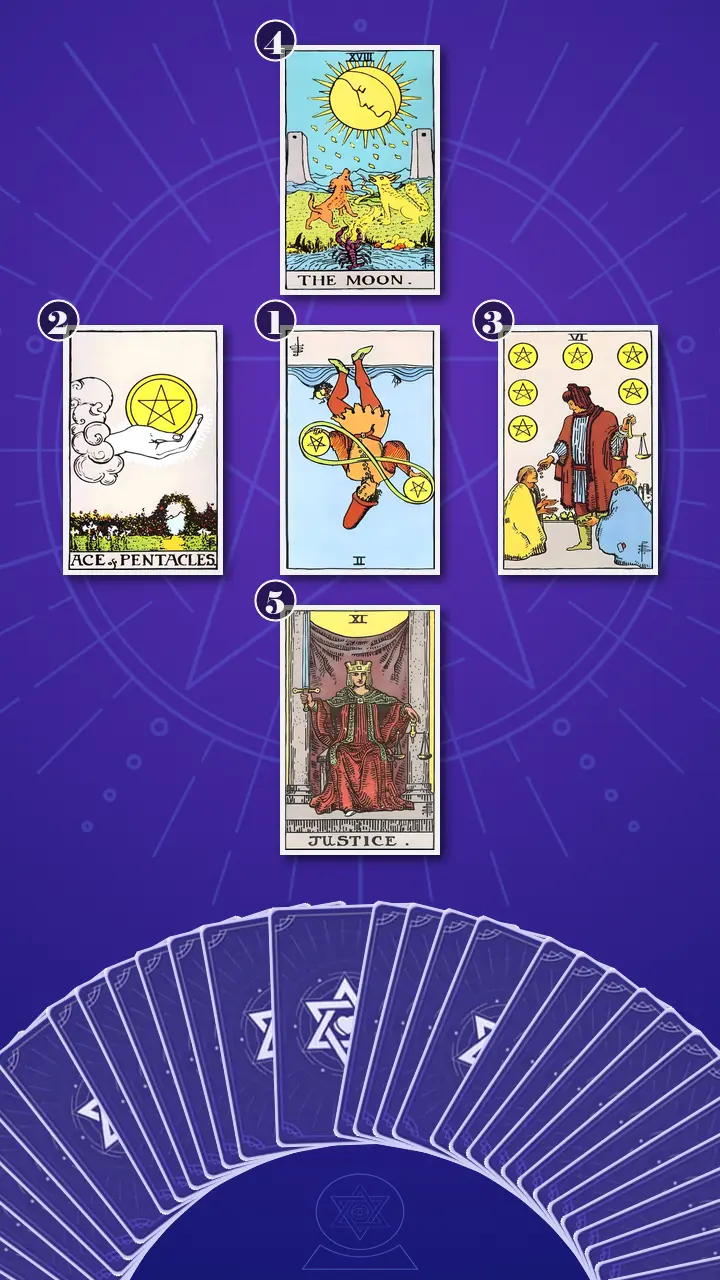
I laid out five cards in a cross and previewed the roles:
“Center is your current decision state—what’s actually happening tonight. Left is Path A: the HSA plan, what it builds and what it asks. Right is Path B: the PPO plan, what it simplifies and what tradeoff it requires. Above is the hidden influence—the fear or assumption inflating the stakes. Below is guidance for tonight: a decision principle you can stand behind, even with imperfect information.”
Reading the Map: Tabs, Tokens, and the Juggle That Isn’t Working
Position 1 — Your current decision state: what’s happening tonight
“Now flipping over,” I said, “is the card representing your current decision state: the specific behavior pattern and stress response showing up tonight.”
Two of Pentacles, reversed.
I didn’t need to dramatize it. Alex’s whole setup was already inside the card: two choices, choppy water, and the frantic attempt to keep both coins spinning.
“This is late-night reality,” I told them, using the card’s modern translation as plainly as I could. “It’s late and you’re trying to keep two futures alive at once: HSA in one tab, PPO in the other, plus a spreadsheet you keep ‘fixing.’ Every time you get close to choosing, you reopen the comparison page like it’s a slot machine that might finally pay out certainty.”
Alex let out a quick, bitter little laugh. “That’s… kind of rude,” they said. Then softer: “But, yeah. That’s literally what I’m doing.”
“You’re not bad at math—you’re overloaded by uncertainty,” I said. “Reversed, this card isn’t about you being incapable. It’s about energy that’s blocked by switching—too many variables, too little time, your attention bouncing like a pinball between tabs.”
I leaned forward. “And here’s the quiet trap: juggling can feel like control, but it’s actually avoidance. It keeps both futures alive so you don’t have to land the plane.”
Alex stared at the screen for a second, then—almost without meaning to—closed one of the PDFs. Just one. A tiny, visible exhale followed, like their body had been waiting for permission.
Position 2 — Path A (HSA plan): what it supports and what it asks
“Now we turn over the card representing Path A: the HSA plan—what this option supports in your life, what it asks of you, and what kind of security it builds.”
Ace of Pentacles, upright.
“This card is the opposite of juggling,” I said. “One coin. One clear object. Something you can actually hold.”
I drew directly from the modern-life scenario. “The HSA option looks like a quiet, tangible seed you can plant: a dedicated account that grows over time, especially if you automate even a small contribution. But it also asks you to tolerate a higher deductible without feeling betrayed by your own choice.”
Alex nodded—small, practical. The kind of nod that says, Okay, we’re back in reality.
“Think of it like opening a dedicated bucket in your budget app,” I added, careful to keep it grounded. “Not a mythical ‘someday I’ll have savings’ bucket. A named one. You see it. It grows. And because it’s automatic, you don’t have to rely on willpower in February.”
“I could do like… fifty a paycheck,” Alex murmured, eyes flicking to the side as if they were already doing the math in their head, but calmer this time. “Maybe twenty-five if I’m being honest.”
“That honesty,” I said, “is the Ace. It’s not about being impressive. It’s about being viable.”
Position 3 — Path B (PPO plan): what it simplifies and the tradeoff
“Now we turn over the card representing Path B: the PPO plan—what this option supports in your life, what it simplifies, and what tradeoff it requires.”
Six of Pentacles, upright.
The image of scales and exchange landed like a clean sentence.
“This is a system-support card,” I told them, using the modern translation. “The PPO option feels like paying for smoother access: higher premiums, but less mental math every time you consider a doctor visit. It’s a predictable exchange.”
Alex’s mouth tightened—not fear this time, more like recognition. “I’m tired,” they said, almost surprised by their own honesty. “Like… I’m tired of everything being another spreadsheet.”
“Exactly,” I replied. “You’re not paying for perfection. You’re paying for predictability and lower friction. If your life is already heavy—hybrid job, tight budget, decision fatigue—less point-of-care uncertainty can be a real form of support.”
I watched their hands finally stop tapping for a beat. Their shoulders didn’t rise. The Six of Pentacles energy was balanced, not dramatic—steady support rather than heroic self-reliance.
Position 4 — The hidden influence: what’s filling the gaps
“Now we turn over the card representing the hidden influence: the fear, assumption, or uncertainty you’re projecting that makes the choice feel bigger than it is.”
The Moon, upright.
The timing was almost too perfect. As I said the words, a police siren somewhere below Alex’s window rose and faded, the sound warping down the street like a nervous thought that won’t settle.
“This,” I said, “is the fog.”
I used the scenario exactly as it showed up in modern life: “Under deadline pressure, your brain treats uncertainty like a threat and starts casting worst-case scenes: surprise ER bill, out-of-network trap, a year where you can’t access care. Online anecdotes become ‘evidence’ and your spreadsheet becomes a way to soothe the fear, not just compare plans.”
Alex swallowed. Their thumb twitched toward their phone—an almost automatic move, like they could summon a Reddit thread to confirm danger.
“One viral bill story is not a forecast. It’s a fear amplifier,” I said, gently but firmly. “The Moon makes imagination feel like data.”
I introduced one of my own field tools, because archaeology has taught me this lesson the hard way: when you can’t see the whole site, your mind invents what’s under the sand. “I use a method I call Time Stratigraphy,” I said. “We separate layers. Not to judge them—just to stop mixing them.”
“Three columns,” I continued. “FACT, GUESS, FEAR. Fact: what the plan documents actually say. Guess: what you think next year might look like. Fear: the horror-trailer your brain is running.”
Alex let the silence sit for a moment. Their gaze went slightly unfocused—like a replay had started behind their eyes. Then they whispered, “I read that $7,000 surprise bill post while brushing my teeth. And now I can’t stop seeing it.”
“That’s The Moon,” I said. “Not you failing. You being human under fog.”
When Justice Spoke: The Rule That Ends the Spiral
Position 5 — Guidance for tonight: the decision principle
I held my hand over the final card for half a second. The room on Alex’s side seemed to quiet—not because the city stopped, but because their attention finally stopped sprinting.
“Now we turn over the card representing guidance for tonight: a decision principle and a grounded next step that restores self-trust without needing perfect certainty.”
Justice, upright.
Justice always makes me think of excavated courts—stone floors worn smooth by centuries of ordinary disputes. Not drama. Structure. In the field, we don’t get perfect information either. We choose a trench location based on a fair rule, log our reasoning, and accept that you can’t dig the whole city in one season.
Alex stared at the scales and sword, then blurted, sharper than they’d sounded all night: “But if I stop comparing… isn’t that irresponsible? Like, doesn’t that mean I’ve been doing this wrong?”
I nodded, because that resistance was honest. “No,” I said. “It means your brain has been trying to buy safety with certainty. Those aren’t the same currency.”
Setup
At 10:45 p.m., Alex was trapped in a loop that looked like research but felt like doomscrolling: if they could just find the correct plan, the fear would finally shut up. Their jaw was clenched because the choice wasn’t just about premiums—it felt like proof of adulthood.
Delivery
Stop trying to outrun uncertainty and start choosing with integrity—let the scales set your criteria and let the sword end the spiral.
I let the sentence hang there—no extra commentary—so it could land in the body, not just the mind.
Reinforcement
Alex’s reaction came in layers, not all at once: first a tiny freeze—breath held, fingers hovering above the trackpad. Then their eyes softened, unfocusing like they were watching a memory: the benefit portal, the coworker texts, the “it depends” villain of the PDF. Then, finally, the release—an exhale so slow it seemed to unwind their shoulders one notch at a time.
They blinked hard. “I hate that this is true,” they said, voice a little rough. “Because it means I can’t… win. I can’t simulate my way into certainty.”
“Right,” I said, and I kept it warm. “Justice isn’t asking you to be omniscient. It’s asking you to be fair with the information you have, and then commit cleanly.”
Here’s where I used my Historical Case Matching, because crossroads decisions are older than spreadsheets. “Civilizations didn’t rise because they predicted every drought,” I told them. “They rose because they built a rule they could repeat: store grain; diversify trade; keep reserves. A long-term value assessment beats panic optimization. Your modern version is simpler: choose the plan whose worst-case won’t wreck you, then build a small buffer so the unknown doesn’t feel like a cliff.”
I leaned in. “Now—using this new lens—think back to last week. Was there a moment when you reopened the portal because you felt scared, not because you learned something new? What would have felt different if you’d said, ‘I’m choosing with integrity now’?”
Alex looked to the side, jaw loosening again. “Yesterday,” they said. “I was about to click submit, then I saw that TikTok storytime about a surprise bill and I… reopened everything. I didn’t actually get new info. I just got more scared.”
“That’s the hinge,” I said. “And it’s also the bridge from where you started—last-minute decision paralysis—toward what you actually want: grounded self-trust through a fair decision rule and a clean commitment.”
“Pick the plan whose worst-case you can handle without panic—then stop negotiating with yourself,” I added. “Justice likes clean edges.”
From Insight to Action: The Justice Note and the No-New-Tabs Sprint
I pulled the whole spread together for them in one coherent story, the way I’d stitch together layers at a dig.
“Here’s the pattern,” I said. “Two of Pentacles reversed says your real blocker isn’t intelligence—it’s overload. Ace of Pentacles shows the HSA path as self-funded resilience, but only if it’s sustainable and automatic. Six of Pentacles legitimizes the PPO path as system support—paying for lower friction and predictability. The Moon names what’s been hijacking you: uncertainty filled in with worst-case movies. Justice resolves it with a fair standard and a final click.”
“Your blind spot,” I continued, “is confusing certainty with safety. You’ve been treating ‘I’m 100% sure’ as the only acceptable form of protection. But the transformation direction here is different: from trying to predict the entire year to choosing based on one clear affordability-and-risk rule you can stand behind tonight.”
Alex rubbed their forehead. “I get it,” they said, then immediately flinched. “But I swear I don’t have time for a whole process. I still have to… actually do it.”
“Good,” I replied, a little wry. “Then we make it archaeological: we restore the artifact that matters, and we stop polishing dust.”
I offered them a tight, low-friction plan—small steps, practical boundaries, no heroics.
- The 25-Minute No-New-Tabs Enrollment SprintSet a timer for 25 minutes. Do one final pass only on four items: premium per paycheck, deductible, out-of-pocket max, and whether your current meds/providers are covered (if relevant). Ignore everything else tonight. When the timer starts: no new tabs, no Reddit threads, no coworker polling.Expect resistance—your brain will insist you need “one more detail.” That’s The Moon trying to buy time. If panic spikes, do the 2-minute version: check out-of-pocket max + premium and move on.
- Write the Max-Tolerable Worst-Case Number (On Paper)On a sticky note or actual paper, write one number: the maximum annual healthcare cost you could realistically handle without panic (based on your real checking/savings reality, not your ideal self). Circle it. This is your Justice threshold.If your jaw tightens while you write it, pause for three slow exhales. You’re not “manifesting” a bad year—you’re defining your safety boundary.
- The 10-Minute “Justice Note” (Voyage Log Technique)Set a timer for 10 minutes. Choose the plan whose worst-case (out-of-pocket max, or deductible + realistic worst-case) stays under your number. Then write a 3-sentence note to future-you in Notes: “I chose ___ because ___. The tradeoff I’m accepting is ___. If surprises happen, my backup is ___ (buffer fund / payment plan / asking HR).”Document the reason once, so regret has less room to improvise later. When the note is done, click submit when the timer ends—no extra browsing after the buzzer.
“And if you land on HSA,” I added, “make it real with automation—even $25–$50 per paycheck. If you land on PPO, name the emotional value without shame: you’re buying lower friction. Either way, Justice says: a clean decision beats a perfect simulation.”

A Week Later: The Quiet Proof
Six days later, Alex messaged me a screenshot: confirmation page, date-stamped, boring in the best way. Under it, they’d pasted their Justice Note—three sentences, clean and slightly defiant. “I chose PPO,” they wrote. “I’m paying for predictability. I made a tiny buffer category in Monarch Money. I still hate this system, but I’m not spiraling.”
They added one more line: “I celebrated by sitting alone in a coffee shop for an hour. It felt weirdly quiet. Like I could hear my own thoughts again.”
That’s what a Journey to Clarity often looks like in real life—not fireworks, just the nervous system no longer sprinting. Not certainty, but ownership.
When the deadline hits, it’s not the premiums that mess you up—it’s the fear that one imperfect choice will “prove” you’re not safe, so you keep both futures open until your body is tense and your brain feels like it’s chewing numbers for comfort.
If you didn’t need a perfect forecast tonight—only a rule you could respect tomorrow—what would your “fair enough” decision look like in one sentence?