From Deposit-Deadline Panic to Values-Led Commitment: Two Programs

Grad School Decision Paralysis Under a Deposit Deadline
You’re an early-career professional in Toronto who has two grad program portals bookmarked—and a “deposit due by Friday” email sitting in your inbox like a countdown timer (hello, Sunday Scaries).
That was the first thing Taylor (name changed for privacy) said to me on our video call, like she was confessing a minor crime. Behind her, a condo kitchen light buzzed a little too bright for 9:38 p.m. Her laptop was open on the counter, screen glare bleaching her face; the fan made that thin, constant whirr that always sounds like pressure. Every few seconds, her cursor flicked between Program A’s funding page, Program B’s course list, and a tuition spreadsheet—like muscle memory.
“It’s not even that one is bad,” she said, voice low. “They’re both good. But the deposit… it feels irreversible. I just want to make the smart choice and not regret it.”
I watched her swallow and rub her jaw with two fingers. The anxiety wasn’t abstract—it sat in her body like a seatbelt pulled one notch too tight: chest compressed, jaw locked, energy restless enough to keep her tab-switching even as she talked.
“You’re not behind—you’re overloaded,” I told her. “And tonight, we’re not going to force a perfect answer out of your nervous system. We’re going to map what actually matters—so you can find clarity and take a grounded next step.”

Choosing the Compass: The Decision Cross Spread
I asked Taylor to set her hands flat on the counter and try my Pre-meeting 3-minute cosmic breathing: inhale as if you’re drawing air up from your feet, exhale as if you’re letting gravity take what you don’t need. Not a ritual for mystique—just a way to transition from “I have to solve my whole future right now” into “I can see what’s true in this moment.”
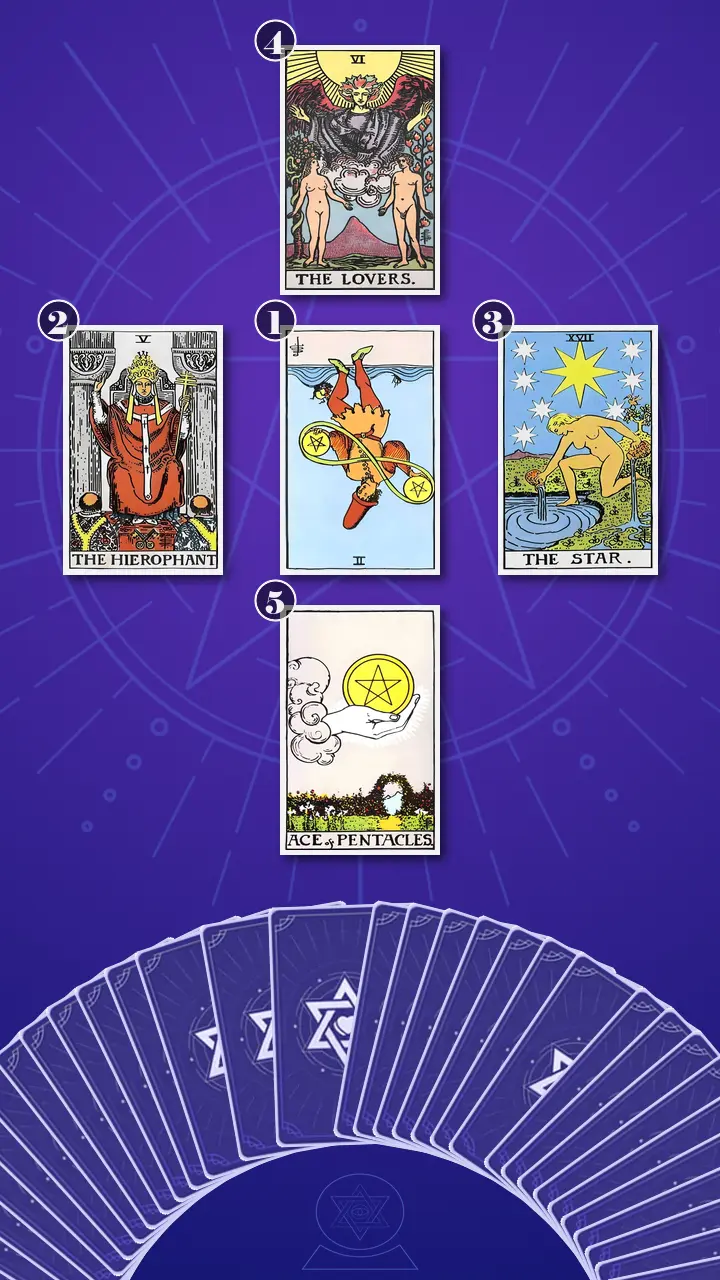
Then I shuffled. “Today we’ll use a spread called the Decision Cross—a Decision Cross tarot spread for choosing between two grad programs under a deposit deadline.”
For readers: I like this spread when someone has two real options and one real commitment point. It’s minimal—five cards—so we don’t create more noise. The center card shows how you’re getting stuck right now; the left and right arms hold Option A and Option B side-by-side; the top card forces the question of what matters most; and the bottom card gives a practical next step that turns insight into action.
“Think of it like a compass,” I said, and my planetarium brain kicked in—crosshairs on a star chart, not a prophecy. “We’re not asking the sky to pick for you. We’re checking direction, constraints, and timing.”
Reading the Map: How Tarot Works in a Two-Option Career Crossroads
Position 1 — The current decision pressure: the observable ways you’re getting stuck
“Now turning over the card for the current decision pressure—the way you’re getting stuck this week.”
Two of Pentacles, reversed.
“This is the tab-switching card,” I said gently. “You’re holding two futures open at once: two tabs, two budgets, two versions of yourself. You keep switching between Program A and Program B so fast you can’t feel what matters—only the panic of the Friday deposit clock and the fear that one wrong move proves you’re not in control.”
Reversed, the Two of Pentacles isn’t “bad”—it’s earth energy in blockage. Practical life (money, time, deadlines) feels unstable, so your mind tries to juggle harder. It’s like spinning plates on the TTC: your phone warms in your hand, the subway brakes squeal, and every time you reopen the same cost breakdown your jaw clenches because your brain whispers, If I just get one more data point, I’ll finally feel safe.
Taylor gave a short laugh that sounded a little bitter. “That’s… so accurate it’s kind of rude.”
“I know,” I said, letting the honesty land without shame. “This card isn’t calling you irresponsible. It’s showing you that your system can’t stabilize because you keep changing the criteria mid-game.”
She exhaled—small, reluctant—and I watched her mouse hover over a tab like she wanted to close it, then didn’t.
Position 2 — Program A’s defining energy: what it offers you day-to-day
“Now turning over the card for Program A’s defining energy—what this option asks you to lean into and what it offers you on an average weekday.”
The Hierophant, upright.
“Program A feels like the established track,” I said. “Clear requirements, recognizable credential, predictable pipeline, a culture where you can follow the rules and get the outcome. The pull here is relief—because it’s easier to explain to recruiters (and even to yourself) why it’s the ‘smart’ choice.”
Upright, The Hierophant is structure in balance when it supports your learning style—rubrics, mentorship, institutional resources. But it can become a hiding place if you’re using external legitimacy to avoid the discomfort of choosing. The keys on the card always make me think of gatekeeping—and of permission. Sometimes we’re not asking, “Do I want this?” We’re asking, “Will this choice protect me from judgment?”
Taylor nodded, slow. Then she glanced off-screen—probably at the spreadsheet. “It’s… legible,” she said. “I can picture the LinkedIn headline in one sentence.”
“Exactly,” I said. “And there’s nothing wrong with legible. We just need to know when ‘legible’ is a true priority—and when it’s a shield.”
Position 3 — Program B’s defining energy: what it offers you day-to-day
“Now turning over the card for Program B’s defining energy—what it awakens in you, and what it costs you to choose it.”
The Star, upright.
“Program B is the one that makes you breathe,” I said, and Taylor’s shoulders dropped a millimeter like her body recognized the sentence before her mind did. “When you read the curriculum, you feel energized—not because it’s guaranteed, but because it matches your curiosity and the person you’re trying to become. The risk isn’t that it’s bad—it’s that it asks you to trust an inner signal over what looks easiest to defend.”
The Star upright is hope in balance: not delusion, but a long-view orientation. In my work at the planetarium, the brightest stars aren’t always the ones that feel closest; they’re the ones you use to keep your direction when everything else is moving. The open horizon here says: there’s room. Room to grow, to be a beginner again, to become more yourself without needing certainty upfront.
I drew the contrast for her like a split screen. “On the left: rubrics, pipelines, alumni titles. On the right: breath, curiosity, room to grow. Public explanation versus private truth.”
She stared at the Star for a beat, then said quietly, “If nobody ever asked me to justify it… I think I’d choose B faster.”
“The data won’t pick for you,” I said, not harsh—just clear. “But your body is giving us information your spreadsheet can’t.”
When The Lovers Zoomed Out—Finding Clarity Without a ‘Perfect Sign’
Position 4 — What matters most: the values and non-negotiables that should guide the choice
I let the silence settle—just long enough for her nervous system to feel the gap where more research usually floods in.
“Now turning over the card for what matters most—the values and non-negotiables that should be your decision criteria.”
The Lovers, upright.
The room felt different when it landed, like the kitchen light stopped buzzing for half a second. In the Lovers, the angel’s gaze is the vantage point that isn’t trapped inside the tabs.
Setup: Taylor was still caught in that 9:38 p.m. loop—both portals open, tuition spreadsheet, the “deposit due Friday” email starred—tab-switching like the right answer would finally appear if she checked one more detail. Her mind was trying to A/B test her entire future the way an app tests button colors, as if the variable were the UI instead of her values.
Delivery:
Not “a flawless choice,” but an honest choice—let the angel’s perspective be your values, then pick one hand to hold the coin.
I stopped talking on purpose. Let it ring.
Reinforcement: Taylor’s reaction came in a chain. First, a freeze—her breathing caught, and her fingers went still above the trackpad. Then the thought hit—her eyes unfocused like she was replaying every late-night scroll and every “Thrilled to announce…” LinkedIn post that made her rewrite her criteria again. Finally, emotion moved—her shoulders slumped as if something heavy slid off them, and she made a sound that was half laugh, half ache.
Then—an unexpected flare. She blinked hard and said, sharper than before, “But if I choose ‘honest’… doesn’t that mean I’ve been doing this wrong? Like, all this research was pointless?”
I didn’t rush to soothe her. “No,” I said. “It means your research has been trying to do a job it can’t do: eliminate regret. And it can’t. That’s not a you-problem—that’s a physics problem.”
That’s when I brought in my signature lens, almost without thinking—the way I do when I’m explaining orbital mechanics to a crowd of teenagers and someone asks why the rocket doesn’t just go straight.
“I want to run a Gravity Assist Simulation with you,” I said. “In spaceflight, you don’t get a perfect, frictionless choice. You choose a trajectory based on a few non-negotiables—fuel, time, distance—and you accept a tradeoff on purpose. A gravity assist isn’t about being ‘right.’ It’s about using what’s real to change direction efficiently.”
“So,” I continued, “instead of ‘Which program is objectively best?’ we ask: What are your top three values and constraints right now—and what tradeoff are you choosing on purpose for the next 12–24 months? That shift is how you move from deadline-driven analysis paralysis and fear-of-regret to values-based commitment and integrity-led self-trust.”
I set a 10-minute timer with her. “Write two lines,” I coached. “(A) ‘My top 3 non-negotiables are __, __, __.’ (B) ‘If I choose Program A, I’m trading __ for __.’ Then repeat for Program B. Circle the tradeoff you can live with.”
Her pen scratched on paper off-screen. I heard the tiny sound over her mic—one of my favorite sounds in readings, because it’s the sound of energy turning into structure.
When she looked up, her eyes were wet but steady. “Okay,” she said. “My non-negotiables are: debt cap, mentorship style, and… day-to-day pace. Like, I don’t want my weekdays to feel like constant panic.”
“Good,” I said. “Plain language. Not MBA-speak.”
Position 5 — How to choose and commit: the grounded next step
“Now turning over the card for how to choose and commit—the smallest concrete action that turns thinking into building.”
Ace of Pentacles, upright.
“This is the hand offering one coin,” I said. “A single, tangible commitment that ends limbo. You treat the deposit like placing the first brick, not signing your soul away. You pay it, save the confirmation, then do one practical follow-up within 24 hours—draft a bare-bones monthly budget, book an advising call, or map your move/commute—so your energy moves from ‘deciding’ to ‘building.’”
Upright, the Ace of Pentacles is earth energy in balance: simple, doable, real. This is where the body unclenches because the task is finally the right size.
Taylor stared at the card and whispered, like testing the words: “A deposit is a seed, not a verdict.”
“Exactly,” I said. “And we can prep your mind for the click. Think of it as a Spacecraft Attitude Adjustment: you don’t wait until you feel fearless—you align your orientation so the next move is stable, even with a little shake in the cabin.”
The 48-Hour Plan: Actionable Next Steps for Choosing Between Two Grad Programs
I pulled the whole spread together for her in one story—short, coherent, no fluff.
“Right now, you’re in a Two of Pentacles reversed loop: too many moving parts, too much meaning assigned to the deposit, and a belief that uncertainty means you’re failing. Program A (Hierophant) offers legibility and structure—great if those genuinely support your learning style. Program B (Star) offers alignment and breath—great if you’re ready to trust your inner signal. The Lovers says the actual decision point is values: choose with integrity, name the tradeoff, and stop asking the data to promise you a regret-proof future. The Ace of Pentacles says: end limbo with one concrete commitment, then immediately take one grounding step.”
“Here’s the blind spot I want you to see,” I added. “You’ve been treating this like there’s one correct program hiding in the data. But what you’re really choosing is the tradeoff you can live inside—money, pace, identity, community—for the next season. That’s not a failure. That’s adulthood.”
Then I gave her a plan she could actually do, built from my interstellar-navigation style: pick your coordinates, pick your trajectory, then burn fuel once—on purpose.
- Top 3 Non‑Negotiables Sticky NoteTonight, write your three must-haves in plain language (ex: “debt cap,” “mentorship I can access weekly,” “weekdays that don’t feel like constant panic”). Put the sticky note on your laptop where the tabs live.If your brain demands a fourth, ask: “Is this a preference or a dealbreaker?” Stop at three on purpose.
- 30‑Minute Compare Cap + Tradeoff SentenceUntil the deposit is paid, limit all comparison to one 30-minute block per day. End the block by writing: “If I choose Program A, I’m consciously trading ___ for ___.” Repeat for Program B.Add friction: keep program sites logged out at night; put the spreadsheet link in a folder called “Tomorrow.” If you break the rule, just note the trigger—no self-attack.
- Deposit-as-a-Seed + 24‑Hour Grounding StepChoose a specific hour within the next 48 hours to pay the deposit. Immediately after, do one grounding follow-up: schedule an advising call OR draft a simple monthly budget OR map your commute/housing timeline.If fear surges mid-click, pause for 60 seconds of cosmic breathing and name it: “I’m afraid I’ll regret this.” You can act while feeling that.

A Week Later: Ownership, Not Certainty
A week later, Taylor messaged me a screenshot: a deposit confirmation email and a calendar invite underneath it titled “Budget + Move Plan (30 min).” No dramatic caption. Just: “Did the seed thing. Felt sick for like five minutes. Then… weirdly calm.”
I pictured her in that same Toronto kitchen, but with fewer tabs open—maybe still a little shaky, but no longer living inside the comparison spiral. Clarity rarely shows up as fireworks. More often, it shows up as one steady action taken while your body is still learning it’s safe.
This is what I love about a Decision Cross reading: it doesn’t pretend to give certainty. It gives you a way to choose with integrity—so your next step is real.
When the deadline gets loud, it can feel like you’re not choosing a program—you’re trying to choose a future that guarantees you’ll never regret anything, and your body tightens because it knows that promise doesn’t exist.
If you trusted your top three values for just this season of life, what tradeoff would you be willing to choose on purpose—so you can stop living in the tabs and start living on one path?