From Lease-Email Panic to a Time-Boxed Plan You Trust This Week

The 11:47 p.m. Gmail Subject Line That Started a Whole-Life Audit
You flag the renewal email, open ten rental tabs, and tell yourself you’re being ‘responsible’—but it’s really Career Pivot Anxiety meeting housing math at midnight.
When Taylor (name changed for privacy) said that out loud, it landed with the flat honesty of someone who’s already tried to talk themselves out of the spiral and failed.
They were in Toronto; I was on video from my small studio space where I keep my cards and a notebook that still smells faintly like sea air. Taylor described the moment like it was a freeze-frame: 11:47 p.m. on a Tuesday, laptop warm on their thighs, the fridge hum louder than it should be, and Gmail’s blue light making the lease renewal subject line look like a warning label. Ten tabs open—Rentals.ca, PadMapper, a neighborhood guide, a Google Sheet budget with too many sub-tabs—while their jaw stayed clamped like it was holding a door shut.
“It’s just an email,” Taylor said, fingers flicking in and out of frame like they were still tab-hopping. “But it feels like a life decision.”
I watched their shoulders inch upward as they talked—subtle, but unmistakable. The body always tells the truth first. “And the second it arrives,” I said, “your brain treats it like a full system update. Except it’s not just your housing—you’re trying to update your entire identity in one click.”
Taylor let out a quick, almost embarrassed laugh—half relief, half bite. “Yeah. That’s… painfully accurate.”
Under the humor, I could hear the core tension: wanting an intentional next step for where and how to live versus fearing that committing will lock you into the wrong life and prove you don’t have control. The anxiety wasn’t a vague cloud; it had edges: tight chest, jaw tension, restless hands, and that buzzy urgency that makes it impossible to sit with one option long enough to decide.
“I can’t tell if I want to move,” they added, voice dropping, “or if I just want to feel different.”
I nodded. “That makes so much sense. And before we do anything else: this is adult admin, not a moral referendum.”
I softened my voice the way I would with a client whose nervous system is already sprinting. “Let’s treat this as a Journey to Clarity. Not a performance review of your entire adulthood. We’re going to map what this email is really activating, and then we’ll leave with one next step you can actually do this week.”

Choosing the Compass: Celtic Cross · Context Edition
I asked Taylor to place one hand on their chest—not to force calm, just to notice what was true. “Is your breath shallow or deep right now?” I asked. “No fixing. Just naming.”
They inhaled, and the inhale caught slightly, like their ribs were a too-tight coat. “Shallow,” they said.
“Perfect data,” I replied, and I meant it. Then I began to shuffle—slowly, audibly—because the sound is a kind of metronome for the mind. Not magic. A transition. A way of telling your brain: we’re not tab-hopping now; we’re looking at one thing at a time.
“Today I’m using the Celtic Cross · Context Edition,” I said. “It’s based on the classic Celtic Cross, but tuned for modern pressure—market stress, social comparison, and the way a single email can trigger decision fatigue.”
For you reading this: I choose this spread when a problem looks simple on the surface—reply to the landlord—but it’s actually layered. Identity, money, safety, and future direction are braided together. The Celtic Cross separates those layers cleanly: what’s happening now, what blocks you, what fear is underneath, what patterns you’re carrying, and then—most importantly—how to get back to agency with a grounded next step.
“A few positions matter most for your situation,” I told Taylor. “The center will show what this email is activating in your body and behavior. The crossing card will pinpoint the exact mechanism that turns admin into paralysis. And later, there’s an advice position that gives you a decision process—not a prediction. Finally, the last card becomes an integration point: a practical next step that creates options.”
Taylor swallowed and nodded like someone hearing, for the first time, that the goal isn’t to pick the perfect door—it’s to stop treating the hallway like a trap.
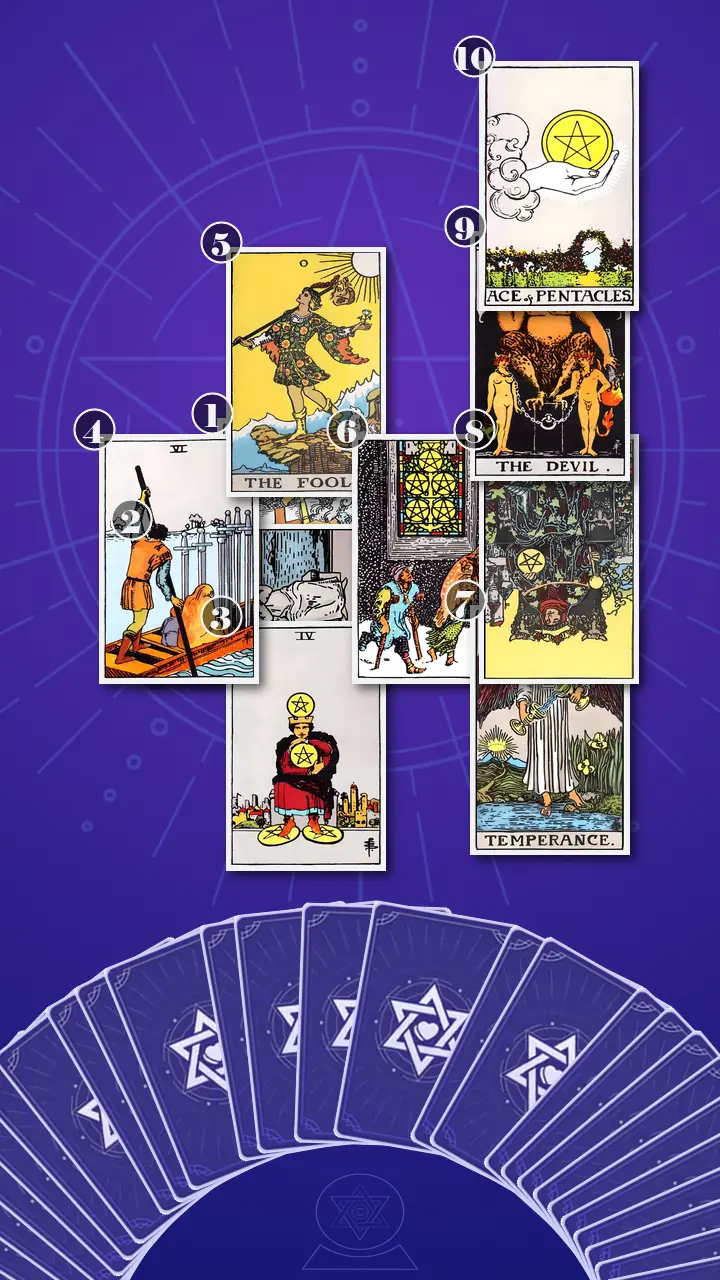
Reading the Map: Card Meanings in Context for a Lease Renewal Spiral
I laid the cards in the cross-and-staff pattern. Even through a screen, I could feel Taylor’s attention narrow—less scatter, more contact. When your nervous system finally gets a structure, it often stops trying to build one out of panic.
Position 1: The immediate experience of the lease renewal trigger
“Now flipped over,” I said, “is the card representing the immediate experience of the lease renewal trigger: what this email is really activating in your inner world and day-to-day behavior.”
Judgement, upright.
Judgement is the “wake-up call” card—the moment a trumpet sounds and you realize something in you wants to rise and answer. In modern life, it looks like this: the email subject line reads like a verdict. Not “Lease Renewal Options,” but “Are you living correctly? Are you behind? Did you choose wrong?”
I said, “This is why it doesn’t feel like ‘just rent.’ The card says: this email is acting like a notification that pings every unresolved question at once—stability, freedom, money, identity. Your jaw clenches because your body hears it as a summons.”
Energy-wise, Judgement here isn’t ‘bad’—it’s loud. It’s an excess of meaning pouring into a practical task. You’re not broken for reacting strongly. You’re at a threshold.
Taylor’s mouth twisted into a small, disbelieving smile. They gave that earlier laugh again—quieter, more bitter. “So it’s not that I’m dramatic,” they said. “It’s that I’m… hearing it like I’m being graded.”
“Exactly,” I replied. “And the question becomes: what part of you is trying to use this email to finally prove you’re in control?”
Position 2: The blockage that turns a practical task into choice paralysis
“Now we’re looking at the card representing the specific mental/emotional blockage that turns a practical task into choice paralysis and a whole-life audit,” I said.
Two of Swords, reversed.
Reversed, this card is the stalemate that starts leaking. Instead of one clean pause, it becomes rumination. Instead of still water, you get mental ping-pong.
I described what I saw in Taylor’s story as a split screen:
On the left: your landlord reply draft—three sentences, rewritten like it’s a cover letter for your entire life. On the right: the browser—Rentals.ca, a Reddit thread on Toronto rent, your Google Sheet “Rent Scenarios,” and then, somehow, LinkedIn career pivot posts because your brain decides housing and identity must be solved in the same sitting.
“If I keep both doors open,” I said, borrowing the card’s core defense mechanism, “I don’t have to feel the grief of closing one.”
Then I added the line I knew Taylor needed to hear without shame: “Ten tabs isn’t clarity—it’s decision debt. It feels like flexibility, but it’s actually interest accruing.”
Taylor’s response happened in three tiny beats: their breath caught; their eyes unfocused as if replaying last night; then a sharp exhale—like air escaping a sealed jar. “Oh,” they said softly. “So the stall is… protection.”
“Yes,” I said. “Not laziness. Protection from the feeling that if you choose wrong, you waste years.”
Two of Swords reversed is a blockage—Air energy that’s overactive and unstable. Too many pros-and-cons lists, not enough contact with what you actually value. When Air runs wild, it pretends it’s solving something while it’s really avoiding the emotional risk of choosing.
Position 3: The underlying fear and body-level survival story
“Now flipped over is the card representing the underlying fear and body-level survival story—security and control—that keeps the spiral running,” I said.
Four of Pentacles, upright.
This card always makes me think of a person gripping a coin to their chest like it’s a heartbeat they can’t risk losing. There are coins under the feet too—like even standing still is a strategy. The city behind them is safe, but distant. Controlled. Locked.
In modern terms: this is the part of you that chooses “secure enough” and then holds on—because letting go feels like losing control, not gaining freedom.
Energy-wise, Four of Pentacles is excess holding. A nervous system that learned: “If I clutch the known hard enough, I can prevent regret.”
I said, “Taylor, this tells me your body isn’t reacting to the lease as preference. It’s reacting like control is the only thing keeping you safe.”
They nodded once, slow. Their fingers pressed together, then released. “My brain says, ‘Just be responsible.’ But my body…” They swallowed. “My body acts like this is survival.”
“That’s exactly the distinction,” I told them. “And it matters, because survival logic demands certainty that housing decisions can’t offer.”
Position 4: The prior pattern with stability and ‘playing it safe’
“Now we’re looking at the card representing the prior pattern with stability, routines, and ‘playing it safe’ that shaped the current reaction,” I said.
Six of Swords, upright.
Six of Swords is a boat leaving choppy water for calmer water. It’s not a victory parade; it’s a deliberate transition. It carries your thoughts with you (those swords are still in the boat), but the water changes when you commit to a direction.
As a past pattern, this tells me something important: you’ve used structured movement as relief before. Maybe you chose a neighborhood, a job, or a routine that wasn’t perfect—but it got you out of turbulence. You know how to do “not dramatic, but better.”
Energy-wise, Six of Swords is balanced transition. It’s the part of you that can say: “I don’t need to be 100% ready to take the next sensible step.”
“So I’m not new to transitions,” Taylor said, almost surprised.
“Not at all,” I replied. “You’re new to trusting that transition can be guided by a process—not by panic.”
Position 5: The conscious desire behind the spiral
“Now flipped over is the card representing the conscious desire behind the spiral: what you want your next chapter to feel like beyond just housing logistics,” I said.
The Fool, upright.
The Fool is the craving for fresh air. Beginner energy. A lighter backpack. Not because you’re irresponsible—because your spirit is tired of being audited.
In modern life, The Fool shows up when you fantasize about moving as a clean slate—but what you’re actually seeking is permission to be in motion and learn as you go.
Energy-wise, this is a desire for openness that’s been compressed. You want to feel alive again, not just “on top of life admin.”
Taylor looked away from the screen, like they were trying to see that version of themselves in their mind. “I just… want my home to feel like a base,” they said, “not a waiting room.”
“That’s The Fool’s real request,” I said. “Not ‘blow it up.’ More like: ‘Let me start relating to my life with curiosity again.’”
Position 6: The near-term direction of energy
“Now flipped over is the card representing the near-term direction of energy if you stop over-auditing and start moving with a plan,” I said.
Five of Pentacles, upright.
This card is snow, bare feet, and the feeling of walking past warmth you don’t think you’re allowed to enter. It’s not just about money—it’s about perceived support. It’s the story that says: “If I mess this up, I’ll be alone in the cold.”
As “what approaches,” I read this as a forecast of your internal weather in the next week: if you keep the decision unmade, the scarcity narrative will get louder. Not necessarily because reality gets worse—but because uncertainty makes your nervous system interpret everything as threat.
Energy-wise, Five of Pentacles is a deficiency of felt safety—even when practical supports exist (savings buffer, negotiation, friends who would help you tour a place, a simple email that buys time).
Taylor’s shoulders tensed, then they frowned. “But I do have savings,” they said. “Not a ton, but… I’m not actually… in danger.”
“Exactly,” I replied gently. “So this card is less about your bank account and more about your body’s old headline: ‘I’m on my own.’ We’re going to challenge that headline with facts—and with support.”
When Temperance Spoke: A Process That Builds Self-Trust
I drew a breath before turning the next card. The room got quieter—not because anything mystical happened, but because Taylor stopped fidgeting. Their attention arrived fully, the way it does right before someone hears the sentence they didn’t know they needed.
Position 7 (Key Card): The most helpful internal stance and decision process to adopt this week
“Now we flip the card representing the most helpful internal stance and decision process to adopt this week to regain agency,” I said. “This is the bridge.”
Temperance, upright.
Temperance is an angel pouring between two cups—measured, patient, steady. One foot on land, one in water: reality and emotion. Not choosing one, not denying one. Integrating.
In modern terms, Temperance is a decision workflow: one sprint, clear constraints, a tiny deliverable—then ship. It’s the opposite of the all-or-nothing audit.
I saw Taylor’s face tighten for a second, like part of them wanted to reject the simplicity. And here came the unexpected reaction—the flash of defensiveness that often appears right before relief.
“But… if it’s that simple,” Taylor said, a little sharp, “doesn’t that mean I’ve been doing it wrong? Like I’ve just been… wasting time?”
I didn’t rush to soothe that away. “It means you’ve been protecting yourself with the tools you had,” I said. “Perfectionism and research loops are intelligent defenses. They just have a long-term cost.”
This is where my Jungian training always steps in: the spiral isn’t a character flaw. It’s a strategy. A shadow strategy—trying to keep you safe by controlling uncertainty.
And this is also where I used my own diagnostic lens—what I call Energy State Diagnosis. I looked at the situation in three dimensions, because Taylor’s energy leak wasn’t in one place.
Environment: Toronto rent discourse, listing apps, deadlines, the market intensity. Relationships: friends’ “apartment upgrade” reels and the unspoken timeline comparisons. Self: jaw tension, shallow breath, midnight spreadsheets, the belief that certainty equals control.
“Temperance is telling you exactly where the leaks are,” I said. “And it’s offering you a fix that doesn’t require you to become a different person first.”
Stop treating this email like a final verdict and start blending facts and feelings like Temperance pouring between two cups until the next workable step appears.
Setup (what you’re trapped in): You’ve got the renewal email pinned, ten rental tabs open, and your Notes app holding three versions of the same reply—yet your thumb keeps drifting back to listings like that’s the only way to feel in control.
I let a pause sit there. Even through the screen, I could feel the words hitting the exact place the spiral starts—right behind the ribs.
Reinforcement (what to do with it): “Set a 10-minute timer,” I told Taylor. “Open the lease email and do exactly one Two-Cups Blend note: left column is three facts—deadline, proposed rent, your max number. Right column is three feelings/values—what you want your home base to feel like, what you’re protecting, what you’re craving.”
“Then circle one seed-step you can complete today,” I continued. “Send a short email asking for 48 hours. Or send the simplest renew/clarify message. If your chest tightens or you start tab-hopping, pause and put both feet on the floor. You can stop at any time—the goal is one real action, not a perfect conclusion.”
Taylor’s reaction came in a clear three-beat chain: first, a stillness—like their whole body paused to listen. Then their gaze went slightly distant, as if they were watching last night’s spiral from above instead of inside it. Then their shoulders dropped. Not dramatically—just a quiet unclenching. They took a deeper breath and looked almost dizzy for a second, the way people do when they realize they’ve been bracing for impact for weeks.
“I don’t need the answer,” they whispered, like testing the sentence. “I need a method.”
“Yes,” I said, and my voice warmed. “You don’t need a perfect answer. You need a workable process.”
This was the shift from Taylor’s starting state—standing in the doorway with the email open, believing they must pick the perfect door—toward the desired state: choosing a small, time-bound experiment and building self-trust through follow-through.
Position 8: External pressures shaping the decision
“Now we look at the card representing external pressures—market, money narratives, social comparison—and how they amplify the stakes,” I said.
King of Pentacles, reversed.
Reversed, this king becomes a distorted authority voice. The throne turns heavy. The pentacle becomes a scoreboard. This is the vibe of: “If you were doing life right, this wouldn’t feel hard.”
In modern life, it’s Toronto’s rental reality plus Instagram optics plus that cultural script that says stability should look effortless. It’s treating the landlord, the market, or other people’s upgrades as the final authority.
Energy-wise, it’s rigid externalization—outsourcing your self-trust to external metrics. When this is loud, you don’t ask for what you need (time, clarity, negotiation) because you feel you have no standing.
I said, “This card doesn’t mean money is evil. It means the voice of money is trying to drive your decision. Temperance says: you get to define your own ‘enough.’”
Position 9: The emotional bind underneath it all
“Now we flip the card representing the emotional bind—what you’re craving and afraid of underneath the decision,” I said.
The Devil, upright.
The Devil is attachment: the loop you consent to because it promises relief. Loose chains, but you still feel bound. Comfort versus freedom.
For Taylor, I read this as the compulsion to measure worth through lifestyle optics—checking what friends pay, scanning apartment tours, comparing timelines until you feel chained to an invisible standard you never consciously chose.
This is where I brought in a Jungian Shadow lens, because Devil + King of Pentacles reversed is a classic combo: the shadow of Material Authority feeding the binder of comparison. The “shadow” isn’t badness—it’s unconscious rule-making. The rule sounds like: “If I can’t optimize this, I’m failing.”
“Your hope,” I said, “is that the ‘right’ choice will quiet the insecurity. Your fear is that any choice will trap you.”
Taylor nodded, eyes glossy but steady. “That’s it,” they said. “I want it to stop feeling like a trap.”
“Then we don’t chase the perfect apartment,” I replied. “We loosen the chain by changing the process.”
Position 10: Integration and next step
“Now we flip the card representing integration and next step—the most grounded action you can take now that creates real options without requiring certainty,” I said.
Ace of Pentacles, upright.
This is my favorite kind of ending card because it refuses drama. A hand offers a pentacle like a seed. A garden path. An archway. Reality will meet you once you take one tangible step.
In modern terms: one sent message. One calendar hold. One note titled “Enough.” Not the whole life plan—just the first commit that gets you out of theory and into real agency.
Energy-wise, this is healthy Earth: grounded beginnings, practical stewardship, a next step that’s doable even with a tight chest.
I smiled slightly. “One seed-step beats a thousand certainty-thoughts,” I said. “Your clarity grows after you move, not before.”
Taylor’s face did something I’ve learned to recognize across thousands of readings—on cruise decks, in cramped cabins, in city apartments over video calls. It’s the moment someone realizes the future isn’t demanding a perfect self. Just a present self who can take one honest step.
The One-Page ‘Enough’ Standard: From Insight to Actionable Next Steps
Here’s the story the spread told when I stitched it together: a practical email arrived (Judgement) and triggered a life-review reflex—because your mind has been using control as safety (Four of Pentacles). Under pressure, you protect yourself by keeping options open and re-litigating the decision (Two of Swords reversed), while external authority voices—market optics, money scripts, social comparison—inflate the stakes (King of Pentacles reversed). The bind is the craving for comfort and the fear of being chained to it (The Devil). The way out isn’t a perfect answer. It’s a transition process you can trust (Temperance), grounded by one real action that creates options (Ace of Pentacles).
Your cognitive blind spot—what’s been hardest to see from inside the spiral—is this: you’ve been treating “more research” as movement, when it’s actually a way to postpone the emotional risk of choosing. In other words, your mind keeps trying to buy certainty with spreadsheets, but certainty isn’t for sale in the rental market. What you can build instead is self-trust—through follow-through.
The transformation direction is clear: shift from treating the lease decision as a permanent identity verdict to treating it as a time-bound experiment anchored in values and concrete constraints.
Here are the next steps I gave Taylor—simple on purpose, because your nervous system can’t execute a manifesto at midnight:
- The 48-Hour Default MoveToday, send a two-sentence email to your landlord: confirm you received the renewal and ask for 48 hours to review (or ask one specific clarifying question). If you already know you’ll likely renew, send: “Thanks—I’m planning to renew. Can you confirm the next steps and date?”Expect your brain to call this “not enough.” That’s the spiral recruiting you back into certainty-chasing. Make it smaller: two sentences is allowed. After you hit send, do a no-tabs-until-send boundary: no listings/LinkedIn until tomorrow.
- The Two-Cups Decision Blend (10 minutes)Set a timer for 10 minutes. Two columns: Facts (deadline, proposed rent, your max number) and Feelings/Values (what “home base” needs to feel like, what you’re protecting, what you’re craving). Circle one workable seed-step you can complete the same day.Do it at a non-nighttime hour—lunch break or right after work. If you feel activated, put both feet on the floor and unclench your jaw. You’re regulating the “canal current” of your attention: small gates, steady flow.
- The One-Page ‘Enough’ DocDo one 20-minute facts pass. Write: your max rent number, your hard deadline, and two non-negotiables (commute time, light, laundry—whatever actually changes your quality of life). Save it as a single note titled “Enough for This Lease Cycle.” Use only this document for the next 7 days when you feel the urge to spiral.If you reopen the spreadsheet, write down what you’re seeking and stop after 10 minutes. If the comparison urge hits, try a modern cleanse: spend 5 minutes organizing one month of your phone photo album—same soothing “sorting” energy, without the algorithmic doomscroll.
When I teach intuition on ships, I often talk about currents: you don’t fight the sea by tensing your whole body; you adjust your stance and steer in small, consistent increments. Venetian canals work the same way—gates, pacing, redirection. Temperance is that canal wisdom in card form: not a dramatic leap, but a regulated flow that gets you where you’re going.

A Week Later: The Quiet Proof of Finding Clarity
Six days later, Taylor messaged me a screenshot. Two sentences. A sent email. Their landlord replied with—exactly what Taylor needed—48 hours to review.
“I did the Two-Cups Blend at lunch,” they wrote. “It was weirdly… calming. I circled ‘ask for time’ and did it before I could overthink it.”
They added one more line that felt like the real win: “I still don’t know if I’m staying. But I’m not frozen.”
Later that week, they told me they sat alone at a coffee shop after hitting send—no celebration, no big reveal. Just a quiet hour watching streetcar lights smear across the window, feeling both steadier and slightly exposed, like someone who finally loosened a grip and noticed their hand is tired.
That’s the real Journey to Clarity: not certainty, but ownership. Not a perfect life answer, but a workable process that turns fear into one small, real step.
When a lease renewal lands and your chest tightens, it’s not because you’re incapable—it’s because part of you thinks this one reply will prove whether you’re in control of your life or just improvising it.
If you let this be a time-bound experiment instead of a forever verdict, what’s the smallest real seed-step you’d be willing to take this week—one that creates options without demanding certainty?