My 'Self-Care' Was a Worth Audit: How I Learned to Step Back

The Nightly Worth-Audit Under Toronto LEDs
If you lean in so close to the mirror you can see every pore, then feel like you can’t leave the bathroom until you’ve “fixed” something, that’s not skincare—that’s a nightly audit of worth.
Jordan (name changed for privacy) said that to me like they were confessing a bad habit they should’ve outgrown. But it wasn’t a confession. It was a pattern asking to be named.
They described 11:57 PM in their Toronto condo bathroom: the overhead LED so bright it felt accusatory, the fan humming like it was keeping time, the mirror turning their face into an HD close-up. Jordan leaned toward the sink until their breath fogged the glass. Their jaw set hard. Their shoulders climbed. Their fingers hovered—restless, ready to pick or re-check—like their hands were trying to negotiate with their own reflection.
“I start with a normal plan,” they told me. “Cleanser. Moisturizer. One treatment. And then I catch… something. Texture. A bump. And my brain goes: okay, we’re behind. And then it’s Reddit, TikTok, ingredient lists, Sephora cart. Like I’m building a case.”
I could hear the emotional signature in the way they said it: hyper-analytical scanning for flaws, constant comparison, the private mental math of if I don’t optimize this, I’m failing. Their shame wasn’t loud—it was quieter than that. It was the kind that sits in the stomach like a cold stone and pulls your face closer to the mirror, as if the closer you get, the safer you’ll feel.
“I’m glad you asked this,” I said, keeping my voice steady and unhurried—the way I would when I’m cueing a nervous guest on-air. “Because you’re not asking ‘what serum should I buy.’ You’re asking: why does a routine turn into a verdict? Let’s try to map the pattern so you can get your nights back—and find some actual clarity at the sink.”

Choosing the Compass: The Four-Layer Insight Ladder Spread
I invited Jordan to take one slow breath in through the nose and a longer exhale out, just to mark a transition. Not as a mystical thing—more like pressing pause on the mental tabs that were already open. Then I shuffled while they held the question in mind: Why does my skincare routine trigger not-enough thoughts—what pattern?
“Today I’m going to use a spread I designed for questions exactly like this,” I told them. “It’s called the Four-Layer Insight Ladder · Context Edition.”
For you reading this: this is a six-card tarot spread built for pattern recognition and actionable next steps—not prediction. It works especially well when you’re dealing with a loop—compulsive mirror checking, comparison fatigue, decision fatigue—because it moves like a diagnostic: surface trigger (what’s happening) → hook (what keeps it sticky) → root belief (what it ‘means’) → integration (what balances it) → transformation (the turning point) → action (what to do next).
I also like the “ladder” structure for modern self-exploration because it doesn’t make the cards an external authority. It makes them a mirror—just not the kind with harsh LEDs and a front-camera distortion filter.
“Here’s what we’ll listen for,” I said, laying the positions out top-to-bottom. “Position 1 shows the exact moment your routine flips from care to verdict. Position 3 goes underneath that to the belief that turns skincare into a worth-measuring ritual. And Position 5—the transformation layer—will tell us what inner shift changes the whole relationship.”
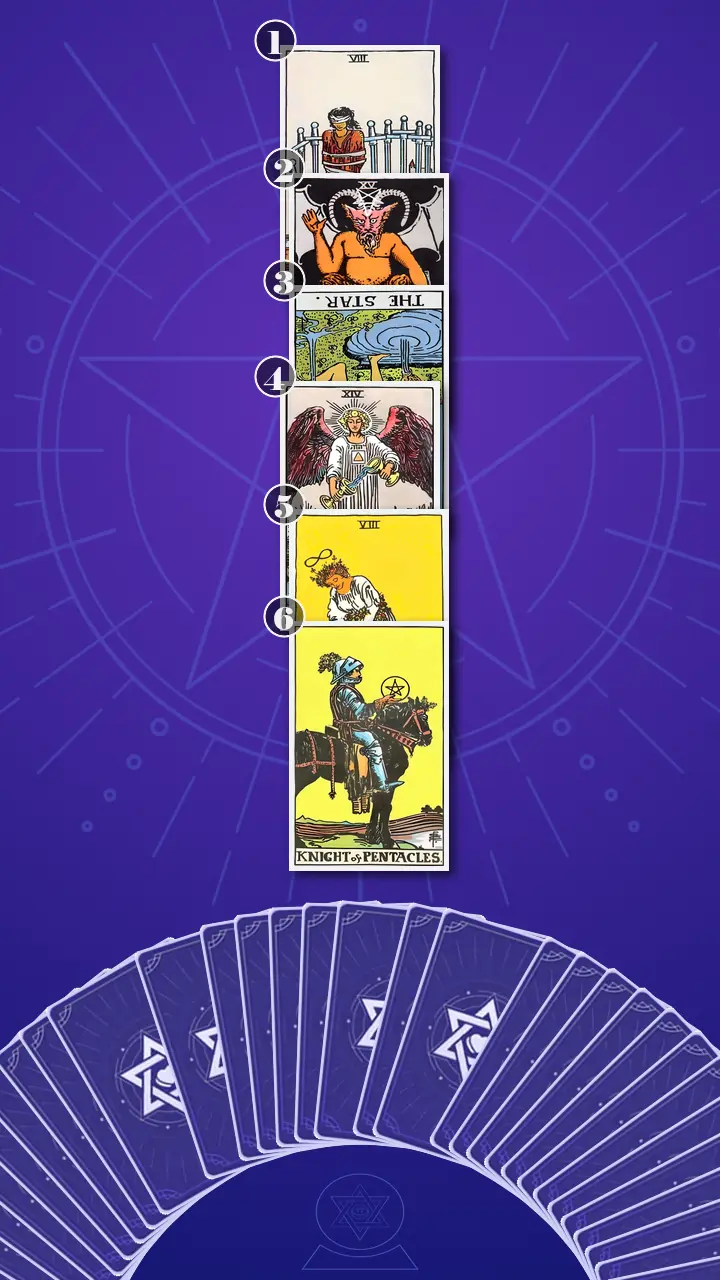
Reading Down the Ladder: The Mirror Cage, the Hook, and the Dimmed Star
Position 1: Surface experience—what the routine is triggering in the moment
“Now I’m turning over the card that represents Surface experience: what the routine is triggering in the moment,” I said. “This is what you can actually catch yourself doing.”
Eight of Swords, upright.
I tapped the blindfold lightly on the card. “This is the mental trap card. Not because you’re ‘weak’—because your attention gets narrowed until it feels like there’s only one safe outcome.”
And I used the exact modern translation that fit Jordan’s life: “It’s like you’re standing at the sink late at night, leaning in until your face fills the mirror. You rotate your head to catch the light like you’re trying to confirm a fear. Even though you could stop, step back, and keep it simple, it feels impossible—like you’re not allowed to end the routine until the mirror agrees you’re ‘okay.’”
In energy terms, this is Air in excess: thoughts so sharp they cut off options. The bindings in the Eight of Swords are loose, but your body acts like they’re tight. That’s the key. The cage is made of interpretation and repetition—mirror-checking, scoring, re-checking—more than it’s made of reality.
Jordan let out a small laugh that wasn’t really funny. It had a bitter edge, like they’d been caught by a camera they didn’t know was recording. “That’s… yeah,” they said. “It’s accurate in a way that feels kind of rude.”
“I know,” I said softly. “And it’s also hopeful. Because if the trap is ‘self-imposed restriction through interpretation,’ we can change the interpretation. We can widen the frame.”
Position 2: The hook—what keeps the trigger sticky
“Now I’m turning over the card that represents The hook: what keeps the trigger sticky—the pressure that intensifies the loop,” I said.
The Devil, upright.
“This card doesn’t mean you’re broken,” I told Jordan immediately. “It names compulsion. Attachment. The belief that more control equals more worth.”
And again, the modern-life scenario landed with precision: “You tell yourself it’s self-care, but it has the vibe of compulsion: one more active, one more serum, one more TikTok creator’s routine. The real hook isn’t your skin—it’s the belief that you need to earn the right to feel confident and be seen, so buying/optimizing becomes a quick hit of temporary safety.”
This is bonded energy—a blockage where the routine stops being care and becomes a contract: if I perfect this, I’m safe to be seen.
I offered Jordan the split-screen I was hearing in their story, exactly the kind that shows up in a tired Toronto night:
(A) “I’m just doing skincare.”
(B) “If I don’t fix this, I can’t show up tomorrow—on camera, in the office, in bright lighting, in photos.”
In my mind I saw them on the TTC after work, headphones in, scrolling a glass-skin close-up reel while their body carried commute fatigue like a weighted blanket. The Eight of Swords says: no choices. The Devil says: and if you choose wrong, you lose belonging.
Jordan’s reaction came in a small sequence—subtle, but unmistakable. First: their breath paused mid-inhale. Then: their eyes lost focus for a second, like they were replaying a familiar clip. Then: a long exhale, shoulders dropping a fraction. “Oh… yeah,” they said quietly. “It’s like my skin is… a performance review.”
“Exactly,” I said. “If skincare feels like a nightly courtroom, of course you’re anxious at the sink.”
I watched their hands. They kept rubbing their thumb against the side of their index finger—an invisible fidget I’ve seen in studio guests right before they admit something tender. “Also,” I added, “more steps isn’t more care—it’s often just more panic with better packaging.”
Position 3: Root layer—the deeper belief underneath the routine
“Now I’m turning over the card that represents Root layer: the deeper belief that turns skincare into a worth-measuring ritual,” I said. “This is the ‘meaning’ your brain assigns.”
The Star, reversed.
“This is the heartbreak underneath the optimization,” I told Jordan. “Because The Star is supposed to be replenishment—when you can receive care. Reversed, it’s like the channel is there, but the signal keeps getting interrupted.”
I pulled in the modern-life scenario: “Even when you’ve been consistent, you can’t let it count. You finish your routine and immediately re-check under different lighting or with your front camera. One breakout wipes out two weeks of effort in your mind, and the ritual stops feeling restoring—it feels like evidence you’re failing at something you should already have figured out.”
The energy here is a deficiency of gentleness—not because you’re incapable of it, but because the “audit mindset” keeps filtering it out. It’s like a phone camera setting turned up too high: sharpening every pore into a headline. You’re not seeing more truth; you’re seeing more noise.
Jordan swallowed, then looked down at the card instead of at me. “That’s the part that scares me,” they said. “I don’t even know what my skin looks like anymore without judging it.”
“That makes sense,” I replied. “When your nervous system is looking for danger, it’ll treat normal texture like a threat. But we can rebuild a way of seeing that doesn’t punish you for being human.”
Position 4: Integration layer—what restores balance and interrupts escalation
“Now I’m turning over the card that represents Integration layer: what restores balance and interrupts the escalation pattern,” I said.
Temperance, upright.
Something in Jordan’s face softened before I even spoke—like their body recognized the shape of permission.
“Temperance is boring on purpose. That’s why it works,” I said, letting the line be both practical and kind.
Then I translated the angel pouring between two cups into a metaphor Jordan could feel: “This isn’t ‘smash the speaker because the song is too loud.’ It’s adjusting the volume on a playlist. Calibration, not punishment.”
And I anchored it to the modern-life scenario: “You decide your routine is allowed to be boring. You pick a small set of steps and treat changes like calibration, not panic. You track irritation triggers like data (not a moral grade), and you let time be part of the formula—because you’re building steadiness, not chasing a nightly ‘perfect.’”
In energy terms, Temperance is balance. It restores the middle. It’s the opposite of the Devil’s “one more fix” adrenaline.
Jordan exhaled again, slower this time. Their hands were still. “That sounds… doable,” they said, like they were surprised by the word.
“Doable is the whole point,” I told them. And because my day job is audio, my mind flashed to a mixing desk: if you keep turning every knob every night, you never learn what the track actually sounds like. Consistency is how you get real feedback. Not perfection.
When Strength Spoke: Gentle Courage at the Sink
Position 5: Transformation layer—the key inner shift that changes your relationship with the trigger
When I reached for the next card, the room felt quieter—not in a dramatic, spooky way, but in the way a studio quiets when everyone senses the next line matters.
“Now I’m turning over the card that represents Transformation layer: the key inner shift that changes your relationship with the trigger,” I said. “This is the turning point energy.”
Strength, upright.
I let Jordan look at the image for a beat: the calm hands, the lion, the infinity symbol—power that doesn’t clench.
The setup was already written across their face, because I’ve seen that particular moment a thousand times: bright bathroom LEDs, head tilted side-to-side like you’re trying to catch “the truth,” and then the chest-drop when one tiny texture suddenly means something bigger. Jordan had been living inside I have to do this perfectly or it proves something about me.
Not a nightly trial in front of the mirror—choose gentle courage and steady hands, like Strength calming the lion instead of fighting it.
I didn’t rush past the sentence. I let it hang there like a sustained note.
Jordan’s reaction came in layers—an almost textbook three-step chain. First, a physiological freeze: their shoulders held still, and their lips parted slightly like their body forgot what came next. Then, the cognition seeped in: their gaze drifted away from the table, unfocused, as if they were replaying last night at the sink and hearing the inner dialogue with new subtitles. Finally, the emotional release: their eyes got glassy, and a shaky breath left their chest—half laugh, half relief.
“But if I do that,” they said, and there was a flash of anger under the tenderness, “doesn’t it mean I’ve been doing it wrong? Like… I’m the reason I’m stuck?”
“No,” I said, clear and gentle. “It means you were using the tools you had to try to feel safe. The Eight of Swords and The Devil are survival logic: control it, or get judged. Strength isn’t a scolding. It’s a new kind of power.”
Then I brought in my signature lens—because this is where my work in sound energy and music psychology fits like a key in a lock.
“When I hear your story,” I told them, “I don’t just see the mirror. I hear the sound of it: the fan’s steady hum, the harsh acoustics of tile, the way a bathroom echoes and makes everything feel sharper. That’s why one of my core tools is Space Tuning.”
“Your nervous system reads an environment like it reads a soundtrack,” I continued. “Bright light + echo + late-night fatigue equals: danger, evaluate, fix. Strength is when we change the soundtrack—not by lying to you, but by giving your body a cue that you’re not in a threat scenario.”
I offered Jordan the “Strength pause” as a practical, almost embarrassingly small practice—because big change rarely starts big.
“Tonight,” I said, “before the first product, do a 2-minute Strength pause. Set a timer. Both feet on the floor. Three slow breaths.”
“And because you’re a human with a brain that loves proof,” I added, “name the urge—out loud or in your head: ‘This is the part of me that wants proof.’”
“Then pick one boundary for the routine: either no zooming closer than arm’s length, or one mirror check only at the very end—max 30 seconds. If you feel yourself spiraling, you’re allowed to stop and do the simplest version (cleanse + moisturize) and call it complete. No moral score attached.”
Jordan nodded slowly, like they were testing the idea for sturdiness. “Okay,” they said. “I can feel how… my body wants to argue. Like it’s unsafe to stop checking.”
“That’s the lion,” I said. “Strength isn’t winning against your reflection. It’s refusing to negotiate your worth with it.”
I leaned forward a little. “Now, with that lens—just for a second—can you remember a moment from last week where this would’ve changed the night?”
Jordan blinked hard. “Tuesday,” they said. “I was about to open Reddit. I had cleanser on my hands. I could’ve… just stopped.”
“That’s it,” I told them. “That’s the first rep.”
And I named the deeper arc explicitly, because clarity loves language: “This isn’t only about skincare. It’s a shift from shame-driven mirror policing and proof-seeking to self-respect-based consistency and quiet, non-conditional confidence. You can still want clearer skin. Strength just refuses to make your worth conditional on the outcome.”
Position 6: Action layer—the next grounded step that builds self-trust
“Now I’m turning over the card that represents Action layer: the next grounded step that builds self-trust through consistency,” I said.
Knight of Pentacles, upright.
“This is the card that makes progress look almost boring,” I said, smiling a little. “One routine. Repeated. Long enough to give you real feedback.”
And I tied it to the exact scenario: “You run a four-week ‘no new products’ window. You do the same core steps at roughly the same time, and you measure success by follow-through and comfort—not by perfect skin every day. The routine starts supporting your life instead of hijacking your nights, and your nervous system learns it doesn’t need daily proof to be okay.”
In energy terms, this is Earth in balance: grounded, repeatable behavior. The opposite of the Devil’s frantic upgrades. It’s evidence-based confidence built through repetition.
Jordan’s face pinched with a practical concern. “But I literally don’t know if I can put my phone away,” they admitted. “I use it for… I don’t know, comfort? Music? And also—if I don’t look up what I’m doing, I feel like I’m messing it up.”
“That’s real,” I said. “So we don’t do an all-or-nothing ban. We make it easier. Put the phone on the other side of the bathroom and play one pre-chosen track before you start—no scrolling, no switching. If you need guidance, write the routine steps on a sticky note. Let your hands learn.”
As a radio host, I’ve learned: the nervous system loves a repeatable cue. A theme song. A consistent intro. The Knight of Pentacles is basically the ‘same show, same time slot’ card.
From Insight to Action: The Care-Not-Proof Routine
I summarized the ladder for Jordan in plain language, stitching the cards into one coherent story.
“Here’s what’s been happening,” I said. “The Eight of Swords is the mirror-cage moment—where your perception narrows and you feel like you’re not allowed to stop until you’re ‘okay.’ The Devil is the hook: the external standard that convinces you control equals safety, so you chase one more fix. The Star reversed shows the cost: you can’t receive your own care because you’re using it as proof. Temperance restores balance through calibration. Strength is the turning point: gentle courage that holds discomfort without escalating. And the Knight of Pentacles makes it real through consistent, boring-on-purpose follow-through.”
“Your cognitive blind spot,” I added carefully, “is thinking the goal of the routine is to erase discomfort immediately. That’s why the checking and researching feel urgent. The transformation direction is the opposite: treating skincare as consistent, moderate care guided by self-respect rather than self-correction.”
Then I gave Jordan a small set of next steps—clear, realistic, and designed to break the loop without shaming them for having it.
- 7-Night Temperance ProtocolFor the next 7 nights, do the exact same core routine: cleanse + moisturize + one treatment you already use. No new additions, no “just in case” actives, no mid-week overhaul.Expect your brain to call this “settling.” That’s the Eight-of-Swords/Devil combo trying to keep the courtroom open. Tell yourself: “I’m not committing forever—this is a 7-night experiment.”
- Mirror Audit Exit Strategy (Lighting + Boundary)Do your routine with the overhead light off and a softer lamp/night light if you can. Then allow only one final mirror check at arm’s length, max 30 seconds.Use my Space Tuning rule: if the room feels like an interrogation (bright + echo + harsh), your brain will act like it’s in danger. Softer light and less “bathroom reverb” (even hanging a towel, closing the door, lowering the fan) can make the whole routine feel less like a trial.
- Strength Pause + Gentle Hands (60 seconds)Mid-routine, say one line: “I can want improvement without making my worth conditional on it.” When the re-check impulse hits, take one slow breath with your hands still. Then apply moisturizer slowly for 60 seconds—no picking—like you’re caring for someone you genuinely like.If you want a sound-based anchor (my specialty): try my 21-Day Sound Bath in the smallest version—3 minutes a day. Pick one low, steady hum on your exhales or one calming track you always use. The goal isn’t ‘good vibes’; it’s giving your body a consistent cue: “We’re safe. We’re done.”
Jordan looked at the list the way people look at a plan that finally respects their actual life. “So it’s not ‘never care about your skin,’” they said. “It’s… care without proving.”
“Exactly,” I told them. “A ‘bad skin day’ is not evidence. It’s just a day.”

A Week Later: The Quiet Proof
Six days later, I got a message from Jordan. It wasn’t a dramatic transformation photo. It was one sentence: “I did the 7-night thing. Phone on the other side of the bathroom. One mirror check. And I left even though my brain wanted to renegotiate.”
They added, almost as an afterthought: “Had a breakout on day four and I still went camera-on for my Monday meeting. I felt shaky for like thirty seconds and then… it was fine.”
That’s what a real Journey to Clarity looks like most of the time: not fireworks—just a nervous system learning new evidence.
When you’re inches from the mirror under the harshest light, it can feel like your skin is giving a verdict on whether you’re safe to be seen—so you keep trying to earn “enough” with one more fix.
If your routine didn’t have to prove anything tonight, what would “care” look like in the smallest, most realistic version you’d actually do?