From Insecurity to Self-Witnessing: Breaking the Validation-Verdict Loop

When Silence Feels Like Proof: the Validation-Verdict Loop on Line 1
If you work in tech in a high-feedback city like Toronto, you’ve probably sent a perfectly normal Slack update and still felt your chest tighten until someone reacted—classic “validation loop” energy.
Jordan (name changed for privacy) sat across from me with the kind of stillness that isn’t calm—it’s braced. Their hoodie sleeves were tugged down over their hands like a soft barricade. When they spoke, the words came out practical and controlled, but their fingers kept worrying the fabric, as if their body was trying to refresh something invisible.
“It’s embarrassing,” they said. “The phrase ‘I’m not a robot’ makes me… crave validation. Like I need someone to confirm I’m real. I hate that I need a reaction to feel real.”
They described Tuesday morning in a way I could almost hear: 8:47 AM, packed on TTC Line 1. Harsh fluorescent lights. The squeal as the train slid into Bloor-Yonge. The warm phone screen stuck to their palm. They reread a Slack update for the fifth time, hit send, and their thumb instantly app-switched back to the channel—waiting for an emoji like a green checkmark for their nervous system.
Jordan’s chest tightened as they told it, like the story itself was a trigger. Their hands went restless. “And the worst part is,” they added, looking down, “part of me thinks, why can’t I just be normal and move on?”
In my family, we’ve always said the body tells the truth before the mind writes the press release. What Jordan was calling “weird” looked to me like a very human system trying to buy safety.
“You’re not broken,” I said gently. “You’re noticing a pattern. And today, we’re going to make it visible—so you can stop living inside it. Let’s turn the fog into a map. Let’s look for clarity.”

Choosing the Compass: the Transformation Path Grid (6)
I asked Jordan to take one slow breath with me—not as a ritual for mystery, but as a clean transition: from spiraling inside the story to observing it. Then I shuffled, steady and unhurried, until the cards felt like they’d stopped fighting my hands.
“For this,” I said, “I’m using a spread called the Transformation Path Grid (6) · Context Edition.”
For anyone reading along: this is a simple 2x3 layout that’s perfect for a repeating loop—especially a loop that feels modern and automatic, like checking notifications. It maps the surface behavior (what you do), the immediate blockage (what keeps pulling you back), the root attachment (why it has such gravity), and then it gives a pivot (the turning point), a practical next step, and an integration theme. It’s less prediction and more pattern-breaking—loop → attachment → inner strength → pause → embodied aliveness.
“Card one,” I told Jordan, “will show your visible loop—what you do in the first couple minutes after you share something.”
“Card three will go underneath the trigger,” I continued, “to the deeper attachment that keeps the whole thing running.”
“And card five is the part people usually skip,” I said, tapping the lower middle space. “The concrete next step. Not ‘think differently’—something your nervous system can actually do.”
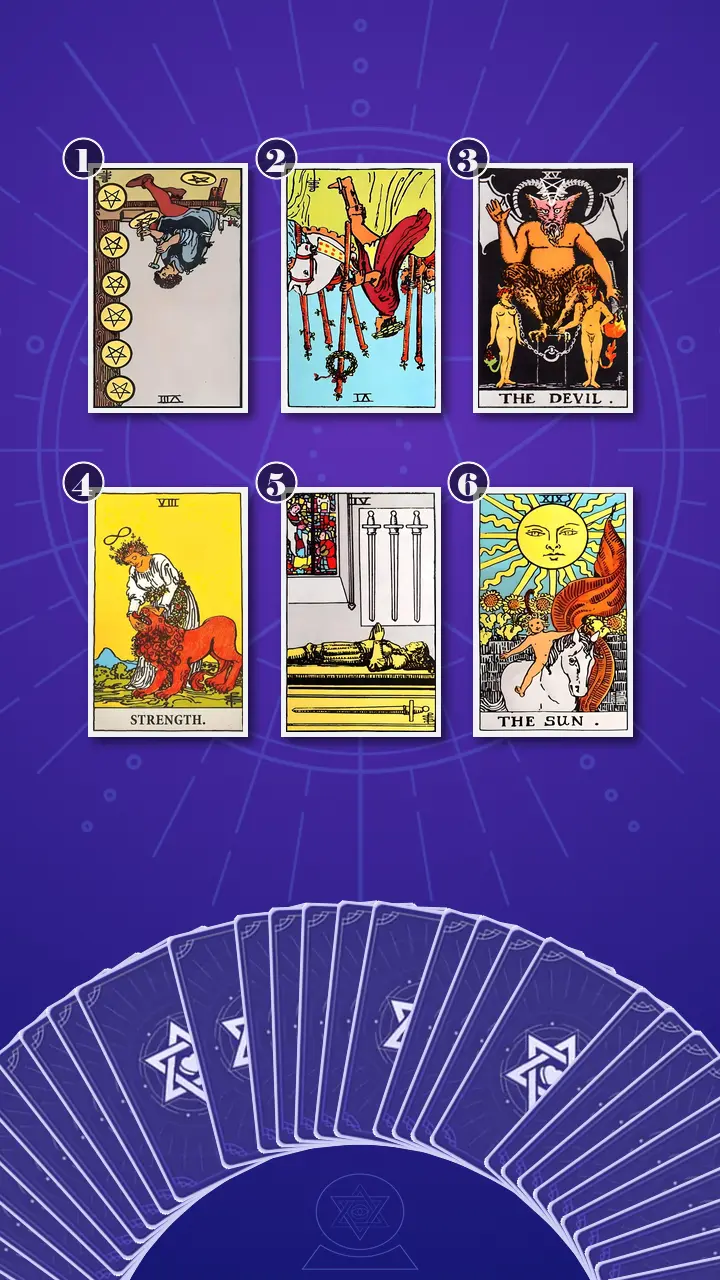
Reading the Map: how tarot works in a high-feedback life
Position 1 — The visible loop: what you do when ‘prove you’re human’ gets triggered
“Now flipping over,” I said, “is the card that represents the visible loop: what you do (behaviorally) when ‘prove you’re human/valid’ gets triggered.”
Eight of Pentacles, reversed.
In the image, there’s a worker at a bench, repeating the same pentacle again and again. Reversed, that focused practice turns into misdirected effort—energy spent on proving instead of building.
“This is like your morning on the TTC,” I said. “Rewrite, tweak, proofread, rephrase, re-check—until it feels ‘safe enough’ to be seen. Not because the content is unclear, but because you’re trying to pre-empt being misread. The loop looks productive from the outside. Inside, it’s self-proof: ‘If I optimize this enough, nobody can reject me.’”
I named the energy plainly: “This is effort turning robotic. A blocked kind of craftsmanship—where the workbench becomes a checkpoint.”
Jordan let out a small laugh that had no humor in it. Their eyes flicked up, then away. “That’s… too accurate,” they said, and there was a bitter edge to it. “It’s like I’m A/B testing my personality.”
“Exactly,” I replied. “And here’s the thing I want you to hear early: Being human isn’t something you earn through flawless output. The card is showing us where your worth got tied to ‘perfectly understood.’”
Position 2 — The blockage: the form your validation hunger takes
“Now,” I said, “we’re looking at the card that represents the specific form your validation hunger takes and how it blocks self-trust.”
Six of Wands, reversed.
In the traditional image, someone rides forward with a laurel wreath—public recognition, a crowd, a win. Reversed, it’s the crown you can’t feel. The applause that doesn’t absorb.
“You can do something objectively solid and it still won’t land inside,” I said. “Without quick, enthusiastic feedback, your brain reads the silence as failure. So you watch the channel, the notifications, the view count—like the crowd is supposed to confirm you’re allowed to feel good.”
I let the scene get specific, because that’s where shame loosens into clarity.
“It’s: (1) hopeful refresh—just a quick check. (2) a micro-drop when the silence holds. (3) the meaning-making spiral: ‘They saw it. They hated it. They think I’m cringe.’ (4) the scramble to repair—extra context, rewriting, over-explaining, deleting the post, or messaging a friend with ‘Was that weird?’ disguised as casual.”
Then I said the line I knew Jordan needed, without judgment: You’re not chasing attention. You’re chasing a verdict.
Jordan winced like I’d pressed a bruise they didn’t know they had. Their shoulders rose, then slowly fell. A quiet nod. Their hand hovered near their phone, then pulled back.
“Yeah,” they whispered. “If nobody reacts, my brain assumes I did something wrong.”
“And notice the word you used,” I said softly. “Assumes. This card is literally the habit of treating ‘no signal’ like a failing grade.”
Position 3 — The root driver: the attachment underneath the trigger
“Now flipping over,” I said, “is the card that represents the deeper pattern underneath the trigger: the attachment or fear that keeps the loop running.”
The Devil, upright.
People expect me to soften this card. I don’t soften it—I translate it. In the Devil, the chains are loose. You can technically stand up. But you don’t. Because the thing you’re tethered to feels like safety.
“This doesn’t mean you’re ‘bad,’” I told Jordan. “It means you’ve got an attachment pattern: approval has become the emergency signal that calms your body. Likes, praise, quick replies—oxygen.”
I watched their throat move as they swallowed. Their fingers went still for the first time.
“This is the invisible contract,” I continued, voice steady. “‘If I’m impressive, I’m safe.’ You didn’t sign it because you’re vain. You signed it because at some point, being seen started to feel like being safe.”
My mind flashed—briefly, quietly—to the Highlands where I was raised. In winter, the hills teach you something brutal and kind: if you chase every gust of wind as a threat, you’ll never rest. You learn to read the weather without worshipping it. I returned to Jordan with that same principle.
“And this,” I said, “is where we say it out loud: Silence isn’t proof. It’s just silence. The Devil makes silence feel like a verdict because the nervous system is trying to prevent exile.”
Jordan sat very still. There was a long pause, the kind where the room feels louder. “If nobody reacted for a week,” they said finally, “my brain would be like… ‘See? You’re forgettable.’”
“That,” I said gently, “is the fear. Not the post. Not the Slack message. The fear of being overlooked turning into a story about worth.”
When Strength Spoke: holding the inner lion instead of chasing the crowd
Position 4 — The turning point: the energy that loosens the pattern
I slowed my hands before turning the next card. “We’re flipping,” I said, “the card that represents the turning point energy that can loosen the pattern without needing a perfect outcome.” The air in the room felt like it tightened, not from dread—more like attention.
Strength, upright.
Setup. Jordan was still living in that subway moment—thumb hovering after “send,” body demanding a green checkmark before breath. The loop was so fast it felt like personality: check → interpret → fix → seek reassurance → repeat. And under it, the question that never got asked out loud: What if I don’t get approved? What would that mean about me?
Delivery.
You don’t need to ‘win the crowd’ to be real; you need to hold your inner lion with steady hands and let self-trust be the proof.
I let it hang there for a beat, the way you let a new thought settle into the body before the mind tries to debate it.
Reinforcement. Jordan’s reaction came in a chain—three small, honest movements. First: a freeze. Their breathing paused, like their nervous system had hit a loading screen. Second: their eyes unfocused, as if replaying a hundred micro-moments—Slack, Instagram views, a teammate’s neutral face—through a different lens. Third: a slow exhale that sounded like surrender, but not the defeat kind. The “I’ve been carrying this alone” kind. Their shoulders dropped a fraction. Their jaw unclenched. One hand—without thinking—went to their sternum.
“But… if I don’t check,” they said, and there was a flash of irritation, almost protective, “isn’t that irresponsible? What if I miss something?”
“That’s such an honest question,” I said. “And it’s exactly why Strength isn’t ‘confidence theater.’ It’s nervous-system leadership. Strength doesn’t delete the urge. It holds it steady until it stops barking.”
“In my Nature Empathy Technique,” I added, “we treat your body like weather—information, not a judge. A chest tightening is like pressure dropping before a storm. It doesn’t mean you are the storm. It means you’re sensing one. Your ‘sixth sense’ isn’t magic—it’s pattern recognition. Strength is learning you can notice the pressure shift and still choose your next step.”
Then I gave them a micro-experiment—because Strength needs a practice, not a slogan:
“Do it once this week,” I said. “Send one thing—one Slack update, one design comment, one text. Start a 10-minute timer. Put your phone face-down or out of reach. In Notes, write two lines: ‘What I meant was: ____.’ and ‘The value I acted from was: ____.’ If your hands get itchy, name it out loud: ‘This is the prove-it reflex.’ Then take three slower breaths. If it spikes into panic, shorten it to 60 seconds. This is practice, not punishment.”
Jordan stared at the Strength card like it was a door they hadn’t noticed in a room they’d lived in for years. “What if,” they said quietly, “my worth doesn’t update in real time?”
“That,” I said, “is you stepping from reactive self-doubt toward cautious self-trust. It’s not about never liking praise. It’s about not needing the room to certify you before you’re allowed to feel real.”
Position 5 — The practical release valve: a pause your nervous system can understand
“Now flipping over,” I said, “is the card that represents a concrete next step for reducing checking/reassurance behaviors and building internal validation.”
Four of Swords, upright.
“This card is so unglamorous,” I told Jordan, “and that’s why it works.” I pointed to the resting figure, protected, still. “It’s a deliberate pause. A recovery container.”
“Four of Swords says: after you share something, you build a measurable boundary—a ‘no-check window.’ Not forever. Not a detox that turns into self-punishment. Just a block your nervous system can survive.”
I could practically see Jordan’s calendar in my head: meetings, Figma, Slack, Notion dashboards pretending to be a life. So I made it concrete. “Literally call it ‘No Metrics.’ Ten minutes. Thirty if you’re brave.”
And here is where I brought in one of my own tried-and-true tools. “During that window,” I said, “use my walking meditation using environmental sounds. Step out—hallway, balcony, one block. Let the city do the counting. Hear: the crosswalk chirp, a streetcar bell, a bike chain, your own footsteps. Your job is just to listen and name three sounds. That’s it. It pulls your attention out of the chain without needing more input from people.”
Jordan’s face softened, relief showing up as something almost like surprise. “I can actually do that,” they said.
“Good,” I replied. “A pause is a boundary your nervous system can understand.”
Position 6 — Integration: what ‘being human’ feels like without an audience
“Now flipping over,” I said, “is the card that represents what integration looks like when you relate to visibility and feedback in a healthier way.”
The Sun, upright.
The Sun is not a ‘perfect life’ card. It’s an aliveness card. The kind of warmth that doesn’t need to be witnessed to be real.
“This,” I told Jordan, “is you sharing something imperfect but honest—and then still going to make dinner, still meeting a friend, still feeling like yourself even if the notifications are quiet. Feedback becomes information, not identity.”
“The question The Sun asks you,” I added, “is simple: what makes you feel most like you when nobody’s watching?”
The One-Page ‘Private Win Condition’: actionable advice for reassurance-seeking loops
I leaned back and stitched the six cards into one story Jordan could actually carry out of the room.
“Here’s the pattern,” I said. “Eight of Pentacles reversed is the grind—polishing as self-proof. Six of Wands reversed is the scoreboard—applause that doesn’t stick, silence that feels loud. The Devil underneath is the contract—‘If I’m impressive, I’m safe.’ Strength is the bridge: holding the urge without obeying it. Four of Swords is the container: a pause your nervous system can tolerate. And The Sun is the outcome: feeling human without needing to pass the test.”
“Your cognitive blind spot,” I continued, “is that you treat reactions like reality. Like your worth refreshes the way a feed does. That turns neutral silence into ‘data’ about you—when it’s often just… people being in meetings.”
“The transformation direction is clear,” I said. “Shift from chasing external proof to practicing self-witnessing: name what you value, choose one internal success metric, and act before you feel fully approved.”
Then I offered Jordan a short list—small enough to start, specific enough to measure.
- The 10-Minute No-Check WindowAfter you send/post one thing this week (Slack update, email, story), start a 10-minute timer and keep Slack/Instagram closed until it ends.Expect the itch. If 10 minutes is too big, do 60 seconds. This is practice, not punishment.
- The Value Receipt (Strength Practice)Before you send, pick one private win condition—clarity, directness, or kindness. Write it at the top of your draft. After you send, write one line: “The value I acted from was ____.”Answer yes/no later: “Did I act in line with the metric?” No essays. Your worth doesn’t need a full report.
- Walking Meditation with City Sounds (Four of Swords in motion)During the no-check window, walk for one block or stand by a window and name three sounds you hear (streetcar bell, HVAC hum, footsteps, wind). Keep your phone out of reach.If Toronto weather is brutal, do it indoors: hallway, stairwell, even beside the kettle. Seasonal self-care is real—adjust the practice, not your worth.
“And one more,” I added, because nights are where these loops go to breed. “If you’re up for it, try my 3-minute bedtime energy review: before sleep, ask yourself, ‘Where did I look for a verdict today?’ and ‘Where did I witness myself instead?’ Three minutes. Then done.”

A Week Later: the quiet proof of finding clarity
A week later, Jordan sent me a message—short, almost suspiciously simple: “I did the 10-minute no-check window after a Slack update. My hands were SO itchy. I named it: ‘prove-it reflex.’ I didn’t die. I wrote: ‘What I meant was…’ and it was actually… nice?”
They added, “Someone reacted twenty minutes later. It felt good, but it didn’t feel like CPR.”
In the same message, they admitted something softer: they slept through the night once. In the morning, the first thought was still, What if I’m wrong?—but this time they noticed it, breathed, and got out of bed anyway. Not perfect. Just different.
That’s the journey I trust: not the fantasy of never caring, but the reality of choosing yourself before the room decides.
When silence hits, it can feel like your chest is waiting for a notification to tell you whether you’re allowed to be real—like you’re trying to be “human enough” without anyone handing you a pass.
If you let one thing be true this week without checking for a verdict first, what would you want that truth to be about you?