From Receipt Guilt to Steadier Weeknights: A Middle-Setting Ritual

The 6:45 p.m. Receipt Audit
You’re a Toronto early-career office professional who can run meetings all day, but at 6:45 p.m. your brain hits 1% and Uber Eats becomes your default—then the receipts feel like a life-balance audit.
Jordan (name changed for privacy) said it like a confession and a joke at the same time. We were on a video call—my morning in Tokyo, their Tuesday evening in Toronto. Behind me, my desk lamp cast a soft circle over a star chart I’d been using for a planetarium show; behind them, a too-bright overhead kitchen light turned everything the color of paper towels.
“My Uber Eats receipts are basically a mood tracker,” they added, rubbing the heel of their hand along their jaw like it was a stuck hinge. “I keep telling myself I’m buying time, but I’m not sure what I’m doing with it.”
I watched their shoulders as they spoke—how they kept inching up, like their body was still bracing for Slack pings. Even through the screen, I could almost hear the fridge hum and feel that specific weeknight texture: keys dropped, bag thumped by the door, the fridge opened like a dare. Half-used ingredients stared back like homework. Then the phone warmed in their hand as the app opened before they’d even decided they were hungry.
Overwhelm, for Jordan, wasn’t an abstract feeling. It sat in their clavicles like a backpack with a hidden brick in it. It made “chop an onion” feel like trying to solve a puzzle while someone flicked the lights on and off.
“Receipts aren’t a verdict,” I said gently, leaning a little closer to the camera. “They’re data with feelings attached. And we can work with data. We can find a next step that doesn’t require a new personality—just a little more choice, a little earlier in the night.”
I let that land and then named our shared goal out loud, the way I do when I’m about to guide someone through a dark planetarium dome: “Let’s treat this as a Journey to Clarity. Not a strict reset. A map.”

Choosing the Compass: The Transformation Path Grid (6)
I asked Jordan to take one slow breath with me—nothing mystical, just a clean transition between “work brain” and “self-observation.” While they inhaled, I shuffled my deck the way I always do: steady, rhythmic, like I’m listening for pattern rather than trying to force an answer.
“For this,” I told them, “I’m going to use a spread called the Transformation Path Grid (6) · Context Edition.”
And for you, reading this: a classic, huge spread like the Celtic Cross can over-expand a question that’s actually quite specific—an emotionally sticky habit loop. Meanwhile, a simple 3-card pull often misses the mechanics: what keeps repeating, why it makes sense, and what would realistically shift it. The Transformation Path Grid (6) is the smallest structure that still gives the full arc: visible symptom → blockage → root → turning point → practical next step → integration.
I laid the cards in a compact 2x3 “dashboard.” The top row would diagnose the loop (what the receipts reflect, what’s keeping it stuck, what’s underneath). Then we’d drop down and read the bottom row like a recalibration path—moving from messy expense report energy into something you can actually live inside.
“The first card,” I said, “will show what the receipts are reflecting right now—the pattern, not the story. The second will show what keeps it in place. And the fourth—our turning point—will show the balancing principle that makes a next step possible.”
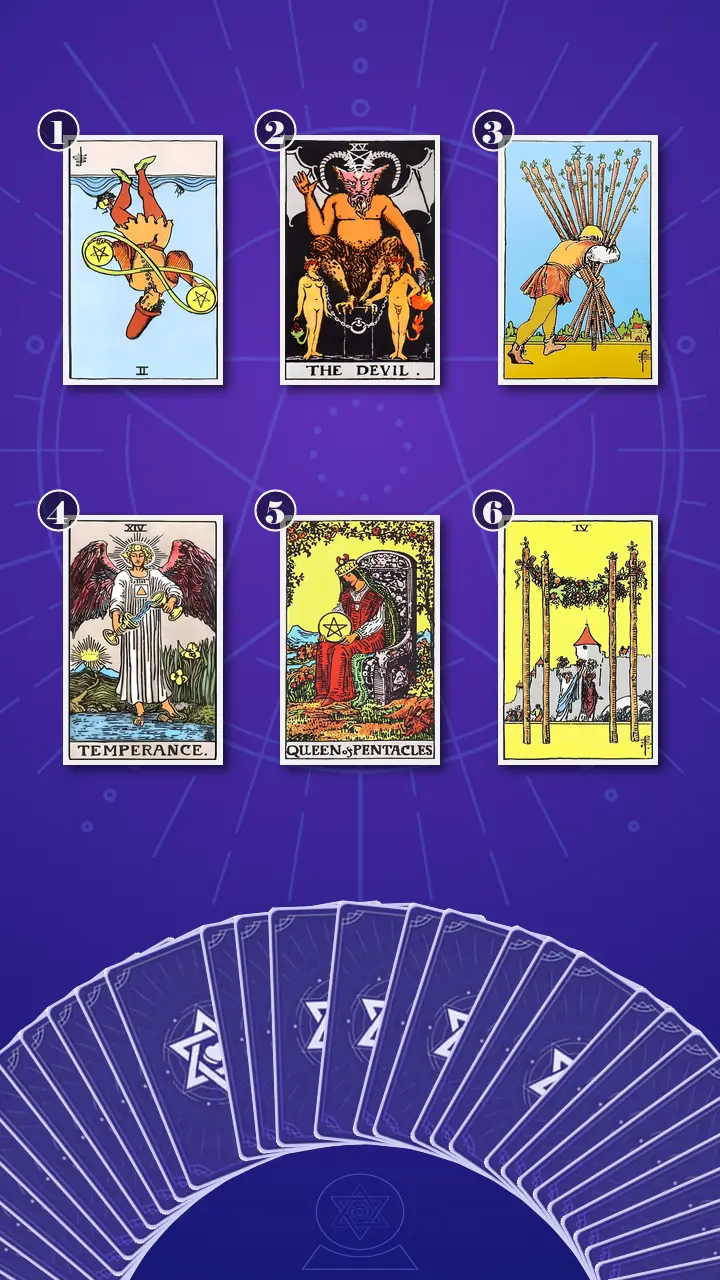
Reading the Map: Why the Loop Keeps Running
Position 1: The receipts as a mirror, not a moral scorecard
“Now we turn over the card that represents what the receipts are reflecting right now: the most visible imbalance and the concrete behavioral pattern driving it.”
Two of Pentacles, reversed.
Even on-screen, Jordan’s face did that tight little wince people do when they recognize themselves before they want to. The Two of Pentacles reversed is the juggler losing rhythm—the infinity loop still there, but now it’s more like an endless scroll than a dance.
“This is you juggling like it’s a job requirement,” I said, using the card’s modern mirror exactly as it showed up for them. “Calendar, Slack, budget, social plans, health goals. And at 6:45 p.m., your fridge contents feel like another project—so you outsource dinner with one tap. Later, the receipt total hits like a mini performance review you never asked for.”
In reversed position, the energy here isn’t “you’re bad at balance.” It’s blockage: the ability to adapt is jammed because there are too many moving parts at once. Dinner becomes the first ball you drop because it’s the easiest one to outsource.
Jordan let out a small laugh that had a bitter edge. “That’s… brutal,” they said. “Like, accurate. But brutal.” Their fingers worried the rim of their mug, then stilled—as if their hands finally got the message that we were looking, not sentencing.
Position 2: The sticky loop that opens the app before you decide
“Now we turn over the card that represents what is keeping the pattern in place: the sticky loop, temptation, or friction point that blocks change.”
The Devil, upright.
I didn’t soften it. I never do with The Devil, because the card itself is not a moral lecture—it’s a design diagram. The chains in the image are loose. That detail matters.
“Here’s the split-screen,” I said, following the echo the card demanded. “Screen A: your thumb opens Uber Eats on autopilot while Slack notifications still buzz in your head—like you’re still half in the office. Screen B: there’s this tiny moment right before you hit Place order where the chain is loose. A ten-second pause exists.”
I watched Jordan’s eyes flick down and to the left—the classic “I’m replaying the memory” look.
“And in that pause,” I continued, “the truth is usually: you’re not hungry-hungry. You’re relief-hungry. You’re trying to access a feeling in 20 minutes—relief, control, comfort, reward.”
The Devil’s energy, upright, is excess: too much pull toward immediate safety, too little space between cue and action. Convenience becomes a tool—until it becomes your emergency response.
Jordan exhaled—quiet, surprised—like their body had been waiting for someone to name the part they felt weirdly trapped by. They nodded once, slow, like they were rereading a line that suddenly made sense.
Position 3: The root—why you arrive home already spent
“Now we turn over the card that represents the deeper root: what overload, belief, or context makes the current pattern make sense.”
Ten of Wands, upright.
In the Ten of Wands, the figure’s arms are full and their view is blocked. They’re almost home, but they can’t see it. That’s decision fatigue. That’s Toronto winter dusk at 5 p.m. That’s “I can do hard things all day… and then I can’t do one more thing.”
“This isn’t laziness,” I said, keeping my voice steady and plain. “This is capacity mismatch. You’re carrying your calendar, your inbox, the unspoken expectations, the standards creep—like you’re hauling the entire day through your front door. Cooking isn’t hard; it’s just the eleventh thing.”
The Ten of Wands is excess again, but different: too much load, carried too long, with no redistribution. When you’re this overloaded, the brain doesn’t pick the ‘best’ option—it picks the option that ends the decision-making fastest.
Jordan’s shoulders dropped a fraction, almost involuntary. Shame softened into something more honest: a tired kind of relief at being seen without being judged.
When Temperance Poured Between Two Cups
Position 4 (Key Card): The turning point—the middle setting
I touched the next card lightly before turning it, the way I do in the planetarium right before I reveal the night sky: a small pause that makes the moment feel earned. The room—both rooms—seemed to quiet. Even Jordan’s kitchen light looked less harsh for a second, as if the brightness had finally stopped yelling.
“Now we turn over the card that represents the turning point: the most helpful reframe or balancing principle that makes a realistic next step possible.”
Temperance, upright.
Temperance is the antidote to extremes. The angel pours between two cups. One foot on land, one in water. It’s not dramatic. It’s calibrated. It’s the difference between flipping a switch and turning a dial.
Setup: I could feel Jordan’s usual loop sitting right behind their eyes: I have to fix this. I have to be consistent. If I slow down, I’ll fall behind. That pressure makes dinner into a pass/fail test—so the easiest “pass” becomes ordering, and the receipts become punishment after.
Delivery:
Stop treating dinner as a pass/fail test and start pouring a middle way—like Temperance—so balance comes from calibration, not extremes.
I let silence hold it for a beat.
Reinforcement: Jordan’s reaction came in layers. First, a brief freeze—like their breath forgot what it was doing, their mouth slightly open as if their brain had hit a buffering screen. Then their gaze went soft and unfocused, drifting past the camera toward the fridge door, replaying a dozen Tuesdays at once. Finally, their shoulders loosened downward, not in triumph, but in a tired surrender that felt strangely kind. Their eyes shone—not tears, exactly, more like the body’s way of admitting, Oh. I’ve been turning this into an exam.
“But if I do that,” they said, and there was a flicker of irritation underneath the vulnerability, “doesn’t it mean I was wrong? Like… I’ve been doing it wrong this whole time?”
“It means you were surviving with the tools you had at 6:45 p.m.,” I replied. “Temperance isn’t a verdict. It’s a mixing practice. And you can install it without rewriting your identity.”
This is where I bring in my own lens—the one I’ve learned from years of explaining celestial rhythms to people who think the sky is random. In my work at the Tokyo planetarium, I teach that pulsars look chaotic until you realize they’re precise: bursts of energy in repeatable intervals. That’s why my signature tool is Pulsar Breathing—syncing your nervous system to a simple, reliable rhythm before you make a choice.
“I want you to try something I call Pulsar Breathing,” I told Jordan. “Seven slow cycles. Not because it’s magical, but because it gives you back the ten seconds The Devil steals. It creates a middle setting before you’re empty.”
I watched their jaw unclench as if the idea of a tiny stabilizer—rather than a lifestyle overhaul—finally gave their brain something it could say yes to.
“Now,” I asked, “with this new lens, can you think of one moment last week—right before you opened the app—where a tiny mixing practice would’ve changed how the night felt?”
Jordan stared up at the ceiling for a second. “Thursday,” they said quietly. “I’d ordered in under a minute. And then I just… sat there. Like I bought time and didn’t know what to do with it.”
“That’s the exact fork in the road Temperance cares about,” I said. “Not whether you ordered. Whether you had a choice.”
This was the emotional shift in real time: from end-of-day overwhelm and receipt-driven self-judgment to the first hint of calm steadiness—built through a repeatable middle-setting ritual.
Position 5: The practical next step—care that works on a random Tuesday
“Now we turn over the card that represents a grounded next step you can actually do: a practical routine or choice that reduces reliance on autopilot ordering.”
Queen of Pentacles, upright.
The Queen of Pentacles is the energy of “life ops.” Not glamorous. Not influencer-perfect. Quietly competent. The kind of care that notices what’s actually happening in your fridge and plans for the version of you who comes home with a foggy brain.
“This is you setting up your environment so feeding yourself is easy when you’re tired,” I said, anchoring it to the modern scenario the card offered. “A few reliable staples you actually like, a freezer backup, and a simple rule for intentional delivery.”
The Queen’s energy is balance: enough structure to support you, not so much that you collapse under it. And she’s budget-aware without being punitive. She treats receipts like a dashboard, not a report card.
Jordan’s eyes sharpened a little—the first spark of, I could do this. “So… like a capsule wardrobe,” they said, surprising themselves. “But for dinner.”
“Exactly,” I smiled. “Stewardship beats shame: make the easiest good choice even easier.”
Position 6: Integration—when evenings become a soft landing
“Now we turn over the card that represents how balance can look when it starts working: the felt sense of integration and what to reinforce.”
Four of Wands, upright.
In the Four of Wands, home isn’t a place you recover in like a crash site. It’s a place you return to. The garland is a container—light structure that holds joy without demanding perfection.
“This looks like weeknights becoming a soft landing,” I said. “A default dinner, a quick reset, maybe music or a candle—tiny cues that the day is done. Delivery becomes something you choose on purpose, sometimes even celebrate, not something you use to rescue yourself from depletion.”
Jordan’s mouth tilted, almost a smile. “That sounds… suspiciously nice.”
“It’s nice because it’s designed,” I said. “Not because you suddenly become a different person.”
The Middle-Setting Method: Receipt-to-Routine Translation
I leaned back and looked at the whole grid as one story, the way I look at a constellation: not six separate stars, but a shape you can navigate by.
“Here’s the logic,” I told Jordan. “Two of Pentacles reversed says you’re over-juggling, so dinner becomes the first outsourced ball. The Devil says the app loop is giving you immediate safety, so it runs before choice has a chance. Ten of Wands says the reason it works is you’re arriving home already loaded—capability at work, collapse at home. Temperance is the bridge: a tiny mixing practice before depletion. Queen of Pentacles turns that into a practical system. Four of Wands is the payoff: a light ritual container that makes home feel supportive.”
“The blind spot,” I added, “is that you’ve been treating the receipts as a judgment about adulthood—when they’re actually showing you your bandwidth. You don’t need to fix your whole lifestyle. Your transformation direction is simpler: move from ‘fix my whole life’ to ‘build one repeatable stabilizer that protects my energy before I’m depleted.’”
Jordan frowned thoughtfully. “Okay,” they said. “But I’m going to be honest—when you say ‘ritual’ or ‘pause,’ my brain is like, cute, but I don’t have time. I barely have time to eat.”
“That’s the real-world obstacle,” I nodded. “So we make it smaller than your resistance. And we attach it to something already happening—like the microwave running, or the kettle boiling.”
Then I gave them a plan that matched the cards and respected city life, decision fatigue, and the weird shame of small recurring purchases.
- The 7-minute Two-Cups Pause (Pulsar Breathing version)Before you open Uber Eats (or any food app), set a 7-minute timer. Do 7 slow breaths—steady like a pulsar. Then ask: “What do I need in 20 minutes—relief, control, or comfort?” and “What’s one 10% version I can give myself first?” (water, a 2-minute rinse-off shower, lying on the floor, stepping onto the balcony for air).If your brain says “this is silly,” that’s data, not failure. Do the 2-minute version once. The goal is the pause, not perfection.
- Build a 15-minute default dinner (one line, pinned)Pick one weeknight meal that takes under 15 minutes and doesn’t require “real cooking” (frozen dumplings + microwaved veg; toast + eggs + fruit; bagged salad + rotisserie chicken). Write it as a one-line note and pin it to your phone home screen or Notes widget so it’s visible at 6:45 p.m.If 15 minutes feels impossible, do the “heat-and-eat” version. You’re building a stabilizer, not winning a cooking show.
- Set up a Queen of Pentacles shelf (two staples + one freezer backup)Claim one small fridge shelf (or one bin). Stock it with 2 staples you’ll actually eat + 1 freezer backup + 1 sauce/spice you genuinely like. Take a photo of the shelf so your tired brain can “see” options without thinking.If budgeting anxiety spikes, set a kind weekly delivery cap and revisit later. Stewardship beats shame—adjust the system, don’t punish the person.
“And if you want one of my ‘it’s-actually-doable’ environment hacks,” I added, pulling from my own strategy toolkit, “use background sound on purpose. If your washing machine is running, let it be your cosmic meditation track—the steady whoosh is a built-in tempo for the pause. You don’t add time; you add rhythm.”

A Week Later: The Quiet Proof
Six days later, Jordan messaged me a screenshot. Not of a perfect meal-prep Sunday. Not of a zero-delivery week. A Notes app widget, plain and slightly embarrassing in its simplicity:
“DEFAULT DINNER: dumplings + veg. If ordering: do 7 breaths first.”
Under it: one line—“Didn’t order last night. Still wanted the app, but I didn’t feel trapped.”
Their follow-up text was even smaller, and somehow that made it bigger: “I slept through the night. Woke up and my first thought was still ‘what if I fall behind?’—but this time I made tea and didn’t open my banking app like it was a punishment.”
That’s the kind of clarity I trust. Not certainty. Ownership.
When you’re exhausted but still terrified that slowing down will cost you control, even dinner can start to feel like evidence—like the receipt is grading your life while your shoulders stay braced for the next day.
If you let your receipts be neutral data for one week, what’s one small ‘middle setting’ you’d be curious to try before you’re depleted—just to see how it changes the night?