Recents at 11:26 p.m.: Turning Screenshot Overwhelm into One Rhythm

Recents at 11:26 p.m.: When “Saved for Later” Starts to Feel Like a Verdict
If you’re a Toronto early-career office girlie whose camera roll is basically three folders—Career, Fitness, Relationships—and all of them feel urgent at once, you’re not alone in that life-admin overwhelm.
Taylor (name changed for privacy) said it like she was confessing to a crime, not describing a normal Sunday night: “I open Photos and it’s… everything I’m not doing.”
I watched her shoulders sit a little too high, like they’d forgotten how to drop. She described 11:26 PM in her condo bedroom: dim light, phone warm against her palm, blue glow making her eyes sting. Under the duvet, her leg bounced in quick, angry little taps while she screenshotted a sleep-hygiene carousel—then a salary negotiation thread—then a dating coach post about “how to not seem needy.”
Even off the clock, her body was on-call. A tight jaw. A restless, buzzing hum under her skin. The kind that doesn’t let you sink into rest; it keeps you hovering over your own life like a tab you forgot to close.
“What’s off in work, health, love,” she said, looking at me like I might hand her a single, correct answer. “And what do I fix first?”
I nodded, letting the question land without rushing to solve it. “We can absolutely look at that,” I told her. “And we’ll do it in a way that doesn’t turn your whole week into three separate crises. Let’s try to give the fog a map—something practical enough that you can take one real step and feel your nervous system unclench.”

Choosing the Compass: The Energy Diagnostic Map (7) · Context Edition
I’m Esmeralda Glen, and I’ve spent a lifetime watching patterns—first in people, and then, as I got older, in the way people forget they’re allowed to have seasons. My family is from the Scottish Highlands. We learned early that you can’t force spring by yelling at the snow.
Before we touched the cards, I asked Taylor to take one slow inhale and exhale—not as a ritual for “manifesting,” but as a clean handoff: from scrolling for answers to listening for them.
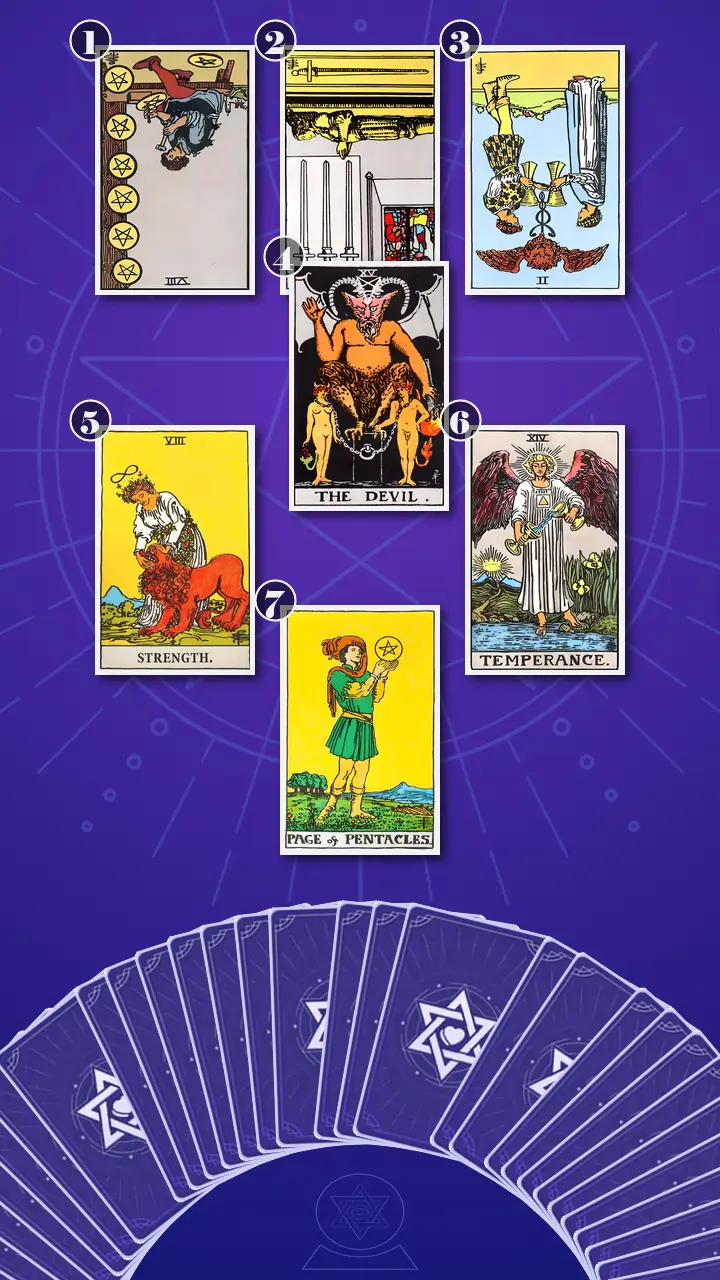
“Today, we’ll use a spread I call the Energy Diagnostic Map (7) · Context Edition,” I said. “It’s a 7-card tarot spread for work, wellbeing, and love clarity—especially when everything feels off at once and your brain wants to fix all three lanes at the same time.”
To you, reading this: the reason I chose it is simple. A classic Celtic Cross can be powerful, but for a three-domain scan (work/health/love) plus the question what first?, it can get sprawling. This spread is the smallest structure that (1) separates the three signals, (2) finds the shared driver underneath, and (3) gives one priority lever and one grounded next step—actionable advice, not a dramatic prophecy.
“Card one will show the work signal—what’s visibly ‘off’ in effort,” I explained. “Card four is the common thread tying all of it together. And card five is the ‘what first’ lever—the smallest boundary that creates the biggest shift.”
Reading the Map: Three Lanes, One Nervous System
Position 1 — Work signal: the visible ‘off’ pattern
“Now flipped over is the card representing your Work signal: the most visible ‘off’ pattern in career/effort right now.”
Eight of Pentacles, reversed.
“This is like a hybrid office day in Toronto,” I said, keeping my voice plain. “You screenshot ‘how to level up’ posts and rebuild your workflow—Notion templates, color-coded Google Calendar spirals—but you don’t do the one 45-minute block that would actually build mastery. The messy draft. The analysis. The slide deck that becomes real.”
Reversed, the Eight of Pentacles isn’t a lack of effort—it’s misdirected effort. The energy is blocked: a lot of motion, not enough repetition. Busy polish without reps.
Taylor let out a short laugh that had a bitter edge to it. “That’s… too accurate. Like, rude.” Her fingers tightened around her mug, then loosened, like she’d caught herself gripping.
“It’s not rude,” I said gently. “It’s information. And we can use it without shaming you.”
Position 2 — Wellbeing signal: the rest-and-recovery loop
“Now flipped over is the card representing your Wellbeing signal: what’s off in rest, energy, and the body–mind recovery loop.”
Four of Swords, reversed.
“This is ‘off-duty body, on-duty mind,’” I said. “You get into bed exhausted, but keep your phone in hand—scrolling, saving wellness routines, listening to one more optimization podcast. Your body is tired, your mind is sprinting, and your ‘health plan’ becomes more content instead of more rest.”
Reversed, this card shows a deficiency of true downshift. Not a moral failing. Not a willpower issue. A system that never gets the ‘safe to power down’ signal.
Her eyes flicked away from the cards to the window, as if Toronto’s streetlights could answer for her. “I’m so tired,” she said. “But when I stop scrolling, it’s like… I can hear my brain.”
“Yes,” I said. “Silence can feel loud when you’ve been using input as anesthesia.”
Position 3 — Love/connection signal: reciprocity and communication
“Now flipped over is the card representing your Love/connection signal: what’s off in relating, reciprocity, and communication patterns.”
Two of Cups, reversed.
“This is the modern scene where you reread texts and overthink tone,” I said, “then screenshot dating advice instead of asking for clarity in one sentence. You try to manage closeness through strategy—be chill, don’t double text—and connection starts to feel like a performance review.”
Reversed, the Two of Cups can look like a blockage in direct exchange. The cup is offered, but it’s not fully received. You draft and re-draft, hoping to avoid vulnerability—and then the ambiguity you feared is exactly what you get back.
Taylor nodded once, slow. Her mouth pressed into a line, then softened. “It’s not even just dating,” she admitted. “I do it with friends too. I don’t want to be… a lot.”
“Wanting clarity isn’t being ‘a lot,’” I said. “It’s being honest.”
Position 4 — Common thread: the shared blockage tying it all together
“Now flipped over is the card representing your Common thread: the shared blockage that ties work/health/love together into one repeating loop.”
The Devil, upright.
Before Taylor said anything, I saw it: her jaw tightened again, like her body recognized the card before her mind did.
“This,” I told her, “is the camera roll as an open browser with 47 tabs you’re afraid to close. The loose chains in this card are the reflex to save instead of choose.”
And I named it without drama, because it doesn’t need drama—it needs light: “Every time you feel behind, you grab for a safety net: threads, routines, templates, dating rules. It gives five minutes of relief. It also keeps you from making one vulnerable commitment that might not ‘work’ instantly.”
Information can be a tool—or a hiding place.
That sentence hit like a tiny bell. Taylor gave a tense laugh—half “oh no,” half recognition. Her shoulders froze for a beat, then she exhaled through her nose as if she’d been caught and—strangely—felt less alone.
“So it’s not that I’m lazy,” she said. “It’s that I’m… avoiding the verdict.”
“Exactly,” I said. “The Devil doesn’t say you’re doomed. It says the chain feels real—and it also says it’s loose.”
Position 5 — What first: the priority lever with the least force
“Now flipped over is the card representing your What first: the priority lever that creates the biggest systemic shift with the least force.”
Strength, upright.
“Here’s the relief,” I said, and I meant it. “Strength isn’t ‘delete your apps, wake up at 5 a.m., become a new person by Tuesday.’ It’s low-force self-leadership.”
I described the kind of moment that looks almost laughably small: your phone goes in another room for ten minutes. Your brain throws a tantrum—this is stupid, this won’t matter—and you don’t escalate. You don’t negotiate with the tantrum. You just keep the boundary.
Strength is balance between impulse and intention. Not excess. Not collapse. A steady hand on the lion, not a chokehold.
Taylor’s shoulders dropped a fraction, like her body understood the concept of “less force.” She swallowed, then said, “But what if ten minutes doesn’t change anything?”
“Then it changes one thing,” I replied. “It proves you can choose.”
When Temperance Spoke: Finding Clarity in the Two Cups
Position 6 — Key transformation: the reframe that reorganizes the whole system
When I reached for the sixth card, the room went quieter—not in a spooky way, but in the way a street goes quiet right after fresh snow. The kind of quiet where you can finally hear your own footsteps.
“Now flipped over is the card representing your Key transformation: the mindset/behavioral reframe that dissolves the core blockage and reorders priorities.”
Temperance, upright.
“This is the opposite image of your camera roll spiral,” I said. “Not more input. Not three separate overhauls. One steady blend.”
As someone who’s spent decades watching seasons change, Temperance always reads to me like a river meeting another river: two currents, one direction. In my work, I call it a piece of my Nature Empathy Technique—learning your inner weather so you stop making decisions from a storm. Temperance asks for a practice that steadies the climate first, so your choices stop feeling like life-or-death.
Setup: I watched Taylor’s eyes flicker the way they do when someone is right back in that Sunday-night bed-scroll: the dark room, the warm phone, the buzzing leg. That moment where saving one more “fix your life” post feels safer than choosing one small thing—because choosing makes it real, and real can disappoint you.
Delivery:
Stop treating your life like three separate crises to solve; start mixing one steady daily practice like Temperance’s two cups, and let consistency create clarity.
Reinforcement: Taylor’s reaction came in layers. First, a physical freeze—her breath caught, and her fingers hovered above her phone as if she’d been about to reach for it. Then her gaze went slightly unfocused, like her mind was replaying the last week in fast-forward: Slack unread anxiety, the burnt coffee, the doomscrolling, the unsent text. Then the release: a slow exhale that lowered her shoulders in a way she couldn’t fake. Her eyes went wet at the edges, not in a breakdown way—more like the body finally believing it doesn’t have to hold everything at once.
And then—because clarity can sting—she frowned. “But if that’s true,” she said, voice tight for a moment, “doesn’t that mean I’ve been doing it wrong?”
“No,” I said, steady. “It means your system has been trying to protect you. You learned a strategy that gave you control in the short term. Now we’re choosing a kinder strategy that gives you agency in the long term.”
I leaned in, practical. “Right now, with this Temperance lens, can you think of one moment last week when you felt the urge to screenshot—work tip, wellness hack, dating rule—and if you’d blended one small action instead, you would’ve felt even 5% calmer?”
That’s the real shift here: from overwhelmed, comparison-driven planning to low-force self-leadership and steadier self-trust. Not because you found the perfect system—because you stopped asking one choice to prove your worth.
Position 7 — Next step: a one-week action that makes it real
“Now flipped over is the card representing your Next step: a small, grounded one-week action that turns insight into lived experience.”
Page of Pentacles, upright.
“The Page is devotion to one real thing,” I said. “Not ten ideas. Not a new identity. One seed.”
In the modern translation: you choose one screenshot and give it a real-world home—one calendar event, one grocery list, one drafted message you actually send. The Page doesn’t ‘save for later.’ The Page plants.
Taylor’s face softened into something like relief. “So… I don’t have to fix all three?”
“You don’t need three overhauls—you need one rhythm,” I told her. “Saved for later isn’t the same as done.”
The One-Lever Week: Actionable Advice That Reduces Variables
I tied the whole spread together for her in one clean thread: your work lane looks “off” because your effort is scattered into optimizing instead of practicing (Eight of Pentacles reversed). Your wellbeing lane looks “off” because rest keeps getting replaced with input (Four of Swords reversed). Your love lane looks “off” because you’re negotiating closeness indirectly to avoid exposure (Two of Cups reversed). The shared driver is the saved-input chain—the urge to screenshot and compare so you don’t have to risk choosing (The Devil).
The blind spot is that you’ve been treating information like safety. The transformation direction is the opposite: reduce inputs, build one blended daily rhythm, and let reality teach you. That’s Temperance. And it starts with Strength: low-force boundaries you can actually keep.
I gave Taylor a plan that was intentionally small—because small enough to repeat is how self-trust returns. I also offered my own simple protection practice (it’s not mystical; it’s environmental): treat your bedroom like winter ground—quiet, dark, and not for “harvesting more content.” Let it be a place where your nervous system can thaw.
- The Phone-to-Body Switch (10 minutes)Tonight, set a 10-minute timer and put your phone in another room. Sit on the edge of the bed or the couch and only notice body signals (jaw, shoulders, breathing). No fixing. Just naming.Your brain will say it’s “too small to matter.” That’s the point. If you spike, do 5 minutes instead. Low force. High consistency.
- The Two-Cup Daily Mix (7 days)For seven days, do one blended block: 15 minutes of one work rep (one paragraph, one slide outline) + 10 minutes of downshift. For the downshift, try my walking meditation using environmental sounds—step outside and let TTC hum, footsteps, wind, and elevator cables be the “playlist,” no podcast.If resistance shows up, shrink it: 10 minutes total. The metric is repetition, not intensity.
- The One-Screenshot Rule (Page of Pentacles landing)Choose ONE screenshot and turn it into ONE calendar block this week (start time + location). After you do it, take one photo of “done proof” (your draft on screen, your walk route, your sent text) to replace screenshot-hoarding with evidence.If you miss a day, don’t “restart Monday.” Just do the next smallest version next time. Keep tracking frictionless—one checkmark.
Before we ended, I added one more tool—my 3-minute bedtime energy review. “Not journaling,” I said. “Just three minutes: ‘What drained me today? What steadied me today? What’s one thing I’m not carrying into sleep?’ Then lights out.”

A Week Later: Ownership, Not Certainty
Six days later, Taylor messaged me a photo instead of a screenshot. It was her calendar—one simple block titled “Two-Cup Mix,” repeated three times. Under it, a slightly blurry picture of her laptop with a draft open and, in the corner, a glimpse of her sneakers by the door.
“I did it three times,” she wrote. “Not perfect. But… I stopped adding new systems. Also I sent the straightforward text. I didn’t die.”
Her update wasn’t a movie montage. It was something quieter: she slept a full night, then woke up and her first thought was still, What if I mess this up?—but this time she noticed her jaw, softened it, and got up anyway.
This is what a real Journey to Clarity looks like in modern life: less frantic input, more steadiness. Less proving, more practicing. The spread didn’t “fix” Taylor—it helped her see the common thread, choose one lever, and build trust through what she could repeat.
When everything feels urgent at once, it can feel safer to keep saving possibilities than to pick one real step—because a single choice feels like it could expose you as “not enough” if it doesn’t instantly work.
If you gave yourself permission to run one tiny, repeatable experiment for the next seven days—no proving, no reinventing—what would you want that experiment to protect in you: your energy, your confidence, or your capacity to be honest with someone?