Stuck in Prove-It Mode on Slack: Finding a Work/Body/Home Baseline

Finding Clarity in the 8:58 a.m. Slack Ping
If you’re a hybrid software dev in Toronto and missing standup makes your stomach drop like you just got caught, you’re not alone—and the Sunday Scaries aren’t the only place burnout shows up.
Jordan (name changed for privacy) sat down across from me with her tote still on her shoulder, like she hadn’t fully decided she was allowed to stop moving. “It’s not like I’m falling apart,” she said, and then her eyes flicked to the corner of the room as if she could see her apartment from here. “But… I missed standup. And my laundry pile is basically a roommate now.”
I could picture it immediately—the iconic Toronto small-space reality where clutter gets loud fast. 8:58 a.m., laptop half-open on the edge of the bed, Slack already chirping. Phone screen too bright. Shoulders tense. That exact stomach-drop when you realize standup started two minutes ago—while a laundry pile slumps against the closet door like a neon sign saying not coping.
Her exhaustion wasn’t dramatic. It was the kind that feels like trying to walk through wet cement with a brain that won’t stop refreshing like a tab bar with 27 open tabs—everything technically running, but memory-leaking.
“I hear two truths at war,” I told her, keeping my voice gentle and plain. “One: you want to stay on top of work expectations and be the reliable person. Two: your capacity is maxed out, and your system is begging for ‘good enough for now.’ Let’s make a map through the fog—something that gives you clarity without asking you to become a whole new person.”

Choosing the Map: The Energy Diagnostic Spread for a Burnout Leak Audit
I asked Jordan to take one slow breath—not as a ritual for the universe, but as a handoff for her nervous system. Then I shuffled, the soft snap of cards sounding like tiny doors closing.
“Today we’ll use a spread I call the Energy Diagnostic Map (7) · Context Edition,” I said. And for you reading this: the reason I like this spread for quiet burnout is because it doesn’t treat the problem like one dramatic choice. It treats it like a system audit—where the leak shows up (work/home/body), what pressure is amplifying it, and what belief keeps the leak open.
We’ll start with the surface leak—what’s most visible right now. Then we’ll look at the inner tug-of-war, the external pressure, and the core blockage at the center. Finally, we move into what support is already available, the key integration shift, and one realistic next step for the coming week.
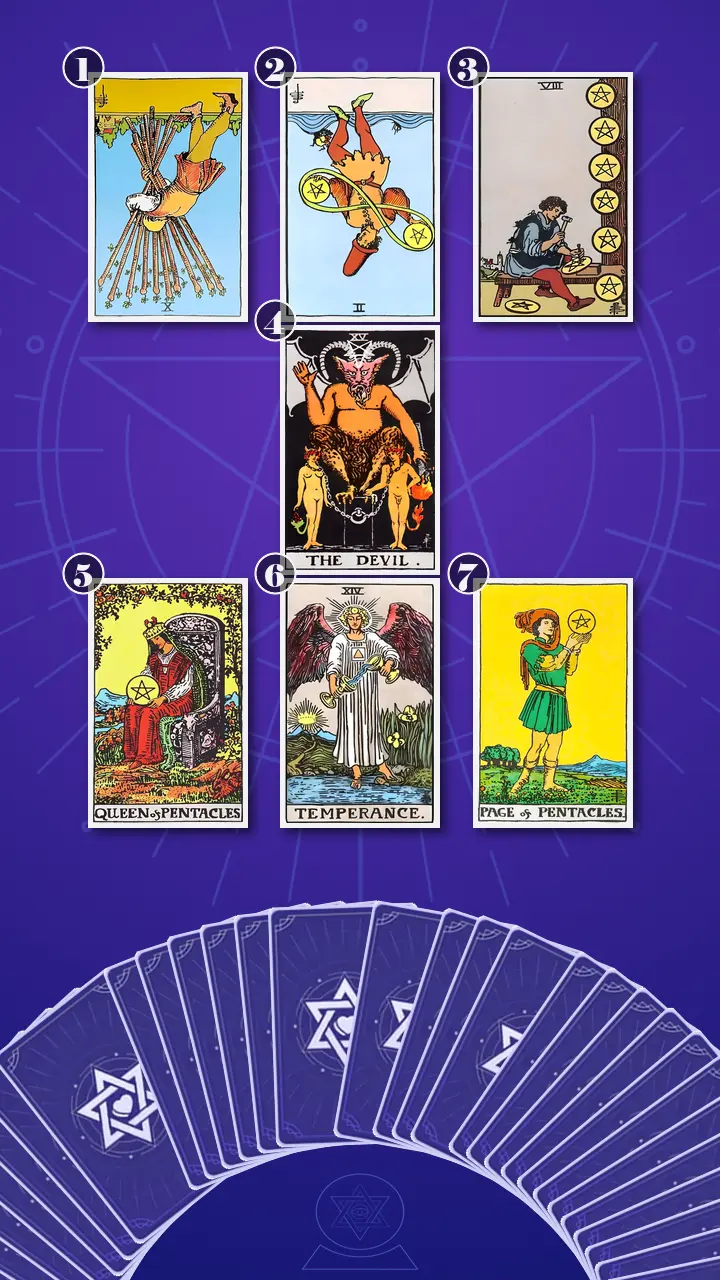
Reading the Leak: The Cards That Name It (Without Shaming It)
Position 1 — Surface leak: the visible symptoms
“Now turning over is the card that represents Surface leak: the most visible burnout symptoms showing up in work/home behavior,” I said.
Ten of Wands, reversed.
The image is a person bent under a bundle so big it blocks their view. “Here’s the modern version,” I told her, and I made sure to say it like it was information, not judgment: You’re carrying your week like a stack of grocery bags up a Toronto walk-up: standup, tickets, DMs, ‘quick asks,’ plus the invisible home stuff. Nothing looks dramatic—until you drop one bag (miss standup) and suddenly everything feels like it might spill. The laundry pile isn’t laziness; it’s the first thing your overloaded system stops funding.
Reversed, this isn’t ‘push through.’ It’s unsustainable load—the energy is blocked. You can’t keep carrying it with your arms locked. Your body will force a loosened grip somewhere: missed touchpoints, skipped meals, the home baseline slipping.
Jordan let out a small laugh that had a bitter edge to it. “That’s… annoyingly accurate,” she said. “Like—too accurate. Almost mean.”
“I know,” I said. “But I’d rather we call it what it is. A missed standup isn’t a moral failing. It’s a capacity metric.”
Position 2 — Inner tug-of-war: what’s splitting your attention
“Now turning over is the card that represents Inner tug-of-war: how your time/attention is being split,” I said.
Two of Pentacles, reversed.
Its symbol is the infinity loop—everything in motion, nothing truly done. I connected it directly to her lived week: Your day runs on juggling: Slack responsiveness, coding focus, meals, laundry, tiny apartment maintenance. When you’re at capacity, the switching costs eat your brain—so you start three things (reply to a thread, open a PR, sort clothes) and finish none. By night, the only thing that ‘completes’ is exhaustion.
Reversed, the energy is deficient in steadiness and excess in context switching. It’s like paying a transaction fee every time you jump from Jira to dishes to Slack. You’re not failing at time management—you’re paying too many fees.
Jordan nodded once, sharp. “I’ll open the washer. Then Slack pings. Then I’m in a thread. Then I’m staring at my kitchen like it’s someone else’s problem.”
Position 3 — External pressure: what the environment rewards
“Now turning over is the card that represents External pressure: what your environment is rewarding or amplifying,” I said.
Eight of Pentacles, upright.
This is the craft card—repetition, skill, output. In her life: Your environment rewards visible progress: updates posted, tickets moved, PRs cleaned up, consistent standup presence. Even when you’re depleted, the culture (and your internal standard) nudges you toward ‘one more refinement.’ It’s not that you don’t know how to work—you’re in a system where ‘good’ quietly turns into ‘never done.’
Upright, the energy is powerful and functional—you can work. But it’s also a pressure cooker: if the only praised rhythm is constant output, your nervous system never gets a true off-ramp. This is where “I’m fine” turns into “Why is laundry impossible after work?”
“It’s like that vibe in The Bear,” Jordan said quietly. “The frantic catch-up energy. Minus the knives.”
I smiled because she wasn’t wrong. “Exactly. The pace becomes the culture.”
Position 4 — Core blockage: the belief that keeps the loop running
“Now turning over is the card that represents Core blockage: the deeper belief or attachment that keeps the burnout cycle in place,” I said, and I placed it in the center like a drain cover we were about to lift.
The Devil, upright.
I didn’t go mystical with it. I went specific: After a slip, you go into prove-it mode: Slack green dot stays on, replies get faster, you volunteer for extra, and you postpone rest and home basics like they’re a reward you haven’t earned. You’re not just overworked—you’re bound to a standard where being seen as competent matters more than being okay.
The Devil’s chains are loose in the image—that detail matters. This isn’t permanent. But the energy here is sticky: compulsion, not choice.
I mirrored her inner monologue the way I’ve heard it a hundred times in young professionals, and I watched her shoulders inch up toward her ears as I said it: “If I don’t reply fast, they’ll think I’m slipping.” I paused. “If I miss one touchpoint, it proves I’m not reliable.”
Jordan’s mouth tightened; then she winced and gave me a tiny, recognized nod. The kind that says: yeah… I do that.
“If rest has to be earned,” I said softly, “you’ll always be in debt.”
Position 5 — Available resource: support you can access without a life overhaul
“Now turning over is the card that represents Available resource: a stabilizing capacity you can access now,” I said.
Queen of Pentacles, upright.
The modern translation is almost boring—and that’s why it works: The turning point looks almost boring: you start one laundry load, you eat something with actual protein, you clear one surface. But it changes the next morning—less friction, fewer mini-panics, less shame. This is the version of you that treats home and body like the platform your work runs on.
Here the energy is balanced earth: grounded care, not productivity theater. I asked her to imagine it like a tiny cinematic reset—hoodie off, laundry pod in, kettle on. Steam in the air. Warm mug in hands. The texture of a clean tee that doesn’t feel like an emergency solution.
Jordan’s face softened. Her jaw unclenched in a way that was almost imperceptible—until you’re trained to watch for it.
“Care is infrastructure, not a reward,” I said. “This Queen doesn’t ‘deserve’ clean clothes. She builds a system where clean clothes exist.”
When Temperance Poured Between Two Cups
Position 6 — Key integration: the turning point that reconnects work, body, and home
When I turned over the sixth card, the room got quieter—not in a spooky way, in a finally we’re touching the real issue way. Outside my window, a streetcar bell rang and faded, like a gentle reminder that time keeps moving whether or not we punish ourselves.
“Now turning over is the card that represents Key integration: the most important shift that reconnects work, body, and home into a sustainable rhythm,” I said.
Temperance, upright.
Its modern life version landed cleanly: Instead of a weekend ‘full reset’ fantasy, you start doing daily calibration: if work ran long, you still pour a small dose into body or home so tomorrow doesn’t start in deficit. One foot on land, one in water feels like: you stay functional at work, but you don’t abandon your nervous system or your space to do it.
Temperance is integration energy—not excess, not deficiency, but calibration. And because I’ve spent ten years explaining celestial motion under a planetarium dome, this card always pulls my mind toward rhythms that don’t negotiate: orbits, tides, rotation. You can’t brute-force your way out of them. You work with them.
“I want to use one of my frameworks here,” I told her, tapping the card lightly. “I call it Orbital Resonance. In physics, resonance is what happens when two cycles line up—sometimes it amplifies, sometimes it stabilizes. In your week, standup is a gravitational point. Slack is another. Your home baseline is another. Right now, your cycles are lining up in a way that amplifies panic—so one slip turns into a full-day shame orbit.”
She swallowed, eyes still on the card.
Setup. I named the exact moment she kept reliving: the Slack ping that hits, the stomach drop, the deal you make with yourself—I’ll stay online late, I’ll fix everything, and this weekend I’ll finally reset the apartment. That bargain feels like safety, but it’s actually the loop.
Delivery.
Not ‘I’ll catch up by pushing harder,’ but ‘I’ll regain stability by pouring my energy on purpose’—Temperance asks you to trade all-or-nothing recovery for daily calibration.
I let the sentence sit there. No extra explanation. Just air.
Reinforcement. Jordan froze for half a second—breath held, shoulders hovering. Then her gaze unfocused the way it does when someone’s brain replays a familiar scene: 9:12 p.m., in bed, phone warm in hand, thumb auto-scrolling while Slack stays open like a safety blanket. Finally, her body released it in a slow exhale that made her collarbones drop. Her eyes went slightly shiny, not in a dramatic cry way—more like the nervous system recognizing something survivable.
“Oh,” she said, almost embarrassed by how simple it sounded. “That’s… actually doable. Like, on a Tuesday.”
“Exactly,” I said. “Your day isn’t a moral scorecard. It’s a mixing board—Work, Body, Home—levels you adjust. You’ve been turning up Work to drown out guilt. Temperance is you learning to move one slider down without feeling like the whole song stops.”
Then I asked the question that makes the insight real: “Now, with this new lens—pouring on purpose—can you think of one moment last week where this would’ve changed how you felt? Even a little?”
She nodded. “Thursday. I stayed online late because I felt behind. If I’d just done… five minutes of laundry instead of doomscrolling, tomorrow wouldn’t have started like a disaster movie.”
That was the shift—from guilt-driven overcompensation and always-on panic to capacity-based steadiness. Not perfect. But grounded.
Position 7 — Next step: the one-week practice that builds momentum
“Now turning over is the card that represents Next step: a realistic one-week action that reduces leakage and builds momentum,” I said.
Page of Pentacles, upright.
Here’s the lived scenario: You pick one tiny habit that pays you back fast: a 7-minute tidy, starting laundry right after logging off, filling the water bottle, laying out clothes. You treat it like learning a skill—something you iterate—rather than a test of whether you’re a ‘functional adult.’
The Page’s energy is beginner mind—stable, humble, repeatable. Not proving. Practicing.
Don’t Fix Your Life. Fix Tuesday.
When I stitched the whole spread together for Jordan, the story was painfully coherent: the Ten of Wands reversed showed overload leaking through basics; the Two of Pentacles reversed showed the switching-cost chaos; the Eight of Pentacles showed a work culture that rewards endless output; the Devil showed the binding belief that you must earn rest through performance; and the Queen and Page of Pentacles offered the antidote—care as infrastructure, practiced in tiny reps. Temperance was the bridge: a minimum-viable rhythm instead of weekend rescue missions.
Her cognitive blind spot wasn’t “I need better discipline.” It was the belief that slowing down will expose me—and the habit of turning every recovery attempt into another performance metric. The transformation direction was clear: from rescuing everything at once to building a minimum-viable daily rhythm—one true work priority, one body anchor, one small home reset.
I offered her a one-week plan that didn’t require motivation—just cues and friction reduction. I also layered in one of my planetarium-grounded tools: Earth-rotation perspective before morning meetings. The Earth turns whether or not you punish yourself. Your job is to ride the rotation, not fight it.
- Standup Safety Net (2-minute setup)Today, set a recurring phone alarm named “Standup = show up, not impress” plus a calendar notification 10 minutes before. If you’re running late, post a 2-line async update instead of disappearing.Make the async template a pinned note: “Yesterday / Today / Blocked.” Copy-paste. No over-explaining.
- Post-Logout Starter Task (under 60 seconds)Right after you log off, do a “tomorrow friction check”: ask, “What’s one thing that makes tomorrow morning 10% easier?” Then do only that—start one laundry cycle, clear just the sink, or fill the water bottle.Expect your brain to argue, “Too small to matter.” That’s the point. Go smaller until it becomes repeatable.
- Temperance Ratio Check (10 minutes, stop anytime)Open Notes and write three lines: “Work / Body / Home.” Choose ONE must-do for Work that protects tomorrow, ONE 5-minute Body anchor (water + stretch or a walk to the end of the block), and ONE 5-minute Home reset (start laundry or clear one surface). Then stop.Boundary rule: if you try to add more than one item per line, that’s the signal—go smaller, not stricter.
Jordan hesitated, then hit me with the real-world obstacle—exactly the kind I want in a session because it means we’re being honest. “But I don’t even have five minutes,” she said. “Because the second I’m done, Slack pings. Or someone’s like, ‘quick question.’”
“That’s the Solar Sail Principle,” I told her—another of my tools. “A solar sail doesn’t win by fighting resistance head-on. It uses the environment’s force as propulsion. You can’t stop Slack existing, but you can decide what it does to you.” I suggested one tiny rule: after logging off, set Slack to ‘away’ for 10 minutes. Not forever. Just long enough to pour on purpose once.

A Week Later: The Quiet Proof
A week later, Jordan messaged me. Not a long update. Just: “I missed nothing this week. Not because I became organized—because I set the alarm. Also, I started laundry three nights in a row. Didn’t fold. Still counts. My mornings feel… less hostile.”
In my mind I saw the bittersweet version of progress: she’d done the smallest resets, and the apartment looked calmer—but she ate dinner alone on a Friday night, sitting on the edge of her bed, feeling both proud and weirdly tender about how close she’d been to breaking without noticing.
That’s what a real Journey to Clarity looks like to me: not a life overhaul, but a sustainable rhythm—work still demanding, but choices made from capacity instead of panic. One foot on land, one in water. One pour at a time.
When you’re exhausted, even a missed standup can feel like a verdict—so you keep performing ‘reliable’ while your body goes heavy and your home quietly becomes proof you can’t afford to slow down.
If you treated one small reset as infrastructure (not a reward), what’s the tiniest thing you’d pour energy into tonight to make tomorrow feel 10% easier?