My Reset Day Was Perfectionism: How I Built a 10-Minute Counter Rhythm

Finding Clarity in the 9:34 p.m. Landing Strip
If your counter looks like your brain—half-opened envelopes, a gym bag you packed “just in case,” and delivery containers you swear you’ll recycle later—welcome to the open loops spiral: you’re not messy, you’re overloaded.
Taylor (name changed for privacy) joined my session from a small Toronto condo kitchen, the kind where the counter is always in your line of sight. It was already dark outside her window, and the under-cabinet light made everything on the counter feel sharper: two envelopes, a crumpled receipt, a gym tote slumped like it had given up, and the warm glow of her phone after an Uber Eats order. Somewhere in the background, I could hear the soft whir of her fridge motor—steady, indifferent, like time.
“My counter looks like my brain,” she said, but it came out as a laugh that didn’t fully land. Her fingers kept tapping the edge of the table. Her jaw was set in that tight, braced way people get when they’re trying not to admit something hurts.
She told me the pattern: she comes home from a fast-paced day of Slack pings and back-to-back meetings, drops everything on the nearest flat surface, and then tries to do a little bit of everything—open mail, think about the gym, figure out food—until she can’t. Then takeout wins. And the pile becomes tomorrow’s problem. Again.
What she wanted was simple: a clean, nourishing routine that didn’t feel like a performance. What she feared was even simpler: that slowing down to reset would make her fall behind on everything else. The overwhelm around it felt to me like standing under a planetarium dome while someone keeps switching constellations too fast—your eyes can’t settle, so your body stays on high alert.
“You’re not here to be judged by your kitchen,” I told her. “We’re here to figure out what needs rebalancing—so your space can give you feedback, not a verdict. Let’s draw a map through the fog.”

Choosing the Compass: How the Horseshoe Spread Works for Daily Life Balance
I asked Taylor to take one slow breath in, then out—not as a mystical ritual, just a nervous-system shift. While she held her question in mind, I shuffled on my side of the screen. In my Tokyo planetarium job, I’ve watched thousands of people settle down the moment the lights dim and the stars appear; the body recognizes a transition when it gets one. A tarot reading, at its best, does the same thing: it gives your mind a container.
“Today I’m using the Horseshoe Spread · Context Edition,” I said.
For readers curious about how tarot works in an everyday problem like counter clutter: this spread is structured like a gentle scan—past to present, then under-the-surface beliefs, then the core obstacle, then external pressures, then advice, then a near-term integration snapshot. It’s ideal for a career crossroads-adjacent kind of overwhelm too, because it shows where your bandwidth is going—not just what your room looks like.
In this version, Position 6 is sharpened into “rebalancing medicine,” so the guidance turns into actionable rhythm rather than vague encouragement. And Position 7 is framed as a one-week integration snapshot—less “prediction,” more “here’s what works if you try it.” The arc layout matters: it mirrors a cycle you can redirect instead of “fix” in one heroic weekend overhaul.
“We’ll look at what built the load, what your counter is revealing right now, and what hidden rule is making small tasks feel high-stakes,” I said. “Then we’ll land on practical next steps—something you can actually do on a Tuesday.”
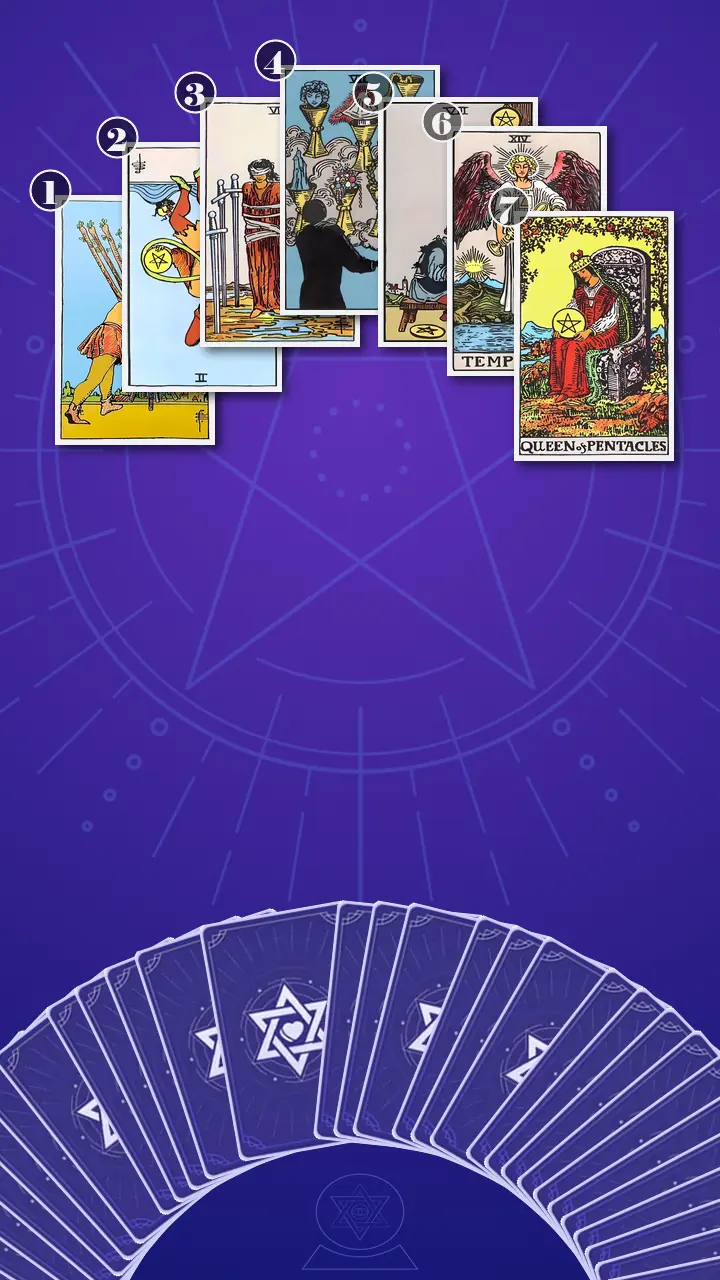
Reading the Map: Open Loops, Decision Fatigue, and the Shame-Scoreboard Counter
Position 1: How the imbalance built up over time
“Now flipped over is the card for how the imbalance built up over time—the load you’ve been carrying that eventually spills onto your space,” I said. “Ten of Wands, upright.”
The modern-life translation landed instantly: you walk in from work carrying too much—laptop, tote, random packages, gym bag—so you set everything on the counter because it’s the nearest flat surface. Not laziness. A body-level, “I can’t hold one more thing” moment.
In terms of energy, this is pure excess. Not excess ambition—excess load. The Ten of Wands always makes me think of vision being blocked: you can’t see what’s urgent because you’re literally carrying everything at once. And when you can’t see, you default to “keep moving,” which is how a counter becomes a dumping ground.
Taylor’s mouth twitched into a small, bitter smile. “That’s… honestly a little too accurate,” she said. “Like, I’m fine until I’m suddenly not fine.” Her shoulders rose, then dropped half an inch, as if her body recognized itself in the image.
Position 2: The visible present-state imbalance
“Now flipped over is the card for the visible present-state imbalance—what your counter clutter is revealing right now,” I said. “Two of Pentacles, reversed.”
The scenario was practically a security camera clip: after work you try to do everything at once—open mail while reheating something while thinking about the gym while mentally budgeting. You shift items around—counter to table to chair—so it looks different, but nothing finishes.
Reversed, the Two of Pentacles is a blockage in flow. Upright, it’s juggling with rhythm; reversed, it’s juggling right at the moment the “infinity loop” ribbon starts to snap. It’s not that you can’t handle life—your pacing has no stable container, so your routines stall and spill.
I layered in the echo technique: “It’s like your counter is a browser with 27 tabs open, and all of them are playing audio,” I said. “Half-opening envelopes. Half-unpacking the gym bag. Half-cleaning a takeout spill. Your brain calls it multitasking, but your nervous system calls it noise.”
Taylor winced—then laughed. “This is literally me shifting piles like it counts as progress.” Her laugh had that sharp edge of recognition, the kind that says, Okay, you saw me.
Position 3: The hidden inner factor
“Now flipped over is the card for the hidden inner factor—the mental rule that makes small tasks feel hard to start,” I said. “Eight of Swords, upright.”
The modern-life scene here is brutal because it’s so quiet: you stand in the kitchen staring at the pile and it feels like a courtroom. If you open the mail and there’s bad news, it means you’re careless. If you don’t go to the gym, it means you can’t stick to anything. So you do nothing—because doing something feels like risking a verdict.
Energy-wise, the Eight of Swords is constriction. The bindings are real to your body even if they’re loose in reality. This is the “Terms & Conditions pop-up you never agreed to, but you keep clicking accept.”
I spoke it in second person, exactly as the card tends to sound inside someone’s head: “If I open it and it’s bad news, it means I’m careless.If I start and don’t finish, it means I’m the kind of person who never follows through. And then you’re standing barefoot on cold tile, phone warm in your hand, thinking you don’t have time for a full reset—so you deny that you have enough time for one tiny loop.”
Taylor went still. I watched a three-step reaction chain move through her: her breath held for a beat; her eyes unfocused like she was replaying a specific night; then a long exhale slipped out. “Oh,” she said softly. “It’s not that I’m lazy. I’m stuck in… a rule.”
Position 4: The core obstacle
“Now flipped over is the card for the core obstacle—the pattern that keeps the counter re-cluttering and blocks follow-through,” I said. “Seven of Cups, upright.”
This card is the streaming-scroll effect: endless options, and somehow you watch nothing—and then feel guilty anyway. The modern-life version: you try to design the perfect routine—meal prep, workouts, budgeting, cleaning, skincare—then you get so flooded you default to the easiest option (takeout) and leave the rest as physical reminders on the counter.
Energy-wise, this is excess again, but not load—excess possibility. Too many “should-self” versions of you standing in the same kitchen at once: the person who meal preps, the person who has inbox zero, the person who never misses a workout, the person who recycles perfectly. No wonder you freeze.
Taylor’s fingers stopped tapping and curled into her palm. “I literally have a Notion template for ‘life admin,’” she said. “It’s gorgeous. I haven’t opened it in, like… months.”
“That’s the Seven of Cups in a trench coat,” I said, gently wry. “Beautiful options. Zero grounding.”
Position 5: The external pressure
“Now flipped over is the card for external pressure—the environment that adds fuel to the cycle,” I said. “Eight of Pentacles, upright.”
The scenario: your work day is all deliverables and checklists, so by the time you’re home, opening mail feels like continuing the shift. Even self-care starts to feel like another KPI.
This is excess of work-current—steady output, improvement pressure, and the belief that rest must be earned. The Eight of Pentacles is competence, but it can also be a treadmill. When you live inside constant productivity culture, home tasks can feel like unpaid overtime, and your brain rebels with convenience—then punishes you with guilt.
Taylor nodded, but it was the tired nod of someone who’s been trying to outwork her own nervous system. “It’s like I get home and my brain is still in ‘deliverable mode,’” she said. “So the counter becomes… where I put deliverables I don’t want to look at.”
“Exactly,” I said. “Your counter is a public inbox.”
When Temperance Spoke: Don’t Juggle—Pour
Position 6 (Key Card): Rebalancing medicine
I paused before turning the next card. The room on my end was quiet except for the soft hum of my laptop fan. On Taylor’s end, I could hear city-night stillness—distant traffic, the small mechanical sighs of a lived-in apartment. “We’re flipping the bridge card now,” I said. “This is the one that shows how balance returns without extremes.”
“Now flipped over is the card for rebalancing medicine—the principle and posture that restores rhythm without extremes,” I said. “Temperance, upright.”
The modern-life scenario is almost annoyingly doable: instead of waiting for a mythical free weekend, you build a nightly sequence that’s small enough to survive real life: open a few letters, put gym items in one place, prep one simple breakfast or snack. It’s not a glow-up; it’s flow.
Energy-wise, Temperance is balance—integration. Not the kind that looks aesthetic on a “Sunday reset” Reel, but the kind that regulates your system. In my astronomy work, I think about pulsars—collapsed stars that emit pulses at astonishingly steady intervals. Even after cosmic chaos, they become clocks. That’s what I want for Taylor: not perfection, but a rhythm her body trusts.
Setup: I watched Taylor hover in the same nightly loop: the 9:30 p.m. fridge open, ingredients that require decisions, fridge closed, takeout ordered—because if she can’t do a full reset, starting feels like inviting judgment. She’s trying to choose the “right” life instead of choosing one small next action.
Stop juggling your life in the air and start pouring it cup by cup until your counter reflects a calmer flow.
I let the sentence hang for a second, the way I let a starfield settle before I start pointing out Orion. Taylor’s face changed in layers: first a blink like she’d been interrupted mid-spiral; then her eyebrows lifted a fraction, like a door opening; then her mouth softened. Her shoulders, which had been creeping upward since the Ten of Wands, dropped as if someone finally took a bag off her back. She swallowed, and her eyes went shiny—not dramatic, just human.
“But… if I stop at 10 minutes, it’ll still be messy,” she said, and there was a flash of resistance in it—almost anger. Like accepting “small pours” meant admitting she’d been wrong to chase the heroic reset.
“That resistance makes sense,” I told her. “Your brain learned that ‘starting’ equals ‘losing the whole night.’ Temperance is teaching the opposite: you’re not fixing your life; you’re regulating the flow.”
I taught her my Pulsar Breathing as an anchor—my signature way of syncing action to a steady rhythm. “Pick a simple cadence,” I said. “In for four, out for six. Like a pulse. You don’t negotiate with it. You just return to it. You’ll use that cadence to pour attention between tasks without spilling into perfectionism.”
Her reaction came in a three-step wave: a brief freeze (eyes locked on the card); then cognition seeping in (she stared past the screen, as if seeing her counter from above); then release (a shaky exhale, and a small nod). “That feels… doable,” she said. Not excited. Not hyped. Relieved—because it didn’t depend on motivation.
“Now,” I asked, “with this new lens—small pours, not big overhauls—can you think back to last week? Was there a night when this would’ve changed how you felt in your body, even by five percent?”
Taylor looked down at her hands. “Thursday,” she said. “I stood there, staring at the mail, and my jaw hurt from clenching. If I’d done… literally three minutes, I think I would’ve slept better.”
That’s the real shift here: moving from overwhelm and self-judgment to steadier self-trust through a simpler, repeatable rhythm. Not a new identity—an identity-safe way to begin.
Position 7: The most supportive next-step state
“Now flipped over is the card for the most supportive next-step state—what it looks like when you apply the guidance for the coming week,” I said. “Queen of Pentacles, upright.”
The modern-life snapshot is not a makeover. It’s “supportive, not aspirational”: one tray for keys/mail, one hook or bin for the gym bag, one clear counter square that stays protected. Toronto weeknight reality, not Pinterest kitchen fantasy.
This is grounded balance in Earth energy: warm, practical stewardship. The Queen doesn’t prove worth through intensity; she builds safety through repeatable care. And she has one of my favorite principles for people stuck in all-or-nothing cleaning mindset: contained beats organized.
Taylor’s expression softened again, but this time with something like tenderness. “I like that,” she said. “Supportive, not… like I’m failing.”
The Temperance Pour: Actionable Advice You Can Start Tonight
Here’s the story the whole spread told, in one thread: you’ve been carrying too much for too long (Ten of Wands), then trying to keep it all in motion without a stable rhythm (Two of Pentacles reversed). Underneath, a strict inner rule turns tiny tasks into a courtroom (Eight of Swords), and too many competing “shoulds” freeze you in place (Seven of Cups). Meanwhile, your external world rewards constant output (Eight of Pentacles), so home becomes the place where unfinished tasks pile up like unread notifications.
The blind spot isn’t that you “don’t know how” to keep a counter clear. It’s the belief that starting small doesn’t count—that if it can’t be done perfectly, it isn’t worth beginning. The transformation direction is clear: shift from “reset everything perfectly” to “blend one small, repeatable daily reset with one clear priority.”
Taylor hesitated right on cue. “But I don’t even have ten minutes,” she said. “I get home and I’m just… done.”
“Then we protect ten minutes the way you protect a meeting,” I said. “Not because you’re disciplined—because your future self deserves fewer open loops.” I offered one of my planetarium-friendly strategies: if her building’s laundry room noise was already in the background, she could use it as a metronome—washing machine sounds as cosmic meditation background. “Let the spin cycle be your timer,” I said. “When it stops, you stop.”
- Do the 10-minute “Counter Close-Down” (the Temperance Pour)Set a timer for 10 minutes. Do only this sequence: 3 minutes open mail + toss junk + stack action items in one visible pile; 2 minutes put every gym item into one container/hook (no organizing); 5 minutes clear all food packaging and wipe one square foot of counter.Stop when the timer ends on purpose. If your body tightens and you want to “keep going,” take one Pulsar Breath (in 4, out 6) and end it anyway—repeatability beats intensity.
- Set up two “homes” in under 15 minutes (contained beats organized)Pick one shoebox/basket labeled “Mail: Open Here,” and one bin/hook labeled “Gym: Lives Here.” Put them where you naturally drop things after work—no extra steps, no aesthetic overhaul.If you feel the urge to buy new containers, wait 72 hours. Use what you have. Contained beats organized.
- Choose one “good-enough meal anchor” for the weekPick one zero-brain dinner or breakfast you’ll default to on work nights (e.g., yogurt + fruit, rotisserie chicken + bagged salad, eggs + toast). Stock it once, then let it reduce nightly decisions.Expect the thought “this is too small to matter.” That’s the perfectionism reset trap. Small and repeatable is the point.
Before we ended, I gave Taylor a tiny “stargazer” addition from my toolkit: intuition training while stargazing on balcony. “After your 10 minutes,” I said, “step onto your balcony for 60 seconds. Look up. Pick one bright point—doesn’t matter if it’s a star or a plane. Ask yourself one question: ‘What got lighter in my kitchen because I poured instead of juggled?’ Then go to bed.” It’s not productivity. It’s closure.

A Week Later: One Square of Quiet Proof
Six days later, Taylor messaged me a photo. Not a spotless kitchen. Just one protected 12x12-inch square of counter—clear enough to set a mug down without moving anything first. In the corner of the frame, I could see a shoebox with “Mail: Open Here” written in Sharpie, and her gym tote hanging from a hook like it finally had permission to belong somewhere.
“I did the 10-minute close-down three nights,” she wrote. “Not even every night. But the counter feels… less loud. Also I opened the scary envelope and it was fine. I slept.”
That’s the Journey to Clarity I care about: not becoming a new person overnight, but becoming someone who can close one tiny loop and trust it counts. Temperance tarot meaning for balance in daily routines isn’t “be perfect.” It’s “regulate the flow until your space supports you.”
When your counter is full, it’s not just clutter—it’s that tight-jaw feeling of wanting to be ‘on top of life,’ while being scared that one slow-down will prove you’re not.
If you trusted that balance is built by small pours—not a perfect reset—what’s the one tiny loop you’d be willing to close tonight so tomorrow feels a little less loud?