My Messy Nightstand Wasn't Failure—It Was Feedback: How I Changed My Rhythm

The 9:58 p.m. Nightstand Verdict
If you’re a 20-something/early-30s hybrid office person in Toronto who can run meetings all day but still ends up with a nightstand pile by Sunday night—welcome to life-balance drift (hello, Sunday Scaries).
Jordan said that to me with the kind of laugh that isn’t really a laugh. We were on a video call, but I could still picture it instantly because I’ve lived versions of it too: 9:58 p.m., overhead light too harsh for anyone’s nervous system, a charger brick doing that faint electric hum, and a phone screen warming your palm like a tiny space heater.
They described the nightstand like a crime scene you can’t stop revisiting: a water glass planted on top of yesterday’s receipts, lip balm wedged beside a half-used notebook, two chargers tangled like old wired earbuds, skincare half-open like it gave up mid-routine. “It’s just a nightstand,” Jordan told me. “But it feels like my whole life in one pile.”
I watched their shoulders sit a little too high, as if they were bracing for impact even though they were already in bed. Their jaw did that tight thing you get when the day finally goes quiet and your brain decides now is the time to review your performance.
“Here’s what I hear,” I said, keeping my voice gentle and matter-of-fact. “You’re functioning. But you’re not feeling grounded. And the messy surface has started acting like a verdict.”
Jordan nodded, eyes flicking away from the camera like they were looking at the actual nightstand. “Yeah. And if I slow down and really look at it, I’m scared of what I’ll realize. Like… that I don’t have control.”
I let that land for a beat. “Okay. Then our goal tonight isn’t to judge the pile. It’s to translate it. A messy surface isn’t a personality test—it’s a system check. Let’s try to draw a map through the fog and get you to a kind of clarity that comes with next steps you can actually do when you’re tired.”

Choosing the Compass: Celtic Cross · Context Edition
I’m Alison Melody. Most people know me as a radio host who talks about music therapy and the way sound affects the body—tempo, frequency, nervous system, all of it. Tarot is part of my toolkit for the same reason music is: it helps us name patterns without getting stuck in shame.
I asked Jordan to take one slow breath, not as a ritual for the universe, but as a clean transition for the brain. Then I shuffled—slow, steady, like counting beats in a song—while they held the question: Why does my messy bedside table reveal life-balance drift—what’s next?
“We’re going to use the Celtic Cross · Context Edition,” I told them. “It’s based on the classic Celtic Cross spread—because your question needs a full chain: visible symptom → immediate pressure → root mechanism → recent momentum → what you think you need → what actually helps next. It’s not about predicting your future. It’s about showing you where the system is leaking.”
For anyone reading along who’s ever Googled how tarot works and felt suspicious: this is the practical version. The spread is a structured conversation. Each position gives the mind one job at a time, which is exactly what decision fatigue takes away.
“The first card,” I said, “will speak to what the nightstand is showing you right now—your current balance drift. The crossing card will show what’s making a simple reset feel weirdly hard. And the card above—the conscious aim—will reveal what you think balance should look like.”
Jordan exhaled like they’d been waiting for someone to stop making it about willpower.
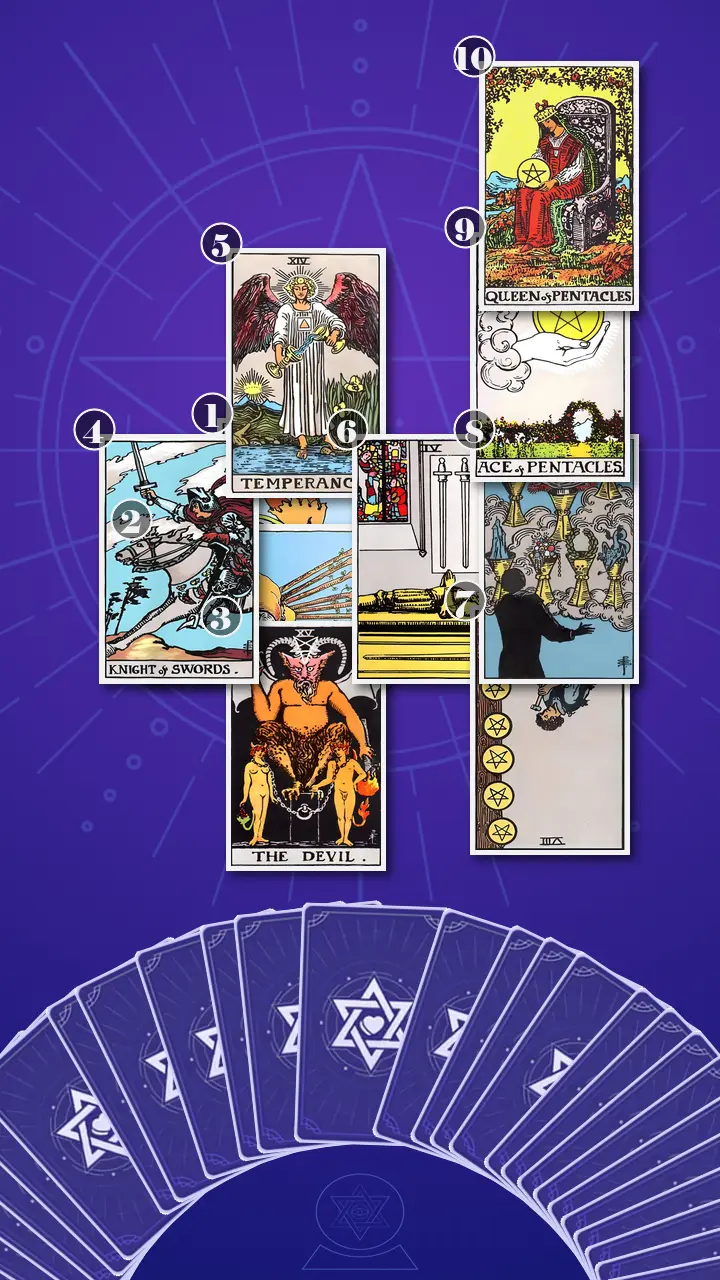
Reading the Map: Why the Clutter Keeps Coming Back
Position 1 — The visible symptom: what the messy bedside table is showing you about your current life-balance drift.
“Now we flip the card that represents the visible symptom,” I said. “What’s most central right now.”
Two of Pentacles, reversed.
In the Rider–Waite deck, it’s a juggler with an infinity-shaped ribbon looping around two coins, with waves behind him—like life doesn’t stop moving just because you’re trying to keep your hands steady. Reversed, that loop doesn’t disappear; it wobbles. Things spill.
I translated it into Jordan’s world: their nightstand as a micro-dashboard of imbalance—where day leftovers keep circling because nothing ever fully closes. It’s the water glass on receipts. It’s chargers over a notebook. It’s the “I’ll reset tomorrow” promise that keeps repeating like a chorus you don’t even like.
“This isn’t a character flaw,” I told them. “This is bandwidth. Your daily cadence isn’t sustainable, so the smallest system—two minutes of closure—collapses first.”
Jordan did the unexpected thing: they let out a short, bitter little laugh. “That’s… so accurate it’s kind of rude.”
I smiled, because I knew exactly what they meant. “Rude-but-useful is a valid tarot genre.” Then I softened my tone. “Notice what just happened in your body. That laugh? That’s your system recognizing itself. We can work with recognition.”
And I ran the montage out loud—three fast cuts, like edits in an IG Reel, except instead of aesthetic calm it was real life: glass on receipts. charger on notebook. skincare balanced on top. Then the inner script, stacked like notifications: “If I can’t do it properly, I won’t start.” → “I’ll do it this weekend.” → “Why am I like this?”
“Two of Pentacles reversed,” I said, “isn’t here to shame you. It’s here to say: your infinity loop needs a gentler tempo. Less juggling. More closure.”
Position 2 — The immediate pressure: what’s making it hard to restore balance in simple, daily ways.
“Now we flip the card for the immediate pressure—the thing crossing you, making the simplest reset feel impossible.”
Ten of Wands, upright.
This card always looks like someone trying to carry their entire life home in one trip. Wands stacked so high you can’t see ahead. Shoulders rounded, posture collapsed under effort.
“This tells me the issue isn’t laziness,” I said. “It’s overload. You’ve been carrying too much for too long without renegotiating what’s actually yours to hold.”
Jordan’s eyes went a little distant—the way people look when they’re replaying their week like a highlight reel they didn’t consent to. Hybrid work days that never end. Slack messages drafted mentally while brushing teeth. That constant low-level sense of still being ‘on’ even when you’re technically home.
“When you walk into your bedroom,” I asked, “what are you still carrying—unfinished tasks, expectations, messages you haven’t replied to?”
“All of it,” Jordan said immediately. Then quieter: “Even the ‘better me’ stuff. Like, I’ll buy something for a routine, and then it just lives on the nightstand and becomes pressure.”
“Exactly,” I said. “The Ten of Wands says: basic upkeep becomes emotionally expensive when you’re still hauling the day. The nightstand becomes the nearest drop zone because your nervous system never got to set things down earlier.”
Position 3 — The root mechanism: the underlying habit loop or attachment that keeps the drift going.
“Now we flip the card for the root mechanism,” I said. “The loop underneath the loop.”
The Devil, upright.
Jordan went very still. The Devil can do that—not because it’s ‘bad,’ but because it names the bargain we make when we’re depleted.
“This isn’t about morality,” I said quickly, because I never want anyone to hear this card as a scolding. “This is habit physics. Attachment. The late-night trade: short-term relief bought with tomorrow’s calm.”
I described the modern version of the loose chains: the phone as a warm, glowing tether; the thumb-scroll that keeps the nervous system lit. The inner script that sounds like a reasonable deal when your eyes are heavy and your jaw is wired: ‘I’ll borrow calm from tomorrow for ten minutes of relief tonight.’
Jordan swallowed. “That’s… literally what I do.”
“Of course you do,” I said. “It makes sense. It works short-term. But your body pays interest. Bright screen. Tight jaw. Restless shoulders. And the nightstand becomes the physical parking lot for that loop—chargers, snacks, ‘just in case’ items, all within reach so you never have to face the quiet.”
Jordan’s hand moved off-screen, and I could hear a tiny clink—like they’d set their phone down without realizing it.
“Here’s the good news hidden inside The Devil,” I added. “The chains are loose. That means you have choices. Not huge choices. Micro-choices.”
Position 4 — Recent past momentum: what pace or pattern brought you here.
“Now we flip the card for recent past momentum,” I said. “The pace that brought your nervous system to this bedtime state.”
Knight of Swords, upright.
This is sprint-energy. Wind in the background. A mind that solves problems by charging straight through them.
“This card says you’ve been moving fast—handling things on the fly, powering through,” I told Jordan. “That’s competence. It’s also costly. It leaves no room for gentle closure rituals, so the bedroom becomes the crash site.”
Jordan nodded once, sharp. “I keep thinking I’ll slow down after… whatever the next thing is.”
“The Knight of Swords always has a ‘next thing,’” I said. Then, because it’s my world, I added: “It’s like playing every song at the same high BPM and wondering why your body can’t find the downbeat. You can’t unwind if the tempo never changes.”
That was my own quiet flashback—years of producing live radio, watching how a playlist can either soothe or spike someone. A high-energy track isn’t wrong. It’s just wrong at bedtime.
When Temperance Poured Between Two Cups
Position 5 — The conscious aim: what you think you need in order to feel balanced again.
“We’re flipping the card for the conscious aim,” I said. “What you think balance needs to look like.”
The room felt quieter, even through a screen—as if Jordan had stopped bracing for bad news and started bracing for truth.
Temperance, upright.
The angel pours between two cups, one foot on land and one in water. There’s a path behind them leading to a sunrise. The whole card is about integration: not extremes, not punishment, not a dramatic reinvention—mixing.
Setup. I watched Jordan’s face tighten the way it always does when people are stuck in the “I must fix this correctly” loop. Sunday night, the overhead light too bright, noticing the receipts and cords right as they’re promising themselves they’ll reset tomorrow. The mind tries to make it a project because projects feel like control.
Delivery.
Stop treating your life like it needs a dramatic makeover; start pouring one small habit into another until the mix becomes your new normal—Temperance-style.
I let it hang in the air. No rushing. No extra words to dilute it.
Reinforcement. Jordan’s reaction came in a three-part wave I’ve learned to respect. First, a tiny freeze—breath held, eyes locked on the card like it had just called them out by government name. Then the cognitive seep: their gaze went slightly unfocused, like they were replaying a weeknight in their head, seeing the exact moment they always go for the phone, the exact moment the nightstand becomes an unpaid emotional inbox. And then the release—one long exhale that looked like their shoulders finally remembered gravity.
“But… if I do it small,” they said, and their voice had a crack of irritation in it, “doesn’t that mean I’ve been doing it wrong? Like I should’ve been able to handle this?”
There it was: the flash of anger that often comes right before relief. Not at me—at the old contract.
“It doesn’t mean you were wrong,” I said. “It means you were using the only rhythm you had—sprint, carry, numb. Temperance is offering a new contract: balance by design, not balance by willpower.”
Because I work with sound, I used my signature lens—Space Tuning. “Your nightstand isn’t just visual clutter,” I said. “It’s an acoustic cue. The hum of the charger, the buzz of notifications, the bright light—your space is ‘loud’ even when it’s quiet. Temperance is the sound engineer in the room. We’re not rebuilding the studio overnight. We’re adjusting two faders: reduce one stimulant, add one stabilizer.”
Jordan’s eyes glistened, not in a dramatic way—more like their system had gotten close to calm and didn’t know what to do with it. “So… like… less doomscroll. More… something else?”
“Exactly. And boring is allowed,” I said. “Balance isn’t a makeover. It’s a rhythm you can keep when you’re tired.”
“Now,” I added, “use this new lens and think back to last week. Was there a moment when you were about to do the usual bargain—borrow calm from tomorrow—and this insight could’ve changed how it felt?”
Jordan looked down and nodded slowly. “Thursday. I remember the TTC service alert buzzing and I just… carried that stress all the way into bed. If I’d treated the nightstand like feedback, I could’ve closed it. Even a little.”
“That’s the shift,” I said. “From verdict to feedback. From self-judgment to a smaller, kinder rhythm. That’s you moving from overwhelm toward grounded calm—one micro-closure at a time.”
The Pause That Makes Fixing Possible
Position 6 — What’s next: the near-term shift that supports realignment without forcing an outcome.
“Now we flip the card for what’s next,” I said. “The near-future move that supports realignment.”
Four of Swords, upright.
The image is stillness on purpose. A protected pause. Not collapse—container.
“This is your permission slip,” I told Jordan. “Stop trying to fix your life at 11:30 p.m.”
I painted the scene like a script their body could follow: phone face-down. Notifications off, or at least Focus Mode. One lamp instead of the overhead. Quiet that isn’t empty—quiet that’s held.
“The pause isn’t what you earn after you fix everything,” I said. “It’s what makes fixing possible.”
I watched Jordan’s jaw unclench a millimeter. Shoulders lowered. Relief—not the hype kind, the real kind.
Position 7 — Your role: the self-pattern you bring to maintenance, rest, and consistency.
“Now we flip the card for your role in this pattern,” I said. “What you bring to consistency.”
Eight of Pentacles, reversed.
“This is the perfectionism-to-postponement cycle,” I said, plain and kind. “When you can’t do it properly, you avoid doing it at all.”
I connected it back to the first card—the major blockage pairing: Two of Pentacles reversed (wobbly rhythm) plus Eight of Pentacles reversed (maintenance friction). “You’re not failing at balance,” I said. “You’re treating maintenance like an identity judgment instead of a neutral skill.”
Jordan’s mouth twisted into a small, resigned smile. The kind that says, Yep. Caught.
“The fix,” I added, “isn’t motivation. It’s a standard so small it can survive tired nights.”
Position 8 — Environmental drift factors: the lifestyle inputs (space + digital) that amplify clutter and imbalance.
“Now we look at the environment,” I said. “What’s around you—space and digital inputs.”
Seven of Cups, upright.
“This is the buffet,” I said. “Too many options within arm’s reach.”
Skincare, notebook, book you should read, cable you might need, random mail, five apps begging for attention, TikTok ‘clean girl’ routines floating by like a parallel universe where everyone has time for eucalyptus towels.
“When everything is available at once,” I told Jordan, “rest has to compete. And the nightstand becomes a staging area for unfinished intentions.”
Jordan sighed—half embarrassed, half relieved. “I literally have like… three different ‘wind-down’ things. And I always pick the phone.”
“Because it’s designed to win,” I said, not blaming them for a second. “Temperance doesn’t fight the algorithm with shame. It changes the room’s menu.”
Position 9 — Hopes and fears: what you long to build, and what stops you from starting small.
“Now we look at hopes and fears,” I said. “The dream and the hesitation.”
Ace of Pentacles, upright.
“You want a fresh start you can hold,” I said. “A stable routine that feels real. And you’re afraid you won’t keep it—so you hesitate to begin.”
Jordan nodded hard. “If I start and break it, it’s like… proof.”
“Temperance would call that a misunderstanding,” I said. “This isn’t streak culture. This is stewardship. You don’t ‘ruin’ a garden because you missed one day. You return.”
Position 10 — Integration direction: the most empowering ‘next chapter’ quality to embody around home, self-care, and balance.
“Last card,” I said. “Integration direction—your next chapter energy.”
Queen of Pentacles, upright.
This card is practical self-care. Warmth. A home base that supports you quietly. Not aesthetic perfection—reliability.
“This is the version of you who treats your space like part of your well-being,” I told Jordan. “Who asks, ‘What would the most caring version of me place within arm’s reach—and what would they remove?’”
Jordan’s shoulders softened again, like they were imagining a nightstand that wasn’t a scoreboard. “So… the goal isn’t a perfect bedroom. It’s a resettable one.”
“Exactly,” I said. “Make it resettable, not perfect.”
Make It Resettable, Not Perfect: Your Sound-Backed Next Steps
I pulled the whole spread into one story so Jordan could feel the logic instead of trying to remember ten separate meanings.
“Here’s what I see,” I said. “You’ve been running sprint-speed (Knight of Swords) while carrying too much for too long (Ten of Wands). At night, your system looks for quick relief (The Devil), and the room is set up like a buffet of options (Seven of Cups), so your brain keeps choosing the most stimulating comfort—your phone. Then the practical rhythm breaks (Two of Pentacles reversed), and perfectionism makes the tiny maintenance feel pointless unless it’s done ‘properly’ (Eight of Pentacles reversed). What changes the trajectory is not a bigger effort—it’s integration (Temperance) plus an intentional pause (Four of Swords). That’s how you get back to steady Earth: small real beginnings (Ace of Pentacles) and warm, realistic upkeep (Queen of Pentacles).”
“Your cognitive blind spot,” I added gently, “is that you’ve been using the mess as a verdict about you. But the spread keeps saying: it’s feedback that your system needs a smaller, kinder rhythm. Balance isn’t achieved by intensity. It’s achieved by repeatability.”
Then I gave Jordan the part they actually came for: actionable advice—specific, low-friction, and designed for tired nights.
- The 2-Minute “Close the Day” ResetTonight, set a 2-minute timer. Do only three moves: (1) take any cups/dishes to the kitchen (or at least to the door), (2) throw out obvious trash/receipts, (3) put both chargers in one single spot. Stop when the timer ends—no bonus rounds.If your chest tightens or your brain starts bargaining (“just one more thing”), that’s your cue to end it on purpose. You’re practicing a boundary with the night, not proving anything.
- The 5-Minute No-Decisions Zone (with a 3-Minute Sound Bath)For seven nights, create a 5-minute buffer before sleep: one lamp (not overhead), phone face-down (or on Focus Mode), and one chosen activity only. For the first 3 minutes, do my “21-Day Sound Bath” micro-version: sit or lie down and hum softly on one steady note, or play a single calming track around 60–70 BPM—no lyrics, low volume.If you feel edgy without your phone, start with 90 seconds. The goal is downshifting, not banning your lifeline.
- Space Tuning: Reduce the Buffet to Five ItemsFor one week, limit the nightstand to five items max (example: lamp, water, book, charger, one small tray). Remove three “maybe I’ll do this” items (extra skincare, random mail, unused notebook) into a daytime bin—out of arm’s reach.Keep it blunt. If you start optimizing, you’re back in the old loop. Your nightstand is allowed to be boring. Your sleep deserves it.
Before we ended, I offered Jordan one more sound-based reframe—my Wish Frequency approach, in the least woo way possible: “Pick a two-sound goal for bedtime,” I said. “One sound that signals closing—like plugging your phone in and hearing the soft click. One sound that signals care—like placing the water glass onto a coaster. You’re teaching your brain a new cue sequence. Like a playlist: two tracks, same order, every night.”

A Week Later, the Bedroom Sounds Different
Six days later, Jordan messaged me a photo—not an Instagram-perfect nightstand, not a ‘clean girl’ set, just something quietly functional. A small cereal bowl acting as a tray. One charger neatly looped. No dishes. The overhead light off, a single warm lamp on.
Their text was simple: “Did the 2-minute timer thing. I wanted to keep going, but I stopped on purpose. Also… I didn’t doomscroll. Not perfectly, but enough. I woke up and didn’t feel instantly behind.”
It was the bittersweet kind of win I trust: they weren’t magically cured of stress. They just had proof they could return. And their space—finally—was supporting them instead of shaming them.
That’s the whole Journey to Clarity, really. Not a dramatic makeover. A smaller rhythm that still works on your most tired nights. A shift from using the mess as a verdict to treating it as feedback that your system needs kinder design.
When you’re exhausted, it’s weirdly easy for a single messy surface to feel like a verdict—like if you can’t close the nightstand, you can’t close your life.
If you treated tonight’s nightstand as feedback—not a grade—what’s the smallest ‘closing time’ ritual you’d actually be willing to repeat for seven tired nights?