On the TTC, I Scrolled Promotions—Then Built One Weekly Stabilizer Instead

Finding Clarity in the 10:40 p.m. Tab Spiral
If you’re a late-20s project coordinator in Toronto and your birthday week turns into a private performance review (hello, birthday scorecard burnout), you’re not imagining the spike.
Jordan (name changed for privacy) settled into the chair across from me like they were trying to make their body smaller. Their hoodie sleeves were tugged down over their palms. They kept rubbing their thumb along the edge of their phone, not scrolling—just holding it the way people hold a rail when they don’t trust the floor.
They described a very specific Tuesday at 8:47 p.m. in their tiny Toronto apartment kitchen: eating something quick over the sink, overhead light too bright, phone screen warm from constant tapping. Banking app. Then Slack, “just to clear a few things.” Shoulders locking up. Jaw clenching. Half of them chasing control, half of them begging to stop.
“I don’t even want a big birthday,” they said, voice steady in that practiced way. “I just want to feel like my life isn’t slipping. But it’s like… work, money, health, love—everything spikes at once. And then I try to fix all of it. Overnight.”
The overwhelm wasn’t a concept in the room; it was a physical substance—like trying to breathe while wearing a backpack full of wet towels, with a low electrical buzz under the skin that makes rest feel suspicious. Tight shoulders. Tight jaw. Wired-but-tired, like sleep had become another task on the list.
I nodded slowly, letting them hear that I believed them. “Your birthday isn’t a verdict—it just turns the volume up on whatever’s already running you,” I said. “Let’s try to map what’s happening—without shaming you for it. We’re here for clarity, not a lecture.”

Choosing the Compass: The Celtic Cross · Context Edition
I asked Jordan to take one slow breath—nothing mystical, just a nervous system handrail. Then I shuffled the deck the way I always do: steady, unhurried, like smoothing a bedsheet. Not because the cards need drama, but because people do better thinking when the room stops rushing them.
“Today I’m going to use a spread called the Celtic Cross · Context Edition,” I told them. “It’s a classic structure, but with two positions tuned specifically for what you’re describing—how birthdays trigger the spiral, and how your environment rewards the spiral.”
For anyone reading along who’s ever Googled how tarot works and gotten lost in the incense-and-mystery vibe: this is the practical part. The Celtic Cross works well when the question spans multiple life domains—work, money, health, love—because it gives us both the surface diagnosis and the deeper root. It’s not about predicting your whole life; it’s about making the pattern readable enough to change.
I previewed the map out loud. “Card 1 will show the burnout snapshot—what’s overloaded right now. Card 3 will reveal the hidden driver, the automatic script underneath. And the staff on the right will move us from your role in it, to system pressures, to what you hope and fear… and finally, the most supportive direction for the next month.”
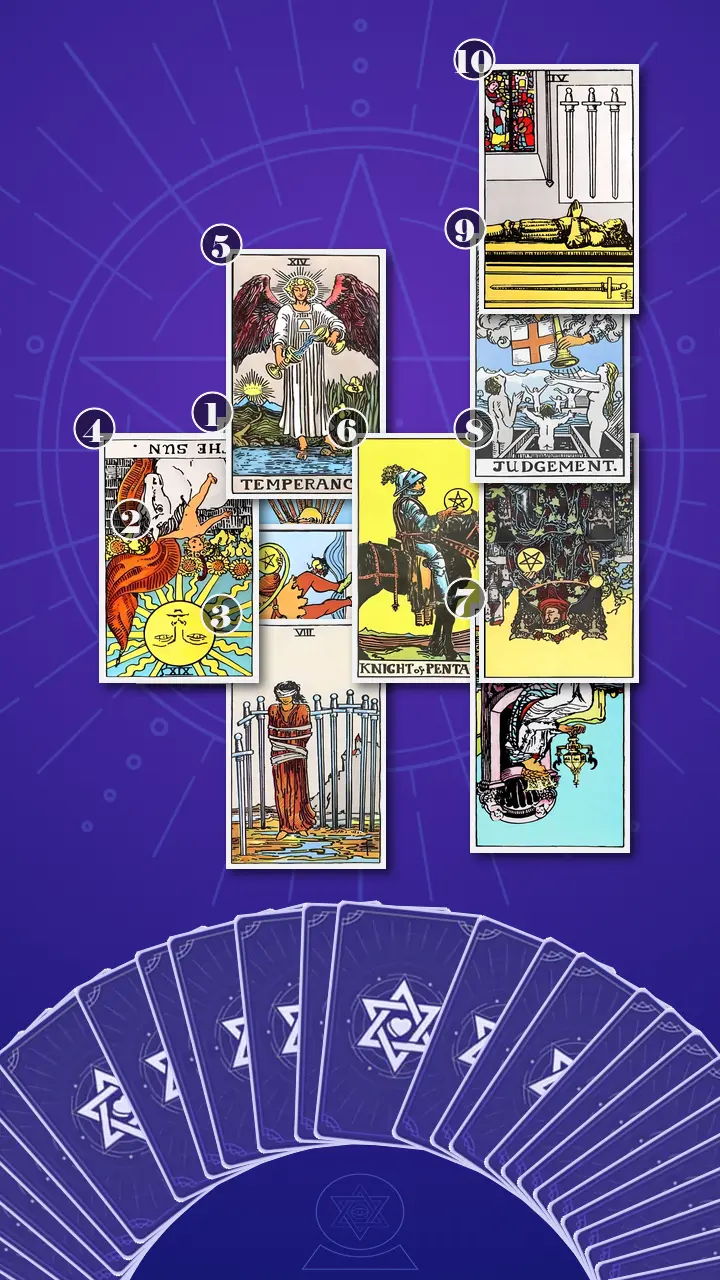
Reading the Map: Card Meanings in Context, Not in Theory
Position 1: The current burnout snapshot
“Now we flip the card that represents the current burnout snapshot: what’s most visibly overloaded across work-money-health-love right now.”
Ten of Wands, upright.
I didn’t need to embellish it; the image already said it. “It’s 10:40 PM and you’re carrying your entire life like one heavy tote bag: a half-finished work deck, a rent reminder, a mental list of ‘I should work out,’ and unanswered texts. You keep walking because setting anything down feels like admitting you can’t handle it—so you grip tighter, your shoulders ache, and you lose sight of what actually matters tonight versus what can wait.”
“This card is Fire energy in excess,” I said. “Effort, responsibility, pushing through—so much of it that the bundle blocks your view. Not because you’re weak. Because ten wands is too many wands for one body.”
Jordan let out a small laugh that had a bitter edge to it. “That’s… honestly kind of brutal. Like, yeah. That’s exactly it.” Their shoulders rose toward their ears without them noticing, then dropped a millimeter when they realized I wasn’t going to judge them for it.
Position 2: The primary obstacle
“Now we flip the card that represents the primary obstacle: what’s actively throwing your balance off or making relief feel out of reach.”
Two of Pentacles, reversed.
“You’re ping-ponging between apps and responsibilities—bank balance, inbox, calendar, meal plan, dating—trying to keep everything ‘moving’ so nothing drops. But the movement is the problem: constant switching turns your day into choppy water, and you end up exhausted without feeling stabilized anywhere.”
I watched their eyes flick down like they were seeing their own browser history. “Reversed, this is Earth energy in blockage,” I explained. “The juggling is supposed to be flexible. But right now the infinity loop is a trap: refresh, tweak, re-check—without one grounding choice.”
And here’s the modern loop I hear constantly from smart, capable people: If I just fix work, then money will calm down. If money calms down, I can relax. If I relax, I’ll finally do health. If health is stable, I’ll have energy for love. Then the email comes in. Then you check your account again. Then you open a ‘30-day reset’ video. The calm never arrives… because the switching is the stressor.
“Motion isn’t progress,” I said simply. “Sometimes it’s just panic with good branding.”
Jordan nodded hard—like the truth landed in their chest before it landed in their head. “Oh my god,” they said, half-laughing. “I do this exact loop.”
Position 3: The hidden driver
“Now we flip the card that represents the hidden driver: the subconscious belief or automatic script feeding the burnout spike.”
Eight of Swords, upright.
“You act like you have no options: you ‘can’t’ slow down, ‘can’t’ say no, ‘can’t’ rest until everything is handled—because the moment you stop, you assume life will collapse. But the trap is mostly internal: the rules are loud, not absolute. The bindings are loose enough that one small choice (one boundary, one pause) could change the whole week’s tone.”
Air energy here is in excess—not intelligence, but mental rule-making. A belief that sounds like a fact: By 29, I should have work-money-health-love handled. The blindfold isn’t a punishment; it’s the nervous system trying to avoid the shame of “falling behind.”
I thought of the Highlands in late winter—how the land looks dead if you only judge it by green leaves. My grandmother used to say, “Don’t call a field lazy because it’s resting.” That’s ancestral wisdom, yes—but it’s also just accurate biology.
Jordan’s mouth tightened, then softened. “I hate how true that is,” they whispered, like admitting it might make it real—and make it solvable.
Position 4: The birthday trigger pattern
“Now we flip the card that represents the birthday trigger pattern: what gets activated at milestone moments and pulls you into scorekeeping.”
The Sun, reversed.
“Your birthday becomes a bright spotlight instead of warmth: you feel like everyone can see what’s unfinished—career stability, savings, body routines, relationship clarity. You pressure yourself to perform happiness (plans, posts, upbeat texts), but it lands like forced brightness, and you crash afterward feeling even more alone.”
The Sun is supposed to be vitality. Reversed, it’s vitality in deficiency—and the light becomes pressure. Like TTC fluorescent buzz at 7:58 a.m. when your thumb is scrolling LinkedIn promotions and Instagram ‘new era’ posts, and your chest tightens as if the calendar is holding up a red pen over your life.
Jordan swallowed. “It’s like I’m watching other people be… finished. And I’m still assembling the basics.”
“That’s the spotlight effect,” I said. “And it’s brutal because it makes normal tiredness feel like moral failure.”
Position 5: The conscious aim
“Now we flip the card that represents the conscious aim: what you think you need in order to feel okay (and what you’re truly craving underneath).”
Temperance, upright.
“You stop trying to reinvent your life and instead build a repeatable blend: a week where work has edges, money gets one calm check-in, your body gets gentle movement, and connection is small but real. Nothing is extreme. The win is that you can do it again next week without white-knuckling it.”
Temperance is balance as a practice—Water and Fire learning how to share a kitchen without starting a fire alarm. Its energy is balance. Not a total reset—an actual rhythm.
“Here’s what a ‘middle-way week’ could look like,” I offered, keeping it concrete: “One money check-in midweek. Two short walks after work. One protected rest block. One low-pressure hang—like takeout with a friend or a call while you fold laundry. Nothing that requires you to become a different person overnight.”
Jordan exhaled—an honest one, the kind that drops the shoulders on its way out. “That feels… realistic,” they said, almost surprised.
Position 6: The next-step energy
“Now we flip the card that represents the next-step energy: what becomes available if you stop trying to fix everything at once and choose a single stabilizer.”
Knight of Pentacles, upright.
“Your next step looks almost boring: one weekly system you can repeat even when you’re tired. A set money check-in time. A consistent post-work walk. A protected ‘no inbox in bed’ rule. You don’t need a glow-up—just a steady baseline that makes the week feel less like emergency maintenance.”
This is Earth energy in balance. The horse doesn’t sprint. It stands still. It says: consistency will do what motivation can’t.
“In a city that makes everything feel like a subscription you forgot to cancel,” I added, “this card is your permission to build a minimum viable week. Something you can run even when your brain is foggy.”
Jordan’s eyes brightened a touch—not happy, not fixed. But less hunted.
Position 7: Your role in the pattern
“Now we flip the card that represents your role in the pattern: how you’re showing up and what part of you is trying to protect you.”
Queen of Cups, reversed.
I translated it into their actual Sunday nights: “It’s 9:26 PM in bed: group chats, a family text, a friend’s voice note. You stare at the notifications, thumb hovering, and feel resentment you don’t want to admit. Your throat tightens, your eyes sting, and you think, ‘I can’t be the dependable one and also be falling apart. So I’ll just disappear for a bit.’”
Reversed, this is Water energy in overflow—empathy with no container. You care, you absorb, you overfunction, and then you shut down to survive. Love and health start to feel like more demands instead of support.
Jordan blinked fast, like they were trying not to make it a whole thing. “I ghost people when I’m fried,” they admitted. “Then I write… paragraphs to apologize.”
“That’s not you being flaky,” I said. “That’s you being under-resourced.”
Position 8: The external system pressures
“Now we flip the card that represents the external system pressures: what your environment rewards, demands, or mirrors back to you.”
King of Pentacles, reversed.
I didn’t even have to ask what company culture felt like. This card said it: “You’re in a workplace and city economy where output, salary, and visible ‘adulting’ are treated as proof that you deserve rest and respect.”
Reversed, the King’s Earth energy is in distortion—stability treated like a number. Slack green-dot anxiety. The quiet belief that if you reply fast enough, you can finally relax. Toronto rent increases, subscription creep, grocery sticker shock at Loblaws, and the way money check-ins can feel like a moral audit.
“This is why your birthday hits so hard,” I said. “Because the system around you already grades people. Your birthday just makes the report feel personal.”
Jordan’s jaw worked once, then unclenched. “Yeah,” they said. “It’s like I’m always proving I’m stable.”
When Judgement Became a Wake-Up Call (Not a Sentence)
Position 9: The split desire-fear
I paused before turning the next card. The room went oddly quiet—the way it does right before rain, when even the city sounds seem to pull back.
“Now we flip the card that represents the split desire-fear: what you’re hoping will change and what you’re afraid it will reveal about you.”
Judgement, upright.
Setup (what you’ve been trapped in): Birthday week on the TTC, you’re scrolling promotions and engagement posts while your chest tightens—like the calendar is holding up a red pen over your life. Part of you wants a clean slate. Part of you is terrified the ‘review’ will confirm you’re behind.
Delivery (the line I want you to sit with):
Not a birthday verdict—answer the call, and let the trumpet wake you up to what actually matters.
I let the silence do its job.
Reinforcement (what I saw happen in their body): Jordan froze first—breath suspended, fingers hovering mid-air like they’d been caught about to refresh an app. Then their gaze unfocused, not dissociating exactly, more like replaying a memory: TTC lights, the buzz in the chest, the thought I’m 29 landing like a weight. Then emotion rose in a clean, surprising line. Not tears—anger. “But that’s…,” they started, voice sharper. “If it’s not a verdict, does that mean I’ve been doing this wrong the whole time?”
I held the moment gently, without rushing to soothe it away. “It means you’ve been trying to survive inside borrowed standards,” I said. “And you did what your mind thought would keep you safe: you tried to control the calendar with spreadsheets, plans, and overworking. That’s not ‘wrong.’ It’s just exhausted.”
This is where I bring in my Nature Empathy Technique—because Judgement is a season-shift card. “In the Highlands,” I told them, “we don’t ask spring to prove it deserves to arrive. We listen for it. A change in birdsong. A softer wind. The first thaw. Your intuition works the same way: it doesn’t scream at you like shame. It signals like weather.”
“So let’s do a quick call-and-response,” I continued, keeping it grounded. “What are you done proving?”
Jordan swallowed. Their shoulders dropped, but their eyes went glossy. “That I’m… okay. That I’m not a mess.”
“And what are you ready to choose?” I asked. “Not on LinkedIn. Not for Instagram stories. For your actual Tuesday nights.”
“A week that doesn’t destroy me,” they said, voice quieter. “A baseline.”
“That’s the awakening,” I said. “Not a personality transplant. A values-led reset. This is the step from overwhelm and self-criticism toward steadier self-trust—choosing one stabilizing priority and letting it compound.”
“Now,” I added, “use this new lens and think back: last week, was there a moment when this would’ve changed how you moved?”
Jordan looked up and gave a small, stunned exhale. “In bed,” they said. “Refreshing everything. I could’ve… just stopped. Like stopped without needing to earn it.”
Position 10: Integration outcome (non-predictive)
“Last card,” I said. “This represents the integration outcome: the most supportive direction for the next month if you follow the reading’s guidance—not fate, not a prophecy. Direction.”
Four of Swords, upright.
“This is like blocking time for real downtime—phone off, no metrics, no fixing—so your nervous system can reset and choices stop feeling like emergencies.”
Its energy is Air in balance: thoughts finally getting space between them. “Rest isn’t a reward for being perfect; it’s the thing that makes your choices readable again,” I told them. “Right now, your mind is trying to do advanced planning on an overheated system.”
Jordan nodded slowly. “I keep opening Headspace and then closing it,” they admitted, almost embarrassed.
“That’s normal,” I said. “Stillness can feel weirdly hard when your brain thinks motion equals safety. We’ll make the rest concrete.”
From Scorecard to System: Actionable Next Steps for the Week
I pulled the story together the way I’d explain it to someone who’s feeling stuck at a career crossroads but also trying to be a person with a body and relationships.
“Here’s what your cards are saying,” I summarized. “At the center is the Ten of Wands: you’re carrying four domains like one emergency bundle. The obstacle is the Two of Pentacles reversed: constant switching cost disguised as responsibility. Underneath is the Eight of Swords: an invisible timeline that turns flexibility into danger. Your birthday trigger is The Sun reversed: the milestone becomes a spotlight, not warmth. The medicine is Temperance and the Knight of Pentacles: one repeatable rhythm, not a dramatic reset. And the liberation is Judgement: you choose values over being graded by the calendar. The direction is Four of Swords: rest as structure, so your system can cool and your decisions stop feeling like emergencies.”
The cognitive blind spot I named gently: “You keep trying to solve burnout with more optimization—because optimization feels like control. But for you, especially around birthdays, optimization becomes the trigger. The transformation is toward a paced, values-led weekly system that protects your energy.”
Then I gave Jordan a short list—small enough to start, specific enough to count. I also folded in one of my simplest ancestral practices: let nature set the pace of your attention, not your apps.
- The One-Stabilizer Pick (15 minutes on Sunday)Open your calendar and choose one stabilizer for the week: (a) one 10–15 minute money check-in, or (b) a 10–20 minute walk after work, or (c) one protected rest block. Put it on your calendar at a realistic time.If your brain says “one thing isn’t enough,” set a 2-minute timer and ask: “Will adding this reduce switching—or increase it?”
- Maintenance-Only for the Other Three DomainsFor the three areas you didn’t pick, write one tiny “keep it from sliding” action each. Example: reheat something + drink water (health); reply to one person with “thinking of you” (love); check upcoming bills once with no extra tweaking (money/work).Completion is the win. This is the Knight of Pentacles: boring, steady, compounding.
- A Protected Rest Block + a 3-Minute Bedtime Energy ReviewSchedule one 30–60 minute rest block this week: phone on Do Not Disturb, no inbox, no budgeting, no “self-improvement” content. Afterward—or at bedtime—do my 3-minute review: (1) what drained me today, (2) what steadied me, (3) what can wait until next week.Make it sensory: low light, one playlist, one blanket. Your body learns faster than your mind.
- Walking Meditation Using Environmental Sounds (10 minutes)On one walk this week, don’t listen to a podcast. Let the city be your metronome: footsteps, streetcar hum, wind, distant voices. Each time you want to mentally open a new “tab,” name one sound instead.This is energy protection in real life: you’re shielding your attention from the doom-loop without force.

A Week Later: The Quiet Proof
A week later, Jordan sent me a message that wasn’t a life transformation speech. It was a screenshot of a calendar event: “Wednesday 7:10 p.m. — Money check-in (15 min).” And beneath it, one line: “I didn’t open my inbox in bed twice. It felt illegal. Then I slept.”
They added, almost as an afterthought: “Also I told my friend, ‘Birthday week, I’m a bit fried.’ No essay. They were chill.”
That’s the kind of clarity I trust—the kind that shows up as a smaller jaw clench, a single choice that holds, a system that doesn’t require you to become a different person overnight. Not perfection. Ownership.
When your birthday turns into a scoreboard, even resting can feel like failing—so you keep carrying work, money, health, and love all at once, tense-jawed and wired, hoping control will finally feel like safety.
If you didn’t have to earn your birthday by fixing everything, what’s one tiny weekly system you’d be willing to try—just to protect your energy and see what gets easier?