From Laundry Shame Spirals to Calm Competence: The Middle-Pace Practice

Finding Clarity in the 8:52 p.m. Sunday Scaries
If you’ve ever stood over a laundry pile on Sunday night, felt the Sunday Scaries hit, and somehow ended up checking your bank app and LinkedIn like the hamper just triggered a quarterly review—this is for you.
Alex joined my Zoom room from a small Toronto apartment where the overhead kitchen light had that slightly harsh buzz—like it was judging the counters for not being influencer-clean. In the corner, a laundry pile sat with the confidence of a houseguest who’d decided to move in. Alex picked up a hoodie, thumbed the slightly damp cuff, and I watched their shoulders climb toward their ears as if they were bracing for a scolding that hadn’t even arrived yet.
“It’s just laundry,” they said, voice tight in a way that sounded more like swallowing glass than making conversation. “But it feels like a personality test I’m failing.”
They admitted the sequence with the kind of embarrassed precision that only comes from repeating it too many times: see the pile → chest tightens → stomach drops → phone opens to banking → then LinkedIn → then, somehow, a replay of a text thread like the laundry had subpoena power over their love life.
In my work, I’m rarely interested in the sock itself. I’m interested in the story the sock gets forced to carry.
What I heard underneath Alex’s words was a tug-of-war: wanting to feel competent and put-together vs fearing that one messy corner proves you’re not capable of stability in work, money, or love. Shame was doing what shame always does—turning a task into a character verdict.
“Let’s make this practical,” I told them, keeping my tone warm and unembellished. “We’re not here to diagnose you as a person. We’re here to map the pattern—so you can get back some choice. Tonight is a Journey to Clarity, not a trial.”

Choosing the Compass: How This Tarot Spread Maps a Spiral
I asked Alex to take one slow breath—not as ceremony, but as a gear shift. I shuffled while they held the question in mind: Why does my laundry pile trigger a work-money-love spiral—what next?
“Today,” I said, “we’ll use a spread I call the Energy Diagnostic Map (7) · Context Edition.”
For you reading this, here’s why that matters: some problems aren’t linear. They don’t behave like a timeline where you simply ‘move on.’ They behave like systems—loops that get reinforced by triggers, habits, and cultural pressure. This spread is designed to show how the loop works and then point to the one reframe that unwinds it, plus a grounded next step. It’s also a clear example of how tarot works in modern life: not prediction, but pattern recognition and actionable advice.
I described the map in plain terms so Alex could feel the structure under their feet:
“The first card shows the surface trigger—the first ten seconds. The fourth card is the core blockage—the belief that makes this feel high-stakes. And the sixth card is our key transformation—the pivot where the spiral becomes a different path.”
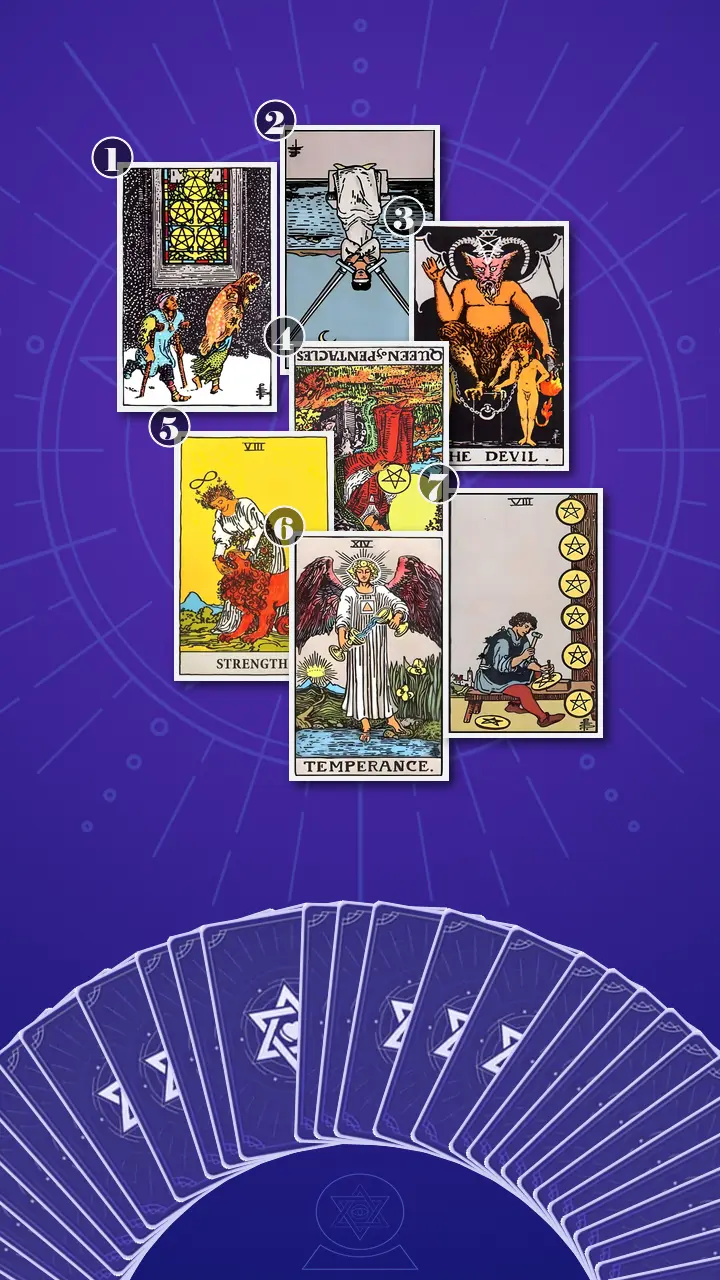
Reading the Map: Card Meanings in Context (Not in the Abstract)
Position 1 — Surface trigger: what the laundry pile immediately activates
“Now we turn over the card that represents the surface trigger: what the laundry pile immediately activates in perception and self-story.”
Five of Pentacles, upright.
I didn’t need to dramatize it; the image does that on its own. Two figures in the cold. The sense of being shut out. And—most important—the lit window nearby, warm and available, but somehow invisible when the mind is in survival mode.
I said, “This is like when you walk into your small apartment after work and the laundry pile hits your eyes like a red warning banner. Before you’ve made a choice, your body braces—tight chest, sinking stomach—and your brain translates fabric into scarcity: ‘I’m behind.’ You open the closet, see there’s nothing that feels ‘clean enough,’ and within seconds you’re checking your bank balance or LinkedIn—like the pile just proved you’re shut out of stability.”
Energetically, the Five of Pentacles is Earth gone cold: practical life interpreted as lack. Not ‘I have laundry’ but ‘I have failed.’
Alex let out a short laugh that was half recognition, half pain. “Okay,” they said. “That’s… brutal. But yes. That’s literally my Sunday night.”
“Laundry isn’t a verdict. It’s a queue,” I replied, and watched their eyes soften a fraction—like a muscle unclenching without asking permission.
Position 2 — Inner tug-of-war: how the mind turns it into a spiral
“Now we turn over the card that represents the inner tug-of-war: how your mind turns the task into a work-money-love spiral and freezes action.”
Two of Swords, reversed.
“You stand over the pile doing micro-movements—pick up a shirt, put it down—while your mind runs simultaneous debates: ‘I should be more disciplined’ vs ‘I’m exhausted,’ ‘save money’ vs ‘buy solutions,’ ‘be independent’ vs ‘I want reassurance.’ Because choosing one small action feels like picking a side, you avoid the choice by opening apps and ‘researching’ systems instead.”
In a Cambridge lecture hall, I’d call this a conflict of competing imperatives. In a kitchen with buzzing light, it’s decision fatigue with teeth.
I named the reversed energy: “This is Air in blockage—too much thinking, not enough doing. Reversed, the ‘pause’ leaks into overwhelm. And there’s an overcorrection risk here: the midnight ‘life reset’ fantasy. Middle pace beats midnight resets.”
Alex’s gaze slid off-camera—toward the laundry corner. Their fingers did that small, restless tap on the mug they were holding, as if their nervous system was trying to open an escape hatch.
Position 3 — External pressure: the scripts that intensify the spiral
“Now we turn over the card that represents external pressure: cultural scripts, comparison, or expectations that intensify the spiral.”
The Devil, upright.
“The laundry pile becomes a portal to performance pressure,” I said. “Work KPIs, money anxiety, and relationship narratives stack on top of each other until everything feels like proof. You feel compelled to check numbers—balance, job listings, ‘how to be more attractive/put together’ advice—because the rule underneath is brutal: ‘If I’m not disciplined, I don’t deserve security or love.’”
I paused, because The Devil isn’t only personal; it’s cultural. “Think of the chains here as tabs you don’t have to open,” I added. “Budgeting TikToks. LinkedIn doomscrolling that you call ‘networking.’ Threads that claim there’s one right way to be lovable. Your life isn’t a dashboard, even if the internet treats it like one.”
Alex’s expression sharpened—mild anger, the healthy kind. “So it’s not just that I’m… broken?”
“No,” I said. “But it is sticky. The algorithm rewards fear and fixes. And when you’re tired, fear sells itself as ‘being responsible.’”
Position 4 — Core blockage: the belief that makes laundry feel high-stakes
“Now we turn over the card that represents the core blockage: the underlying belief about worth/control that makes laundry feel high-stakes.”
Queen of Pentacles, reversed.
“You want your home to feel grounding,” I told them, “but when you’re tired, care tasks feel like something you have to earn. So the laundry isn’t just laundry—it’s a test of whether you’re ‘a real adult.’ You postpone it until you have a mythical uninterrupted day, then feel worse living in the visual noise. The core blockage is that support has become conditional: ‘I get comfort after I perform.’”
Here I used a contrast I’ve seen again and again—especially in bright, tight apartments where mess becomes visually loud: “This card is the difference between home-as-scoreboard and home-as-nest.”
I watched Alex’s reaction move through three small stages: first a slight freeze (their breath caught), then a faraway look (as if replaying every time they’d cancelled plans because they felt ‘not put together’), and finally a slow exhale that made their shoulders drop.
“Oh,” they said quietly. “That’s why it feels so personal.”
“Exactly,” I replied. “You’re not procrastinating—you’re negotiating worth.”
As an archaeologist, I’ve spent days brushing soil away from a threshold stone—an actual threshold, the kind people crossed for hundreds of years. This reversal feels like that: the threshold is still there, but the idea of safety has been swapped out for a performance metric. The site is the same; the meaning has changed.
Position 5 — Usable resource: strength you can access without perfection
“Now we turn over the card that represents the usable resource: the strength you can access without needing motivation or perfection.”
Strength, upright.
“You catch yourself reaching for your phone and instead try a calmer move,” I said. “ ‘I’ll do 10 minutes, then I’m done.’ No speeches. No punishment. Just steady hands folding a few things, starting a load, or clearing one small area. Your shoulders drop a notch, because your brain can cooperate when it’s not being yelled at internally.”
Strength here is Fire, but not wildfire—more like a pilot light. “Firm but kind,” I added. “The gentle parent voice, not the drill sergeant voice. Consistency over intensity.”
Alex nodded once, like someone accepting water after being told to survive on willpower alone.
When Temperance Spoke: The Steady Pour That Breaks the Spiral
Position 6 — Key transformation: the reframe that integrates work, money, and love
“Now we turn over the card that represents the key transformation: the reframe that integrates work, money, and love without collapsing into one spiral.”
The room felt quieter, even through a screen. Alex’s apartment noises—the distant washer rumble, a neighbour’s faint bass through the wall—suddenly sounded like a metronome.
Temperance, upright.
“Instead of trying to fix your career, finances, and dating life in one night,” I said, “you design a middle pace: a time-boxed laundry practice with a minimum finish line. You stop treating the pile as proof and start treating it as information. The steadier you get with this ‘small pour,’ the less you need to open the work-money-love tabs to self-soothe.”
Setup
Alex was still standing in the doorway in their own mind—bag half-on, eyes landing on the pile—and within seconds they were already three tabs deep: bank app, LinkedIn, and a replay of that last text thread. Their body was braced like the apartment was about to deliver a performance review.
Delivery
Stop treating the pile as proof you’re failing and start treating it like Temperance’s steady pour—small, consistent inputs that blend into stability.
Reinforcement
Alex went still. Not dramatic-still—more like the moment a scrolling thumb hovers and doesn’t move.
I saw the micro-sequence unfold in their face: first the blink that didn’t quite finish (a brief physiological freeze), then their eyes unfocused as if the sentence was rewinding their last week in their head, and then—finally—a breath that came from lower in the chest, loosening the jaw they’d been clenching like a secret.
“But… that’s so small,” they said, and the resistance was immediate—honest, not argumentative. “If I do ten minutes, it won’t even make a dent. And then it’s like… what’s the point?”
“That thought—‘this is too small to count’—is part of the loop,” I answered. “And it’s exactly why Temperance matters. Temperance is not a glow-up. It’s not a crash. It’s a repeatable pace your nervous system can tolerate.”
I reached for one of my own tools—what I call Mythic Archetypes. “In ancient stories, people don’t survive by winning one gigantic battle every night. They survive by learning the route home. Temperance is the route.”
Then I gave them the experiment, as specific as fieldwork instructions on a dig site:
“A 10-minute ‘Temperance Pour’ experiment: Set a timer for 10 minutes. Put your phone face-down (or in another room). Do only one laundry action you can finish inside the timer: start the washer OR fold 10 items OR put away one category (just shirts, just socks). When the timer ends, stop on purpose—even if it’s unfinished—and say out loud: ‘This counts.’ If you feel your chest tighten or you get the urge to open your bank app/LinkedIn, pause and take one slow breath before choosing whether to continue. You’re allowed to stop; the point is practicing a pace you can repeat, not proving anything tonight.”
I held the silence for a beat and then asked, “Now—using this new lens—can you think of one moment last week when the laundry triggered the spiral, and this would have let you feel different?”
Alex swallowed, eyes shining but steady. “Thursday morning,” they said. “I was mad at myself for not having a clean ‘safe outfit.’ I checked my balance, then I panicked about rent, then I didn’t text back the person I’m seeing because I felt… gross. If I’d done the ten minutes, I think I would’ve just… had a shirt. Not a crisis.”
“That’s the shift,” I told them. “From shame spike and mental spiral to one tiny concrete step despite discomfort. This is how you move from catastrophizing to calm competence. Tiny care, repeated, becomes self-trust.”
Position 7 — Next grounded step: the one-week practice that rebuilds self-trust
“Now we turn over the card that represents the next grounded step: a practical, one-week experiment to rebuild self-trust through action.”
Eight of Pentacles, upright.
“You treat this like apprenticeship,” I said, completing the image for them with the clarity the card demands. “One load. One small fold. One put-away. You set up a bench—a repeatable setup—so you’re not improvising every time.”
And I anchored it in modern life: “This is the opposite of a perfect Notion template trap. It’s boring on purpose. It’s visible progress, one unit at a time.”
Earth energy returns here, but not as scarcity—as craft. The same domain—daily upkeep—changes its meaning: from shame to skill.
The One-Page Plan: Actionable Next Steps for the Laundry Shame Spiral
I summarized the story the cards told, the way I might summarize a site report after a season of excavation:
“The spiral starts with a scarcity lens (Five of Pentacles): the pile reads like lack. Then your mind turns a simple task into a multi-domain debate (Two of Swords reversed). Culture tightens the script—your life as a dashboard, productivity as worth (The Devil). Underneath it all is the core blockage: home-as-scoreboard, where care feels conditional (Queen of Pentacles reversed). The counter-force is not intensity—it’s calm courage and self-compassion (Strength), and the pivot is Temperance: a repeatable middle pace. Finally, Eight of Pentacles says: treat it as practice, not identity.”
“Your cognitive blind spot,” I added gently, “is that you’ve been treating care as something you must earn after you perform. That turns a hamper into a courtroom exhibit. The transformation direction is simpler—and kinder: shift from treating laundry as a verdict on your life to treating it as a time-boxed practice that rebuilds self-trust through repetition.”
Then I gave Alex (and, frankly, anyone who’s ever typed ‘why does laundry make me spiral’ into a search bar) a small set of next steps. I also brought in one of my own strategies—Inscription Affirmations—because sometimes the mind needs a phrase it can touch, like carved stone, when the spiral tries to start again.
- The 12-Minute Middle PaceOnce this week, set a 12-minute timer and do one thing: start one load or fold 10 items or put away one category (only socks/only tees). Stop when the timer ends—on purpose.Expect the thought “This is too small to count.” Answer it out loud: “This counts.” That’s the nervous-system retraining.
- The Three-Outfit Finish LineChoose a “good-enough” goal: get three reliable outfits clean and put away first (the ones you actually wear to feel like yourself). Ignore the rest of the pile for now.You’re aiming for “supported,” not “spotless.” When you hit three outfits, stop and notice the relief—don’t immediately raise the bar.
- The No-Tabs Boundary + InscriptionCreate a “phone parking spot” for laundry time (counter, shelf, or another room). Then place a one-line paper note near the hamper—your inscription: “Laundry is not a verdict.” Read it once before you touch the pile.Don’t open the money/work/love tabs during laundry time. Those are real topics—but they’re not invited into the laundry moment.

A Week Later: The Quiet Proof (Not the Perfect Reset)
Five days later, I received a message from Alex—short, almost suspiciously calm.
“Did the timer thing,” they wrote. “Ten minutes. Phone in the bedroom. Folded like… twelve items. Said ‘this counts’ and felt ridiculous. But then I didn’t open LinkedIn. I just made tea. Still have laundry, but I don’t feel like I’m on trial.”
It wasn’t a montage of a spotless apartment. It was something more valuable: a micro-proof that their worth didn’t have to be negotiated through chores.
In the language of Temperance, the pour had begun—small, consistent inputs blending into stability. In the language of my own discipline, it reminded me of excavation: you don’t uncover a city by panicking. You uncover it with patient, repeatable strokes that build trust between your hands and the ground.
When a laundry pile makes your chest tighten like you’re about to be judged, it’s not because you’re “bad at adulthood”—it’s because you’ve been using small messes as evidence in a bigger trial about your worth and control.
If you didn’t have to earn care through perfection, what would your most repeatable 10-minute ‘steady pour’ look like this week—just enough to feel supported, not spotless?