From Commute Overwhelm to a Repeatable Week: Redesigning Balance

The 6:41 PM Slack Pings on Line 1
If you keep telling yourself you’ll get back to the gym / cooking / dating once things calm down—but you’re reading this on a train, jaw clenched, already doing tomorrow’s time-math in your head—yeah.
Jordan (name changed for privacy) showed up to my little studio corner in Toronto with that specific kind of tired you can’t nap off. Not sleepy—compressed. Like their whole day had been vacuum-sealed and labeled “URGENT.”
They described Tuesday at 6:41 PM: watching the station names tick by while Slack pings stacked up. Their phone was warm in their palm, fluorescent lights buzzing above, and their shoulders kept creeping toward their ears like they were trying to become a coat hanger. They opened a dating app message, started to reply, then closed it—because the idea of planning anything made their stomach drop.
“I didn’t choose this commute,” they said, voice flat like a conclusion they were tired of repeating. “But somehow I’m the one paying for it with my life.”
I watched their jaw work—tiny, constant pressure. It reminded me of the way people hold a paintbrush too tightly when they’re terrified of messing up the line. Overwhelm doesn’t always look like panic. Sometimes it looks like carrying your entire week in your molars.
They wanted to know the thing that’s Googleable and still somehow unanswerable: what’s my work-life balance now—across work, health, dating—if my commute doubled?
Underneath that was the engine of the whole problem: wanting to keep performing at work and still have a life, while fearing that if they set limits they’ll fall behind and lose control of their stability.
“A doubled commute doesn’t just take time—it takes your buffer,” I said. “And when the buffer disappears, everything starts to feel personal. Like you’re failing, instead of your system being overloaded.”
Jordan swallowed and looked away, as if the window had an easier version of their week on it.
“Let’s not moralize this,” I added, keeping my voice gentle and plain. “Let’s map it. We’re not here to judge how disciplined you are. We’re here to find clarity—what’s actually happening, what’s blocking you, and what’s one realistic next step.”

Choosing the Compass: The Energy Diagnostic Map (7)
I asked Jordan to take one slow breath and—without forcing anything—unclench their jaw by about five percent. Then I had them hold the question in their mind while I shuffled. Not as a ritual for the universe, but as a way to stop the mental tab-switching long enough to hear a pattern.
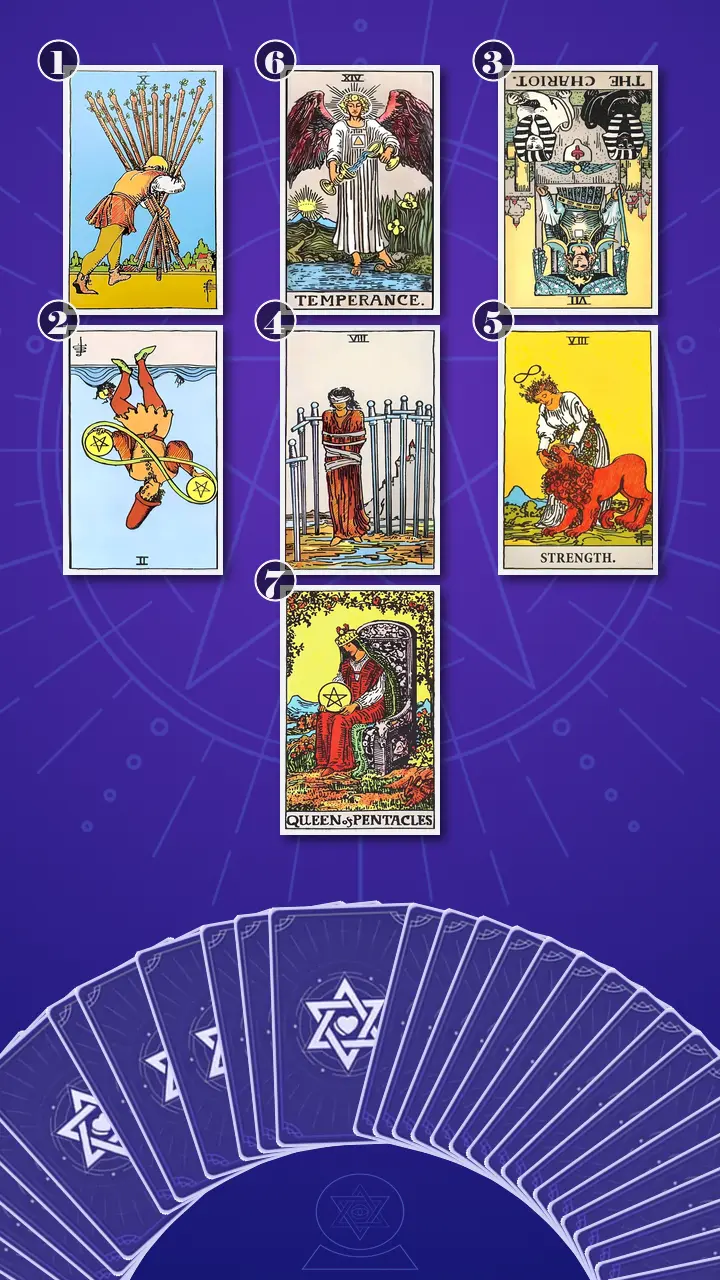
“Today,” I told them, “we’ll use something called the Energy Diagnostic Map (7) · Context Edition.”
For anyone reading who’s new to tarot: this is how tarot works in my world. It’s not a crystal ball. It’s a structured conversation with symbols—like storyboards. When you’re at a career crossroads or feeling stuck, you usually don’t need more motivation. You need a clearer map of what’s actually driving the loop. A spread like this lets us look at the full system: external constraints, internal coping, the bottleneck belief, and the simplest lever to pull next.
This spread is perfect for “work-life balance when your commute got longer” because the problem spans multiple domains (work, health, dating). A single-card pull can validate the vibe, but it won’t show the mechanics. Here, the center card is the bottleneck—the belief that makes everything ripple outward. And the way we read it mimics commuting: you transfer lines. You can’t delete distance overnight, but you can redesign how your energy moves through the week.
I pointed to a few positions so Jordan (and you) would have a handrail. “The first card shows your surface reality—the most obvious strain. The center is the core blockage, the thing that makes balance feel impossible. And the top card is the turning point—the reframe that changes the whole system.”
Reading the Transit Map: The First Transfers
Position 1: The Weight You’re Carrying in Plain Sight
I turned the first card. “Now flipped,” I said, “is the card representing Surface reality: the most visible day-to-day strain created by the doubled commute.”
Ten of Wands, upright.
“It’s 6:15 PM and you’re carrying the commute, your laptop bag, a grocery tote, and the invisible pressure to stay ‘on’ for work. You answer emails between stops because it feels responsible, but it steals the only recovery time you had. By the time you get home, the idea of cooking, moving your body, or meeting someone feels like adding another weight to an already full set of arms—so you drop the things that don’t scream the loudest.”
I tapped the image lightly. “This is overload. Not drama—math. The energy here is excess: too much responsibility, too little margin. And the wands block the figure’s view. When life gets this heavy, your perspective narrows to: ‘Just get through today.’”
Jordan let out a small laugh that wasn’t amusement so much as a pressure release. “That’s… kind of brutal,” they said, half-smiling like it was rude of the card to be accurate.
“It is,” I replied. “And it’s also kind. Because it’s naming what your body’s been carrying without permission.”
Position 2: The Juggling Loop That Tightened
“Now flipped is the card representing Inner tug-of-war: how you’re trying to juggle work, health, and dating internally (and where the juggling breaks).”
Two of Pentacles, reversed.
I nodded at the twisted infinity ribbon. “On the train you try to juggle three lives at once: reply to Slack, check your calendar, and keep a dating conversation alive. You bounce between apps like you’re doing triage, but the constant switching leaves you more scattered. The commute changed the math, yet you’re still using the old juggling pattern—so you end the day feeling guilty, behind, and like you’re failing at everything at the same time.”
Reversed, this is an energy blockage: flexibility collapses into chaos. It’s the “thirty browser tabs open” feeling—everything technically exists, nothing loads.
Jordan’s eyes flicked to their phone on the table like it might buzz in defense. “I keep thinking if I plan harder, I’ll catch up,” they admitted. “But then one delay happens and… it all shatters.”
“That’s the reversal,” I said. “Your system is too tight. It can’t absorb reality.”
Position 3: Motion Without Control
“Now flipped is the card representing External pressure: environmental demands and constraints shaping the situation.”
The Chariot, reversed.
“You plan the day with military precision,” I said, “then the commute and office demands yank the wheel. Delay announcements. Platform crowds. PRESTO taps. A last-minute ‘can you jump on this?’ message before you’ve even had dinner. You’re in motion, but you’re not in control of the line.”
This is willpower versus terrain. Reversed, the Chariot’s energy is disrupted traction: you’re trying to drive, but the road keeps changing. And when people are told to ‘just manage your time better’ inside a context like this, it lands like an insult.
Jordan exhaled through their nose, sharp. “Thank you,” they said. “Because it’s not like I’m choosing to be like this.”
“Exactly,” I replied. “We’re going to respect the context pressure without pretending you have zero agency. Both are true.”
Position 4: The Mental Cage That Feels Like Fact
I placed my hand near the center of the spread. “Now flipped is the card representing Core blockage: the key belief or stuck pattern that keeps balance from recalibrating.”
Eight of Swords, upright.
The room got quieter in a way I’ve learned to trust. This card often does that—like it lowers the volume so you can hear the thought underneath the thought.
“This is like thinking your calendar is a locked app—when it’s actually just full of default settings you never edited,” I said. “A frozen transit map screenshot. It ignores detours, off-peak routes, tiny transfers you can choose.”
Then I anchored it to Jordan’s exact life. “This is like when you assume there’s no way to protect health or dating unless the commute changes, so you don’t try small adjustments that could create breathing room.”
The Eight of Swords is a blockage of air: thought loops that masquerade as truth. The blindfold isn’t just ‘I don’t see options.’ It’s ‘I stopped looking for options.’ And the bindings—on most versions of this card—are looser than they look.
Jordan stared at the image. Their throat bobbed once. Their fingers, which had been gripping their water bottle, loosened, then tightened again like a reflex trying to reclaim control.
“Exhaustion is loud,” I said carefully. “It will convince you it’s telling the truth.”
I let that land. And then, softly: “What’s one constraint that’s truly real for you right now—and what’s one ‘rule’ you’ve been treating as real because you’re scared to test it?”
Jordan blinked, slow. “Real: I have to be on-site more,” they said. “Belief… I guess I act like I have to be available door-to-door. Like if I don’t answer right away, I’m unreliable.”
Their shoulders dropped a fraction, the way a backpack strap slides when you finally admit it’s cutting off your circulation.
Position 5: Steady Is the Flex
“Now flipped is the card representing Usable resource: the inner quality you can access without needing a total life overhaul.”
Strength, upright.
Strength is one of my favorite cards to translate into modern life because people expect it to mean “push harder.” It rarely does.
“This isn’t about more hustle,” I said. “It’s about nervous-system budgeting. Like turning down the stove so the recipe doesn’t burn.”
I gave them a micro-moment instead of a lecture. “This could look like choosing water and a snack on the train instead of more caffeine. Or setting one boundary and not negotiating with yourself about it. The energy here is balance: kind firmness.”
Jordan’s face softened, just slightly. “I always do the all-or-nothing thing,” they said, quieter now. “If I can’t do it big, I won’t do it at all.”
“Strength disagrees,” I said. “Steady is the flex when your life is tight.”
When Temperance Poured Between Two Cups
Position 6: The Turning Point for Work-Life Balance
I paused before turning the next card. Outside, a streetcar bell sounded somewhere down the block—bright and brief, like punctuation. “We’re flipping your key transformation now,” I told Jordan. “The card that shows the reframe that turns survival mode into a sustainable rhythm.”
Temperance, upright.
Temperance is the tarot meaning for work-life balance that I actually trust—because it doesn’t sell the fantasy of a perfectly optimized life. It’s the card that admits you’re human and still asks for design.
I leaned in. “Here’s what I see: balance isn’t equal slices. It’s a repeatable recipe. One foot on land, one in water. Work and feelings. Logistics and needs. And the angel is actively pouring—adjusting. Not judging.”
Jordan’s eyes were focused in that hyper-alert way I recognize from people who’ve been trying to ‘solve’ themselves. I could almost hear the internal narration: meetings, delays, laundry, texting someone back, and then the crash—convenience food plus doomscrolling on the couch, YouTube autoplay doing the soothing they didn’t have energy to ask for.
This was the TTC moment I’d heard in their story a hundred different ways: calculating the week in your head, then getting home and realizing the only thing you can manage is something quick to eat and a scroll until you crash.
Not “carry it all until you collapse,” but “pour and blend with intention,” because Temperance’s cups are your reminder that sustainable balance is a recipe you adjust, not a verdict on your worth.
I let the sentence sit between us like a subtitle on a screen.
Jordan’s reaction came in a chain—three tiny beats I’ve learned to respect:
First, a physiological freeze: their breath paused mid-inhale, eyes widening a hair as if the words had turned the lights on.
Second, cognitive seep-in: their gaze unfocused, not on the card anymore, but somewhere past it—like they were replaying their own week and noticing a pattern they’d been editing out.
Third, emotional release: their shoulders slid down, and their mouth opened on a sound that wasn’t quite a laugh and wasn’t quite a sob. “But if it’s a recipe,” they said, and there was a flash of anger in it, “doesn’t that mean I’ve been doing it wrong? Like… I’ve been failing.”
I stayed with that. “I hear that,” I said. “But recipes don’t mean moral grades. When a recipe burns, you don’t decide you’re a bad person. You lower the heat. You change the timing. You stop trying to cook three dishes on one burner.”
This is where my artist brain always reaches for structure. In my studio, I use a tool I call the Mondrian Grid Method—not to make life rigid, but to make it visible. “What Temperance is asking,” I said, “is for us to stop treating your week like one big blur and start treating it like a grid you can redesign. Not a perfect grid. A workable one.”
I imagined it in colors, like paint laid on a palette: one lane for work, one for recovery, one for connection. Not because you can control everything—but because you deserve to see what you’re actually asking of yourself.
“Right now,” I continued, “your grid is all fire—effort, proving, pushing—until it hits a wall. Temperance brings in water: regulation, pacing, real replenishment. Not so you become less ambitious. So you can stay alive inside your ambition.”
I asked the question that turns insight into memory: “Now, with this new lens—recipe, not verdict—can you think of a moment last week when you told yourself ‘I have no options,’ and a tiny option existed but you dismissed it because it wouldn’t fix everything?”
Jordan swallowed. “Thursday,” they said. “I got home at like 8:50. I stood at the fridge and thought, ‘I can’t work out, I can’t date, I can’t do anything.’ But I… could’ve walked around the block. Ten minutes. I didn’t because it felt pointless.”
“That,” I said softly, “is the shift. From overwhelm and contraction to experimenting with small boundaries. From ‘I’m trapped’ toward calmer self-trust.”
Position 7: The Home Base That Makes Connection Possible
“Now flipped is the card representing Next step: a concrete, realistic action that improves work-life balance in the next week or two.”
Queen of Pentacles, upright.
“This card doesn’t ask you to become a new person,” I told them. “It asks you to build infrastructure.”
In modern life, Queen of Pentacles is the moment you stop treating care as a reward you have to earn. “This is like when you treat meal prep, sleep, and a comfortable home reset as the foundation that makes texting back, going on a date, or exercising feel possible again,” I said. “Not aspirational. Feasible.”
The energy here is balance leaning toward earth: practical routines, a supportive environment, fewer decisions at 9 PM when decision fatigue is already eating you alive.
Jordan frowned, not disagreeing—calculating. “But I genuinely don’t have time,” they said. “Like… I can’t even find five minutes. I get home and there’s laundry and groceries and I still have to eat.”
“That’s real,” I said. “And it’s also exactly why we keep it tiny. The Queen doesn’t demand an overhaul. She asks: what’s one friction point you can remove so your body isn’t paying the commute tax with interest?”
The Temperance Mix: Actionable Advice for the Next 7 Days
I pulled the whole spread into one clean story—because clarity comes from coherence, not from seven separate insights.
“Here’s the narrative,” I said. “Your surface reality is overload (Ten of Wands). Inside, you’re juggling with a loop that’s tightened past sustainable (Two of Pentacles reversed). Externally, you’re being moved around by context pressure—transit, on-site expectations, after-hours pings (Chariot reversed). The bottleneck isn’t just time; it’s the Eight of Swords story: ‘I have no options,’ which makes you default to proving and then shutting down. Strength is your resource—regulated courage, kind firmness. And Temperance is the reframe: balance isn’t something you earn by squeezing harder; it’s something you design so your energy can move between work, health, and dating without constantly draining you. The Queen is the landing: self-care as infrastructure.”
“Your cognitive blind spot,” I added, “is thinking the only solutions that count are the total ones. The transformation direction is smaller and braver: redesign the system with boundaries and replenishment that fit your new commute reality.”
I could feel Jordan wanting a script—something they could do even when their brain was fried. That’s when I reached for one of my own tools: Oscars Speech Training. I use it with creatives who freeze when they have to advocate for themselves. The point is not to perform. It’s to keep it short enough that your nervous system won’t negotiate you out of it.
“We’re going to make your next week like a two-minute acceptance speech,” I said. “Clear. Human. No over-explaining.”
- The No-Work Leg Experiment (3 days)Pick one commute leg (morning or evening) and make it a no-work leg for three days this week—no inbox, no Slack. If that feels too intense, start with the first 10 minutes only.Expect the anxiety spike. Treat it as stress, not wisdom. If you need reassurance, write down: “If it’s urgent, they’ll call.”
- The 2-Minute Transition Ritual (Doorway Reset)The second you walk in: phone on charger, shoes off, drink water. Set a timer for two minutes. Nothing else required. This is your “I’m home” cue so your body stops commuting even after you arrive.If you want to add one layer, play the same 2-minute track every time—make it your nervous system’s “end credits.”
- The 10-Minute Temperance Mix (Calendar Blend)Tonight, open your calendar and pick one weekday. Add (1) one 20–30 minute recovery block right after you get home (walk, shower + real meal, or lie down with a timer), (2) one tiny connection block (reply to two messages or send one voice note), and (3) one boundary line you can reuse: “I’m on transit right now—can I circle back first thing tomorrow?”If your body tenses up, shrink it: 10 minutes / 1 message / 1 boundary. This is an experiment, not a performance review.
Before we wrapped, I offered Jordan one last reframe, something I borrow from jazz: you don’t improvise by panicking. You improvise by choosing a key, a tempo, and a simple motif you can return to when the song gets messy. “Commute delays will happen,” I said. “Your plan isn’t to out-hustle them. Your plan is to return to your motif: one boundary, one recovery pocket, one connection touch.”

A Week Later: The Quiet Proof
Six days later, Jordan messaged me. No long paragraph, no dramatic transformation—just a small update that felt like someone finally putting their shoulders down.
“Did the no-work leg Monday/Wednesday/Friday,” they wrote. “First day felt illegal. Third day felt… normal. I actually replied to someone on Wednesday and didn’t disappear.”
They told me they’d done the two-minute doorway ritual twice and, on Thursday, took a ten-minute walk around the block anyway—rain and all—because it “counted as minimum version.”
It wasn’t a shiny montage. It was bittersweet in the honest way: they said they slept a full night, but the first thought the next morning was still, “What if I’m messing up?”—and then, for the first time in weeks, they laughed quietly at that thought instead of obeying it.
That’s the Journey to Clarity I’m always rooting for. Not certainty. Ownership. Not “I fixed my whole life.” Just: “I edited one default setting, and my week breathed differently.”
When your commute doubles, it can feel like your whole life is balanced on a moving train—so you grip work harder for stability, and quietly lose the parts of you that needed rest and connection first.
If you treated this week like a recipe instead of a test, what’s one small boundary—or one tiny recovery pocket—you’d be willing to try without needing it to fix everything?