When a Concert Ticket Becomes a Recovery Test: Choosing for Now
The Ticket That Started Feeling Like a Verdict
If you’ve asked three friends whether you should still go to the concert, felt worse after every answer, and still saved the resale listing as a draft, I know that particular flavor of post-breakup decision paralysis well. Jordan (name changed for privacy) came to me with the exact search-bar question people type at 1 a.m.: should I go to a concert after a breakup or sell my ticket?
She joined me from her downtown Toronto condo just after work. The overhead light was off. Laptop glow sat blue-white across her knees. Her phone was warm in her hand from toggling between Ticketmaster resale and the venue map, and every few minutes a streetcar rattled below her window while the radiator hummed behind her. I watched her type, ‘Hey, weird question, would you want to come with me?’ then delete it before the message could become real.
Jordan worked in UX, and I could feel her Figma brain still running after hours, trying to prototype her feelings into a clean flowchart. At work, she told me, she could resolve a design decision in minutes. At home, one concert ticket had become something else entirely. ‘I can’t tell if I want the concert,’ she said, her fingers at her throat, ‘or the version of the night I thought I was getting.’
The dread in her wasn’t abstract. It sat like a scarf pulled too tight at the throat and a step missed in the dark at the stomach. She kept talking about prices, transit, seat views, whether she might run into her ex, whether selling meant the breakup won. I listened until the deeper split showed itself clearly: part of her wanted the music, and part of her did not want the breakup to get the last word.
I leaned in a little and kept my voice soft. ‘You’re telling yourself this is about one ticket,’ I said, ‘but your body is reacting like it’s about something much bigger.’ Her eyes lifted to mine through the screen. ‘Yes,’ she said, almost annoyed by how fast the word came out. ‘Exactly.’ I nodded. ‘Then let’s not force a verdict tonight. Let’s make a map and find the kind of clarity that protects your peace.’

Choosing the Compass: The Decision Cross Spread
I asked Jordan to put both feet on the floor, loosen her jaw if she could, and hold the question in one plain sentence: What do I actually want now? Then I shuffled slowly. For me, that moment is never about theatre. It is about helping the nervous system step out of the loop long enough to see.
When someone brings me a shared-plans breakup dilemma with only two visible options, I reach for the Decision Cross spread. It is a five-card tarot spread for comparing two choices without feeding the very over-analysis that already has them stuck. Functionally, this was a go-or-sell question. Emotionally, it was a heartbreak question. The Decision Cross is small enough to stay clean and deep enough to name the wound underneath.
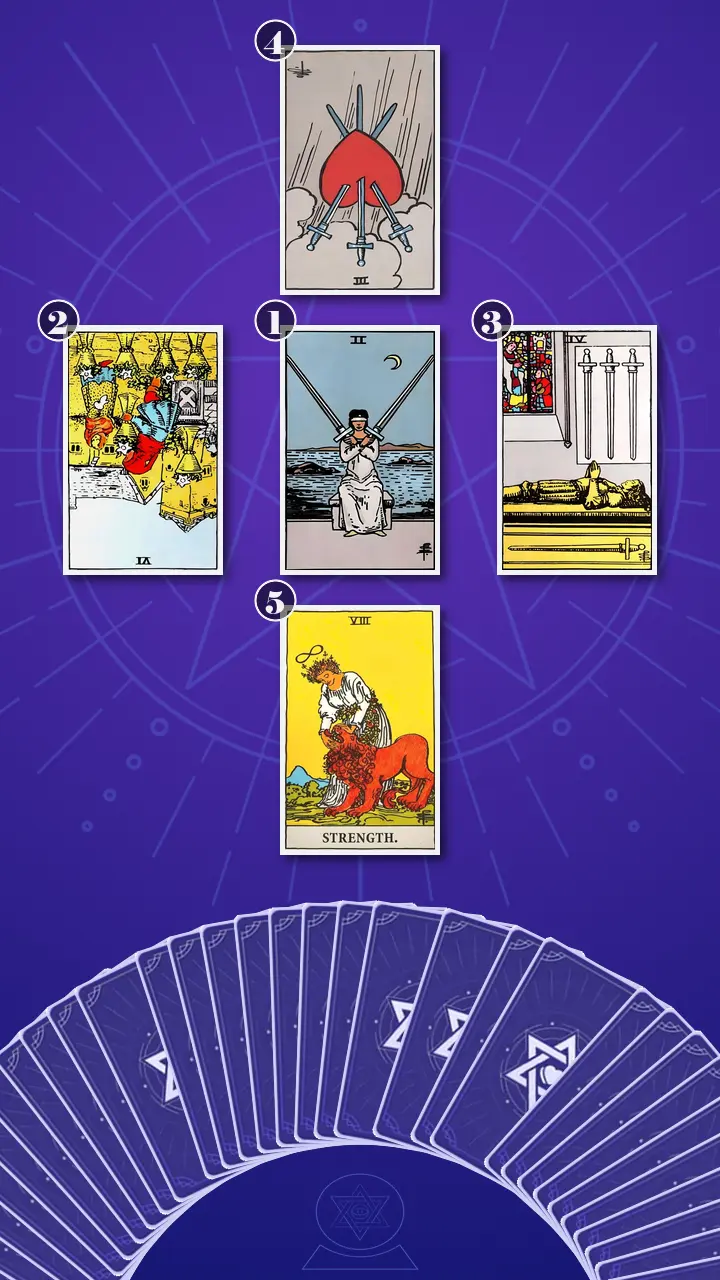
As I laid the cards in a cross, I explained the shape the way I always do. The center would show the current freeze: why the ticket app kept reopening and nothing moved. The left card would show what going to the concert represented psychologically. The right card would do the same for selling. The card above would reveal the heartbreak pressing down on both paths. The card below—the landing stone at the bottom of the spread—would tell us what inner stance could actually carry the choice.
That is how tarot works best in a moment like this: not as a dramatic prediction, but as card meanings in context. One choice. One nervous system. One night that had become far more emotionally high-stakes than it looked on paper.
Reading the Scales of a Concert-After-Breakup Decision
The Blindfold in the Ticket App
I turned over the center card first. ‘This position presents the current symptom,’ I told her, ‘the visible freeze around the ticket.’ The card was the Two of Swords, upright.
I have learned to trust how literal this card can be. In Jordan’s life, it was the couch after work, the resale page open, the seat map glowing on her phone, the half-drafted text to a friend, the mental rehearsal of merch lines and accidental run-ins. She was acting as though the problem was missing information. The blindfold said otherwise. The crossed swords over the chest told the real story: analysis had become armor.
‘This is like a Figma file with twelve versions and no publish button,’ I said. ‘Not because the interface is unclear, but because hitting publish suddenly feels like it will say something about you.’ I watched the thought land. ‘The ticket is a choice, not a verdict,’ I added. ‘And you’re not indecisive; you’re trying not to be ambushed by grief in public.’
Jordan let out one sharp, bitter little laugh. ‘Wow,’ she said, rubbing her thumb across the edge of her phone. ‘That’s accurate enough to be rude.’ Then her shoulders crept up, paused, and slowly dropped a fraction. The defense had cracked just enough for honesty to get in.
The Old Script Hidden Inside Going
I moved to the left arm of the cross. ‘This position reveals what going to the concert represents psychologically.’ The card was the Six of Cups, reversed.
Reversed here, the card did not read as simple desire. It read as memory trying to wear the clothes of desire. I told her what I saw: the original story of the night was still attached to the ticket—what they were going to wear, where they were going after, the easy split of an Uber home, the fact that the relationship still existed when the tickets were bought. Part of her wanted the music. Part of her wanted the version of herself who was still going with them.
‘Nostalgia can sound a lot like desire until you ask what you actually want now,’ I said. ‘That’s why going with a friend can feel weirdly flat. You’re not comparing concert versus no concert. You’re comparing real life versus an old emotional script.’
She went quiet, then gave me the slow nod I had been waiting for. Her gaze drifted sideways, as if she were seeing the old text thread on the wall beside me. ‘That’s it,’ she said. ‘I keep thinking I want the show, but I think I want the night back.’
The Boundary Inside the Sell Button
I turned to the right side of the spread. ‘This position reveals what selling the ticket represents psychologically.’ The card was the Four of Swords, upright.
I felt Jordan brace before I even spoke. People often hear rest as defeat when they are fresh out of something painful. But this card was clean. In her everyday life, it looked like the half-second of relief she felt whenever she imagined being done with the whole question—before guilt rushed in and called that weakness. The energy here was not collapse. It was recovery. It was a nervous system asking not to be turned into a performance project.
‘Rest is not letting the breakup win,’ I said. ‘And upright Four of Swords is balanced rest, not avoidance. Selling may not be retreating from life. It may be choosing not to make this one night carry more than your system can honestly hold right now.’
Her lips pressed together. ‘Selling feels so final,’ she said. I nodded. ‘Sometimes a boundary feels final because it ends the loop, not because it ends your future.’ She stared at the card for a long moment, and this time she did not argue.
The Ache Hanging Over Both Options
I lifted my hand to the card above the center. ‘This position uncovers the deeper mechanism underneath both options.’ The card was the Three of Swords, reversed.
There it was: the hidden weather. Not loud heartbreak anymore, not the first sharp storm, but the ache that goes underground and keeps changing the pressure in the room. In Jordan’s life, this was the Sunday-brunch shrug—‘I don’t know, it’s not a huge deal’—followed by the private hour later that night when the apartment got too quiet, the phone brightness went low, and the sting arrived behind the eyes anyway. She had been treating the ticket like admin in public and grieving it in private.
‘You said it wasn’t a big deal,’ I told her gently. ‘Your body did not agree.’ Reversed, this card showed healing in progress, but not finished. Like an app draining battery in the background even when it looks closed, the heartbreak was still running beneath the logistics. That was the missing explanation for why both options felt bigger than they should.
Her breath caught. Then her gaze unfocused for a second, as if some memory had stepped between us. One hand went to her jaw, then to her sternum. ‘I think,’ she said slowly, ‘I’m not just grieving him. I’m grieving the plan. And the version of me who thought weekends were... easier.’
Outside her window, I heard another streetcar grind against the tracks and then fade. The room on my end went very still. That card had done its work. The hidden grief was finally named without drama, which is often the exact moment a reading turns from interesting to useful.
When Strength Placed a Hand on the Lion
The Landing Stone at the Bottom of the Spread
I turned the last card more slowly. ‘This position points to the key shift,’ I said, ‘and the best decision criterion.’ The card was Strength, upright.
Whenever Strength appears after a spread full of swords, I feel the room change. Air has done enough. Thought has had its turn. What arrives next has to live in the body. On long transoceanic crossings, back when I trained intuition on cruise ships, I learned that the passengers who stayed upright in rough water were never the stiffest ones. They were the ones who stopped fighting the sway. Soft knees. Steady breath. One hand on the rail, not a death grip.
That is part of what I call my Stained Glass Decoding. In Jungian work, I look for the colored light we mistake for the object itself. A ticket is only a ticket. But grief, pride, self-consciousness, and the fantasy of becoming the impeccably healed version of yourself can throw such strong color onto it that the thing starts to look like the source of the pain. Jordan’s ticket had become stained glass: beautiful, loaded, and distorted. When I separated the glass from the light, the choice became human again.
I asked her to picture the late-night loop one more time: resale page open, venue map open, half-written text to a friend, her body bracing like the app itself was about to judge her. ‘That’s the clue,’ I said. ‘This was never just logistics.’
This is not about picking the option that proves you are over it; it is about choosing the path you can hold with a calm spine, like Strength placing a steady hand on the lion instead of wrestling it.
Jordan went completely still. First came the physical freeze: breath suspended, thumb hovering above the black edge of her phone. Then came the cognitive seep: her eyes lost focus, replaying some private scene I did not need her to narrate yet. Then the feeling broke through. Her mouth parted. Her shoulders, which had been half-climbed toward her ears since the session began, dropped as though someone had unclipped invisible straps from them.
‘But then what have I been doing?’ she asked, and there was a flash of anger in it now, not just relief. ‘Turning one concert into a breakup performance review?’
‘Not on purpose,’ I said. ‘You’ve been trying to protect a wound with the tools you trust most: analysis, optimization, outside opinions. That made sense. It just didn’t bring peace.’
She looked down, blinked hard, and laughed once through the ache. A little red came into her eyes. ‘Okay,’ she said. ‘That’s the actual question, isn’t it?’
I nodded. ‘Yes. Which option can you carry before, during, and after the night without abandoning yourself? Like carrying a full coffee on a moving streetcar—not stiff, not reckless, just steady enough not to spill yourself everywhere.’
I let a beat pass, then asked, ‘Now, with that new lens, was there a moment last week when this would have felt different?’
She exhaled from deep in her chest. ‘Monday,’ she said. ‘I thought, just for a second, maybe I should sell it. And I felt relief before guilt kicked the door back in.’ Her hand left her throat completely then. Her spine straightened. There was even a strange little pause after it—the almost-dizzy space that comes when a burden drops and you realize you are the one who gets to choose next.
That was the shift. Not from sadness to happiness. From dread-driven self-testing to steadier self-trust. Self-respect isn’t choosing the harder option. It’s choosing the one you can carry.
From Insight to Action: The Steady Choice Check
By then the story of the spread was clear to me. Two of Swords showed the split. Six of Cups reversed showed memory pulling the decision backward. Four of Swords showed that rest and boundary had been mislabeled as failure. Three of Swords reversed revealed the private ache still charging both options from above. Strength changed the entire frame: the ticket had started feeling like proof of recovery, and it needed to become a choice again.
The blind spot was simple and brutal. Jordan had been asking which option proved she was most okay. That question guaranteed more looping, more group-chat polling, more reopening the app and feeling less clear. The real transformation direction was different: choose from present capacity and real desire, not from optics, panic, or the fantasy of looking impressively healed on schedule.
I could also see something elemental in the cards. There was plenty of Air—thinking, rehearsing, dissecting—and enough Water to keep the whole thing emotionally charged. What the spread lacked was Earth. So I told her clarity would need one grounded act, not one more night of analysis.
In Venice, a gondola tips when too much weight leans to one side. So I used my Gondola Balance Technique with her: do not ask one ticket to carry grief, pride, memory, social optics, and your healing timeline all at once. Redistribute the load. Give the body one job, the mind one job, and the calendar one job.
- Book the Steady Choice CheckPut one 15-minute meeting with yourself on your calendar in the next 48 hours. Before opening the ticket app, write three headings in your Notes app—Before, During, and After—and give each option one honest sentence under each heading.If 15 minutes feels too big, do the 3-minute version and answer only this: Which option feels quieter in my body right now?
- Make the Past Story / Present Desire SplitCreate two short lists on your phone: What I want from the concert now, and What belonged to the old version of this relationship. Keep each list to three bullets max, and do not let anything from the second list count as evidence for going.When the lists are done, close the old text thread for the night. Missing the original plan is real; it is not a command.
- If selling is still the steadier choice, make it realPost the listing within 24 hours instead of keeping it in drafts. Then mute the artist, venue, and ticket emails for one week, and set one small replacement plan for that night now—takeout with a friend, a movie, a walk by the lake, or an intentionally quiet evening.Do it in that order. First the listing, then the rest. Protecting your nervous system is not the same thing as shrinking your life.
Jordan worried her lip between her teeth. ‘And if I sell it and feel sad after?’ she asked.
‘You probably will feel something,’ I said. ‘Sad does not mean wrong. Regret is not always a red flag; sometimes it is just the echo of the road not taken. What matters is whether your body gets quieter or more defended around the choice.’
She nodded. This time it was not the helpless nod from earlier. It was the small, sober kind people give when they know the next step is not glamorous, just true.

A Week Later: The Quiet Proof
Four days later, a message from Jordan lit up my phone: ‘I did the Before/During/After check. Going kept sounding like performance. Selling sounded like relief. I posted the listing before I could overthink it.’ A second message followed a minute later. ‘It sold in nineteen minutes. I hate that that feels emotional. But I can breathe.’
On the night of the concert, she texted me only once. ‘Slept through the night last night. Woke up with: What if I should’ve gone? Then I laughed, made coffee, and my shoulders were still down.’ It was not cinematic. It was better. It was evidence.
That is what a real Journey to Clarity usually looks like in my practice. Not perfect certainty. Not the total disappearance of grief. Just the moment a person stops using a choice as a scorecard and starts using it as an honest expression of current capacity. The Decision Cross spread did not tell Jordan how to perform recovery. It helped her return to herself.
When a breakup has already rearranged your weekends, even a tiny screen-lit choice can make your throat tighten—because you’re not just picking an event, you’re trying to protect your peace without feeling like you’ve lost your pride.
If tonight your own glowing little ticket, reservation, or old plan doesn’t have to prove anything about how healed you are, which option feels a little quieter in your body right now?