The Yearbook Photo Spiral—and the Private Metric That Got Me Moving

The 11:52 p.m. Photo That Turned Into a Performance Review
You see an old yearbook photo in a group chat and suddenly you’re doing a full “life audit” in your Notes app instead of going to sleep—classic timeline shame.
Jordan (name changed for privacy) told me that line almost verbatim, but what I remember most wasn’t the words—it was the way her hand hovered over her phone like it had its own nervous system.
She described the exact slice of time: 11:52 p.m. on a Tuesday in her Toronto bedroom. The blue light from her phone painted the ceiling in a cold aquarium glow. The phone itself was warm from being gripped too long. The room was dead quiet except for that low fridge hum you only notice when you should be asleep. She toggled between the yearbook throwback and LinkedIn “just for a minute,” and her chest tightened as if someone had quietly cinched a strap around it.
“Seeing that photo made me feel like I missed a deadline I didn’t know I had,” she said, almost like she was embarrassed to admit it. “It’s not that I hate my life, it’s that it doesn’t look impressive on paper.”
I watched her swallow, then press her thumb to the side of her mug like she could smooth out the feeling. Shame has a particular physics to it. In Jordan’s body it landed as a tight chest with a hollow, dropping sensation in her stomach—like the floor in a condo elevator stuttering for half a second, just long enough for your body to panic before your brain can explain it.
“You’re not broken for reacting,” I told her, keeping my voice gentle and practical—the way I talk to people in my café when they come in looking steady on the outside and wrecked behind the eyes. “A memory isn’t a report card—until your brain turns it into one. Let’s try to draw a map through the fog. Not to predict your life. To help you find clarity and one real next step.”

Choosing the Compass: The Horseshoe Spread for Timeline Shame
I asked Jordan to take one slow breath in and out—not as a mystical thing, just a clean transition from spiraling into noticing. While she held her question in mind, I shuffled the deck the way I tamp espresso grounds: steady, repetitive, not rushed. A small ritual is sometimes just a way to tell your nervous system, we’re here now.
“Today we’ll use the Horseshoe Spread,” I said. “It’s a classic.”
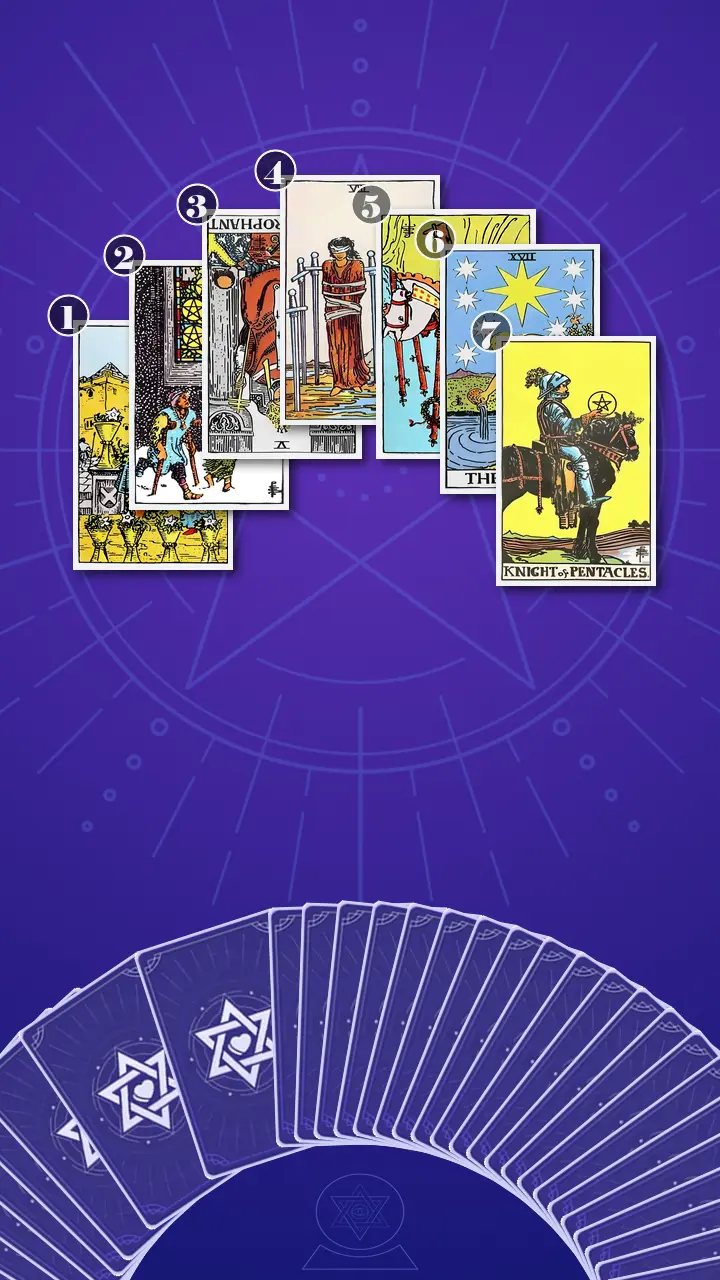
For you reading this: the reason I chose it is simple. When someone asks, “Why do I feel behind, and what’s next?” they usually don’t need a dramatic prediction. They need meaning and a practical direction. The Horseshoe Spread is designed for exactly that arc—past imprint, present pattern, hidden driver, the main blockage, outside pressure, advice, and a grounded direction. It shows how one trigger (like a yearbook photo) activates a whole inner storyline, without forcing a deterministic outcome.
As we lay seven cards in a gentle arc, a few positions do the heavy lifting in this kind of reading: the present-day pattern (what you’re reinforcing), the main blockage (the loop that keeps you stuck), and the advice card (the reframe that restores self-trust). When the cards are placed in a curve, it also visually reminds you: you don’t fix the feeling by jumping ahead. You walk the bend with awareness.
Reading the Arc: Card Meanings in Context
Position 1: What the yearbook photo is emotionally plugging into
“Now flipping over is the card that represents what the yearbook photo is emotionally plugging into—the memory-imprint behind the reaction.”
Six of Cups, upright.
I nodded at the image like I recognized an old regular at my café. “This is that exact moment when something innocent turns into a measuring stick,” I said.
In modern life, it looks like this: a friend posts a yearbook throwback in the group chat and you feel a genuinely soft, sweet nostalgia for about three seconds—then it flips. You start comparing ‘who you were supposed to become’ with ‘what you can prove today.’ The memory becomes a benchmark, and suddenly you’re auditing your life like it’s overdue homework.
Energetically, this card is balanced at the start—warm water, a real tenderness. But it can tip into excess when the sweetness becomes a standard your present self can’t possibly meet. The cup with the white flower is the clue: a pure, lovely thing that your brain turns into a purity test.
I used the “sweet-to-sharp” switch on purpose. “It starts as ‘Aww, look at us,’” I said, and then I softened my voice into the sharper edge: “‘Wait—what did I do with all that time?’”
Jordan let out a short laugh that was half recognition, half sting. Her shoulders lifted toward her ears, then dropped—like her body was admitting the truth before she wanted to.
Position 2: The observable present-day pattern of ‘feeling behind’
“Now flipping over is the card that represents the present-day pattern—what ‘feeling behind’ looks like in real life.”
Five of Pentacles, upright.
“This is the ‘outside the lit window’ feeling,” I said. “Not always because you’re actually excluded. Because you feel excluded.”
In modern life: you’re alone at night, scrolling LinkedIn and Instagram after the photo, and your brain interprets everyone’s milestones as a locked door you’re standing outside of. Even if you’re paying rent and showing up at work, it feels like you don’t ‘belong’ in the room where real adulthood is happening—so you focus on what’s missing and call it failure.
Energetically, this is deficiency—not of talent, but of perceived belonging. Your attention gets magnetized to what you don’t have. The lit window in the card is the part I always point at: support exists, warmth exists, real progress exists. The figures just don’t turn toward it.
Jordan’s reaction came in a three-beat sequence I’ve learned to watch for.
First, physiological freeze: her breath paused, and her fingers stopped moving mid-fidget on the mug handle.
Then, cognitive seep: her gaze unfocused past my shoulder as if her brain was replaying a scroll—promotion posts, engagement rings, rooftop birthdays—like a highlight reel she didn’t audition for.
Then, emotional release: she exhaled through her nose, a small sound like she was trying not to make it a big deal. “It’s weird,” she said. “My job is… fine. I pay my bills. But one LinkedIn post and suddenly I’m convinced I’m failing at adulthood.”
“That’s exactly what this card does,” I told her. “It turns fine into not real.”
Position 3: The deeper belief system behind the comparison reflex
“Now flipping over is the card that represents the hidden driver—the belief system behind the comparison reflex.”
The Hierophant, reversed.
“Underneath the spiral is an internal committee,” I said, tapping the card lightly. “It keeps asking, ‘Will this look legitimate?’”
In modern life, it looks like this: you don’t even fully want the conventional checklist—but you still use it as the scoreboard. So you feel guilty for craving a more personal path and anxious because you can’t summarize your life in socially approved milestones.
Energetically, reversed Hierophant is blockage—not because tradition is evil, but because you’re letting rules you didn’t choose run your self-worth. Those temple pillars become an invisible set of rails in your head: title by age, relationship by age, “impressive” by age.
I asked her the question this position demands: “What’s one ‘by this age I should…’ sentence you would never choose on purpose if no one else could see your life?”
Jordan’s mouth twitched like she was deciding whether to confess. “By 30, I should… have something that looks like a clear identity,” she said. “A title that makes sense. Something people don’t have to ask follow-up questions about.”
“That’s the committee talking,” I said softly. “Not you.”
Position 4: The main internal blockage that keeps you stuck in analysis
“Now flipping over is the card that represents the main internal blockage—the loop that keeps you in analysis instead of action.”
Eight of Swords, upright.
“This is the mind-made trap,” I said. “And it’s convincing.”
In modern life: you run so many scenarios (‘stay, leave, pivot, move, don’t move’) that every choice starts to feel like a trap. You treat uncertainty like danger, so you keep waiting for perfect clarity. The result: you do the safest thing—re-plan, research, rewrite—because it feels like action without requiring risk.
Energetically, this is excess Air—thoughts tightening into a cage. I mirrored her inner tabs out loud, rapid-fire, because that’s what the card feels like in the body: “If I stay, I’m settling. If I leave, I’m reckless. If I pivot, I’ll look flaky. If I don’t pivot, I wasted my potential.”
Jordan’s jaw tightened on instinct; I saw it in the little muscle near her ear. Her shoulders rose. Her breath got shallow.
“Planning can be a form of self-soothing… and still keep you stuck,” I said, making sure it landed as compassion, not a scold. “It gives you a hit of control. But it steals the one thing that actually creates clarity: a real-world step.”
She nodded once, small. “I make ‘Plan (FINAL)’ and then ‘Plan (actual final)’ and I feel calmer for like ten minutes,” she admitted. “Then it’s worse.”
“Because the plan becomes the substitute,” I said. “Not the bridge.”
Position 5: What in your environment is intensifying the ‘behind’ narrative
“Now flipping over is the card that represents external pressure—what around you is turning your life into a scoreboard.”
Six of Wands, reversed.
“This is visibility pressure,” I said. “Toronto can feel like a stage even when you’re just trying to live your life.”
In modern life: your environment is basically a highlight-reel machine—engagement posts, promotions, ‘I moved to X city!’ announcements. When you don’t have a visible milestone, your progress feels invisible—even to you. So you start chasing proof (titles, announcements, status) instead of choosing metrics that actually match your life.
Energetically, this is deficiency of inner validation paired with an excess reliance on applause. I said the line I use like a north star in social-media-heavy readings: “If it needs applause to feel real, it’s not a stable metric.”
Jordan’s eyes narrowed—not in disagreement, but in that “oh, I hate how true that is” way. She looked down at her phone face-up on the table and, very deliberately, turned it over.
When The Star Spoke: Practical Hope Instead of a Verdict
Position 6: The key reframing and emotional medicine
I let the room go quiet for a second. In my café, there’s a moment right after the espresso machine stops hissing when the whole place seems to inhale—the pause before the next thing begins. This felt like that.
“Now flipping over is the card that represents the advice—the emotional medicine that restores self-trust and future orientation,” I said. “This is the heart of your reading.”
The Star, upright.
In modern life: the antidote is a quieter kind of hope. You stop trying to outrun comparison and start rebuilding self-trust through small, repeatable actions that make your life feel like yours. Not impressive. Not optimized. Just honest, steady, and real enough that you can stand in it.
Energetically, The Star is balance returning after constriction. Two streams of water: one for emotional replenishment—what restores you. One for practical grounding—what you repeat.
As I spoke, I could feel Jordan still fighting for a “right answer.” That late-night, phone-warm urgency. Notes app open to yet another five-year plan—but the chest still tight. That’s the setup almost everyone with decision fatigue recognizes: you’re trying to solve your entire future in one sitting because you don’t trust it will hold you if you don’t.
Stop treating your timeline as a verdict and start treating it as a landscape you can heal and re-water, like The Star pouring steadily into the same ground.
I let the sentence sit between us.
Then the reaction hit—layered, not neat.
First, her face went still, eyes widening just a little, as if her brain had lost its usual argument for a moment.
Second, a flush rose in her cheeks and her eyes shimmered—not dramatic tears, just that thin edge of emotion you get when you realize you’ve been punishing yourself with a rule you never agreed to.
Third, she did something small but huge: her shoulders sank. Not slumped—released. Like she’d been holding a heavy tray all day and finally found a counter to set it down on. She exhaled, shaky at the end, and for a second looked almost dizzy with the unfamiliar sensation of not rushing.
“But if I stop treating it like a verdict,” she said, and there it was—brief anger, brief resistance—“doesn’t that mean I was… wrong? Like I wasted time?”
I shook my head. “No. It means you were trying to survive the feeling with the tools you had. The Star isn’t a scolding card. It’s repair. It says: the photo didn’t prove you’re behind. It proved you still care—and caring deserves nourishment, not a verdict.”
Here’s where my own café instincts become part of the reading. I have a practice I call Sacred Timing: coffee has peak flavor windows—minutes where it’s at its truest. If you try to force it outside that window, you don’t get better coffee; you get bitterness. Your life works like that too. Trying to force clarity at 1 a.m. through more scrolling and more planning is like drinking espresso that’s been sitting too long. It’s not proof you’re undisciplined. It’s proof you’re asking your mind to do a job it can’t do in that window.
“So,” I continued, “The Star gives you a different question: if you trusted your pace for one month, what would you stop doing for optics—and what small, consistent thing would you nourish instead?”
I watched her eyes move to the card again, the way someone looks at a map after being lost. “Okay,” she said quietly. “That feels… possible. Not easy. But possible.”
“That’s the shift,” I told her. “Not from confused to certain. From shame to a grounded kind of self-trust. From ‘I’m behind’ to ‘I can build evidence.’”
Position 7: A realistic, non-fated next-step direction
“Now flipping over is the card that represents the direction—what kind of progress you can choose to build now,” I said.
Knight of Pentacles, upright.
In modern life: what’s next isn’t a dramatic pivot—it’s choosing one realistic track and showing up for it long enough to create evidence. One skill, one routine, one project, one rhythm. Confidence comes from receipts: the small, boring proof that you can commit without needing it to be perfect.
Energetically, this is balanced Earth. No fireworks. Just follow-through.
“Evidence beats reassurance: one small step creates more truth than ten perfect plans,” I said, and Jordan actually smiled—small, but real—like something in her body recognized the relief of that.
From Insight to Action: A Private-Metric Reset You Can Start Tonight
I leaned back and stitched the spread into one clear story, because this is the part where a tarot reading becomes actionable advice instead of just an interesting mirror.
The yearbook photo (Six of Cups) isn’t the problem; it’s the spark. It plugs into an old expectation—who you thought you were supposed to become. Then, in the present (Five of Pentacles), your nervous system reads everyone else’s milestones as a locked door, so you self-exclude and call it failure. Underneath (Hierophant reversed) is that internal committee measuring you by inherited timelines you don’t even endorse. The blockage (Eight of Swords) is how your mind tries to escape discomfort by chasing perfect certainty—scenario tabs, five-year plans, endless re-routing—until you feel trapped. And your environment (Six of Wands reversed) amplifies it by rewarding what’s visible, not what’s true.
Your cognitive blind spot is this: you’ve been treating legibility as the same thing as alignment. If your life can be explained quickly at a wedding table, it feels safer—so your brain keeps optimizing for optics. But the transformation direction in this spread is different: shift from chasing a single “correct” timeline to building evidence-based self-trust through one consistent, values-aligned commitment.
To make that real, I offered Jordan a few small experiments—because the Knight of Pentacles doesn’t want a grand reinvention; it wants something repeatable.
- The 10-Minute “Star Reset” for comparison nightsTonight, set a 10-minute timer. Put your phone face down. Drink a glass of water. Then write two lines in Notes: (1) “What am I feeling?” (2) “What do I actually need?” Stop after two lines—no fixing, no planning.Expect your brain to call this “not productive enough.” That’s the training. If shame spikes, end early; the win is stopping the spiral, not finishing perfectly.
- One private metric for one week (no posting)Pick one private win metric for the next 7 days—something small and concrete (example: “2 focused work blocks,” “1 networking message,” or “3 walks”). Track it in Notes without telling anyone and without posting it.If it feels weirdly threatening to keep it private, that’s data. You’re unhooking from the applause scoreboard.
- The 30-day “one track” commitmentChoose one realistic track for 30 days that creates evidence: one course module per week, one portfolio edit session every Sunday, or one networking touchpoint every Wednesday. Put the repeating calendar event in your phone before you pick a “perfect” plan.Make it embarrassingly small. The goal is consistency, not intensity—Knight of Pentacles energy only shows up when you keep returning.
Before Jordan left, I added one more tool from my own practice: Aroma Anchoring. “Pick a scent you already associate with calm—fresh coffee, vanilla, even your hand lotion,” I said. “Use it only during your Star Reset. Over time, your body learns: this smell means I’m safe enough to stop proving.” It’s not magic; it’s nervous-system training.
A Week Later: Quiet Proof in a City That Never Stops Scoring
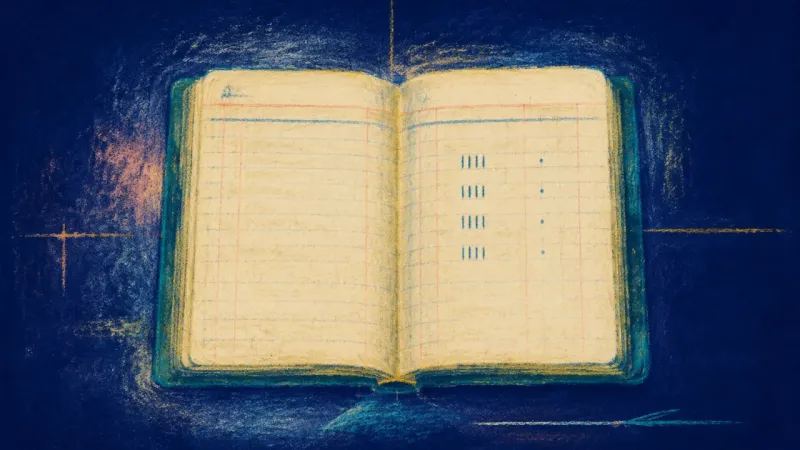
Seven days later, Jordan texted me a photo—not of a milestone, not of a new title. Just her Notes app. At the top it said: “Private Wins (Week 1).” Under it: three bullet points, plain and unpretty. Two focused work blocks. One message sent for an informational chat. One walk on a day she usually would’ve stayed on the couch doomscrolling.
“I didn’t post any of it,” her message read. “I wanted to, though. But I didn’t. And weirdly… it felt more real.”
Her follow-up was softer, honest in a way I trust: “I still had the stomach-drop once. I still wanted to rewrite my whole life at midnight. But I did the 10-minute reset and went to sleep. I woke up scared I’d regret not ‘figuring it out’… and then I laughed a little, because I realized I’m learning a different pace.”
That’s what a Journey to Clarity actually looks like. Not a dramatic reveal. A quiet shift from “I need a verdict” to “I can build trust.” From career crossroads panic to one repeatable step that makes your life feel like yours again.
When an old photo turns your chest tight and your stomach hollow, it’s not because you’re failing—it’s because you’re trying to feel proud in your own pace while fearing that anything less than a visible milestone means you wasted your potential.
If you didn’t have to ‘catch up’—just had to rebuild trust in yourself—what’s one small, repeatable thing you’d be willing to show up for this week?
Every reading at AceTarot is a Journey to connect with inner wisdom and empower next step.
Learn more about our Journey to Clarity.