When Three Tabs and a Lease Deadline Became a Values-Led Choice

Finding Clarity in the Sunday-Night Three Tabs
When someone comes to me saying, “I have options,” while their browser history is basically apartment listings, city comparison notes, and unsent group-chat drafts, I already know the flavor of panic they are bringing me.
That was Jordan (name changed for privacy), a 29-year-old remote product marketer in Toronto, who sat down with me and asked, “My lease is up, my job’s remote, my people are here—what am I choosing?” I hear this kind of analysis paralysis around renewing a lease or relocating when remote-work freedom collides with belonging more often than people think, but hers had a particularly familiar ache to it.
As she spoke, I could see the scene she described as clearly as if I had been standing in her kitchen: 11:26 on a Sunday night, three browser windows open side by side, the fridge humming, cold tea abandoned by her elbow, the blue laptop light drying out her eyes. One tab held the lease-renewal email, one held apartment listings in a city she kept calling a “casual option,” and the third held a half-written message to the group chat where Thursday drinks, birthday brunches, and ordinary weeknight life kept reminding her what she might be leaving.
She told herself it was a housing decision, but I could hear what her body already knew: it was also about whether freedom would cost closeness. Her uncertainty had the feeling of a live charger pressed against the ribs—a low electrical buzz in the chest, nowhere for the current to go.
I told her gently what I tell many people in a belonging-versus-freedom dilemma: she was not failing a simple adult task. She was trying to make one lease decision carry grief, identity, longing, guilt, and possibility all at once. “You’re not weak for feeling the cost of a real choice,” I said. “Let me help you draw a map through the fog. We don’t need perfect certainty tonight. We need clarity about what this decision is actually asking of you.”

The Compass I Chose: A Decision Cross for a Stay-or-Move Question
I asked Jordan to put both feet on the floor, take one slow breath, and say her question once without editing it for anyone else. Then I shuffled slowly. For me, that pause is not theatre. It is simply a bridge: a way to help the nervous system step out of scroll mode and into attention.
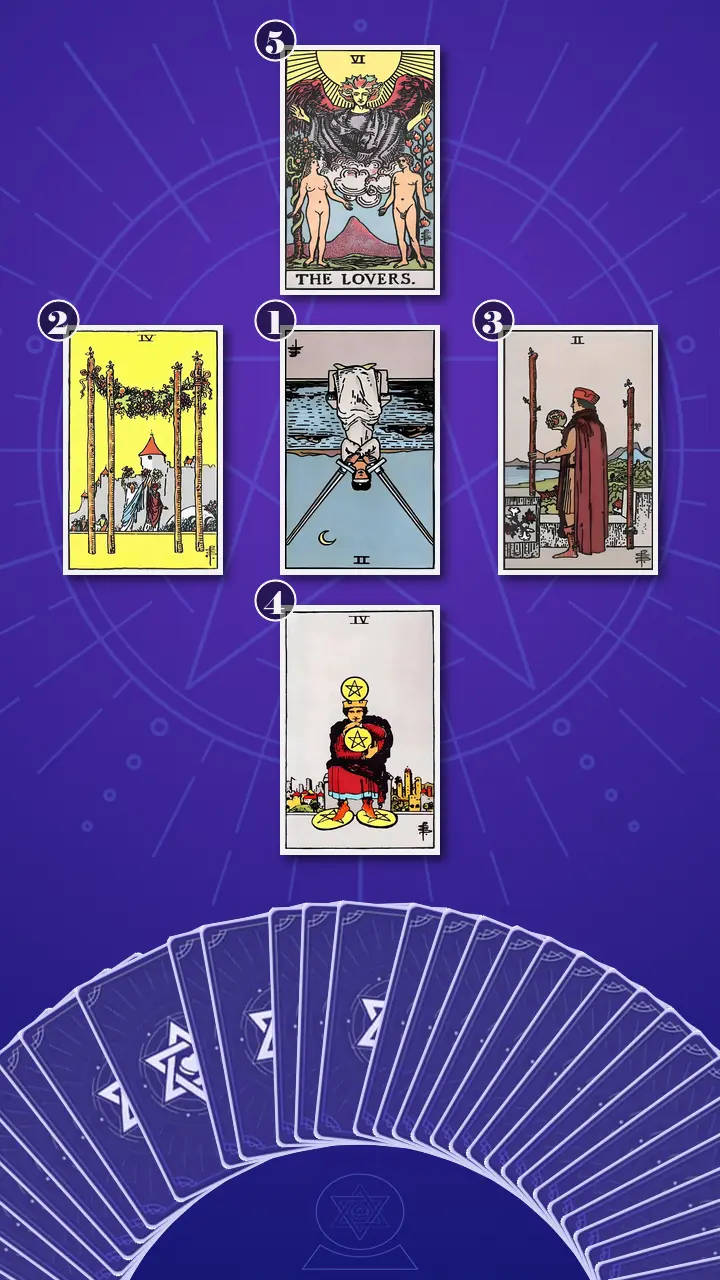
I used a five-card Decision Cross, one of the clearest tarot spreads I know for a stay-or-move question. For readers who wonder how tarot works in a practical decision like this, this Decision Cross tarot spread for a lease-renewal versus relocation choice is useful because it separates the visible housing choice from the deeper psychological choice underneath it.
Five cards are enough to track the whole arc cleanly: the present knot, what staying genuinely offers, what moving genuinely opens, the hidden fear weighting both paths, and the guidance card that brings the decision back to values instead of panic. I was not asking the cards to hand down a postcode from the heavens. I was using them the way I always do—as a mirror with structure, so card meanings stay in context and the logic remains tight.
I told her I would pay close attention to three places in particular: the center card, because it would show the decision exactly as she was living it; the lower card, because that is often where the real fear sits in the body; and the upper card, because clarity usually arrives when the question is lifted above reactivity.
Reading the Crossroads Before the Deadline
Position 1: The Loop That Calls Itself Research
I turned the card representing the present knot: the observable indecision around whether to renew the lease or use remote-work flexibility to relocate. It was the Two of Swords, reversed.
I almost nodded before I spoke, because it was exact. This was Jordan at the kitchen table with a lease email in one tab, a city roundup in the second, and a half-written “What would you do?” text in the third. Every time she got close to setting actual decision criteria, she opened a new note, added another column to the comparison doc, or asked one more friend for input. It looked responsible from the outside. In truth, it was the mind protecting the heart from the fact that either path carried loss.
Reversed, the Two of Swords gives me Air energy in excess and in blockage at the same time: lots of thinking, very little clarifying. The blindfold becomes emotional self-editing. The crossed swords over the chest become using analysis to keep feeling out of the room. It is like having 27 tabs open and calling it a decision-making process when what is really happening is an emotional firewall. More information is not always more truth.
Jordan let out one short laugh that had more ache than humor in it. “Okay,” she said, rubbing one thumb against the edge of her mug. “That’s accurate enough to be a little mean.”
“Not mean,” I told her, “just precise. I’m not interested in mocking the part of you that built this strategy. It has been trying to protect you. But protection can harden into gridlock. What I’m seeing here is not missing data. It’s a nervous system hoping one more tab will spare it from feeling the finality built into a real choice.”
Position 2: The Life That Already Knows Your Name
I turned the card revealing what staying in her current city genuinely protects and nourishes, especially community, familiarity, and everyday belonging. It was the Four of Wands, upright.
This card is the decorated threshold, the welcoming archway, the life you can walk into without explaining yourself first. In Jordan’s world, it looked like texting three people on a Wednesday and having dinner plans within the hour. It looked like familiar streets, a neighborhood that remembered her back, birthday tables, casual weeknight hangs, and the soft social scaffolding that makes a city feel less like an address and more like a living container.
This is Fire in balance, but rooted Fire. A hearth, not a flare-up. That mattered. Staying was not automatically fear, inertia, or playing small. This path held real warmth and real structure. It preserved a form of belonging that already existed in the week-to-week fabric of her life.
I watched her face soften as I said it. Her jaw unclenched for the first time. “That’s the part people skip,” she said quietly. “Everyone talks about freedom like it’s obviously better. Nobody talks about what it means to already be in the middle of a life.”
Position 3: The Horizon That Isn’t a Betrayal
I turned the card showing what leaving or relocating opens up, especially freedom, expansion, and the self that wants to test a wider horizon. It was the Two of Wands, upright.
I was glad to see it. This is not my card for reckless escape. It is my card for authorship. Jordan’s fully remote job gave her the rare gift and burden of true flexibility, and remote work can create a strange modern problem: freedom without enough structure, so every next move starts feeling existential. The Two of Wands named the part of her that wanted a broader horizon on purpose—a different daily rhythm, a life not organized around one familiar radius, the chance to choose rather than simply inherit the next chapter by momentum.
This is Fire reaching forward in balance. Not reinvention for the aesthetic of a TikTok montage. Not moving just because other people’s Close Friends stories make starting over look cinematic. More like zooming out on Google Maps and realizing your life does not have to stay inside one saved cluster of coffee shops, transit routes, and local habits forever.
Jordan exhaled through her nose, slow and steady. Her fingers, which had been curled inward most of the reading, opened flat against her notebook. “That’s it,” she said. “I don’t want to leave just because I can. I also don’t want to stay just because I’m scared.”
Position 4: The Grip Beneath the Logistics
I turned the card below the center, the position that uncovers the deeper fear or attachment turning a practical decision into a test of safety, belonging, and self-trust. It was the Four of Pentacles, upright.
This was where the reading dropped out of the head and into the body. I could hear it all at once: renew so I do not have to test whether closeness survives distance; keep the apartment half-settled so nothing feels final; talk fast about rent increases, moving costs, and market timing while my shoulders creep up and my chest locks down. The pentacles in the image pin the figure at head, heart, and feet. Thinking locks. Feeling locks. Movement locks.
One of my own diagnostic lenses is what I call a Home Energy Diagnosis. When someone is stuck, I listen to the space they are inhabiting almost as carefully as I listen to the cards. Jordan had already told me her apartment was still slightly provisional—no proper rug, art never hung, corners undecided, a life kept on standby in case she needed to bolt. To me, that was Four of Pentacles all over: not freedom, not minimalism, but a grip response. Choosing from clench instead of clarity.
And at that moment the missing element in the spread became obvious. We had Swords, Wands, Pentacles—but not a single Cup. No Water anywhere. She had translated grief, longing, and guilt into logistics. Sometimes the spreadsheet is just grief in business casual.
Her reaction came in a clear little chain. First, her breath stopped for a beat. Then her eyes went slightly unfocused, as if she were replaying every dinner where someone had casually asked, “So are you renewing or leaving?” Finally, her shoulders dropped and her palm went straight to the center of her chest. “Yes,” she said, almost under her breath. “That’s why it feels so much bigger than housing. It’s the fear that if I loosen one thing, everything else comes loose too.”
“Exactly,” I said. “And you are not weak for feeling the cost of a real choice. Caution is protecting something precious. But when it is overused, it turns into self-confinement.”
When The Lovers Stood Under One Sky
Position 5: The Choice Beneath the Choice
When I turned the final card, the room went quiet enough that I could hear the rain thinning against my window. I have spent a lifetime with Highland weather, and I know this much: mist is not the absence of landscape. It is only a condition of seeing. This was the card that changed the visibility of the whole question.
The card clarifying what she was actually choosing beneath the logistics—the internal compass for a values-aligned next step—was The Lovers, upright.
Jordan was still holding the old split so many people bring to me: if I stay, maybe I am playing small; if I go, maybe I am leaving the good part behind. She was trying to make one lease decision behave like a verdict on identity. That is exhausting, and it guarantees that no option ever feels clean enough to trust.
The Sentence That Changed the Room
Not the old split of "love or freedom," but a choice that lets head and heart stand under one sky, like The Lovers.
I let that sit between us for a moment. Then I said the plainer version. “You are not only choosing a city. You are choosing what gets to lead: fear or values.”
This is where the whole reading turned toward making a values-first city choice instead of waiting for one location to guarantee belonging. One of the ways I read The Lovers through my own practice is with that same Home Energy Diagnosis lens. I do not begin with square footage or the smartest-looking neighborhood. I begin with climate. What kind of inner weather is this life being built under? The Lovers told me Jordan did not need a magical city that could promise she would always feel central, connected, and brave. She needed the option in which her work rhythm, relationships, and sense of aliveness could stand together without splitting her in two.
Her reaction came in three waves. First, stillness: even her fingers stopped moving, suspended over the notebook. Then recognition: her gaze drifted slightly past me in that faraway way people get when memory starts re-sorting itself in real time. Then release: she exhaled so slowly it almost sounded like a laugh, and the tightness around her mouth gave way. Relief came first—but right behind it was that strange, lightheaded vulnerability that sometimes follows clarity, when the burden lifts and the responsibility of choosing returns to your own hands.
“So I’ve been asking the wrong question,” she said at last, voice quieter now. “I’ve been asking which city proves something about me, instead of which life actually matches what matters right now.”
“Yes,” I said. “Now use that lens. Think back to last week. Was there a moment when this insight would have made you feel different?”
She nodded slowly. “Thursday,” she said. “The group chat was planning drinks, and I felt my whole body tense. I thought I was panicking about whether to move. But really I was grieving the idea of becoming less local to the people I love. That’s different. I can work with that.”
That was the real turning point: from chest-tight lease renewal panic to steadier self-trust about building home intentionally. Not total certainty. Something better. Honest alignment.
From Clench to Clarity: The Next 7 Days
By then, the story the cards were telling was beautifully coherent. The reversed Two of Swords showed the surface problem: a mind looping hard enough to look productive while emotion stayed edited out. The Four of Wands showed that staying preserved something real—community, rhythm, ordinary belonging. The Two of Wands showed that moving was not disloyalty but a genuine invitation toward authorship and expansion. The Four of Pentacles showed the hidden weight beneath both paths: the wish to keep access, safety, and possibility perfectly intact, as if no real choice should require grief.
The blind spot was equally clear. Jordan had been treating one housing decision like a verdict on her identity, while hoping one city might guarantee belonging forever. It cannot. No postcode can do that. The transformation direction was simpler and braver: stop asking which option removes loss, and start choosing the one that best matches current values—then build the relationships and routines that make that choice feel like home. Belonging is not guaranteed by a postcode; it is maintained by attention.
I did not tell her where to live. I gave her a values-first framework and a few practical next steps that could move her from insight into action without forcing a dramatic leap.
- The Next 12 Months NoteOpen a fresh note called “Next 12 Months.” Write exactly two values that matter most in this season—something like “weekly in-person community” and “more intentional space and pace.” Score only your real options against those two values from 1 to 5, then say out loud to one trusted friend, “I do not need you to choose for me. I just want to hear myself name what matters.”This is a clarity tool, not a committee process. If you feel the urge to add eight more criteria, stop at two and leave it there for one night.
- The 20-Minute Fear-vs-Information CheckFor the next seven days, set one 20-minute decision session and stop when the timer ends. At the end, write one feeling word and one loss word. If your chest starts buzzing while you research, put both feet on the floor and ask: is this fear, grief, guilt, or actual missing information?Before you open a tab, borrow my three-minute home-energy check: look at a houseplant, a windowsill herb, or the most neglected corner of your flat and ask what in your life is being watered—and what is being kept on standby.
- The One-City-at-a-Time RulePick one destination city for this week only. Give it a 30-minute reality check: one neighborhood, one rent range, one coworking setup, and one realistic route back to Toronto. If it still feels alive after that, plan one low-stakes expansion experiment instead of a whole new identity.Do not research five cities at once. One live option is information. Five is self-abandonment dressed up as diligence.
I wanted her next week to be structured, not dramatic. Clarity often arrives that way—through boundaries that are small enough to keep the truth from getting buried under performance.

A Week Later, the Jaw Was Looser
A week later, Jordan sent me a photo of a notes app page titled “Next 12 Months.” Under it were only two lines: “weekly in-person community” and “breathable pace.” She had stopped polling the group chat. She had stopped opening five city tabs at midnight. She chose to renew her Toronto lease for another year—not as surrender, not as default, but as a decision she could actually stand inside—and she booked a three-day summer scouting trip to the other city so her horizon did not have to vanish just because it was not chosen first.
Her message ended with a sentence I have not forgotten: “I still felt sad when I hit send, but I didn’t feel split.” To me, that is the quiet proof. She sent the renewal, then sat alone in a café with sunlight on the table and let herself miss the unlived version of the other city for one honest hour.
That is what a real Journey to Clarity often looks like in my work. Not a perfect ending. A truer beginning. From outsourced certainty to honest alignment. From deadline anxiety to a steadier trust that home can be built intentionally, wherever life is being asked to root next.
Sometimes the tightest part of the decision is not the rent or the map—it is the sick, chest-tight fear that one choice could turn you from part of the picture into a visitor in the lives you love.
If tonight you are in your own three-tabs moment, and this stay-or-move decision does not have to prove where you belong forever, what next small under-one-sky step would feel most honest to your values right now?