From On This Day Longing to Steadier Love: Breaking the Replay Loop

The 8:56 p.m. “On This Day” Spiral
If you’re a London marketing manager who can run a Monday meeting like it’s nothing, but one “On This Day” notification can wreck your whole evening—welcome to the nostalgia spiral.
Taylor (name changed for privacy) told me the moment like it was a scene her body had memorized. 8:56 p.m. on a Tuesday in her London flat. She was still in work clothes, one heel kicked off, the radiator clicking like it had opinions. The overhead light was slightly too bright—the kind of bright that makes your own thoughts feel louder.
Her phone buzzed: On This Day. She tapped it. The screen glow warmed her palm. And her throat tightened like she was about to speak—out loud—to a person who wasn’t there. She said, “I told myself it was just a memory. But my thumb was already heading for the WhatsApp thread.”
I watched her hands while she spoke. Restless. A little too quick, like they were trying to get to the answer before her heart caught up. What she was asking me wasn’t “Should I text my ex?” Not really. It was deeper, sharper: “What past love pattern is replaying? Why does a single clip make me feel like the past is unfinished—and like I’m about to repeat it?”
The longing in her wasn’t soft and romantic. It was physical—like trying to swallow with a tight throat, like standing on an escalator that suddenly moves the wrong direction. And under it, the quiet fear she couldn’t quite say without hating how it sounded: letting go might mean losing proof that she was lovable.
“Okay,” I said, gentle but steady, the way I speak to someone who’s already been hard on herself all week. “Let’s not make this about willpower or shame. Let’s make it about clarity. We’ll take what your nervous system is doing seriously, and we’ll give you a map for what to do the next time the algorithm tries to hand you the past like a gift.”

Choosing the Compass: How the Celtic Cross Works for a Pattern Replay
In my café, I’ve watched people reach for a second coffee for reasons that aren’t about caffeine. Sometimes it’s comfort. Sometimes it’s focus. Sometimes it’s a way to stay seated in a feeling without admitting that’s what they’re doing.
Tarot, for me, works the same way. Not as fate. As focus.
I asked Taylor to take one slow breath—not to “clear energy,” but to let her body arrive in the room. I shuffled slowly, the familiar sound like cards whispering against each other, and I told her, “We’re going to look at the Celtic Cross spread today.”
For anyone reading along: the Celtic Cross is a classic fit for questions like “why does this keep happening?” because it separates the trigger from the unconscious root, the recent imprint from the current story, and—most importantly—the integration pathway from the compulsive loop. It’s one of the clearest ways to explore card meanings in context without turning the reading into a prediction about a specific person’s behavior.
I pointed to the center of the layout as I built the cross. “This first card is the present trigger—what the ‘On This Day’ memory activated in you right now. This crossing card shows what has its grip on you, what makes it hard not to reenact. And this card on the right—near future—shows the shift that’s available, the next phase you can choose.”
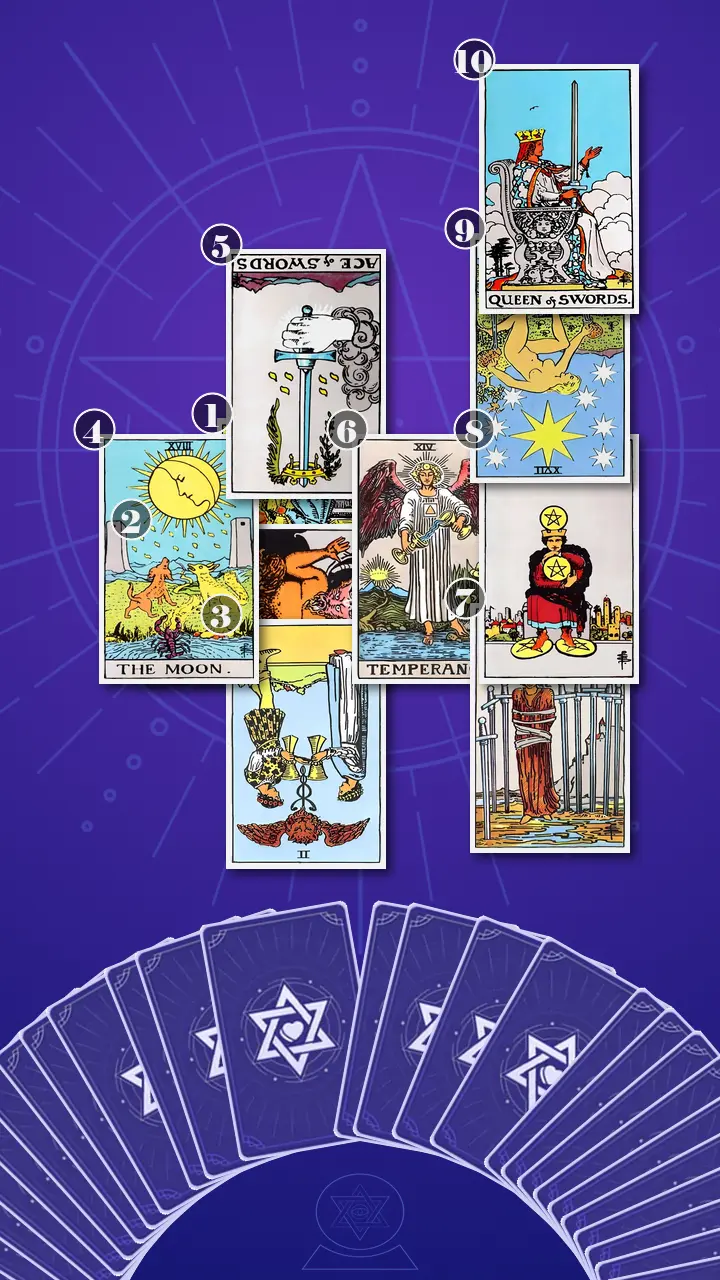
Reading the Map: Highlight Reels, Chains, and the Need to Make It Make Sense
Position 1: The present trigger—what the “On This Day” memory activated
“Now I’m turning over the card that represents the present trigger—what the ‘On This Day’ memory activated in you right now,” I said.
Six of Cups, reversed.
I tapped the image lightly. “This is the card of nostalgia and emotional time-travel. Reversed, it’s not a gentle ‘aww, remember.’ It’s selective. Like your phone’s On This Day feature is an auto-playing highlight reel that skips the hard scenes.”
And I used the translation that always lands with people living inside a scroll: “It’s like you get the notification, and the curated memory arrives wrapped like a little present—a sweet cup of flowers. Your brain treats it as evidence: ‘See? It was real. It mattered. It could’ve worked.’”
Then I gave her the split-screen that I could already see playing behind her eyes.
“Part of you is like: I just want to feel close for one minute. And another part of you knows: that minute is expensive. One minute becomes forty. Deliveroo bag on the floor, tea going cold, screen glow in your face, and suddenly you’re deep in the thread like it’s research.”
Taylor let out a sharp exhale—and then she did something that surprised her. She laughed. Small. Embarrassed. Bitter at the edges.
“That’s… so accurate it’s kind of cruel,” she said, but her eyes were wet in that way that isn’t crying yet—just recognition.
I nodded. “It’s not cruel. It’s clean. And it’s normal. The algorithm is designed to hand you sweetness first. But here’s the line I want you to borrow this week: A memory isn’t a map back. It’s data. Not direction.”
Position 2: The repeating pattern’s grip—what makes it hard not to reenact
“Now I’m turning over the card that represents the repeating pattern’s grip—what makes it hard to stay in the present and not reenact the bond,” I said.
The Devil, upright.
People hear “Devil” and tense up, expecting a moral lecture. I don’t read it that way. I read it like I read the dessert case in my café: you’re not weak for wanting the thing. But you do need to know what the wanting is doing to you.
“This is compulsion,” I told her. “Not because you’re dramatic. Because something in this attachment loop gives you a hit: closeness, control, reassurance. The Devil is an app with infinite scroll. It isn’t a character flaw—it’s a design. And it keeps you hooked.”
I pointed to the loose chains. “See how they’re not even tight? This is the part where you could stop, but you don’t. ‘Just one minute.’ ‘Just a quick check.’ And suddenly you’ve given the past your whole nervous system.”
Taylor went still. Her shoulders rose toward her ears without her noticing. Her phone, sitting face-down on the table, might as well have been vibrating.
Position 3: The underlying love pattern—the foundational dynamic beneath the surface
“Now I’m turning over the card that represents the underlying love pattern—the foundational dynamic that keeps replaying beneath the surface,” I said.
Two of Cups, reversed.
“This is the part most people don’t want to admit,” I said softly. “Because it doesn’t match the highlight reel.”
I used the modern translation exactly as it is in real life: “This is like remembering the chemistry and the ‘specialness,’ but forgetting how often you had to initiate, interpret, or wait for basic clarity.”
Reversed, the Two of Cups isn’t “no love existed.” It’s “the exchange wasn’t balanced.” Energy-wise, this is blockage—mutuality trying to happen, but the channel is uneven. One person over-functions: soothing, explaining, waiting, proving. The other stays slightly out of reach.
Taylor’s jaw clenched, then loosened. “I hate that I hear that and I instantly know what you mean,” she said.
“That’s the diagnosis,” I replied. “Not a verdict. And it matters because if the foundation wasn’t mutual, then reaching back for closure is like trying to renovate a building that never had stable plumbing.”
Position 4: Recent past imprint—what the earlier relationship taught your nervous system to expect
“Now I’m turning over the card that represents the recent past imprint—what the earlier relationship taught your nervous system to expect,” I said.
The Moon, upright.
“This is the maze,” I said, and I traced the winding path between the towers. “Ambiguity. Mixed signals. Projection. The Moon is when intuition and anxiety wear each other’s clothes.”
In modern terms: decoding WhatsApp timestamps like tea leaves. Reading emoji punctuation like a prophecy. Feeling like you’re in a “Normal People” episode where the intensity seems meaningful, but the day-to-day reality is fog.
Energy-wise, the Moon is excess—too much meaning-making, too little daylight. It trains your nervous system to expect that love is something you solve, not something you receive.
Taylor’s eyes drifted to the window as if she could see her old self on that path. The café’s espresso machine hissed behind the counter at exactly the wrong moment—an environmental co-conspirator, making the room feel briefly surreal.
Position 5: Conscious story—the explanation you’re trying to make true about the past
“Now I’m turning over the card that represents the conscious story—the explanation you’re currently trying to make true about the past,” I said.
Ace of Swords, reversed.
She didn’t even wait for me to finish. “That’s the Notes app,” she said, half-laughing.
“Exactly,” I replied. “This is blocked clarity. It’s the fantasy that if you find the perfect sentence, you’ll finally know what it meant. But the sword can’t cut cleanly through the clouds, so you keep swinging.”
I let it sound like her internal monologue—tight, listy, treadmill-fast:
“If I say it like this… If I soften it… If I sound casual… If I don’t mention the memory… If I mention it but not too much…”
Energy-wise, this is deficiency in truth. Not because you don’t know the truth—because you keep demanding a truth that comes with zero discomfort. And that kind doesn’t exist.
I paused, because this is where shame usually tries to sneak in.
“Clarity isn’t a mood,” I said. “It’s a practice.”
When Temperance Poured Between Two Cups
Position 6: The shift that’s available—what can interrupt the replay next
I felt the reading gather itself the way a room quiets just before a song changes. “Now I’m turning over the card that represents the shift that’s available—what can help you interrupt the replay in the next phase.”
Temperance, upright.
Setup—because I wanted to name the exact trap before offering the door out of it.
You know that moment when your phone lights up with “On This Day,” and suddenly you’re back there—warm, sad, and weirdly urgent—like if you don’t do something right now, you’ll lose your chance to make the story make sense.
Not ‘one more replay will give me closure,’ but ‘I can blend love and truth like Temperance pouring between cups—and choose a calmer next step.’
I let the sentence hang. No fixing. No rushing. The espresso grinder in the back went silent, and for once the quiet didn’t feel like pressure—it felt like space.
Reinforcement came in layers, the way real insight does. First: her body.
Her breathing stopped for half a beat. Her fingers froze mid-fidget, hovering over the edge of her sleeve. Then her gaze softened—not happy, not relieved exactly, more like something unhooked. The tight line at her mouth broke, and she swallowed, slow, like she was letting herself taste a truth she’d been spitting out for months.
“But if I don’t text,” she said, and her voice thinned, “it feels like I’m admitting I wasn’t chosen.”
There it was—the hidden underlayer.
“I hear that,” I said. “And I’m not going to argue with your longing. Temperance doesn’t argue. Temperance integrates. It says: you can miss it and still not reopen it.”
This is where my café brain becomes my tarot brain. I’ve made coffee for twenty years, and one thing is always true: when you stir too fast, you get foam and chaos. When you let grounds settle, you can see what’s actually in the cup.
That’s my Conflict Sedimentation lens. We don’t “fix” the feeling by shaking it harder. We let it settle long enough to see: what’s sweetness, what’s sediment, and what’s just caffeine pretending to be love.
“Set a 7-minute timer,” I told her. “Put your phone face-down—better yet, in another room if you can. On paper, write two lines: (1) ‘What I loved:’ three specific moments. (2) ‘What I paid:’ three specific costs. If your body tightens, pause and just breathe. You can stop at any time. Only after the timer ends do you decide whether to open the chat thread.”
Her reaction came as a three-step chain, so subtle you’d miss it if you were only listening to words: (1) shoulders dropping a centimeter; (2) eyes going unfocused, replaying something private; (3) a long, shaky exhale that sounded like oh.
“I can do that,” she said. “That’s… a third option.”
“Exactly,” I replied. “This is the shift from trying to get certainty from the past to building self-trust through one present-day boundary and one present-day choice. That’s how you move from being hijacked to having agency.”
After the Pour: The Chain, the Blindfold, and the Boundary Voice
Position 7: Your role in the loop—the reflex you default to when triggered
“Now I’m turning over the card that represents your role in the loop—the self-belief you default to when you’re triggered,” I said.
Eight of Swords, upright.
“This is the blindfold moment,” I said. “The second the memory hits, your options collapse into two: text or suffer. That’s the trap. The Eight of Swords is perceived powerlessness.”
In modern life: the warm phone in your palm, shoulders tense, throat tight, and a thought that sounds like a fact—I can’t move on until I get closure from them.
Energy-wise, it’s blockage in agency. The bindings are loose. The gap is there. But the brain doesn’t look for gaps when it’s chasing reassurance.
I asked her, “What choice would you make today if you didn’t need their response to validate it?”
She blinked hard, as if the question changed the lighting in the room. “I’d stop giving them my evenings,” she said quietly.
Position 8: The context—habits and cues that keep the past loud
“Now I’m turning over the card that represents the context—habits, environment, and cues that keep the past accessible and emotionally loud,” I said.
Four of Pentacles, upright.
“This is the grip,” I said. “Control impersonating safety.”
In Taylor-language: keeping the chat archived. Keeping the photos. Keeping access one tap away because deleting feels like losing—even when keeping it costs your peace.
Energy-wise, it’s excess in guarding. You hold so tightly that nothing new can reach you. And then you interpret the lack of newness as proof the past was your only real option.
Position 9: Hopes and fears—the tender stake underneath it all
“Now I’m turning over the card that represents hopes and fears—what you’re scared letting go might mean about love and your future,” I said.
The Star, reversed.
This one always lands like a quiet ache. “This isn’t only about them,” I told her. “This is: What if I don’t get that kind of love again? Or worse—what if moving on means settling?”
I gave her the metaphor gently, like placing a cup down instead of slamming it: “Comparison is a hope leak. A present date can feel ‘grey’ only because you’re holding it next to a curated highlight reel.”
Then, in second-person—because sometimes it’s the only way to say the truth without flinching: “You’re not missing a person. You’re testing whether hope is still allowed.”
Taylor nodded once, slow. Her eyes dropped to the table. “Yeah,” she said. “It’s like… if that was my last shot at real love.”
“It wasn’t,” I said, not as a promise about the future, but as a truth about how humans work. “But your nervous system needs evidence. Receipts, not hype.”
Position 10: Integration—the healthiest response to future memory-triggers
“Now I’m turning over the card that represents integration—the healthiest way to respond to future memory-triggers without reenacting the past,” I said.
Queen of Swords, upright.
Her face changed before she spoke. Something in her liked this card. Not because it was cold—because it was clean.
“This is you with boundaries that don’t debate,” I said. “Tender and clear. The Queen of Swords is self-respect with an open sky.”
I kept it script-like, on purpose—because this is where people need language, not poetry.
“You can say: ‘I miss it, and it still wasn’t mutual.’ You can say: ‘If it needs decoding, it isn’t steadiness.’ You can set Do Not Disturb like it’s not a punishment, but a policy.”
And I watched her posture shift: chin lifting, spine longer. Not performative confidence—just the body remembering it has a choice.
The One-Page Boundary Menu: Actionable Advice for the Next Trigger
Here’s the story the spread told, start to finish: a sweet memory (Six of Cups reversed) hits like a gift, and immediately the compulsion engine turns on (The Devil). Underneath, the original bond wasn’t as mutual as the highlight reel makes it feel (Two of Cups reversed), but your nervous system learned to treat ambiguity as meaning (The Moon). So your mind tries to think its way into peace—drafting, editing, decoding (Ace of Swords reversed). The bridge out isn’t more analysis or contact. It’s regulation and integration first (Temperance), so you can see your options again (Eight of Swords), loosen the grip of “just in case” access (Four of Pentacles), rebuild hope with real evidence (Star reversed), and speak to yourself with clean, dignified boundaries (Queen of Swords).
The cognitive blind spot here is subtle: you’ve been treating the past as the judge of your worth. Like if you can get the right explanation—or the right response—you’ll finally be allowed to move on. The transformation direction is the opposite: boundary-first clarity. One present-day boundary. One present-day choice. Self-trust built in small reps.
So I gave Taylor three next steps—small enough to start, specific enough to work.
- The Temperance Pause (Regulate first, decide second)When “On This Day” hits, do one regulating action before touching the chat thread: make tea, take a quick shower, or walk to the end of the street and back (no headphones—just breathing).Expect resistance (“this is dramatic”). Make it smaller: the 2-minute version counts. If you slip and check, don’t punish yourself—restart at the next moment.
- Two-Column Reality Check (What I loved / What I paid)Open Notes (or, better, paper) and write two columns: “What I loved” (3 specific moments) and “What I paid” (3 specific costs) before deciding whether to contact anyone or open the archived chat.Set a 7-minute timer. Stop when it ends, even if it’s incomplete. The goal isn’t a perfect list—it’s interrupting the highlight reel with reality.
- Queen of Swords Boundary Draft (A one-sentence policy)Write one clear rule you can live with for 7 days—e.g., “No ex-profile checks after 9 p.m.” Then change one cue: move Instagram off your home screen or set a Screen Time limit you won’t override in bed.If a hard boundary feels too intense, choose a softer version: mute instead of block; move photos to Hidden instead of deleting. Your attention is a boundary, too.
Before she left, I pulled her an espresso—because in my world, you don’t do hard emotional work on an empty cup. I told her one more thing, from my other signature lens, Relationship Stage Diagnosis: “Right now, your longing is like an espresso shot—strong, concentrated, fast. Temperance teaches you how to add water and time, like turning it into an Americano. Same coffee. Different impact on your body.”

A Week Later: Ownership, Not Certainty
A week later, Taylor messaged me at 7:18 a.m. It wasn’t a paragraph. Just: “On This Day popped up. I did the tea + walk first. Wrote ‘What I loved / What I paid.’ Didn’t open the thread. I still missed it, but I didn’t reopen it.”
It was a small proof, not a perfect ending. She told me she slept a full night, then woke up with the first thought still there—What if I’m wrong?—but this time she sat up, exhaled, and smiled like she’d remembered something important: she didn’t need the past to give her permission to be okay.
That’s what a real Journey to Clarity looks like in everyday life. Not a dramatic purge. Not a sudden certainty. Just steadiness you can repeat.
When a single “On This Day” clip can tighten your throat and make your thumb reach for the chat thread before you’ve even decided, it’s not that you’re ‘not over it’—it’s that letting go still feels like it would erase the only proof you were worth choosing.
If you didn’t need the past to validate you today, what’s one small boundary or choice you’d try—just for the next 24 hours—to protect your attention like it matters?