When Friends Call Out Red Flags and You Start Seeing the Pattern

When Friends Point Out Red Flags and You Defend Him Harder
I know this pattern immediately: the late-20s agency woman who can write a bulletproof client rationale by day and a bulletproof defense of her situationship by 11:47 p.m. after a friend texts, 'that doesn’t sound okay.' When Sophie (name changed for privacy) sat with me, a 27-year-old account coordinator from Toronto, she was carrying exactly that kind of heat in her body.
She described Tuesday at 11:38 p.m. in her west-end bedroom so vividly I could almost hear it with her: phone glow in the dark, a streetlamp leaking through the blinds, the radiator hissing, the phone hot in her hand while she screenshotted her friend’s worried text and opened Notes to draft a point-by-point defense before she had even let herself admit what had felt off. 'I just think people are being too harsh on him,' she said. Then, a beat later: 'It sounds worse when I say it out loud.'
That was the real split in the room: protecting the relationship versus facing what the red flags might mean. Her defensiveness sat in her body like a hand gripping a cracked glass tighter and tighter, as if pressure alone could keep it from breaking. I could see the tight chest, the hot face, the braced shoulders; fear and shame were sitting just underneath the logic.
I told her, gently, 'I’m not here to talk you out of wanting the connection. I’m here to help you see what your body already knows and your mind keeps trying to negotiate with. Let’s make a map through the fog and see where clarity actually begins.'

Choosing the Shadow Spread for Relationship Clarity
I asked her to put both feet on the floor and take one slow breath while I shuffled. Then I touched a blotter strip with cedar and bergamot and laid it beside the deck. After fifteen years in fragrance, I use scent as a focusing rail, not as theatre; it gives the nervous system something steady to land on before the mind starts litigating.
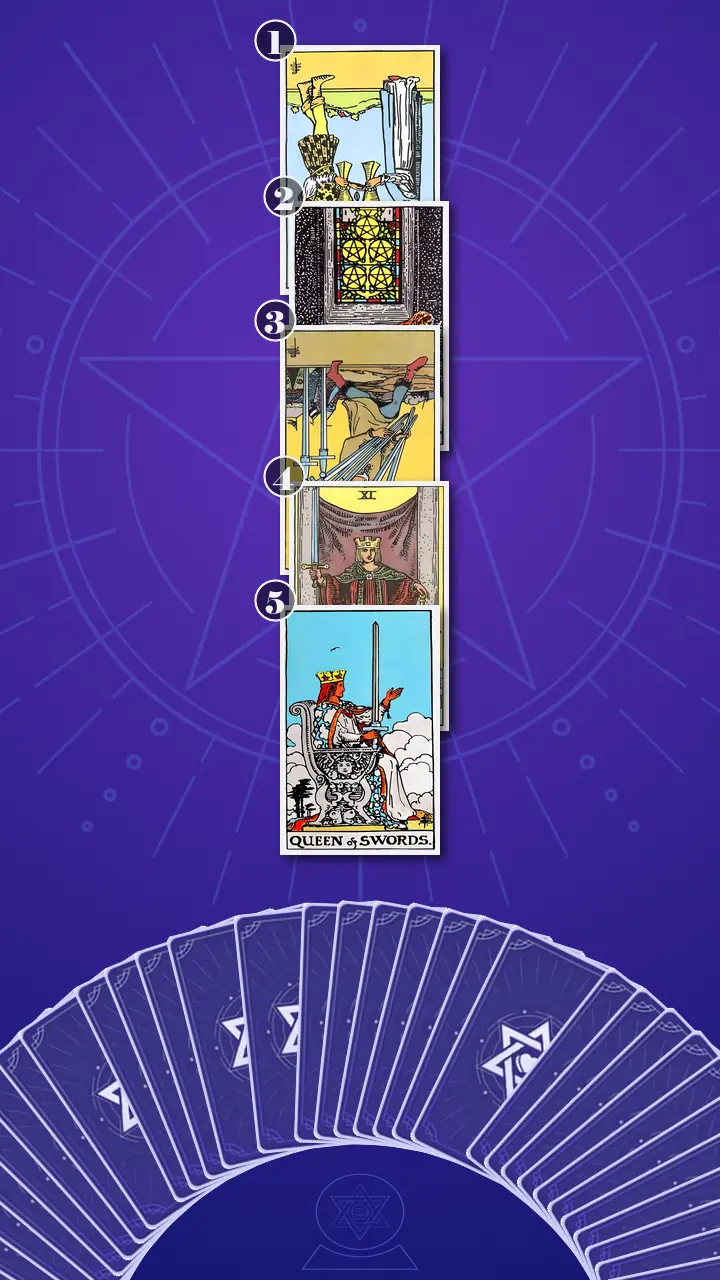
For this question, I chose a five-card Shadow Spread. For me, it is one of the best tarot spreads for relationship red flags when the real issue is not only the partner’s behavior, but the reflex to explain it away. A larger spread would add noise. A three-card pull would flatten the psychology. This one lets me trace the full chain cleanly: the visible reaction, the hidden wound, the protective distortion, the clarifying truth, and the embodied next step. That is how tarot works best in modern dating questions—not as fortune-telling, but as pattern recognition with symbols and timing.
I told her where we were going. The first card would show the conscious habit of defending the story of 'us.' The second would reveal the deeper fear underneath. The third would name the shadow strategy she uses to manage discomfort. The fourth—our key turning card—would show the truth strong enough to interrupt the loop. And the fifth would show how self-trust becomes something lived in conversation, texting, and boundaries.
Reading the Basement of the Pattern
Position 1: The Idea of Us Working Overtime
Now turning the card for the concrete defending behavior currently asking for attention, I found the Two of Cups, reversed.
I stayed with the image first: joined cups, clasped hands, the symbol of connection overhead. In reversal, that mutual flow strains. In Sophie’s real life, it looked exactly like 11:42 p.m. in her apartment: reopening screenshots and building a case in Notes for why his dismissive comment at dinner was just stress, because admitting it landed badly would threaten the idea that they had something real. This is Two of Cups reversed in dating: not a lack of feeling, but a relationship identity working harder than the actual exchange.
The energy here is blocked and overextended. Chemistry is loud. Reciprocity is inconsistent. Her first instinct is to protect the label of the bond before checking whether the bond itself is consistently mutual. It is like keeping the soft-launch story alive while the actual text thread keeps underdelivering. I asked her, 'Are you protecting mutuality—or protecting the hope that mutuality will return if you just stay loyal enough?'
She gave a short laugh with a wince inside it and looked down at her hands. 'Okay,' she said, rubbing her thumb over the edge of her phone, 'that feels a little too accurate.' It was the right kind of reaction—the moment a card stops sounding mystical and starts sounding like someone has read your Notes app.
Position 2: The Fear of Being Left Outside
Now turning the card for the underlying wound beneath that behavior, I found the Five of Pentacles, upright.
The image is cold on purpose: snow, a lit window, bodies outside warmth. I told her this card often appears when feedback does not land as feedback at all, but as exile. I could see her morning TTC commute in it immediately: damp coat from freezing drizzle, coffee lid rattling, an engagement carousel on Instagram followed by a condo-key handoff post, and that hollow drop in the chest that says everyone else has somehow made it indoors.
This is deprived Earth—the feeling that if this relationship fails, she will not just lose a person. She will be the one out in the cold, left behind, embarrassed, unchosen. The bond starts to feel like the last affordable apartment listing in the city, so every warning sounds like someone trying to close the only open tab for belonging. I told her, 'Belonging fear moves faster than discernment.' No wonder a friend’s simple concern can feel unbearable when the body translates it as: this could all collapse, and then what does that say about me?
Sophie went very still. Her eyes drifted toward my window, where evening rain had silvered the glass, and she let out one long breath through her nose. The pause had weight to it. When she finally nodded, it was with the expression people wear when shame has just been spoken plainly enough to stop hiding.
Position 3: The PR-Approved Version of the Story
Now turning the card for the shadow strategy that protects the wound but keeps the pattern in place, I found the Seven of Swords, reversed.
I love this card for its uncomfortable precision. The figure looks backward, carrying some swords away and leaving others behind. That is exactly what self-editing feels like. In Sophie’s life, it looks like Saturday brunch: a friend asks what happened, she leads with his stressful workweek, skips the line that made her stomach drop, and later rereads old sweet texts so she can believe her own cleaned-up version. She tells the true parts, just not the whole truth.
This is Air turned sideways—thought used as damage control. Because the fear underneath is so activated, the mind writes the PR-approved version of the relationship instead of the internal incident report. She crops the screenshot before she sends it to the group chat. She mutes the one detail that changes the whole thread. It works in the short term because it makes the discomfort more manageable. But every edited retelling teaches her to trust the story over her own body.
'I do that,' she said quietly. Her fingers tightened around her sleeve, then loosened. 'I leave out the one part that would make everyone go silent. Then I use their calmer reaction as proof that maybe it wasn’t that bad.' As soon as she said it, her jaw unclenched just enough for me to see the shift. Naming the strategy had already started to weaken it.
When Justice Cut Through the Story
By the time I reached the fourth card, the cedar on the blotter strip had gone dry and woody. Outside, the radiator gave one hard knock and then fell quiet, as if the room itself wanted cleaner air.
Position 4: The Scales, the Sword, and the Dry-Down
Now turning the card for the integrating truth that restores perspective and breaks the cycle, I found Justice, upright.
Justice always changes the atmosphere of a reading. The scales ask for pattern-based assessment. The sword asks for a clean mental cut between intention and impact. In Sophie’s real world, it looks like opening Notes and comparing three things side by side—what he said, what he did, and how often the mismatch has happened—before chemistry or apology gets to decide the verdict. Justice tarot meaning for relationship red flags is rarely glamorous, but it is deeply clarifying: what repeated matters more than what was promised.
At that moment, I could still feel the old reflex trying to bargain inside her. She wanted to be fair. She wanted not to ruin something real over one bad night. She wanted the apology to count more than the pattern because hope still had a grip on her.
You do not have to defend every red flag to prove the connection is real; let Justice's scales weigh the pattern and let its sword cut through the story you use to stay attached.
I let the sentence sit between us. Then I said, 'The goal is not to build a better case for the relationship. The goal is to tell the truth about the pattern, even when that truth hurts your hope.'
The Perfumer’s Dry-Down
Whenever Justice appears in a relationship reading, I have a small professional flashback to perfume school in Paris. On first spray, almost anything can charm. Citrus sparkles. Spice glows. People fall in love with the opening. But I was trained to wait for the dry-down, because that is where structure tells the truth. That is the lens I call my Attraction Analysis: chemistry is the top note; consistency is the base note. If a fragrance collapses after ten minutes, the beautiful opening was never the whole story. Justice asks the same question of dating: what was promised, what repeated, and what are you grading this on?
Chemistry can explain the pull. It cannot excuse the pattern.
Her reaction came in three waves. First, the physiological freeze: her breath caught halfway in, and even her hand stopped moving above the tea she had been absentmindedly cooling. Then the cognitive hit: her eyes lost focus for a second, not vacant but searching, as if memory had just reopened three canceled plans, two polished apologies, and one night she had gone hot-faced and silent in real time. Then the feeling arrived. She looked back at me with a flash of anger before the grief. 'But if I do that,' she asked, her voice thin at the edges, 'doesn’t that mean I’ve been wrong about him? About all of this?'
'No,' I told her. 'It means you’re finally being as evidence-based in love as you already are at work. It means you’re switching from vibes-only dating to receipts-and-patterns mode.'
She swallowed. The color in her face softened. Her shoulders dropped from that braced, almost armored position I had noticed the moment she sat down. Then came the fragile part that often follows clarity: not instant peace, but a slight blankness, the odd dizziness of putting down a weight you did not realize you had been carrying. Relief, then grief, then responsibility. I asked her, 'With this lens, can you find one moment from last week when the pattern was already clear before you explained it away?' She nodded almost before I had finished speaking. 'The third last-minute cancellation,' she said. 'I knew. I just didn’t want to know.' If it sounds worse out loud, that may be the point.
That was the turning point I had been waiting for—not certainty, not a final decision, but the first real movement from hot-faced defensiveness and self-editing toward steadier self-trust and pattern-based discernment.
Position 5: The Sentence That Sounds Like Self-Trust
Now turning the card for the embodied practice that grounds the insight in daily life, I found the Queen of Swords, upright.
I smiled when she appeared. After Justice weighs the data, the Queen shows how to live it. The raised sword and open hand are a perfect combination: clear perception without cruelty, boundaries without theatrical shutdown. In Sophie’s real world, this card looks like a friend asking how things are going and her saying, 'He canceled last minute twice and I felt anxious all weekend,' then stopping before the five-minute defense begins. Or, if she chooses to speak to him directly: 'When plans change last minute and I only hear from you after, I don’t feel considered.'
This is balanced Air. Not overthinking. Not surveillance. Not building a courtroom brief. Just one clean sentence that tells the truth and then watches what happens next. I told her, 'You do not owe a relationship better PR than it gives you in reality.' She laughed softly at that, then repeated her sentence back to me. This time she exhaled after saying it instead of rushing to sand down its edges.
Facts First, Meaning Second
By the time all five cards were on the table, the story was clean. The Two of Cups reversed showed the visible habit: defending the idea of 'us' before checking whether the exchange is truly mutual. The Five of Pentacles showed why that habit feels so urgent: concern about one man quickly activates a deeper fear of being left out, unchosen, or behind. The Seven of Swords reversed showed the maintenance system: softening the facts, editing the story, and then using that edited story to quiet the body. Justice interrupted the loop by asking for standards, evidence, and accountability. The Queen of Swords translated that insight into language and boundary.
The blind spot was not that Sophie cared too much. It was that being fair to him had quietly become being unfair to herself. She was giving chemistry, apology tone, and potential more weight than repeated behavior and her own internal data. The transformation direction was simple and difficult at once: shift from defending the relationship on instinct to evaluating the relationship against her own standards. Not anti-love. Not cynicism. Just reciprocity over fantasy, and pattern over promise when the two stop matching.
This is exactly why I trust a five-card Shadow Spread for relationship defensiveness and red-flag discernment. It turns a shame-heavy swirl into a sequence you can work with. From there, the next steps can stay small, practical, and real.
- The Pattern Over Promise FilterAfter the next confusing interaction, open Notes before you text anyone back. Make two headers: 'What happened' and 'What I wanted it to mean.' Add three bullet points under each, plus one line for 'What my body did.'Keep it tiny. Three bullets is enough. If your chest tightens or your face goes hot, stop after one line and come back later.
- The Three-Fact Truth DropText one trusted friend, 'Can I send the no-context version first?' Then share three facts before any explanation: what was said, what was done, and what impact it had on you.Unedited does not mean cruel. Pick someone steady, not sensational. If three facts feels too vulnerable, write them to yourself first.
- The Clean Sentence PausePractice one sentence out loud in your room, in the elevator, or before replying: 'When this happened, I felt this.' If you speak to your partner, choose one boundary sentence in advance and say it once.Take one breath after the sentence. Do not fill the silence immediately. Clarity is not cruelty.
Because I work with scent as well as cards, I gave her one extra support tool borrowed from my space-clearing practice: before any of these steps, move the phone off the bed, crack the window, and use the same grounding scent each time—cedar, black tea, something dry rather than romantic. I want the body to learn that clarity has its own atmosphere. Facts first. Meaning second.

A Week Later, the Quiet Proof
A week later, Sophie messaged me from a Queen West café. 'I sent the no-context version first,' she wrote. 'Three facts. No defense. My friend didn’t tell me what to do. She just said, yeah... that is a pattern.' Then, after a minute, another message came through: 'I’m weirdly sad. But I’m also not confused.'
That is what finding clarity usually looks like in real life. Not a dramatic finale. Not instant certainty. Just the quiet difference between being ruled by a story and being steadied by your own perception. In her case, the relationship stopped functioning as a test of whether she was lovable. It became a situation she could evaluate.
Sometimes the hardest part is not the red flag itself—it is the split second your chest tightens because admitting what happened might also mean grieving the place you hoped this relationship would give you. Clarity, to me, is often that first thinning of fog, the moment the dry-down tells the truth more gently than the first spray ever could.
So if one uncomfortable pattern counts as real data for you this week, what might become clearer—not about them, but about the standard you want the dry-down of love to meet?