When "You Okay?" Feels Like Exposure: One Honest Sentence Before Humor

Why Do I Joke When Someone Asks If I’m Okay? The TTC Reply That Lands Too Fast
“If you are the friend who keeps the group chat alive but suddenly says ‘lol just tired’ the second someone checks on you for real, this is exactly that loop,” I told Alex (name changed for privacy) when they sat down with me. Alex was twenty-six, a non-binary content strategist in Toronto, the kind of person who could keep a group chat moving all afternoon, build a clean client deck by Monday morning, and still freeze at one soft human question: You okay?
They gave me the scene almost immediately. Tuesday, 8:47 p.m., on the 504 King streetcar heading east through downtown. Fluorescent lights buzzing overhead. Wet coat sleeve sticking cold against their wrist. Phone too warm in their hand. A close friend had texted after a rough week: “You okay?” Before the knot in their throat had even fully registered, Alex had sent back a raccoon meme and, “lol just tired.” Then, almost in the same breath, “How are you though?” By the time someone asked if they were okay, they had already edited themself into the least vulnerable possible version.
What stayed with them was not the joke. It was the aftertaste. The lifted shoulders on the streetcar. The jaw that never unclenched. The Notes app they opened ten minutes later to type the answer they actually wanted to send. They wanted real support from their friends. They were also scared that an honest answer would make the moment awkward, heavy, or somehow prove they were too much to hold. The feeling underneath was like standing outside a warm storefront in February with your hand already on the door and still not being able to step inside.
I nodded. I have spent decades watching weather turn over the Highlands, and people are not so different; the wind arrives in the body before the storm gets named. “That isn’t you failing at closeness,” I said. “That’s humor as emotional armor. And tonight, we’re going to make a map through that fog so you can find the one place where support starts to feel less like a test.”

Choosing the Compass: The Shadow Spread for Humor as Emotional Armor
I asked Alex to put both feet on the floor and take one slow breath before touching the cards. Nothing theatrical, nothing mystical for the sake of it. I use that small ritual as a reset point. It gives the mind somewhere to stop performing and the body somewhere to land.
For this question, I chose The Shadow Spread. When someone is joking instead of answering, sending a meme instead of a real reply, or changing the subject the second care comes toward them, I do not want a yes-or-no answer. I want the chain of logic. This spread is built for that. It separates the visible defense from the feeling under it, the wound beneath that, and then the exact resource and practice that can shift the pattern. This is how tarot works when it is grounded: card meanings in context, not vague fortune-cookie wisdom.
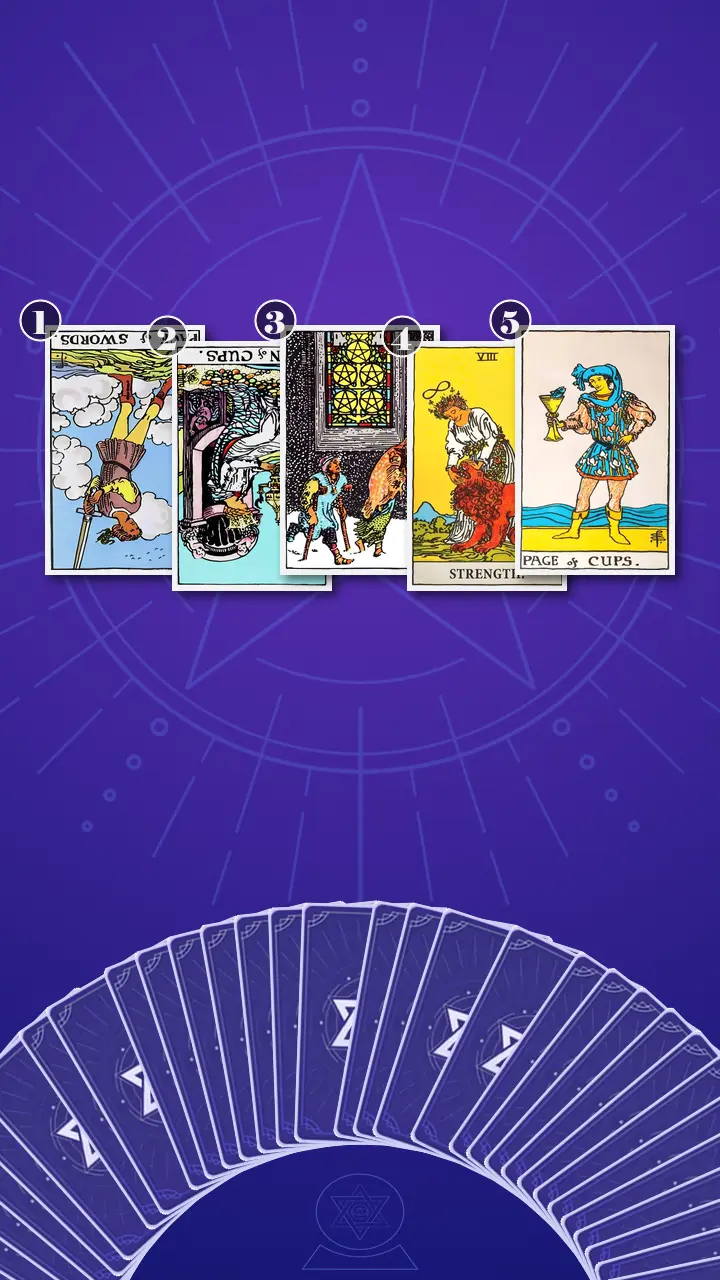
I told Alex what I was looking for as I laid the five cards in a straight line. The first position would show the social mask in real time. The second would reveal the hidden feeling underneath the joke. The third, at the center, would name the deeper belonging wound. Then the fourth card would show the antidote, the inner medicine needed for the shift from performance to one honest sentence. The fifth would translate all of that into a real-life practice for this week.
Reading the Hallway: From Fast Air to Hidden Water
Position 1: The Punchline Before the Feeling
I turned the first card, the one that shows the concrete joking-and-deflecting behavior and how the social mask appears in real time. It was the Page of Swords, reversed.
This card was almost painfully exact. A friend texts, “You okay?” at 10:14 p.m., and before Alex has even checked in with their own body, they answer with, “thriving on iced coffee and denial,” plus a meme. The raised sword becomes the preloaded joke. Very Fleabag-coded timing: the line lands first so sincerity never has to. In elemental terms, this is Air in excess and imbalance: quick wit, quick scanning, quick speech, all moving faster than feeling. Humor here works like sending an auto-reply before you have even opened the message in your own body.
I looked up from the card and said the sentence I knew Alex needed to hear cleanly: “The joke is not the problem. The speed of it is.”
In my Body Signal Interpretation work, I always watch what the body does while the personality is trying to keep the room easy. Alex had already told me about the tight throat, the lifted shoulders, the smile that arrived a beat too fast. That is not random awkwardness. That is the nervous system throwing glitter over an alarm.
Alex let out a short laugh with something bitter tucked inside it. “Okay,” they said. “That’s so accurate it’s almost rude.” I smiled. “Not rude,” I told them. “Useful. You are not bad at closeness. You are fast at self-protection.” Their eyes dropped to the card, and their thumb started rubbing the edge of their sleeve in small, quick strokes.
Position 2: The Answer That Only Arrives in Private
I turned the second card, the one that reveals the feeling state being protected underneath the joke, including the self-conscious vulnerability hidden in the first response. Queen of Cups, reversed.
This was the private after-scene. The honest answer arriving later in the shower, in Notes, on the walk home, in the text draft that never gets sent. The lidded cup said everything I needed it to say: the feelings are not absent, they are present and vivid, but capped the second another person gets close enough to witness them. This is Water in blockage, turned inward rather than shared. Alex could read everyone else’s emotional weather in a room and then go strangely blank when asked to name their own.
“This,” I said, “is why the real sentence shows up only once nobody can hear it. You can name it perfectly once no one is looking.”
Alex went very still. First came the tiny freeze in the breath. Then the gaze softened and drifted past my shoulder, as though they were replaying some late-night shower conversation with themself. Then the release: one slow exhale, almost embarrassed. “Yeah,” they said quietly. “That’s exactly it. I can write the honest version five minutes later like I’m some emotionally literate genius. Just not in the actual moment.”
Position 3: Outside the Warmth
I turned the third card, the one that uncovers the underlying fear about belonging and the limiting belief that keeps the defense loop in place. Five of Pentacles, upright.
Here was the colder layer. This card is not about a lack of caring people. It is about reacting as though the warmth is not really for you. The snowy street and lit window translated almost too neatly into Alex’s life: a friend says, “If you want to talk, I’m here,” and the body hears not invitation, but examination. Care lands like a belonging test. In elemental balance, this is Earth in deficiency and freeze. The ground under the moment goes cold. You hover outside the support that is already there, as if closeness has to be earned before need can be shown.
When I see this card after the Queen of Cups reversed, I think of sleet against a cottage window back home: warmth visible, body still braced on the threshold. “This is the belief under the joke,” I said. “If I answer honestly, I might change the mood, make things awkward, and people may regret asking.”
Alex tucked both hands under their thighs. In my practice, that is a body subtitle I trust. Hidden hands usually mean the system is expecting exposure, not comfort. “So it’s not just that I don’t know what to say,” they said. “It’s that I think I’ll make it weird if I say it.”
“Exactly,” I answered. “And every time the joke lightens the moment for thirty seconds, the body files that away as proof that deflection is safer. That’s how high-functioning loneliness gets built. You stay socially smooth and emotionally untranslated.”
When Strength Put a Hand on the Lion
Position 4: The Antidote
When I turned the fourth card, the room changed. The late light at the window warmed against the table, and outside I could hear the soft hiss of tires on damp Toronto pavement. This was the core card of the reading, the one that shows the inner resource needed for the shift from performance to one honest sentence. It was Strength, upright.
In my Nature Empathy Technique, I read a spread the way I read a storm crossing the Highlands: first the wind, then the water, then the ground it hardens. Here the pattern had moved through overactive Air in the Page of Swords, inward Water in the Queen of Cups, and cold Earth in the Five of Pentacles. Strength brought Fire, but not drama-fire. Hearth-fire. Regulated warmth. In my Elemental Balance lens, Alex did not need a bolder personality. They needed enough steady inner heat to stop treating discomfort like an emergency exit.
I slowed my voice. “Picture that streetcar again,” I said. “You reread a kind ‘you okay?’ text, and your body is already in editing mode before your feelings have even fully arrived. The old move is to keep the vibe easy. This card asks for something smaller, steadier. Not a dramatic confession, just one true sentence.”
The brave move is not keeping the vibe easy for everyone else. It is staying with yourself long enough to give one honest answer.
“Don't keep treating vulnerability like a lion that proves you're too much; meet it with a steady hand, and one honest sentence becomes strength.”
Alex’s reaction came in layers. First, the physical freeze: their fingers stopped moving on the mug, and their breath caught halfway in. Then the cognitive hit: their eyes lost focus, not avoiding me so much as replaying memory behind me, like they were watching the streetcar text thread and the Parkdale kitchen scene side by side. Then the emotional release came, but not as instant relief. It arrived with heat first. “But doesn’t that mean I’ve been doing this all wrong?” they asked, voice suddenly sharper. “Like every time somebody cared, I bailed on myself before they even got a chance?”
I shook my head. “No,” I said. “It means you built a clever shelter. It worked. We are only deciding whether you still need to live in it.”
That landed. Their shoulders dropped maybe half an inch. One hand rose to the base of the throat, the exact place that had been braced all reading. Their next breath came deeper, shakier, less performed. In my Body Signal Interpretation, that touch is one of the clearest signs that the body has finally caught up with the truth. I asked, “Now, with this lens, can you think of a moment last week when one honest sentence would have changed the feeling by even five percent?” Alex nodded before they spoke. “The kitchen,” they said. “I could’ve just said I’d had a rough week.”
That was the crossing right there: from fast self-protection to small, receivable honesty. Not oversharing. Not becoming a different person. Just staying with the steering wheel in the rainstorm long enough not to yank yourself into the nearest exit.
Position 5: The Beginner Reply
I turned the final card, the one that translates the target state into a first relational practice Alex could try this week. It was the Page of Cups, upright.
I love this card because it makes change small enough to use. Old reply: “lol surviving on iced coffee and denial.” New reply: “Honestly, I’m a bit overloaded today.” Same person. Same humor. Same intelligence. Different sequence. This is Water back in balance: no longer trapped, no longer flooding, simply speakable. The fish rising from the cup is exactly that awkward little truth popping up at the surface. A beta version of honesty, not the polished launch.
“So the goal isn’t to become one of those terrifyingly sincere people who answer everything like a therapy worksheet?” Alex asked, and this time the laugh was slower, warmer, more theirs.
“Absolutely not,” I said. “You do not have to stop being funny. You just do not have to hide behind the first punchline. Support starts to feel less like a test when it arrives one honest sentence at a time. And awkward is not the same thing as wrong.”
From Insight to Action: The One-Sentence Honesty Plan
When I laid the whole reading back together, the story was beautifully clear. The surface pattern was fast Air: joke first, body later. Underneath sat private Water, rich feeling that only trusted solitude. At the center was cold Earth: the old fear that visible need might cost belonging. Strength brought the warming Fire that let Alex stay present instead of flee. Then the Page of Cups returned Water in a cleaner form: one emotionally accurate sentence that another person could actually meet. The Shadow Spread had done exactly what it is meant to do. It walked us down the hallway from mask to wound and showed the unlocked door at the far end.
The blind spot was not humor itself. The blind spot was the rule that honesty had to be either fully polished or uncomfortably huge. That all-or-nothing script kept Alex outside the warmth. The transformation direction was simpler than the fear made it seem: humor after truth, not humor instead of truth. Name one real feeling, then let personality come back in.
I gave Alex actionable advice in three very small experiments. None of them required a personality overhaul. All of them were designed to help the body learn that care can be received in small, safe doses.
- Pause-Before-PunchlineThe next time a trusted friend texts or asks face to face if you’re okay, put both feet on the floor, streetcar floor, or kitchen tile and take one full exhale before speaking. If you need a bridge, use: “Give me a sec — actual answer?” Then offer one plain sentence, even if it is only “Honestly, kind of overwhelmed.” This takes about three seconds.If a full sentence feels too exposed, use one feeling word and one intensity word. Resistance will likely show up fast; that is old patterning, not proof you are doing it wrong.
- 5-Minute Balcony Reset + Low-Stakes Truth TextBefore replying to an end-of-day check-in this week, do my 5-minute balcony energy awakening practice: step onto a balcony, stoop, or by an open window, feel the temperature on your face, drop your shoulders, and name the weather without interpreting it. Then text one steady friend something shorter than you want it to be: “Rough week, but thanks for checking,” or “A little tender today, not ready to fully unpack it.”Save three starter lines in Notes ahead of time so you do not have to invent honesty from scratch when you are tired. Beginner honesty beats perfect wording.
- Shower Repair + Ask for Small SupportIf you already deflected, use my shower water-flow meditation technique within 24 hours. Let the water hit the back of your neck for one minute and say out loud, “Earlier I made a joke, but the real answer is I’ve been a little overwhelmed.” Then send that repair text. If you want support, ask for one low-pressure thing using my weather-based activity selection guide: tea at home on a rainy night, a short walk if you feel restless, or ten minutes of listening with no fixing.After you send it, put your phone on Do Not Disturb for ten minutes. Let this be an experiment, not a verdict on your worth. Warm responses are evidence; lukewarm ones are information, not proof you are too much.
Before we ended, I reminded Alex of the simplest rule in the whole reading: one honest sentence before humor. That is enough to begin retraining the first impulse. That is enough to start being emotionally translated inside your friendships.

A Week Later, the Reply Changed Temperature
Six days later, Alex sent me a screenshot. A friend had texted, “You okay?” Instead of the usual meme, Alex wrote, “Honestly, I’m a bit overloaded today. Not ready to fully unpack it, but thanks for checking.” The reply came back a minute later: “Totally get it. Want tea tomorrow instead of going out?”
Alex told me they slept properly that night, then woke with the old first thought — What if that was too much? — and felt it pass like weather instead of law.
That is what this kind of finding clarity looks like. Not a cinematic breakthrough. Not a total reinvention. Just the first quiet proof that support can land without you disappearing from your own answer. That is the gift of this Shadow Spread tarot reading for humor as emotional armor in friendships: it does not ask you to become less funny. It asks you to stop abandoning yourself at the exact second care arrives.
There is a very specific loneliness in making people laugh while your throat is tight, because one part of you wants comfort and another part is scared honesty could cost you your place in the room. If that loneliness is familiar, then the next time someone kind asks if you are okay, if you only had to offer one real sentence — not the whole backstory, not a perfect explanation — what might you want to say?