On the Commute Home, a Deleted Budget Draft Turns Toward Honesty

The 6:18 p.m. TTC Draft
There is a very specific kind of budget boundary guilt I keep seeing in twenty-something office workers living in high-cost cities: they can answer a client email in five minutes and still need forty-five to answer a dinner invite. When Jordan (name changed for privacy) joined my evening session from Toronto, she still had her work lanyard beside her laptop and the look of someone who had spent an entire commute editing one text.
She gave me the scene in one rush. It was 6:18 p.m. on a Thursday, packed into a TTC Line 1 carriage, one hand wrapped around the pole, fluorescent lights humming overhead, brakes screeching as she opened a Resy link in the group chat. Mains in the mid-thirties. Cocktails pushing eighteen. Her phone felt hot in her palm as she flipped to her TD app. Before she had even finished reading the menu, her throat tightened. She typed, "That place is a bit out of my budget right now," deleted it, rewrote it twice, then sent, "I can't make it, work's been insane."
"I want to be included without having to explain my bank balance," she told me. "It's easier to say I'm slammed than to make money weird."
The shame in her body was so immediate I could almost feel it through the screen: a typing bubble lodged in the throat, a knot under the ribs, a private courtroom opening inside a perfectly ordinary phone. She wanted to stay included with her friends, but she feared that if she admitted the plan was too expensive, the group would see her as difficult, less successful, somehow less easy to keep around. In other words, her worth felt like it was going on trial every time the price got real.
I nodded. "That makes sense," I said. "You're not trying to dodge friendship. You're trying to protect your place in it. Let's make a map for the fog and see where this pattern is actually coming from, and where clarity might open up."

Choosing the Compass: A Four-Card Spread for Money Shame with Friends
I asked Jordan to put both feet on the floor and take one slow breath while I shuffled. Not as a dramatic ritual, and not because tarot needs theater, but because her nervous system needed a landing strip before we asked it to tell the truth.
For this reading, I chose the Situation-Obstacle-Advice-Outcome · Context Edition spread. When people ask me how tarot works in real life, especially around questions like why do I say I’m busy when I can’t afford plans, or how do I tell friends I can’t afford dinner without sounding rude, this is the kind of structure I trust. It gives me a clean arc: symptom, root, shift, and integration. Tarot is most useful when card meanings are read in context, not as floating one-word definitions.
This was not a case for a giant predictive spread. Jordan did not need ten cards to tell her whether her future held friendship. She needed to see one repeating defense clearly: the polished scheduling excuse, the belonging wound under it, the honest sentence that could interrupt it, and the kind of connection that becomes possible afterward. Four cards were enough to hold the logic without burying a modern, painfully specific problem under unnecessary complexity.
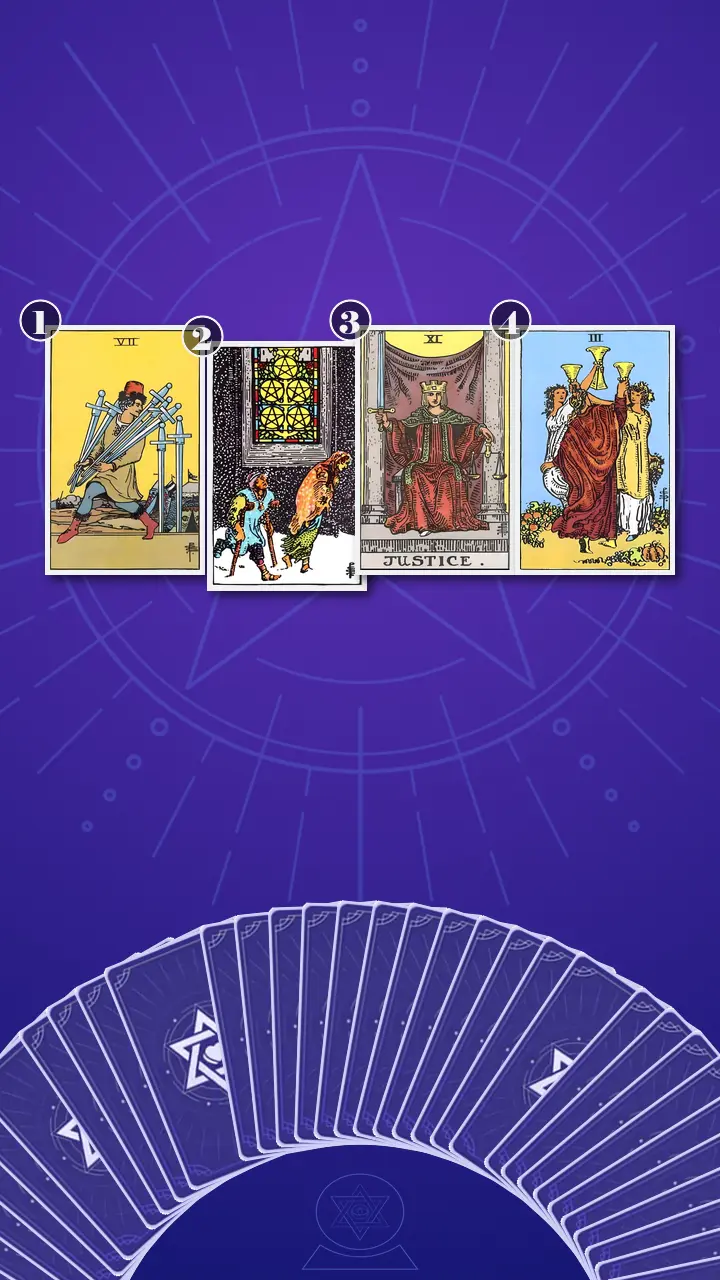
I laid the cards left to right and told her what I would be watching. The first would show the visible pattern: the habit of hiding a budget limit inside a calendar excuse. The second would reveal the real blocker: money shame fused with the fear of being the awkward friend. The third, our hinge card, would show the medicine: the mindset and communication stance that could replace evasiveness with one clear boundary. The fourth would show the likely emotional outcome if she practiced that shift in real life.
Years of guiding people through star maps in a planetarium taught me to respect trajectories. Drift looks random until you map it. So I set the line of cards the way I would explain an orbit: contraction, contraction, pivot, horizon.
Reading the Contraction Zone
The Polished Exit — Seven of Swords Upright
The first card I turned over was the one representing the visible pattern: the habit of using a scheduling excuse instead of naming a budget limit. It was the Seven of Swords, upright.
I felt Jordan recognize it before I even finished speaking. In this position, the Seven of Swords is not about villainy. It is about evasive communication, selective disclosure, and trying to manage exposure. I showed her the figure on the card looking back over his shoulder while carrying away five swords and leaving two behind. "This," I said, "is the group-chat version of open, check, edit, delete, send, reread. It’s like leaving the honest text in your Notes app and only sending the socially optimized version."
I translated it directly into her life. The ride home. The dinner link. The banking app. The draft that told the truth. The deletion. The final text about work being insane. The backwards glance in the card matched the way she reread the chat afterward to make sure the exit looked smooth. Upright here, this was Air energy used in excess for impression management instead of clarity. Her intelligence was not helping her feel safer; it was giving shame better copywriting.
"A budget limit is not a character flaw," I told her gently. "But this card shows what happens when your nervous system treats it like one. You’re not only deciding whether you can go. You’re trying to control how the group experiences you while you leave."
She gave a short laugh, the kind with a little ache in it, and looked away from the camera for a second. "Wow," she said. "That’s accurate in a way I kind of hate." Her mouth curved, but her fingers had already gone to the edge of her mug, circling it once as if she needed something solid to hold.
The Warm Window You Never Knock On — Five of Pentacles Upright
The second card I turned over was the one revealing the hidden blocker: the belonging wound and scarcity shame underneath the excuse. It was the Five of Pentacles, upright.
This card deepened the story instantly. I pointed to the cold street, the two figures moving through snow, the lit stained-glass window behind them. "This is the moment before anyone has actually shut you out," I said. "But your body already thinks you’re outside."
I brought her back into the lived scene the card was naming. The bill lands on a Friday night table beside half-finished fries and a lipstick-marked glass. The room smells like fried garlic and citrus. A vent blows cold air onto your arms. Everyone else is still talking, but your stomach knots while you do silent math and pretend to laugh at a story you didn’t fully hear. That is Five of Pentacles territory: the second a total goes past what feels workable, the shame lands first, and a private story about being less successful starts running before the group has even had a chance to respond.
In energetic terms, this was Earth under strain: material reality fused to emotional meaning until the number stopped being a number. It became a verdict. Like seeing a price tag and reading it as a personality review. Like standing outside a warm restaurant window in your own head while the group is still just making plans. The hidden belief here was brutal and simple: if I can’t keep up, maybe I don’t belong.
Jordan went quiet in a different way then. First her shoulders lifted, almost imperceptibly. Then her eyes dropped to the lower corner of the screen, as if she were replaying a dozen bills, a dozen group chats. When she finally spoke, her voice had softened. "Yes," she said. "Nobody has excluded me yet, but my body already thinks I’m outside. That’s exactly it."
When Justice Lifted the Sword
One Clean Line on Screen — Justice Upright
The third card I turned over was the hinge of the whole reading: the one showing the key shift, the mindset and communication stance that could replace evasiveness with direct honesty. It was Justice, upright.
Even before I started speaking, the atmosphere changed. On my desk, the small brass star lamp threw a steadier amber light over the card, and the rain at my studio window thinned into a faint hiss. I have spent years under a planetarium dome watching constellations click into alignment, and seeing Justice gave me that same feeling: not drama, exactly, but the clean, unmistakable sensation of things finally snapping into their proper coordinates.
By now Jordan was sitting inside the exact trap that had been exhausting her: if she said yes, she would resent the cost; if she said no honestly, she feared becoming the difficult friend; so she kept trying to invent the perfect excuse that would protect belonging without asking anything of reality.
Your worth is not on trial at the table; speak the truth and let Justice's scales separate your budget from your belonging.
She went completely still. First came the freeze: her breath stopped halfway in, and the thumb that had been rubbing the side of her mug just halted. Then the thought-wave passed through her. Her eyes unfocused for a beat, the way they do when someone is no longer listening to me alone but to an entire replay inside themselves — the TTC lights, the restaurant link, the TD app, the deleted text, the fake work excuse. Then came the release, and it happened in layers: one slow exhale from somewhere deeper than the chest, shoulders lowering by a full inch, jaw unclenching, and finally a small, disoriented laugh, like relief had arrived a half-step faster than her body knew what to do with. There was even that strange, honest after-effect I know well from breakthrough moments: the slight dizziness that comes when a person has been carrying tension for so long that space itself feels unfamiliar.
"But if I say it that plainly," she said, and now there was resistance in it, a quick flare of almost-annoyed fear, "doesn’t that make me the difficult friend?"
"No," I said. "It makes you accurate." Then I gave her one of the metaphors I use in my own practice, something I call Cosmic Redshift Communication. At the planetarium, I teach visitors that light stretches as objects move farther apart. In relationships, distance often begins the same way — quietly, before anyone names it. Every polished ‘I’m busy’ text adds a little redshift. The truth and the relationship move farther away from each other by a fraction. Justice reverses that drift. It does not ask for a confession. It asks for one clean, factual wavelength: ‘That sounds fun, but it’s not in my budget this week.’ Same friends. Same phone. Same chat. Different posture.
"This is information, not a confession," I continued. "The price is data. The shame is the story attached to it. And belonging gets tested by truth, not by how convincingly you say you’re busy."
I let that settle, then asked her, "With that new lens, can you think of a moment from last week when this would have changed the feeling, even if it didn’t make it magically easy?"
She nodded almost immediately. "Thursday on the train," she said. "I still would’ve hated sending it. But I think I would’ve felt less fake afterward."
That was the real crossing. Not from discomfort to perfect ease, but from shame-tightened evasiveness to clear self-respect and honest belonging. Justice was the antidote because honesty about your limit is not rude; it is the fairest way to find out whether the friendship can hold real life.
The Circle That Stays Open — Three of Cups Upright
The final card I turned over was the one mapping the integration state: what friendship and self-respect can feel like when honest budget boundaries are practiced. It was the Three of Cups, upright.
I smiled when I saw it. After the solitary defense of the first two cards and the upright clarity of Justice, here was the circle returning. Three women raising cups together. A shared stance. Fruit and flowers at their feet. Not extravagance for its own sake, but mutual presence. "This card is not telling you that the tasting menu suddenly becomes affordable," I said. "It’s showing you what connection looks like when you stop disappearing behind ‘I’m busy.’"
I translated it into ordinary modern terms. A friend replies warmly. Or the group dinner still happens, but one person texts later and suggests dumplings next week instead. Maybe it’s tacos, a walk by the lake, iced coffees after work, a movie night in someone’s living room. Three of Cups says real friendship can survive a cheaper plan. In energetic terms, this is Water in balance: emotional reciprocity, not spending performance. Moving from expensive group optics back to actual friendship bandwidth.
Jordan’s whole face softened at that. The tightness around her mouth eased. "I’d honestly rather do coffee and a walk half the time," she admitted. "I just don’t want to be the one making everyone accommodate me."
"You don’t need a fake calendar conflict to earn a cheaper yes," I said. "And offering an alternative is not the same as demanding a rewrite of the whole group. It is simply leaving the circle open instead of pre-rejecting yourself from it."
The One-Clean-Sentence Method
Once the four cards were on the table, the story was clear. The Seven of Swords showed the symptom: polished excuses used as social camouflage. The Five of Pentacles showed the wound beneath it: the moment cost becomes a self-worth verdict, and honesty starts to feel more dangerous than distance. Justice interrupted that mechanism by separating the plan’s price from Jordan’s value. The Three of Cups showed the integration: friendship that can meet reality, not just performance. The blind spot was not simply that she feared spending money. It was that she had been treating affordability like evidence about her worth, and quietly removing herself before anyone else could respond.
"So the direction here isn’t ‘be less sensitive,’" I told her. "It’s much more precise than that. Move from protecting belonging with vague busyness to testing belonging with one clear sentence about budget."
I do not like advice that sounds wise for thirty seconds and evaporates by tomorrow. I like repeatable orbits. So I gave her a simplified version of one of my own practical tools, a Social Star Map: not mystical in practice, just a week-ahead way of deciding where her money and social energy could genuinely go before shame grabbed the controls.
- Save your one clean budget sentence Open your Notes app tonight and save this exact line: "That sounds fun, but it’s not in my budget this week." If it feels true, add one optional second sentence for the organizer or one trusted friend: "I’d be down for coffee, dumplings, or a walk next week though." Read it out loud once at home so your body hears it before the next expensive group chat moment. Keep it short enough that it cannot turn into a confession.
- Set Justice’s number before the invite arrives Before the weekend, choose one rough social spend ceiling for spontaneous plans, with tax, tip, and transit included, and put the number in your phone. When a plan lands above it, use the saved sentence instead of reopening the internal debate from scratch. Make it approximate, not perfect. This is a friction-reducer, not a moral report card. One number for this week is enough.
- Send one cheaper-yes follow-up Pick one friend this week and offer a lower-cost plan you would genuinely enjoy: coffee after work, a walk by the lake, dumplings in your neighborhood, or a movie night at home. Do it even if the bigger plan is already locked. Offer once, clearly, and let it breathe. You are not asking everyone to orbit around you; you are giving connection another place to land.
She read the list and pressed her lips together. "But what if I can write the sentence now," she asked, "and then the second I see the typing bubble, I freeze?"
I appreciated that question because it was real. "Then the practice still counts before sending," I told her. "Take five slow breaths. Read the sentence aloud. If all you manage that night is not lying and not overexplaining, that is already movement. The awkwardness isn’t proof you did it wrong; it’s often what honesty feels like before it becomes normal."

A Week Later, the Quiet Proof
A week later, Jordan sent me a screenshot. Not a life overhaul. Not some impossible transformation reel. Just a text thread.
A friend had dropped a dinner plan into the chat, and Jordan had replied, "Can’t do that one this week — it’s not in my budget, but want to grab coffee Wednesday instead?" The answer came back two minutes later: "Absolutely. Coffee sounds great."
She told me she still felt the old jolt when she hit send. Then she sat alone by the café window for a while, hands around a paper cup, feeling steadier and a little strangely bare at the same time. The next morning her first thought was still, What if they think I’m difficult? Only this time she caught it, smiled once, and kept getting ready for work.
That, to me, is what a Journey to Clarity looks like in the wild. Not a perfect personality transplant. Not instant fearlessness. Just the first honest proof that a person can stop putting their worth in the same column as the price tag. This Situation-Obstacle-Advice-Outcome reading for money shame in friendships did what good tarot is meant to do: it turned a shame loop into a map, and the map into actionable next steps.
When your throat tightens over a dinner link and you start rehearsing a fake schedule conflict, you’re not just dodging a plan — you’re trying to protect your place in the room. And once you notice that, you are no longer only inside the pattern.
If you didn’t have to treat your budget like a confession, what one upright-sword sentence would feel honest enough to try the next time the group chat gets expensive?