From Unsent Drafts to a Real Talk After a Best-Friend Confession

Finding Clarity in the 12:14 a.m. Confession Text
If you’ve been re-reading one message like it’s a contract, drafting three replies, and still not hitting send because you’re scared you can’t un-weird it once you respond—yep, you’re at the friendship-to-romance crossroads.
Jordan sat across from me on a video call, Toronto night pressed up against their condo windows like a dark palm. They kept one earbud in, not for music—just habit. Behind them, the kitchen light was off, so their phone screen did what it always does at 12:14 a.m.: it became the brightest thing in the room.
“They texted me this really… sincere confession,” Jordan said, voice careful like they were carrying something fragile. “And now my stomach does that tight-drop thing every time their name pops up. I don’t want to lose my person. But I also can’t pretend I didn’t read it.”
I watched their thumb hover near the edge of the screen. Not scrolling—hovering. Like their body thought the right pixel could save them.
Confusion isn’t abstract in moments like this. It’s a buzzy, restless electricity under the skin—like your nervous system is stuck in a loading screen, vibrating but never opening the app.
“We’re not here to find a perfect answer that keeps everything exactly the same,” I told them gently. “We’re here to find clarity: the kind that protects the bond by making it real, not by making it silent.”

Choosing the Compass: The Decision Cross Tarot Spread
I asked Jordan to take one slow breath—nothing mystical, just a clean transition from spiraling to noticing. While they exhaled, I shuffled. The sound of the cards has its own honesty: dry paper on paper, a soft friction that doesn’t care about anyone’s overthinking.
“For this,” I said, “I want to use a Decision Cross tarot spread. It’s built for relationship choices that look like A vs B—date them, or keep it platonic—without forcing a prediction.”
To you, reading along: this is why the Decision Cross works when your best friend confessed and you don’t know what to say. The horizontal line gives each option a real lane (not a blurry ‘maybe’). The vertical line exposes what’s actually freezing you—and then lands on a practical next step, which is what people usually need more than certainty.
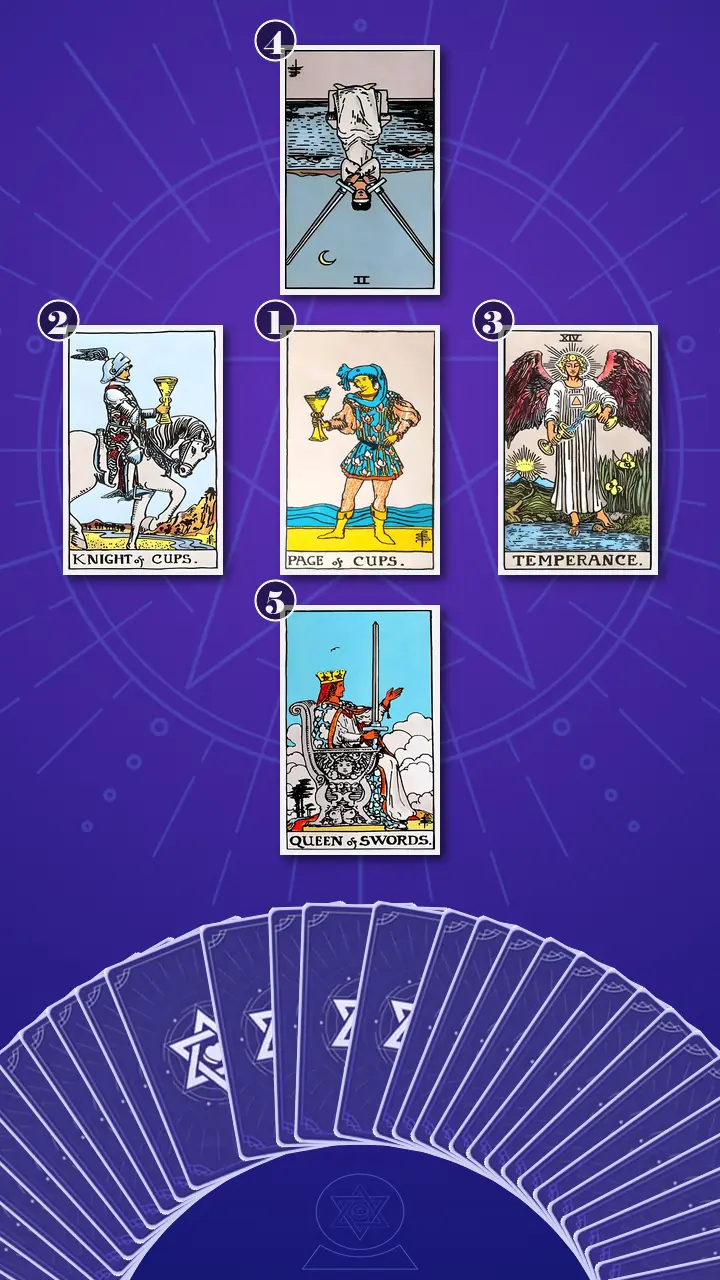
“Card 1 will name what’s already changed between you,” I told Jordan. “Cards 2 and 3 will show the lived reality of each path. Card 4 is the main internal block—what keeps you stuck. Card 5 is the empowering next step: the communication move that restores clarity and self-trust.”
Reading the Map: Cups, Then the Blindfold
Position 1 — The current friendship-to-confession dynamic
“Now flipping,” I said, “is the card that represents the current friendship-to-confession dynamic and what has already changed emotionally.”
Page of Cups, upright.
“This is that moment you’re living in,” I told them. “You’re staring at a heartfelt confession text that feels both sweet and slightly unreal—like someone just changed the script mid-season. You don’t doubt their sincerity, but you feel the pressure that even a small tone shift could change your safest relationship.”
The Page holds the cup forward like an offering. And the fish popping up—awkward, unexpected—says: feelings have surfaced. You can’t unsee them. You can’t go back to ‘before’ by being extra chill.
I framed the energy simply: “This is balanced emotional sincerity—tender, real, not manipulative. The risk isn’t the confession. The risk is treating it like a problem to solve instead of a truth to respond to.”
Jordan gave a short laugh that landed somewhere between recognition and pain. “That’s… too accurate,” they said. “Like, it’s sweet, and I’m touched. But I’m also like—cool, cool, cool, my entire friend group is now a Jenga tower.”
Position 2 — Option A: what dating them invites
“Now flipping is the card that represents Option A: what dating them invites, requires, and tests emotionally and practically.”
Knight of Cups, upright.
“If you date them,” I said, “this path works best when it’s named and real: an actual date with a time, a place, and a check-in after—rather than ‘we’re hanging out like usual but with extra eye contact.’”
This Knight moves forward. Not rushing, but moving. The energy here is balance tipping toward momentum—the part of you that wants to try, in real life, instead of endlessly rehearsing in your head.
“I keep thinking if I say yes, I’m promising forever,” Jordan admitted.
“You can be curious without promising forever,” I said. “That’s the Knight at his healthiest: one sincere invitation, one real data point.”
Jordan’s shoulders loosened a millimeter—the tiniest sign their body liked the word testable.
Position 3 — Option B: what staying platonic looks like now
“Now flipping is the card that represents Option B: what staying platonic looks like now, including the boundaries and adjustments it would require.”
Temperance, upright.
“If you keep it platonic,” I said, “you’re not pretending nothing happened—you’re creating a new, steadier version of the friendship. That means actively adjusting closeness, boundaries, and pace so the friendship doesn’t spill into confusion.”
Temperance is a container. It’s the cup that keeps something precious from sloshing over just because the room shook.
“‘Keeping it platonic’ still takes work—boundaries are how you keep it real,” I added. “This could look like naming what changes—late-night texting, physical affection, flirty jokes—while protecting what stays: support, your regular plans, being each other’s person.”
Jordan nodded slowly, relief and sadness threaded together. “I always thought staying friends would be the ‘do nothing’ option,” they said. “But it’s… still a choice.”
Position 4 — The main internal block keeping you stuck
“Now flipping,” I said, “is the card that represents the main internal block keeping you stuck.”
Two of Swords, reversed.
The blindfold in this card is the part of you that says, Don’t look too directly. Don’t name it. If you don’t name it, maybe it stays safe. The crossed swords are your defenses—tight across the chest.
“This is you keeping interactions upbeat and normal,” I told Jordan, “but privately treating every message like a test. You’re delaying because you believe the wrong choice is irreversible—so you stay ambiguous, hoping time will decide it for you. Meanwhile, the friendship starts to feel slightly performative, like you’re both guessing instead of connecting.”
Jordan swallowed, jaw working. Their eyes flicked away from the screen—freeze first, then the mind catching up, then the emotion landing. “I hate how true that is,” they said quietly. “I literally check their Instagram Story like it’s… analytics. Like I’m going to find a chart that says ‘You’re allowed to say yes’ or ‘You must say no.’”
“Ambiguity isn’t neutral here; it’s a choice with a vibe,” I said, keeping my tone warm but firm. “And your friend can feel it.”
There was a beat of silence. Even through the laptop speakers, I could hear the condo building’s low hum—the same kind of background noise I’ve spent a decade studying on-air: the sounds people don’t name, but their bodies react to anyway.
“Stop hunting for clues,” I added. “Ask for a conversation.”
When the Queen of Swords Cut Through the Static
Position 5 — The most empowering next step
I let my hands rest for a second before turning the final card. “This one,” I said, “is the grounded next step: the communication move or boundary that restores clarity and self-trust regardless of outcome.”
Queen of Swords, upright.
“This is the opposite of the Notes-app spiral,” I told Jordan. “You stop trying to craft a flawless text and choose one clean, respectful sentence that tells the truth about what you can offer right now. You ask for a real conversation, name your pace, reduce guessing—because clarity is how you keep the friendship safe, whether you date or not.”
Then I slowed down. The air in my office felt suddenly still, like the moment right before a song drops into a quieter key. “This is the bridge card,” I said. “It takes all that tenderness in the Cups and translates it into language that actually protects you both.”
Jordan’s whole face had the look I recognize from callers on my radio show right before they cry—not dramatic, just… tired of carrying the same loop alone. They were stuck in that moment where their friend’s name pops up, their stomach clenches, and suddenly they’re writing three different replies like they’re diffusing a bomb—because they’re trying to keep the friendship safe by not saying the wrong thing.
Not the perfect reply in your drafts—choose the clean sentence that cuts through confusion, like the Queen’s upright sword paired with an open hand.
Jordan didn’t nod right away. Their breathing paused—tiny freeze. Their eyes softened, unfocused for a second, like their brain was replaying every unsent draft and every “lol yeah totally” they’d typed while panicking. Then the exhale came: quiet, long, like their ribs finally unclenched.
“But if I’m clear,” they said, and there was a flash of heat—an unexpected edge of anger, not at me, but at the situation, “doesn’t that mean I’m the one changing everything? Like I’m the reason it’s ‘a thing’ now?”
“No,” I said, steady. “The confession already changed the weather. Clarity is just you stepping out of the storm cellar and saying, ‘Okay. Here’s where I actually am.’ The Queen isn’t a weapon. She’s a doorway.”
Then I brought in the tool that’s most natural to me—the thing I’ve watched save people from emotional static again and again. “Jordan, I want to use my Melodic Mirror for a second,” I said. “When your emotions are too big to name, your playlists usually tell the truth faster than your drafts do.”
“Okay…” They blinked, present again.
“What have you been listening to since the confession?” I asked. “Not what you think you should be listening to—what’s actually been on repeat.”
Jordan looked down, almost embarrassed. “Honestly? A bunch of soft, sad indie stuff. And then—randomly—hyperpop when I’m trying to not feel.”
“That’s information,” I said. “Your system is swinging between low-BPM tenderness and high-BPM avoidance. That tells me you’re not ‘missing evidence.’ You’re flooded. The Queen of Swords doesn’t demand certainty. She asks for one kind, specific sentence that makes the connection less like suspense and more like mutual respect.”
I held the moment gently and asked, “Now—with this new lens—think back to last week. Was there a moment when a clean sentence would’ve made you feel different?”
Jordan’s eyes went shiny. “Tuesday,” they whispered. “We did our normal walk. I was laughing, but I was… performing. If I’d just said, ‘I want to talk about your text, I care about you, I need a real conversation,’ I think my body would’ve stopped doing that… buzzing thing.”
That was the shift in real time: from spinning, phone-checking confusion to calm, boundary-based clarity through kind, specific communication. Not a final outcome—just the first grounded step toward one.
The One Clean Sentence That Protects the Friendship
I summarized the spread the way I’d summarize a song: by its movement.
“The Page of Cups says the confession was real and vulnerable—worth gentleness. The Knight of Cups says dating can be intentional and testable, not a foggy slide. Temperance says staying platonic is an active choice that needs a container. The Two of Swords reversed is the choke point: your stalling isn’t keeping things safe; it’s creating mixed signals and tension. And the Queen of Swords is the medicine: clear, kind, specific communication that protects the bond better than suspense ever could.”
“Your blind spot,” I added, “is believing that ambiguity is the safest way to preserve belonging. But ambiguity doesn’t preserve; it delays—and the delay starts writing a story neither of you agreed to.”
“The transformation direction is simple, even if it’s not easy: move from protecting the friendship through vagueness to protecting it through clear, kind communication and a small, testable next step.”
- The Clean Sentence Text (2 minutes)In your Notes app, write exactly two sentences: (1) one true feeling, (2) one next step. Then copy/paste it into your chat—no rewriting after you paste.If “short” feels cold, add warmth with tone, not length: one honest line like “I’m really glad you told me” is enough. A clean sentence is kinder than a perfect draft.
- The 20-Minute Clarity Talk (calendar, not chaos)Send a scheduling message instead of a verdict: “Can we talk for 20 minutes this week? I want to respond with care and not over text.” Pick a neutral place: a walk, a coffee spot, even a TTC ride home if that feels easier side-by-side.Choose timing like an adult, not like a panic: don’t start this at 1 a.m. or mid-group hang. Protect both nervous systems.
- One-Date Data Point (if you lean toward yes)If you want to explore, propose one clearly labeled date with a start/end time and a debrief plan: “Want to try a real date Friday 7–9, and then check in after?”This is a beta test, not a full product launch. Curiosity is allowed; forever is not required.
And because I’m me—because my whole work is sound—I gave Jordan one more practical anchor using my Emotional BPM strategy: “Before you send that message,” I said, “put on one three-minute track that feels steady—mid-tempo, grounded. Not heartbreak, not hype. Let your body find that pace, then hit send. You’re teaching your nervous system what ‘clear and kind’ actually sounds like.”

A Week Later: The Quiet Proof
Six days later, Jordan DM’d me a screenshot: two sentences in a chat bubble, simple and warm. Under it, their friend’s reply: “Yes. Thank you for saying it like this. Thursday works.”
Jordan added one line: “I didn’t throw up. I did shake. But then I slept, like… a full night.”
That’s the Journey to Clarity I trust: not fireworks, not instant certainty—just suspense replaced by shared reality. Just enough honesty to make the safest relationship in your life feel safe again for the right reasons.
When someone you call your safest person wants more, it can feel like your whole sense of belonging is balancing on a single reply—so you keep your words soft and vague, even while your body stays tense like it’s waiting for impact.
If you didn’t need to solve the entire future, what’s the smallest honest sentence you could offer this week that would make the friendship feel less like suspense and more like mutual respect?