Freezing After Your Manager Interrupts You—and Finding Clean Re-Entry

The 9:58 a.m. Throat Lock
I know exactly what kind of client is on my screen when the problem is being talked over at work: usually the person who can write the cleanest strategy note on the team and still goes quiet the moment a manager overlaps the first clause. Taylor (name changed for privacy), a 29-year-old product marketing specialist in Toronto, joined my Zoom session with a cold mug of tea at her elbow and the careful half-smile of someone already trying to seem less bothered than she really was.
Then she gave me the scene. Tuesday, 9:58 a.m., glass meeting room near King and Spadina. Laptop open. Notebook flat beside it. Fluorescent lights buzzing a little too hard overhead. Burnt office coffee in the air. AC cold on her forearms. She started to flag a launch risk, heard her manager talk over the first half of her sentence, and felt her throat tighten before the thought had even landed. She wanted to sound collaborative, not difficult. At the exact same time, she could feel her credibility leaking out of the room in real time.
She gave me the question in the plain language I hear all the time, the kind people type into Google after a bad meeting: my manager talks over me in meetings, so what do I say without sounding rude? Then the deeper truth came out. “I know exactly what I want to say until the second I get cut off,” she said. “And then by the time I find a way back in, the meeting has already moved on.”
What sat in her body was not vague stress. It was frustration like a swallowed fire alarm: silent to everyone else, blaring through her jaw, throat, and face. I told her, gently, “Of course you replay it. When the point is solid in your head but your throat closes the second someone higher-status cuts in, it can feel like your credibility is evaporating in front of the room. Let’s not turn this into another self-critique. Let’s make a map.”

Choosing the Compass: A Relationship Spread for Workplace Communication
I asked her to put both feet on the floor, take one slow breath, and hold the exact interruption in mind: the overlap, the hot face, the swallowed sentence. Then I shuffled. I use that moment as focus, not theater. It helps move us from adrenaline into pattern recognition.
For her question, I chose a classic five-card Relationship Spread, a tarot spread for communication boundaries at work. I use it when the issue is not living only inside someone’s confidence, but inside a repeating interaction with another person and the environment around them. This is how tarot works best for workplace communication: not as fortune-telling, but as a clean way to separate forces that feel tangled in real time.
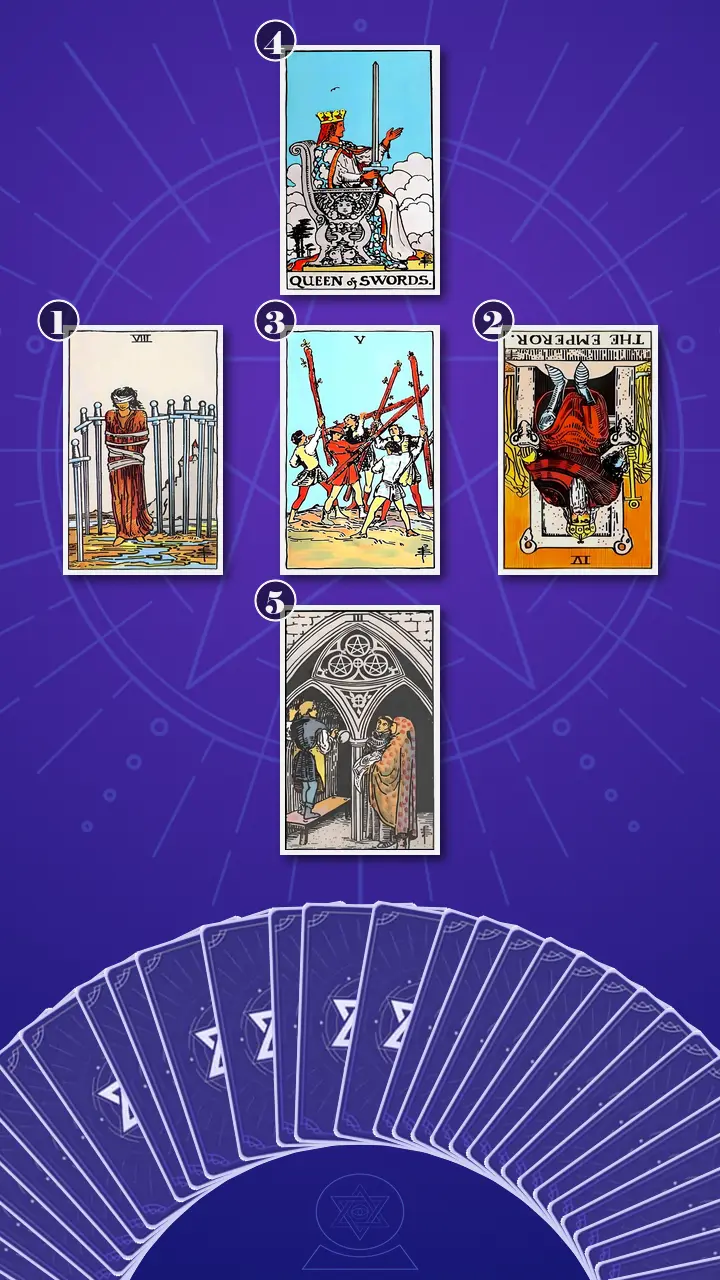
I laid the cards in a small cross on my table: her side on the left, her manager’s influence on the right, the live dynamic in the center, the lesson above, and the grounded next move below. I told her why that mattered. The first card would show what happens inside her in the five seconds after the interruption. The second would show the authority energy coming from the other side. The center card would name the meeting culture created when those two energies collide. Then the top card would point to the shift that changes the pattern, and the final card would translate that shift into practical next steps.
Reading the Noise in the Room
Position 1: The Freeze That Calls Itself ‘Preparation’
I turned over the card representing Taylor’s current stance inside the problem: Eight of Swords, upright.
I told her this card was painfully specific. In modern work life, it looks like a weekly stand-up where she starts to name a real concern, hears her manager overlap the first part of her sentence, and suddenly the whole meeting goes blurry. Instead of finishing the thought, she looks down at her notes, rewrites the line internally, and assumes the moment is gone even when there was still a possible way back in. The blindfold is status-tunnel vision. The loose bindings are the re-entry options she cannot see once self-monitoring takes over.
Energetically, this was blocked Air: thought outrunning speech, intelligence folding inward, self-protection turning into self-silencing. “You don’t need a perfect opening,” I told her. “You need a clean re-entry.”
Taylor let out a short laugh that had more bite than humor in it. “Okay,” she said, “that’s annoyingly exact.” Her fingers hovered over the mug handle, then tapped once against the ceramic. I nodded. “Exact is useful. This card does not say you are weak. It says the interruption flips your attention inward so fast that you lose contact with your own point.”
Position 2: The Pace-Setter Who Feels Hard to Push Against
Next I turned over the card for the other side of the interaction: The Emperor, reversed.
This was not a diagnosis of her manager’s personality. I was careful with that. Tarot card meanings in context matter more than lazy labels. Here, the reversed Emperor showed authority expressed through over-control, pace-setting, and a room that starts orbiting one person’s timing. In real life, it looked exactly like what Taylor had described: the manager summarizing before others finish, jumping to the conclusion early, and making everyone unconsciously rush to keep up.
I gave her the image that came immediately to me: it was like standing at a crosswalk where the light is technically yours, but one aggressive car surges forward and makes you step back onto the curb. After enough moments like that, you stop trusting the signal. You start speaking as if you need permission. You shrink the sentence before anyone else even has to.
She tightened her jaw. “Yes,” she said quietly. “That is exactly what happens. I respect him, and then somehow I start shrinking around him.” I told her, “That makes sense. But hierarchy can affect the room without defining your worth inside it.”
Position 3: The System, Not Just the Scar
The center card, the live dynamic between them, was Five of Wands, upright.
I loved the clarity of it, even if it was not a comfortable card. The meeting itself had become a scramble for airtime: overlapping ideas, side comments, early conclusions, unclear turn-taking. It had the exact chaotic energy of a The Bear kitchen scene, except the tickets were updates and the stakes were her credibility. In that kind of room, Taylor was not only dealing with her own hesitation. She was trying to land a point inside a communication culture that rewarded speed more than listening.
That meant the issue was bigger than private confidence. “If I jump in now, I sound rude; if I wait, it’s gone,” I said, giving voice to the pattern. “That is the Five of Wands problem in a fast stand-up.” Then I added the line I knew she needed most: “The problem is not only your confidence. It’s also the room’s pace.”
For the first time that session, I watched her lean back in her chair. The line of her shoulders dropped an inch. “So I’m not just bad at speaking up?” she asked. “No,” I said. “You’re responding to a real system. That matters, because it means shame is giving you bad data.”
When the Queen Lifted Her Sword
Position 4: One Sentence, Then Substance
I turned the fourth card slowly. The late afternoon light from my New York studio caught the card edge for a second and made the sword flash. This was the hinge of the whole reading, the bridge card that had to hold everything else: Queen of Swords, upright.
I told Taylor the Queen was not asking her to become louder, colder, or weirdly performative about confidence. She was asking for clean language. In modern life, this is the moment she says, “I want to finish that thought,” once, clearly, and then goes right back to the recommendation without apologizing for taking up space. Upright Air. Discernment. Boundary without drama. A deck headline instead of six apologetic bullets.
You know that commute-home replay where the perfect sentence finally arrives after the meeting is over, and you’re staring at the call summary thinking the point was never the problem—the timing was.
You do not need to out-shout the room. Lift the Queen’s sword with one clear sentence, and let precision create the space perfection never could.
I let that sit. My mind went, as it often does, to Casablanca. The line that changes the ending is not shouted across Rick’s Café; it lands cleanly, and suddenly the whole geometry of the scene shifts. That is part of what I call my Iconic Line Diagnosis. The Queen of Swords asks for that same economy at work: one sentence, then the plot moves.
Taylor reacted in three small beats. First came the freeze: her breath caught, and her hand hovered over the notebook as if even her pen did not want to move too early. Then came recognition: her eyes lost focus for a beat, like she was back in Tuesday’s meeting hearing the overlap hit the first half of her sentence. Then came feeling: her shoulders dropped, but her mouth tightened. “But if I say that,” she asked, “won’t I sound difficult?” I answered softly, “Only if collaboration has quietly become code for your disappearing. Being collaborative is not the same as disappearing politely. Your credibility is not hiding behind a perfect opening. It starts growing the moment you mark your place and finish the sentence.” Her eyes brightened with that surprised, almost angry kind of understanding. “This,” I told her, “is the move from interruption-triggered self-silencing to grounded professional self-trust.” Then I asked, “Using that lens, was there a moment last week when one clean line might have changed how the room felt to you?” She nodded immediately. “Tuesday,” she said. “I would’ve felt like I was still in it.”
I told her that was the whole point. Not a personality makeover. Just a clean re-entry, like putting your hand on the elevator door long enough to step in and then releasing it without drama. Her voice would get steadier when it stopped asking permission to exist.
Position 5: Building a Voice the Team Can See
For the final card, the grounded next move, I turned over Three of Pentacles, upright.
After all that heat and mental freeze, this card felt like exhaling onto solid ground. I explained the modern workplace version right away: ask for two minutes on the agenda, send a concise pre-read, name the part you own, and follow up with action items that make your contribution easy to point back to. The shared architectural plans beneath the cathedral arch become agenda notes, one-slide summaries, and documented ownership. This is process-backed voice.
“Slack follow-up can support your point,” I told her, “but it can’t replace your place in the room.” Then I softened the landing. “What it can do is work with better structure, so your voice is not surviving on charisma alone.”
She gave me a smaller, steadier nod. “That part actually calms me down,” she said. “Like my voice doesn’t have to survive on charisma alone.” Exactly. The healthiest next move was not a dramatic confrontation. It was collaboration with spine.
From Insight to Action: The Boundary-First Update
When I looked back over the full spread, the story was startlingly clean. The Eight of Swords showed the first internal lock: the interruption triggers self-surveillance, and Taylor starts editing instead of speaking. The reversed Emperor showed the external pressure: authority setting the tempo so hard that respect begins to blur into shrinking. The Five of Wands named the live meeting culture where overlap, speed, and status make airtime feel contested. Then the Queen of Swords replaced perfect timing with verbal precision, and the Three of Pentacles translated that insight into visible, repeatable work structure.
The blind spot was not a lack of competence. It was the meaning she had started assigning to the interruption. Each cutoff had become a referendum on whether she deserved to be heard, so naturally she rehearsed harder, softened more, and waited for a perfect gap that real meetings almost never offer. The transformation direction was simpler and stronger: from over-editing to clear re-entry, from fear-based hesitation to grounded professionalism. Or in plain language: stop trying to earn uninterrupted space through flawless timing, and claim it through one clear boundary and concise follow-through.
Because I never like to leave a workplace communication tarot reading at the level of insight alone, I gave her a short plan for the next week:
- The Iconic LineBefore your next recurring team meeting, put one sentence on a sticky note near your screen: I want to finish that thought. Pair it with one line of substance you want to land, such as: The launch risk is timing, not demand. If you get interrupted once, use the boundary sentence once and then go straight back to the content.Say it out loud once before the meeting. If your throat tightens or your face heats up, treat that as data, not failure. You can soften it to Let me finish that thought and still keep the structure.
- Agenda-Backed VisibilityFor one meeting this week, ask the organizer in Slack or email if you can have two minutes on the agenda to cover your part. Send a three-bullet pre-read or a one-slide summary beforehand so your idea has a visible frame before the room gets noisy.Keep it light and work-shaped: one clear ask, one clear deliverable. If asking feels too formal, dropping your key point into the agenda doc is a perfectly valid first version.
- The Gallery Label TestI gave her one of my Gallery Communication tricks: write one update the way a museum writes a wall label—title, meaning, next move. In practice, that meant removing just, maybe, and sorry from one sentence and replacing them with a clean recommendation such as: I recommend moving this to next sprint because of timing.Do not overhaul your entire personality. Test one sentence in one meeting, and afterward note how grounded it felt in your body rather than whether it sounded perfect.
When I suggested asking for agenda space, Taylor winced. “I worry that will make me look high-maintenance.” I shook my head. “Structure is not self-promotion theater. It is a normal collaboration tool. You are not asking for the whole meeting. You are making your contribution legible.”

A Week Later, the Quiet Proof
A week later, Taylor sent me a message after her team sync. It was not dramatic, and that is exactly why I loved it. “He cut in once,” she wrote, “and I said, ‘Let me finish that thought.’ My heart was sprinting, but I finished the sentence. Then I posted the action items right after.”
The room did not explode. No one accused her of being rude. The meeting simply moved on—except this time it moved on with her idea still inside it. Later, she sat alone in a coffee shop for twenty quiet minutes, equal parts relieved and shaky, staring at the pale foam ring in the bottom of her cup. Clear, but still a little vulnerable. Real change usually looks like that.
I smiled when I read her message because this is what a Journey to Clarity actually looks like in authority-heavy meetings. Not winning every room. Not becoming someone else. Just one clean interruption repair, one process-backed follow-through, and the first visible step from self-silencing to steadier professional presence. That is what this Relationship Spread for workplace communication, authority dynamics, and meeting boundaries was here to do.
I want to leave this where I often leave readings like this: when you have the point in your head but your throat closes the second someone higher-status cuts in, it can feel like your credibility is evaporating in front of the room. But the moment you notice that old pull between staying likable and staying visible, you are already no longer at the starting line.
So if the room speeds past you again next week, what is the one calm sentence—the small Queen’s sword—you want ready to hold the elevator door just long enough for your voice to step back in?