From Over-Editing to One Clear Message: A Nervous All-Hands Week

The All-Hands Invite That Hits Like a Verdict
You’re a 20-something PM in NYC who can ship real work all week—then a single all-hands invite hits your inbox and suddenly it’s imposter syndrome + Sunday Scaries on repeat.
Jordan said that to me the minute she sat down, like she’d been holding it in all day. We were on a video call—her camera angled slightly too high, the familiar Manhattan daylight flattening everything into “work mode.” Behind her, a tiny kitchen corner and a dish rack. In front of her, Google Slides open, speaker notes visible like a confession.
“I keep rewriting,” she said. “Not even big rewrites—like… swapping might to will, then back. I’m not even sure I’m being humble or just hiding.”
I watched her swallow, the kind that’s half reflex, half bracing. Even imagining the spotlight made her throat tighten. Her breathing stayed up in her chest—short, careful inhales, like she was trying not to take up oxygen.
Self-doubt doesn’t always feel like a thought. Sometimes it feels like trying to speak through a hoodie string pulled too tight—words available, but the channel narrowed.
“Okay,” I told her, keeping my voice steady and plain. “We’re not here to hype you up. We’re here to get you clear. Let’s treat this like a map-making session—so you can walk into that all-hands with a next move you can actually use.”
Choosing the Compass: The Celtic Cross · Context Edition
I asked Jordan to take one slow breath—not to ‘calm down,’ just to mark the transition between spiraling alone and looking at the problem with support. While she exhaled, I shuffled. Not as a mystical performance. More like how I used to brush dust off a fragment at a dig site: the point is attention. Focus. A clean surface for what’s already there.
“Today we’ll use the Celtic Cross · Context Edition,” I said.
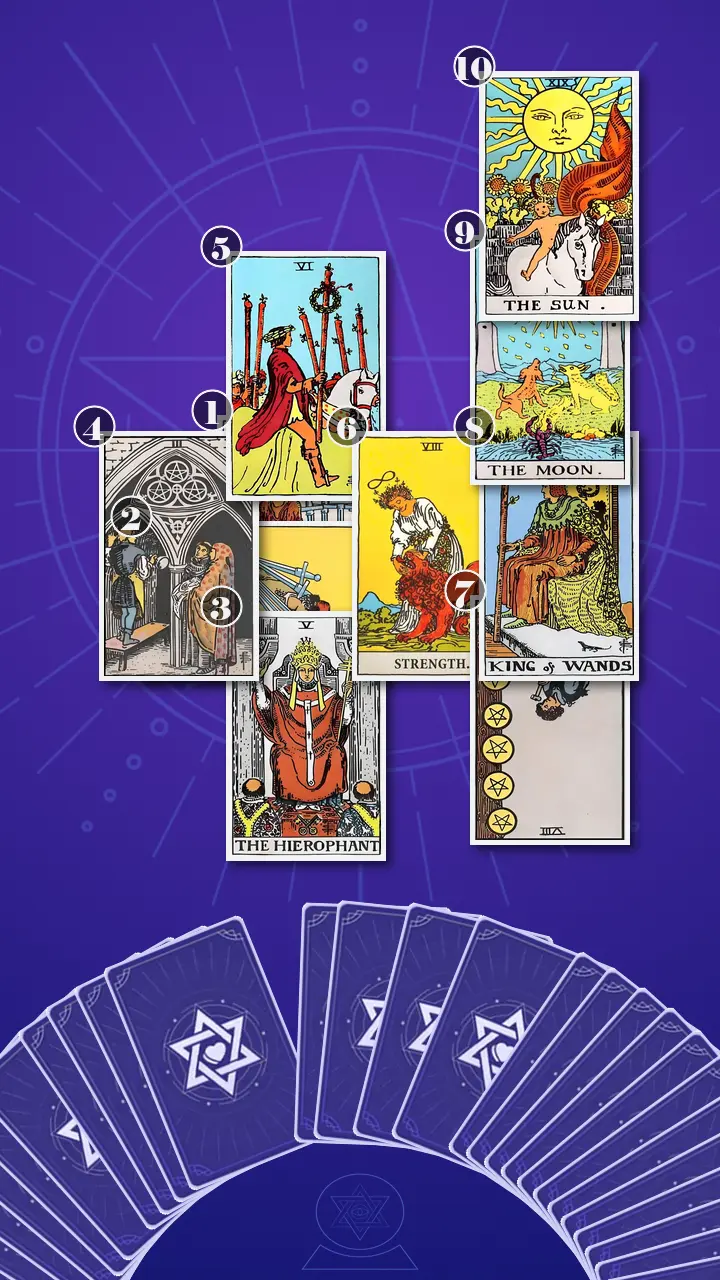
For anyone reading who’s curious about how tarot works in a practical sense: the Celtic Cross is useful because it doesn’t just label a feeling. It shows a system—what’s happening now, what blocks you, what’s underneath, what shaped it, and what the turning point looks like. This version keeps the classic diagnostic depth, but it tweaks two positions so the reading stays anchored to imposter syndrome in high-visibility performance: position 5 becomes “what you think you must prove at the all-hands,” and position 6 becomes “your next move in the moment.”
“We’ll start in the center,” I told her. “The first card shows what your imposter syndrome looks like in real behavior right before the spotlight. The crossing card shows the main strategy that trips you up when you try to be visible. And the card to the right—your next move—that one is often the pivot.”
Reading the Map: From Mental Cages to Clean Daylight
Position 1 — The current presenting moment
“Now we turn over the card that represents the current presenting moment: what your imposter syndrome looks like in real behavior before the all-hands.”
Eight of Swords, upright.
“It’s 11:30 PM and you’re trapped in Presenter View,” I said, letting the modern scene land exactly where her life lives. “Convinced there’s exactly one ‘safe’ way to say your update. You keep rehearsing because you feel like any deviation will expose you—even though your actual competence is sitting right there in your project decisions and shipped work.”
This card is a clarity problem disguised as a competence problem. The energy here isn’t that you lack skill—it’s that your mind is in blockage mode: blindfold on, options narrowed, treating communication like a single-lane bridge with a cliff on both sides.
Jordan gave a small laugh that sounded like it had scraped her throat on the way out. “That’s… painfully accurate,” she said. “Like, almost rude.”
“That reaction makes sense,” I said gently. “The Eight of Swords is ‘rude’ because it shows the bindings are loose. The trap is real—but it’s maintained by interpretation more than facts.”
Position 2 — The main block in the spotlight
“Now we turn over the card that represents the main block in the spotlight: the thought/strategy that trips you up when you try to be visible.”
Seven of Swords, upright.
“During the presentation, you’re half-speaking and half scanning,” I said. “Watching leadership reactions, choosing the least attackable phrasing, trying to avoid live scrutiny. It’s like you’re presenting to not get caught—which steals the grounded energy that would actually make you sound confident.”
I paused and gave her the split-screen that the card demands.
On one side: your hands, clicking between Edit mode and Presenter View, rewriting a bullet like it’s a legal contract. On the other side: your eyes, flicking to the VP’s face in Zoom gallery view like it’s a live reaction feed. Two inner voices running at once:
Be flawless.
Don’t get caught.
Seven of Swords is excess strategy. Too much armor. You’re trying to be “screenshot-proof” instead of clarity-proof. And split attention does something sneaky: it makes you sound less present, which then becomes more evidence (in your own mind) that you’re not safe.
Jordan nodded once—tight, controlled. “Yeah,” she said quietly. “I watch their faces more than my own slide.”
“Right,” I told her. “And here’s the reframe I want you to borrow for the whole reading: This isn’t a trial. It’s an update. The more you treat it like a stealth mission, the more your nervous system believes there’s danger.”
Position 3 — The hidden driver underneath imposter syndrome
“Now we turn over the card that represents the hidden driver underneath imposter syndrome: the deeper standard shaping the fear of being seen.”
The Hierophant, upright.
“Underneath the nerves is an internal corporate rulebook,” I said. “The belief that credibility only counts if it matches a specific ‘executive’ tone. So leadership attention feels like a ceremony where you either get blessed as legitimate—or silently judged as an imposter.”
This is the institutional gatekeeper archetype. The Hierophant’s energy is overweight authority: not authority in the room, but authority in your head. It’s very Succession—the sense there are invisible rules and status tells, even when nobody says them out loud.
“I need to ask you something,” I said. “Whose definition of ‘credible’ are you still trying to satisfy when you speak?”
Jordan stared slightly past the camera, like she was scrolling an internal feed. “Honestly? Some… composite CEO voice. Like every r/ProductManagement thread about ‘executive presence’ turned into one person.”
“That’s exactly The Hierophant,” I said. “A composite. A rulebook without a signature.”
Position 4 — What led up to this
“Now we turn over the card that represents what led up to this: the recent work dynamic that made the all-hands feel higher-stakes.”
Three of Pentacles, upright.
“Your recent work has been reviewed by multiple stakeholders—lots of feedback, lots of visibility,” I said. “Your brain learned: being seen equals being graded. So now an all-hands feels like the next round of evaluation instead of a simple update about what’s true.”
Three of Pentacles is balanced craft: competence demonstrated through contribution, not charisma. In archaeology, we rarely judge a site by a single impressive artifact—we judge it by the layers, the pattern, the workmanship over time. This card says your work has structure. People are looking because you’ve built something real.
Jordan’s shoulders dropped by a millimeter. Not relaxed—just less braced.
Position 5 — What you believe you must prove
“Now we turn over the card that represents what you believe you must prove at the all-hands to feel safe and legitimate.”
Six of Wands, upright.
“You’re secretly hoping the all-hands lands as a clean win,” I said. “The nods, the ‘great job,’ the absence of tough questions. Not because you’re vain—because applause feels like proof you’re real, and silence feels like danger.”
Six of Wands is excess external validation. The laurel wreath becomes a safety blanket. The crowd becomes a scoreboard. And when recognition is your anesthesia, you start performing for relief instead of communicating for impact.
“I want to be seen as someone with leadership potential,” Jordan admitted. The words came out fast, then she looked like she regretted them.
“That desire is human,” I said. “But here’s the trap: if you need the room to confirm you belong, you’ve handed the room your nervous system.”
When Strength Took the Mic
Position 6 — Your next move before and during the all-hands
I slowed my hands before turning the next card. The air in my office felt suddenly quieter, the way it does right before you uncover something intact in the ground—like time itself is holding still so you don’t crack it.
“Now we turn over the card that represents your next move before and during the all-hands—how to meet the moment differently.”
Strength, upright.
“Your next move is to lead your nervous system like a steady PM leads a meeting,” I said. “One breath, one sentence at a time, one pace slower than your panic wants. You don’t try to erase nerves—you keep them in the room without letting them drive.”
Strength is not hype. It’s regulated Fire. It’s the difference between trying to wrestle fear into silence (tight, fast, clenched) and leading fear (steady, warm, paced). In the card, the hand on the lion isn’t a fist. It’s contact.
In that moment when the all-hands reminder hits and your body reacts before your mind can argue—tight throat, shallow breathing, and suddenly you’re rewriting slides like it’s life or death—you’re usually trying to outthink the feeling. You’re trying to win an argument with your own nervous system.
Stop trying to outsmart the fear with perfect scripting; practice gentle control like Strength—hand on the lion, voice steady, presence leading.
Jordan’s reaction came in a chain—three small movements that told me more than her words could.
First, she froze. Her inhale stopped halfway, like the sentence had put a hand up. Her fingers hovered above her trackpad and didn’t click.
Then, her eyes unfocused slightly—not zoning out, but replaying. I could almost see the internal footage: the Midtown glass-walled conference room, the AC hum, the leadership row on Zoom like a scoreboard.
Finally, she exhaled—longer than the breaths she’d been taking all call. Her shoulders loosened, and she looked briefly… annoyed.
“But if I do that,” she said, voice sharper, “doesn’t it mean I’ve been doing it wrong? Like all this prep was pointless?”
I let that land without correcting her too quickly. “That’s a fair reaction,” I said. “And no—your prep wasn’t pointless. Over-prepping isn’t a personality flaw—it’s a nervous system strategy.”
Then I brought in my own lens—my Skill Archaeology tool, the way I’ve learned to read people the way I read a site: not by what’s loudest, but by what’s buried and consistent.
“Here’s what I’m excavating beneath your perfectionism,” I told her. “There’s a skill layer you’re overlooking because it isn’t flashy: you can steer a room. You do it in 1:1s. You do it in planning. You do it when a project wobbles and you make a call. Strength is asking you to bring that same quiet leadership into the all-hands. Not by having zero nerves—but by keeping your hands on the wheel.”
“So what does that look like in under ten minutes?” she asked.
“Exactly this,” I said, and I made it concrete on purpose. “Set a timer for four minutes. Write your ONE sentence message. Then do a 60-second out-loud read with one slow breath before the first word. If it feels too intense, stop—no forcing. The goal is practice, not perfection.”
Her face softened in a way that wasn’t exactly relief—it was more like she’d finally been given a handle. Something to hold.
“Don’t crush the nerves—lead them,” I added, and watched her mouth the phrase silently, as if testing whether it fit.
“Now,” I said, “use this new lens and tell me: last week, was there a moment where this would’ve changed your experience?”
Jordan blinked a few times. “Yesterday,” she said. “I was rewriting my Slack update, thinking about how it could be screenshot. I could’ve just… sent the update.” She let out a small, incredulous laugh. “Like a person.”
“That’s the pivot,” I told her. “This is you moving from tight self-monitoring toward steadier presence—one clear message, and trust that you can respond.”
Position 7 — Your internal posture right now
“Now we turn over the card that represents your internal posture: how you’re showing up to preparation and performance right now.”
Eight of Pentacles, reversed.
“You’re grinding for certainty: polishing slides and wording until clarity starts to blur,” I said. “The work ethic is real, but it’s getting hijacked into perfectionism—like you’re trying to earn the right to speak by doing one more pass.”
This is misdirected Earth: effort that soothes in the short term but costs you in the long term. I named the shadow plainly because Jordan needed the truth without shame.
“One risk,” I said, “is that you over-script every line and end up sounding less present—more rehearsed than necessary. The reframe is simple: do one timed run-through, allow exactly one edit pass afterward, and then stop.”
Jordan’s eyes flicked down to her notes. “That’s so hard,” she murmured. “Stopping.”
“Of course,” I said. “Because stopping removes the illusion of control.”
Position 8 — The room around you
“Now we turn over the card that represents the room around you: how leadership and workplace culture are likely being perceived by you.”
King of Wands, upright.
“The room feels led by people who speak decisively and move fast,” I said. “You interpret that fire as judgment, but it’s often just a culture that rewards clear direction. The ask is clarity—not perfection.”
King of Wands is strong Fire. It can be intimidating when you’re stuck in Swords—when your mind is building cages and escape routes. But this king’s gaze is forward. That’s the lesson: stop looking back mid-sentence to check if you’re safe.
“Translation,” I told her: “fast questions can mean engagement, not indictment.”
Position 9 — Your hope and fear
“Now we turn over the card that represents your hope and fear: what you secretly want from visibility and what you fear it could cost you.”
The Moon, upright.
“After—and during—the talk, ambiguity becomes a projection screen,” I said. “Neutral faces read as disappointment. Short questions feel like traps. Any pause becomes ‘they know.’ You’re not irrational—you’re trying to solve uncertainty by mind-reading.”
The Moon is excess imagination under stress. Instinct howls at what it can’t name. And in a corporate room, there’s always incomplete information—people multitask, cameras freeze, Slack pings, someone’s facial expression means nothing at all.
I shifted into my professor voice for a beat, because history is full of this mistake: taking shadows for facts. “In a trench, moonlight is beautiful,” I said. “But you don’t make measurements by moonlight. You wait for day.”
Position 10 — Integration outcome
“Now we turn over the card that represents the integration outcome: the most empowering trajectory if you practice the key shift after this all-hands.”
The Sun, upright.
“When you practice Strength consistently,” I said, “you come out of the all-hands with clearer memory and less self-monitoring. You can name what went well in objective terms, recover faster from normal imperfections, and feel more at home in visibility.”
The Sun is balanced visibility. Not ‘everyone loved it.’ Not ‘no one challenged you.’ It’s: you were present enough to remember your own words. You spoke in daylight instead of inside a mental maze.
“Clarity is built in daylight—by what you actually do, not what you imagine might happen,” I told her, and that sentence seemed to settle somewhere practical in her posture—like a file finally saved in the right folder.
The One-Page Plan for Finding Clarity Before the Spotlight
I leaned back and stitched the spread into one clean story, the way I teach students to do with a scattered set of artifacts: not as a pile, but as a timeline.
“Here’s the system,” I said. “You start in the Eight of Swords—your mind treats the all-hands like a trap with one safe route. Then the Seven of Swords crosses it—so you try to survive by stealth: approval-checking, hedging, rushing, avoiding questions. Underneath, The Hierophant is enforcing an internal rulebook about what ‘real professionals’ sound like, especially under institutional gaze. Three of Pentacles shows why it’s loud right now: you’ve been evaluated and reviewed, so visibility got paired with grading. Six of Wands crowns it—your brain wants a clean win to finally feel legitimate. But the pivot is Strength: regulated presence, not more proof. From there, you meet The Moon—ambiguity—without mind-reading, and The Sun becomes possible: evidence-based confidence built from what you actually did.”
“Your cognitive blind spot,” I continued, “is believing the only way to be safe is to be flawless. That keeps you stuck in ‘proof mode.’ The transformation direction is the key shift: from ‘I must prove I deserve to be here’ to ‘I will communicate one clear message and let my work speak for itself.’”
Then I gave Jordan what she’d asked for from the start: actionable advice—small, real next steps. I framed it with my own strategy metaphor—Megalith Transport: if you’ve ever seen how ancient builders moved stones that should’ve been impossible to move, it wasn’t by one heroic lift. It was rollers, ropes, teams, and repeatable increments. Your confidence works the same way.
- Write your “Home Base” sentenceOpen your speaker notes and type one sentence at the very top: “This quarter, we shipped X, learned Y, and the next decision is Z.” Keep it literal and specific to your update.If you start adding commas and caveats, treat it as a cue—not a command. Keep it to one breath.
- Do the “Locked Deck” run-throughSet a phone timer. Do one timed run-through in Presenter View. Allow exactly one edit pass afterward (max 25 minutes). When the timer ends, close the deck and rename the file: “LOCKED — [date].”If a full run-through spikes you, do the 20-second version: first two lines + one breath, then stop.
- Relic Authentication: Facts vs Stories (tiny version)Make a two-column note titled FACTS vs STORIES. Write 1–3 objective facts (“My manager approved this plan,” “We shipped X,” “I have data from Y”). Then write the loudest fear sentence under STORIES (“They’ll realize I’m not qualified”).Don’t debate the story—just label it. Like authenticating a relic: you check evidence, not vibes.
“And if you want one line to carry into the room,” I said, “it’s this: One message. One breath. One pace slower than your panic wants.”

A Week Later: The Quiet Proof
Six days later, Jordan messaged me: “I did the LOCKED thing. Renamed the file. Felt insane for five minutes. Then… I slept. Like, a normal amount.”
She told me the all-hands wasn’t flawless. She spoke a little too fast in the first ten seconds. Someone asked a question she hadn’t pre-written an answer for. And she used the uncertainty line anyway: “Great question—what I know right now is ___. The piece we’re validating next is ___.”
After, she didn’t spiral in the Zoom tile reflection. She wrote three Sun facts within fifteen minutes. And then she went to grab a coffee alone—steady but slightly dazed, like someone who’s been holding tension so long that letting it go feels unfamiliar for a second.
That’s a Journey to Clarity I trust: not a personality transplant. Just a cleaner relationship to visibility—proof replaced by presence, fear included but no longer driving.
When the spotlight gets close, it can feel like your throat tightens around a single fear: one imperfect moment, and the room rewrites your worth.
If you didn’t need this all-hands to prove you belong, what’s the one clear message you’d let yourself say—slowly, like you trust you can handle the next moment?