Rewriting the All-Hands RSVP at 11:30 p.m.—Then Choosing Paced Visibility

The 11:30 p.m. RSVP Algebra
You get a last-minute all-hands invite right after a day of back-to-back meetings, and suddenly you’re doing RSVP algebra instead of eating dinner—classic Sunday Scaries energy, just on a weekday.
Taylor (name changed for privacy) settled onto her Toronto apartment couch with her laptop balanced on her knees like it was a fragile tray. Slack glowed on the left. The all-hands invite sat open on the right. Apple Notes hovered in the middle—two sentences, rewritten so many times the words had started to feel fake.
The radiator clicked like it was counting down. Her phone was warm from scrolling, the kind of warm that makes your palm feel vaguely guilty. Every time she imagined speaking in that company-wide room, her throat tightened as if it were trying to close the door from the inside. Her breathing stayed up in her chest—small, quick sips of air. Her shoulders had crept so high they looked like they were trying to turn into earmuffs.
“I don’t know if I’m setting a boundary or making an excuse,” she said. “If I say yes, I have to show up as the version of me who has it together. If I say no… it feels like I’m admitting I can’t handle it.”
I’d heard variations of it for years, but the modern costume is always the same: the calendar invite that feels like a verdict, the unsent draft that masquerades as ‘being thoughtful,’ the quiet belief that visibility must be paid for with perfection.
“We can work with this,” I told her, keeping my voice steady on purpose. “Not to force a brave answer out of you—but to find clarity: to tell the difference between fear-based hiding and capacity-based boundaries, and to choose a level of visibility you can actually live with.”

Choosing the Compass: The Four-Layer Insight Ladder for Work Visibility Anxiety
I invited Taylor to place both feet on the floor and take one slower breath—not as a ritual for mystery, but as a switch for attention. Then I shuffled, the cards making that familiar soft snap against my palms, like turning pages in an old field notebook.
“Today, we’ll use a spread called the Four-Layer Insight Ladder · Context Edition,” I said.
For you reading this: a standard decision spread can flatten a problem like this into a binary yes/no. But this dilemma isn’t really about choosing a single correct answer—it’s about discernment. This ladder separates what’s actually true in your capacity from what’s loud in your fear, then shows how to turn the insight into a clean, communicable next step.
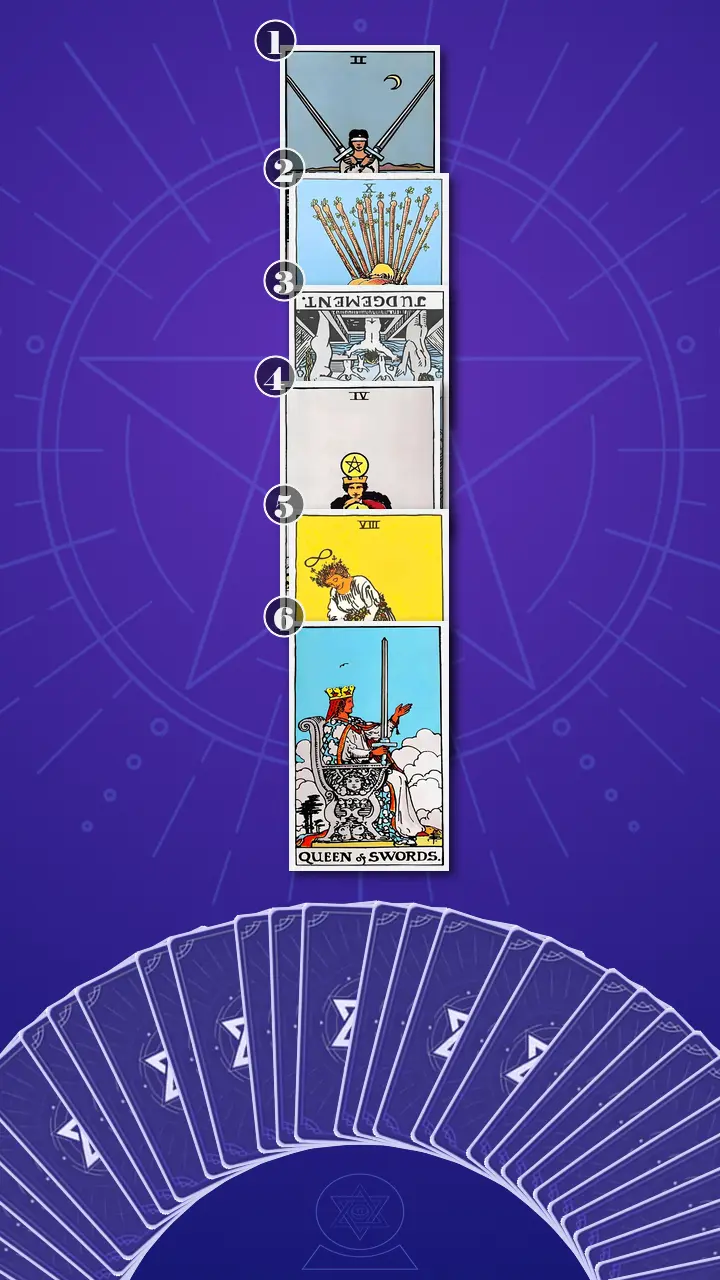
Here’s the map we’re using: the first card shows the surface behavior (what you’re concretely doing with the invite). The second reads your capacity signal (what your workload and nervous system are telling you). The third goes to the root block (the fear-story that makes visibility feel high-stakes). The fifth is the key reframe—the bridge. And the last card gives a practical next step: what you can say and do, without turning your boundary into a courtroom-level argument.
Reading the Map: The Pattern Beneath the Invite
Position 1: Surface behavior — the stall you can see
“Now we turn over the card that represents your surface behavior: what you’re concretely doing with the all-hands invite,” I said.
Two of Swords, upright.
This is the classic stalemate: the blindfold, the crossed swords over the chest, the still water behind her. In modern terms, it’s exactly this: Taylor has the all-hands invite open for the fifth time today. She doesn’t RSVP. She keeps the decision suspended because either option feels like it will say something about her worth. She tells herself she’s being ‘practical,’ but really she’s trying to avoid the spike of being evaluated.
Energetically, this is blocked Air: thinking used as armor. It looks neutral on the outside—no RSVP yet, no decision yet—but it’s an active choice that costs you. The tension doesn’t disappear; it just moves into your shoulders and throat and follows you around like a second backpack.
As I described the micro-behavior—hovering over “Maybe” in her head, toggling between tabs, rereading the agenda like it was evidence—Taylor gave a short laugh that had a bitter edge. “That’s… wow,” she said. “Accurate. It’s almost mean.”
“I’m not judging you,” I replied. “I’m naming the freeze. Because once we can see it clearly, we can stop calling it ‘just being responsible’ and start choosing on purpose.”
Position 2: Capacity signal — the limit data you’ve been ignoring
“Now we turn over the card that represents your capacity signal: what your workload and energy are telling you,” I said.
Ten of Wands, upright.
If the Two of Swords is the mind holding its breath, the Ten of Wands is the body carrying proof. The image is simple: a figure bent forward under a bundle so big it blocks their view. In Taylor’s life it looked like a week of wall-to-wall Zoom blocks, the Google Calendar week view like Tetris, context switching that never gives your brain a clean landing. The all-hands isn’t “just another meeting.” It’s another place you have to be coherent, presentable, and on—and her body was already sending overload signals.
I spoke it as a montage: blue light glare late at night, lukewarm coffee you keep forgetting to drink, the ping of another meeting, the habit of being the person who catches loose ends. Inner OS: “It’s just one meeting.” Body response: “No. It’s one more performance.”
Energetically, this is excess Fire—drive and responsibility burning hotter than your capacity can sustainably hold. Taylor’s shoulders dropped a fraction, like her spine was relieved to be believed. “Thank you,” she said quietly. “I keep telling myself I’m being dramatic. But I’m not. I’m just… full.”
“Exactly,” I said. “Capacity is real. It’s data, not a character flaw.”
Position 3: Root block — the story that turns visibility into a trial
“Now we turn over the card that represents the root block: the deeper fear-story about visibility,” I said.
Judgement, reversed.
In the Rider–Waite image, an angel blows a trumpet and people rise as if called to be seen. Reversed, that trumpet becomes a notification you flinch from. It’s the instinct to duck the call because attention feels like a final verdict.
In Taylor’s context: she treats all-hands like a company-wide report card. She assumes one imperfect update will stick to her reputation—like one messy sentence will get screenshot into her permanent record. So she postpones, over-scripts, and waits until she feels “ready,” but readiness has been defined as perfection. And if it has to be perfect to be said, it will never be said.
Energetically, this is deficiency of trust—not in your skills, but in your right to belong while human. The conflict underneath is brutal and specific: belonging vs. evaluation, contribution vs. exposure.
Taylor’s gaze went slightly unfocused, as if she was replaying the moment she’d seen leadership on the attendee list and her breath had turned shallow. “I always imagine them… noticing everything,” she admitted. “Like they’re watching for cracks.”
“That’s the reversed Judgement story,” I said. “It turns a normal workplace moment into a tribunal.”
Position 4: Shadow payoff — the protection that becomes armor
“Now we turn over the card that represents the shadow payoff: how self-protection works short-term, and what it costs over time,” I said.
Four of Pentacles, upright.
This card is the body holding on: a figure gripping a pentacle to the chest, pentacles under the feet, a posture that says, “Mine. Don’t take more.” In modern work terms, it’s camera-off culture used as battery saver mode: it helps in the moment, but if it’s always on, you never test what your system can actually handle.
For Taylor, it looked like this: she keeps her camera off, speaks only when directly asked, and protects her time with silence. That genuinely conserves energy today. But it also seals her in. Inner dialog: “If I give an inch, they’ll take a mile.” Counter-voice: “If I never show up, they’ll forget I’m here.”
The cost becomes visible after the meeting: you’re still exhausted, but now you’re also unseen. Protection bought with withdrawal is expensive in the long term.
I let the phrase land gently because it matters here: “A boundary isn’t an excuse—it’s a definition.”
When Strength Held the Lion: The Bridge to Finding Clarity
Position 5: Key reframe — separating fear from capacity
“Now we turn over the card that represents the key reframe: the inner shift that helps you tell fear from capacity and choose from self-respect,” I said. “This is the bridge.”
Strength, upright.
The room felt quieter as soon as the card hit the table—one of those small, unmistakable shifts, like when a library door clicks shut and the noise of the street disappears. Outside her window, traffic hissed over wet pavement; inside, her breathing finally had something to match.
Setup: Taylor was caught in the loop I see so often in career crossroads moments: it’s 11:30 p.m., laptop open on the couch, Slack on one side, the calendar invite on the other. She keeps rewriting a two-sentence RSVP while her throat tightens—like the “right” wording will finally make the decision feel safe.
Then I said the sentence I wanted her to borrow for the week ahead.
Not ‘prove yourself’ under the spotlight—tame the lion of fear first, then choose the amount of visibility you can hold with steady hands.
Reinforcement: Taylor’s reaction came in a sequence I’ve learned to watch for—because it’s the body that tells the truth first. (1) She froze for a beat, breath paused, fingers hovering over the edge of her mug. (2) Her eyes softened and slid off the card, as if she’d just remembered every time she’d used adrenaline as “confidence” and paid for it later. (3) She exhaled—lower this time, from somewhere beneath her ribs—and her jaw unclenched in a way that made her look slightly unfamiliar to herself, like she’d been holding a pose for years and finally stopped.
“So… it’s not brave versus weak,” she said, and there was a flash of irritation in it—an almost angry grief. “But if that’s true, doesn’t it mean I’ve been doing it wrong this whole time?”
“It means you’ve been surviving with the tools you had,” I said. “And now you’re updating the tools.”
In my own mind, I saw a dig site—layers of soil separated by centuries. As an archaeologist, I’ve watched people mistake a surface layer for the whole story. Strength is stratigraphy for the nervous system: it separates the impulse to hide from the reality of capacity, and it proves you can handle fear without letting fear drive.
This is where my work tends to go historical. Civilizations don’t collapse because they rest; they collapse because they confuse endurance with wisdom. And they don’t rise because they perform perfectly in one public moment; they rise because they build sustainable systems. That’s the Long-Term Value Assessment here: visibility that requires self-betrayal is a bad investment, even if it earns applause. And that’s the Civilization Pattern Recognition: hiding feels safe short-term, overextending feels heroic short-term—but both are early decline signals. Strength is the third option: regulated courage.
“Right now,” I told her, “your nervous system is not a performance metric. If your body is screaming, ‘I can’t,’ we listen. But we also don’t let fear disguise itself as ‘being responsible’ forever.”
I leaned in slightly. “Now—with this new perspective—think back to last week. Was there a moment when you almost spoke, or almost sent a message, and backed out? If you’d aimed for steady hands instead of ‘impressive,’ what would you have done?”
Taylor swallowed once, but her throat didn’t lock. “I would’ve sent the short version,” she said. “I would’ve stopped trying to sound… exceptional.”
That was the pivot: from visibility guilt and freeze-driven avoidance to paced, boundary-led visibility with self-respect.
Position 6: Next step — the sentence that ends the spiral
“Now we turn over the card that represents your next step: a specific way to communicate and act that honors limits without disappearing,” I said.
Queen of Swords, upright.
Her sword is raised—clarity, decisiveness. But her other hand is open—human, not harsh. This is the card that ends the draft spiral. In Taylor’s life it looked like this: she sends the message she’s been avoiding—simple, precise, and done. “I can join for the first 20 minutes and share one update.” Or: “I’m at capacity today; I’ll read the recap and follow up async.” No extra paragraphs. No apology spiral. Just a clean decision.
“One clean sentence beats ten anxious drafts,” I said, and Taylor nodded like she wanted to tattoo it onto her Notes app.
From Insight to Action: The Paced Visibility Protocol (Defined Contribution + Defined Limit)
I gathered the story the ladder had told, rung by rung. The surface freeze (Two of Swords) wasn’t laziness—it was self-protection under uncertainty. The Ten of Wands confirmed something Taylor had been trying to argue herself out of: her load was already high. Judgement reversed named the hidden engine: visibility had become a verdict story, so any audience felt like a trial. The Four of Pentacles showed the coping strategy—tight control, camera-off, silence—that brings short-term relief but long-term invisibility. Strength offered the bridge: regulate first, then choose. And Queen of Swords turned that inner steadiness into an external boundary you can actually send.
The blind spot, as I saw it, was this: Taylor believed she needed a perfectly defensible reason to justify her capacity. That’s why her messages turned into essays. But your limit doesn’t need prosecuting and defending. It needs defining.
So I offered her a way to act that matched her reality—small, specific, and sustainable. I framed it using one of my own tools, the Voyage Log Technique: ancient navigators didn’t cross oceans by waiting for perfect weather. They logged bearings, adjusted, and made progress in measured, survivable legs. Your career visibility can work the same way.
- The 1-Minute Strength Check-InBefore you RSVP (or before you decide to speak), do five rounds of inhale for 4, exhale for 6. Then reread the invite subject line and notice: does your throat tighten, do your shoulders lift, does your breath shorten?If anxiety spikes, don’t force a decision mid-spike. Ground first. Clarity comes from steadiness, not from white-knuckling.
- The 10-Minute “Paced Visibility Draft”Set a timer for 7 minutes. In Notes, write two versions: (A) capacity-first no/recap: “I’m at capacity today—will read the recap and follow up async if needed.” (B) paced yes with a limit: “I can join for the first 20 minutes and share one update.” Choose the version that makes your shoulders drop even 5%.Spend 3 minutes deleting extra apologies (“sorry!” / “I feel bad but…”). Keep it factual and kind. A limit doesn’t require a case file.
- Define Your Role Before the Room Defines YouIf you attend, pick one: listener only, or one 30-second update, or one sentence in chat. Write it on a sticky note and put it where you can see it during the meeting.This prevents mid-meeting renegotiation. Progressive overload works better than sudden maxing out—visibility is a practice, not a final exam.

Ownership, Not Certainty
A week later, Taylor messaged me a screenshot: one clean RSVP line sent, no paragraph attached. She wrote, “I still felt my throat tighten for a second. But I didn’t spiral. I joined for 20 minutes, shared one update in chat, then logged off and actually ate dinner.”
That’s what a Journey to Clarity usually looks like in real life: not a personality transplant, not sudden fearlessness—just a small, grounded choice that proves you can be seen without being consumed.
When an all-hands invite hits, it can feel like you’re choosing between being judged in public or disappearing to survive—so you hold your breath, clutch the “perfect” script, and call the freeze a boundary.
If visibility didn’t have to be flawless to be real—if it could be practiced with steady hands—what’s one small, specific way you’d let yourself be seen this week, without crossing your own limit?