Talked Over at Work Without Sounding Rude—A Two-Step Boundary Plan

Finding Clarity in the 8:58 a.m. Zoom Green Dot
You’re a junior PM in NYC and every time a stakeholder asks you a direct question, your manager answers so fast you feel like you got muted in real life—classic talked over at work.
Taylor (name changed for privacy) appeared on my screen with her camera on and that practiced neutral face I’ve seen a thousand times in ambitious twenty-somethings who are trying to look “easy to work with” while their nervous system is doing laps. She was in a Midtown office Zoom room: fluorescent light humming, the faint clack of someone’s keyboard off-camera, and the green microphone icon glowing like a dare.
She described Monday at 8:58 AM: Notes app open with bullet points, shoulders squared. A stakeholder says, “Taylor, can you walk us through the rollout risk?” Taylor starts, “Yeah, so the main risk is—” and her manager jumps in mid-syllable with a polished summary. The heat rises up her neck. Her jaw locks. Her posture drops half an inch—just enough for her body to decide, again, don’t make this a thing.
“And then,” she said, voice tight like it had been wrapped in tape, “everyone quotes him in Slack like that was the answer. So at night I’m rewriting a ‘quick recap’ message that’s basically me trying to quietly put my name back on my own work.”
What she wanted was simple and reasonable: How do I set a boundary when my manager answers for me in meetings—without getting labeled ‘difficult’?
Her frustration wasn’t abstract. It had a texture: like trying to speak while someone keeps turning down your volume slider, and you can feel the words in your mouth go stale before they ever reach the room.
I let her sit with that for a beat and then I said, “We’re not here to make you into a different personality. We’re here to find a small, workable move—something you can do in the moment, and something you can align on privately—so your voice doesn’t have to live only in post-meeting ‘cleanup.’ Let’s draw a map through the fog. Let’s find clarity.”

Choosing the Compass: How a Relationship Spread Works for Workplace Boundaries
I asked Taylor to take one slow breath—not as a ritual, but as a handbrake. The kind you pull before you make a change on a slippery road. While she exhaled, I shuffled and kept the question simple: “When your manager answers for you, what do you need to be true in that room?”
For this, I chose a Relationship Spread. Not because this is a romance plot (it’s not), but because this is a relationship system: you, him, and the meeting-room pattern you keep getting trapped inside.
For readers who wonder how tarot works in a practical, non-mystical way: a spread like this is a thinking tool. It separates the mess into clear compartments—your internal constraint, their stance, the shared dynamic, the practical resource, the main blockage, and the advice. For workplace communication boundaries and managing-up dynamics, that separation is everything. It stops you from either (a) blaming yourself into silence or (b) villainizing your manager into a war you don’t actually want.
“We’ll read it like a meeting debrief,” I told her. “First: what happens in you. Second: what happens in him. Third: what the room rewards. Then: what structure can support you, what fear keeps you stuck, and finally: the cleanest next move.”
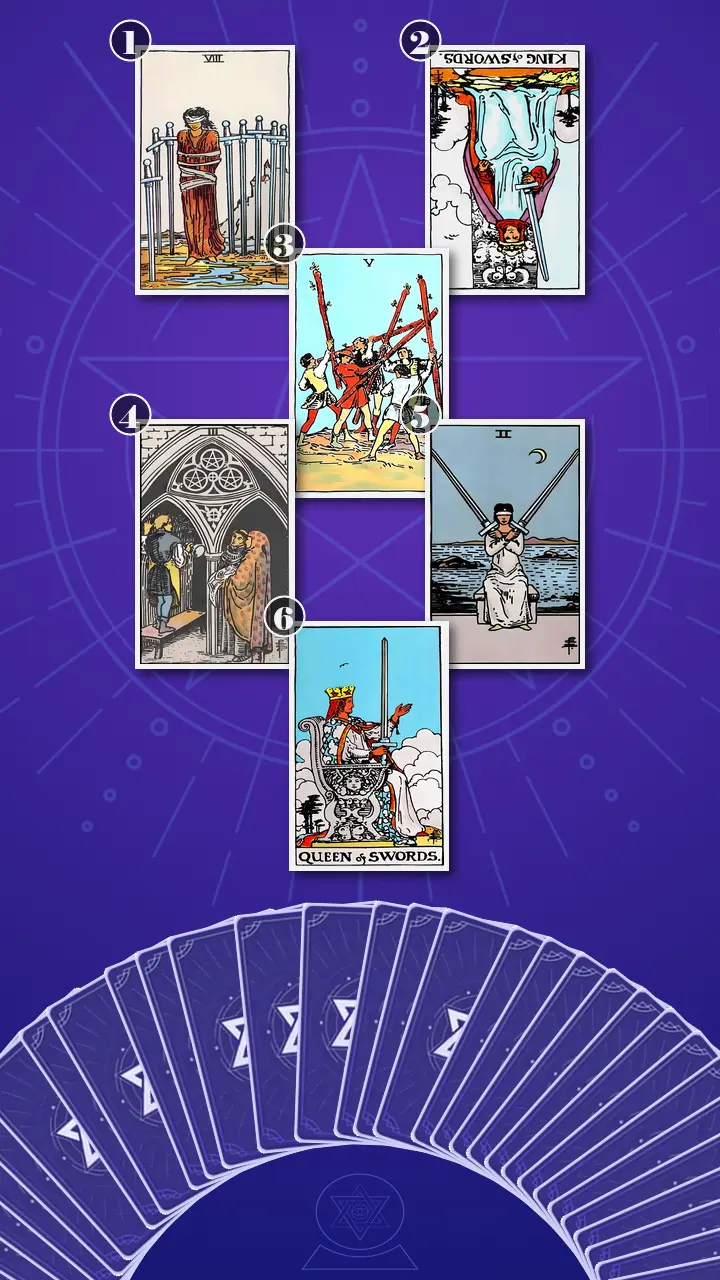
The Meeting Pattern, Laid Out Like Evidence
Position 1: Your lived experience — Eight of Swords (upright)
“Now turning over,” I said, “is the card that represents your lived experience in meetings: the specific self-silencing behavior and internal constraint that shows up when your manager answers for you.”
The Eight of Swords, upright.
In plain, modern terms, this card is painfully specific: You’re in a stakeholder Zoom and you can literally feel the answer forming—then your manager jumps in. You stop mid-sentence, not because you can’t speak, but because a rule flashes through your mind: “Don’t contradict him in public.” You go still, start typing notes, and tell yourself you’ll fix it later in Slack—even though the opening to continue is right there.
I pointed at the blindfold in the image. “This isn’t ‘you have no options.’ This is ‘your brain hits mute to avoid friction.’ The bindings are loose. The gap is real. The rule is assumed.”
I watched Taylor’s face do something I always respect: she tried to laugh it off, and couldn’t fully manage it. It came out as a small, bitter huff. “That’s… kind of brutal,” she said. “Like you were literally in the meeting.”
“Brutal,” I agreed, “but useful. Because if the trap is made of assumptions, it can be opened with a sentence. And noticing the body cue—the tight throat, the jaw clench—is your tell that the pattern is running.”
As an archaeologist, I’ve spent years learning that what looks like solid stone is often layered debris: compacted over time, but not inevitable. This is the same. In my own framework I call it Skill Archaeology—we excavate what’s already there but buried. Taylor’s ability to write clean, clarifying recaps wasn’t a weakness. It was evidence of a buried strength: she already knows how to be precise. The question is whether she’s allowed to be precise live.
Taylor looked down, thumb rubbing the edge of her notebook. She didn’t need a pep talk. She needed permission to stop treating her voice like it required a permit.
Position 2: Your manager’s stance — King of Swords (reversed)
“Now turning over,” I said, “is the card that represents your manager’s communication style in this dynamic and what their behavior is signaling in the room.”
The King of Swords, in reversed position.
The modern translation landed immediately: Your manager treats meetings like a performance of certainty: fast summary, confident tone, no pauses. When a question comes to you, he answers anyway—partly to keep momentum, partly to stay the ‘face’ of the work. It’s not about him being a villain; it’s about a power script where controlling the story equals leading, even when it erases the person who owns the details.
“This is Succession-style meeting energy,” I said, “minus the yachts. Speed and certainty signal power—even when they flatten other voices.”
I was careful here. Tarot, at its best, doesn’t diagnose people you haven’t consented to analyze. “This card isn’t a moral verdict on him,” I continued. “It’s intent versus impact. The intent might be efficiency: keep the room moving, prevent silence from looking like risk. The impact is that your ownership gets overwritten.”
I gave her one concrete format—because that’s how you keep it professional: “In the X meeting, when the Y question came to me, you answered before I finished.” One example. One request. Not a dissertation.
Taylor’s shoulders eased a fraction, like her body liked the idea that this wasn’t a personality flaw in her. It was a negotiable working agreement waiting to be named.
Position 3: The shared meeting dynamic — Five of Wands (upright)
“Now turning over,” I said, “is the card that represents the meeting-room pattern between you: how interruption, speed, and authority are currently interacting.”
The Five of Wands, upright.
This wasn’t subtle either: The meeting itself is a crowded intersection: people talk over each other, jump in mid-thought, and whoever speaks fastest sets the direction. In that kind of room, your manager’s voice naturally dominates—because the environment rewards interruption. If you don’t claim a turn, the group just keeps moving without you.
I could practically hear it as I spoke: overlapping voices, people unmuting too quickly, Slack pings mid-sentence, someone saying “quick one” like that makes it less chaotic.
“Here’s the permission slip,” I told her, and I kept it short on purpose: If you don’t claim a turn, the room will keep moving without you.
Taylor nodded once—small, quick. Not agreement so much as recognition.
Position 4: Your practical resource — Three of Pentacles (upright)
“Now turning over,” I said, “is the card that represents a practical resource you can leverage to set a boundary—process, allies, structure, credibility.”
The Three of Pentacles, upright.
And suddenly, relief entered the spread. The modern scenario was almost boring—in the best way: You send a simple agenda doc with owners listed and your name next to the topics you own. Before the meeting, you message your manager: “If the X question comes up, I’ll take first pass, then I’ll pull you in for context.” Suddenly the room expects you to answer—and your manager has a defined role (add-on, not takeover).
“Design the meeting. Don’t just survive the meeting,” I said, because this card is basically a blueprint with a spine.
Taylor’s mouth softened into something like a smile. “That feels… doable,” she admitted. “Like I don’t have to out-alpha him. I can just… set the stage.”
“Exactly,” I said. “Earth structure stabilizes Air communication. You don’t have to fight for airtime if the room already knows whose turn it is.”
Position 5: The main block — Two of Swords (upright)
“Now turning over,” I said, “is the card that represents the main block to boundary-setting: what keeps the pattern in place when you try to speak up.”
The Two of Swords, upright.
Its modern life scenario matched her calendar-hovering paralysis: You keep telling yourself, “I’ll address it later,” because you don’t want awkwardness in front of stakeholders. But ‘later’ never really arrives—so the pattern becomes normal. Every time you choose silence to keep the vibe smooth, your authority quietly leaks out of the room and into your after-hours recap drafts.
I said the line I knew she’d hate (because it was true) and I said it without shaming her: Peace in the room can cost you presence in the room.
Her reaction came in three steps—so small you could miss it if you weren’t watching for it: first her breath paused; then her gaze unfocused like she was replaying a specific moment on the subway; then she exhaled through her nose, a quiet release that sounded like, “Yeah.”
“And here’s the part you don’t need to moralize,” I added. “Your fear makes sense. If you suspect there could be subtle retaliation, your system is trying to keep you safe. But the cost is that you start doing credibility in post-production.”
That phrase hit. She winced, then laughed once under her breath. “Stop doing credibility in post-production,” she repeated, like she was saving it as a text snippet.
When the Queen of Swords Cut Through the Script
Position 6: The boundary-forward move — Queen of Swords (upright)
I let the room go quiet before turning the last card. Even over Zoom, you can feel it—the way someone’s attention leans forward when they’re finally ready to stop rehearsing and start choosing.
“Now turning over,” I said, “is the card that represents the boundary-forward move: the communication stance and next-step behavior that helps you reclaim your voice without escalation.”
The Queen of Swords, upright.
Her modern-life version is almost cinematic because it’s so small: In the exact moment your manager starts to jump in, you calmly step back into the audio: “I’ve got this one—then I’d love your add-on.” You don’t explain, you don’t justify, you just continue your answer. Later, you reinforce it privately with a quick roles agreement so the boundary isn’t a one-time stunt—it’s the new norm.
In my notes I wrote: clarity without apology. And I watched Taylor’s eyes flick—like she could see the exact inhale her manager takes right before he jumps in.
Setup: She’d been living in that split-second trap: camera on, question lands on her, her throat tightens, and before her first sentence fully arrives her manager takes the floor. The old script runs—If I say something, I’m difficult. If I don’t, I disappear.
Delivery:
Stop waiting for permission to speak; raise one clean sentence like the Queen of Swords’ upright blade and let clarity—not tension—set the boundary.
I let that hang for a beat—like the moment in a lecture hall when you can hear pens stop because something finally got simple.
Reinforcement: Taylor’s face changed in layers. First: stillness, almost a freeze—her lips parted, eyes fixed on the card as if it had just named her private file. Second: her gaze softened and drifted slightly to the side, like she was watching a replay of last week’s stakeholder call. Third: her shoulders dropped a fraction, and her jaw unclenched like someone had quietly removed a weight she’d been carrying with her teeth.
“But—” she started, and there was a flash of resistance, a protective edge. “If I do that… doesn’t it imply he was wrong? Like I’m correcting him in public?”
“That’s the King-of-Swords-reversed trap,” I said gently. “It frames airtime as a verdict. The Queen frames it as a handoff. You’re not saying he’s wrong. You’re saying: this is my part.”
I gave her an internal anchor—short enough to fit through a tight throat: Not a fight. Just my turn.
Then I asked the question that makes insight usable: “Now, with that new lens—think back to last week. Was there a moment when you felt that jaw-clench, saw him inhale to jump in, and this one line could have made you feel even 10% more present?”
She nodded slowly. “Yeah. Tuesday. The rollout risk question. I could’ve said it. I… could’ve said it.”
“Good,” I replied. “That’s not a personality transplant. That’s one rep.”
And because I’m who I am—a professor who has watched civilizations rise and collapse over who gets to speak—my mind flashed to an excavation briefing years ago, when a brilliant junior researcher kept getting summarized by a senior lead. The dig didn’t improve when she ‘got more confident.’ It improved when we changed the structure: who presented findings first, and who added context after. In other words: boundaries work best when they’re built into the system.
This moment was the pivot in Taylor’s emotional journey: from frustration-driven self-silencing and after-the-fact over-explaining to calm, concise in-the-moment authority backed by clear meeting agreements. Not certainty. Not perfection. Just a clean first step toward being audible.
The One-Sentence Boundary, Supported by Meeting Design
I summarized the spread the way I’d summarize a historical dispute over territory: not as a battle of personalities, but as a boundary problem with a known loop.
“Here’s the story your cards are telling,” I said. “You’re walking into meetings with good work and a tight throat (Eight of Swords). Your manager walks in with a habit of controlling the narrative to protect speed and certainty (King of Swords reversed). The room rewards whoever speaks fastest (Five of Wands), so his habit gets reinforced. You cope by choosing silence to keep things smooth (Two of Swords), and then you try to repair your visibility afterward in Slack and recap emails. The practical lever is structure—owners, agendas, pre-briefs (Three of Pentacles). And the breakthrough is one clean, repeatable sentence delivered live (Queen of Swords).”
“Your cognitive blind spot,” I continued, “is thinking the only ethical options are total silence or public confrontation. The spread offers a third option: a turn-taking rule you enforce once in the moment, backed by a private agreement.”
“That’s the key shift,” I said plainly. “From indirect repair after the meeting to a simple, practiced in-the-moment boundary—plus a private alignment conversation about roles.”
Then I switched into pure practicality, and I used my own intervention framework—what I call Megalith Transport. Ancient builders didn’t move a stone the size of a bus by ‘believing in themselves.’ They broke the task into rollers, ropes, and synchronized steps. Same here.
- Design the room before anyone speaksBefore your next recurring meeting, add an “Owner” column to the agenda (Notion/Google Doc is fine) and put your name next to the items you own. Share it in the calendar invite or Slack channel.Keep it tiny: one agenda line is enough. The point is to make it socially normal for the room to look at you first.
- Pre-brief your manager (10 minutes before)Send a short message: “If the question on X comes up, I’ll take first pass, then I’ll pull you in for context.” You’re not asking for permission—you’re proposing a clean handoff.This is my “Relic Authentication” move: test the opportunity in a safer container first. Private alignment reduces the need for public correction.
- Use one Queen-of-Swords line once (live)In the meeting, when he starts to jump in, say—calmly—“I’ve got this one—then I’d love your add-on.” Then continue your answer without apologizing or over-explaining.Expect your nervous system to protest. If your throat tightens, drop your shoulders and say it anyway. If you feel unsafe, skip the live move and do the private alignment first.
To make it even more usable, I gave Taylor a 7-minute rehearsal that matched what the cards were asking for—Tool Evolution in miniature: upgrade the skill progressively, not dramatically.
“Open Notes,” I told her. “Write three boundary lines: (1) ‘I’ve got this one—then I’d love your add-on.’ (2) ‘Let me finish my thought, then I’ll hand it back.’ (3) ‘I’ll take first pass on this since it’s my area.’ Set a timer for two minutes and say each line slowly, twice. If your throat or jaw tightens, pause, drop your shoulders, and continue—no forcing. Then pick one line for this week.”

A Week Later: Proof Measured in One Sentence
Six days later, Taylor messaged me right before another stakeholder sync. “I did the ‘Owner’ thing,” she wrote. “And I sent the pre-brief. My manager thumbs-upped it. Also… I used the line once. My voice shook a little, but I did it.”
She described it like a quiet experiment, not a victory parade: she said the sentence, she kept going, nobody exploded, and the world didn’t end. After the meeting, she didn’t spend the whole subway ride drafting a recap essay to reclaim credit. She still felt that familiar flicker—what if I looked rude?—but it was smaller, like an old alarm with a lower volume.
That’s what I mean by a Journey to Clarity. Not a dramatic personality makeover. A micro-proof that your voice can exist in real time—and that meeting agreements can protect it.
When you keep choosing ‘no awkwardness’ over ‘my voice,’ your body learns the meeting is a place where you disappear on purpose—tight throat, hot face, and that quiet collapse the second someone else starts answering for you.
If you gave yourself permission to protect your credibility with just one calm sentence—no speech, no drama—what would you want that sentence to be in your next meeting?